Sea Thrift (Armeria maritima)
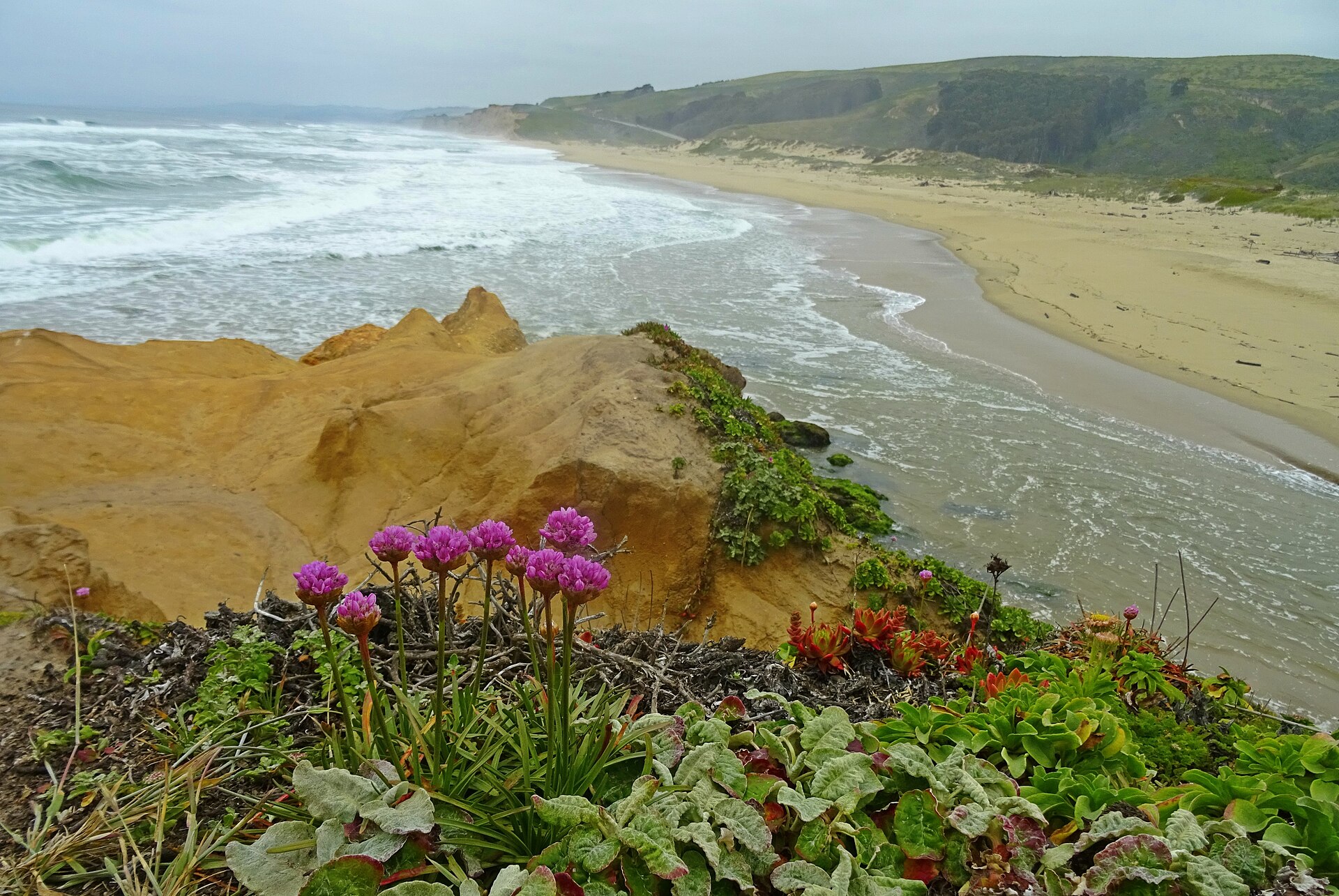
Armeria maritima, commonly called Sea Thrift, Common Thrift, or Sea Pink, is a low, tufted, grass-like perennial best known for the round, pompom-shaped flower heads it holds on bare stalks above dense cushions of narrow foliage. The species as a whole is circumboreal, meaning it grows wild on coasts and in arctic and alpine habitats right around the Northern Hemisphere. In the United States, the plant you find growing truly wild is restricted to two very different places: rocky and sandy bluffs along the Pacific coast from northern California up through Oregon and Washington, where it is treated as the subspecies Armeria maritima ssp. californica, and the coasts and tundra of Alaska, where separate arctic subspecies occur.
That distinction matters because Sea Thrift is also an extremely popular garden perennial, sold under the same common names at nurseries and big-box garden centers nationwide, usually as seed strains or cultivars derived from European stock (the widespread Atlantic and Mediterranean coast subspecies, Armeria maritima ssp. maritima, and its relatives). That European-derived “garden thrift” is a fine, well-behaved ornamental almost anywhere in temperate North America, but it is not native outside the Pacific coast and Alaska — planting it in, say, New England or the Midwest is just growing an introduced perennial, not restoring habitat. This page focuses on the native coastal and Alaskan populations and tells you how to grow true Pacific coast Sea Thrift if that is what you are after.
Where it does grow wild, Sea Thrift is a tough, salt-tolerant little plant of the hardest coastal sites: wind-scoured headlands, rocky bluff tops, stabilized dunes and the thin soil at the edge of sea cliffs, often rooted in little more than a crack in sandstone. Its dense, fibrous root system and evergreen foliage cushions help hold loose coastal soil in place, and its early, long-lasting bloom is a reliable nectar stop for native bees along the immediate coast.
Identification
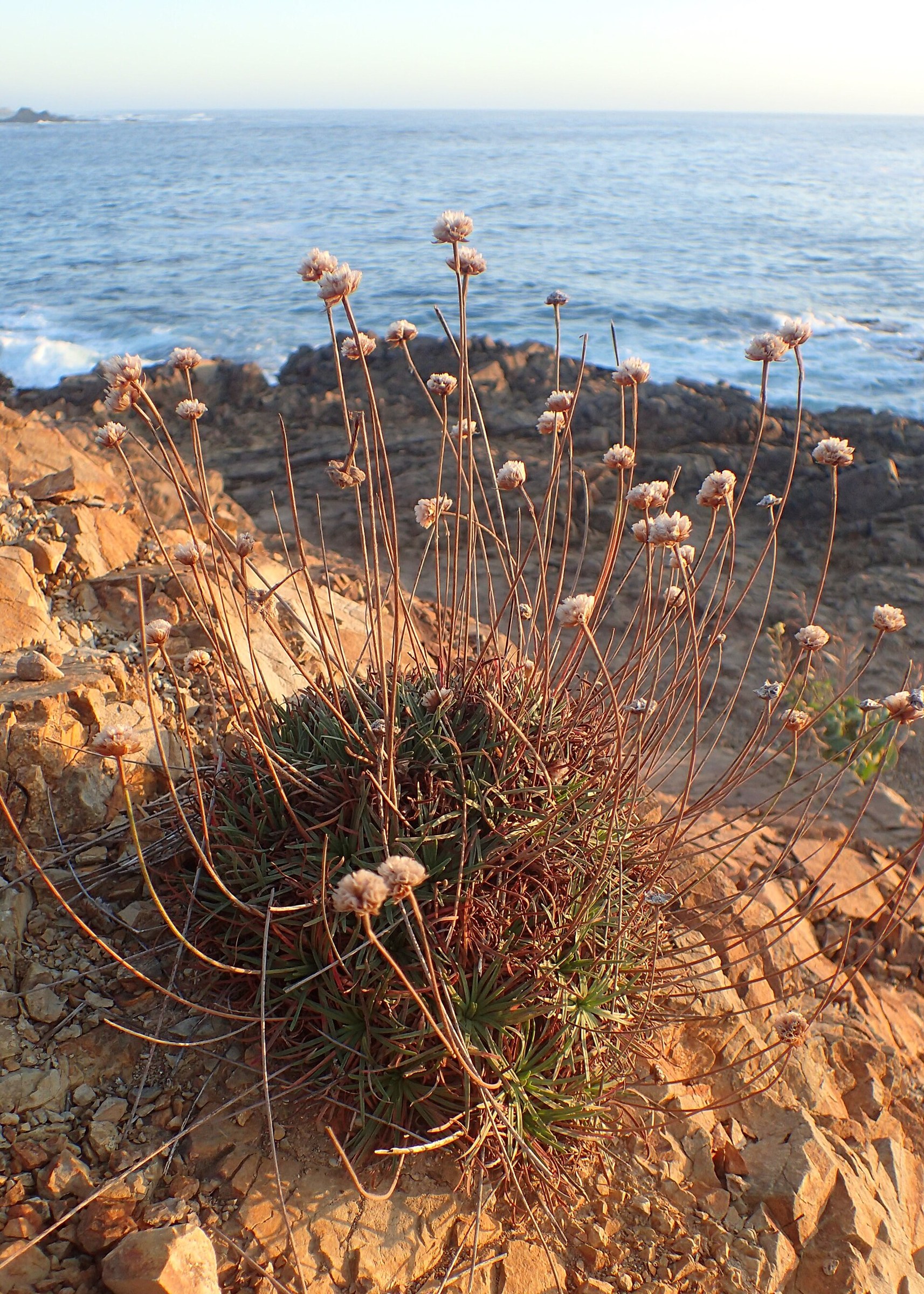
Sea Thrift forms a dense, rounded tuft or cushion of foliage, usually only 4 to 6 inches tall, with flowering stalks rising well above the leaves to about 10 to 12 inches. Clumps slowly widen over the years into mounds roughly 6 to 12 inches across, but the plant never runs or spreads aggressively; it stays a tidy, well-behaved tussock.
Foliage
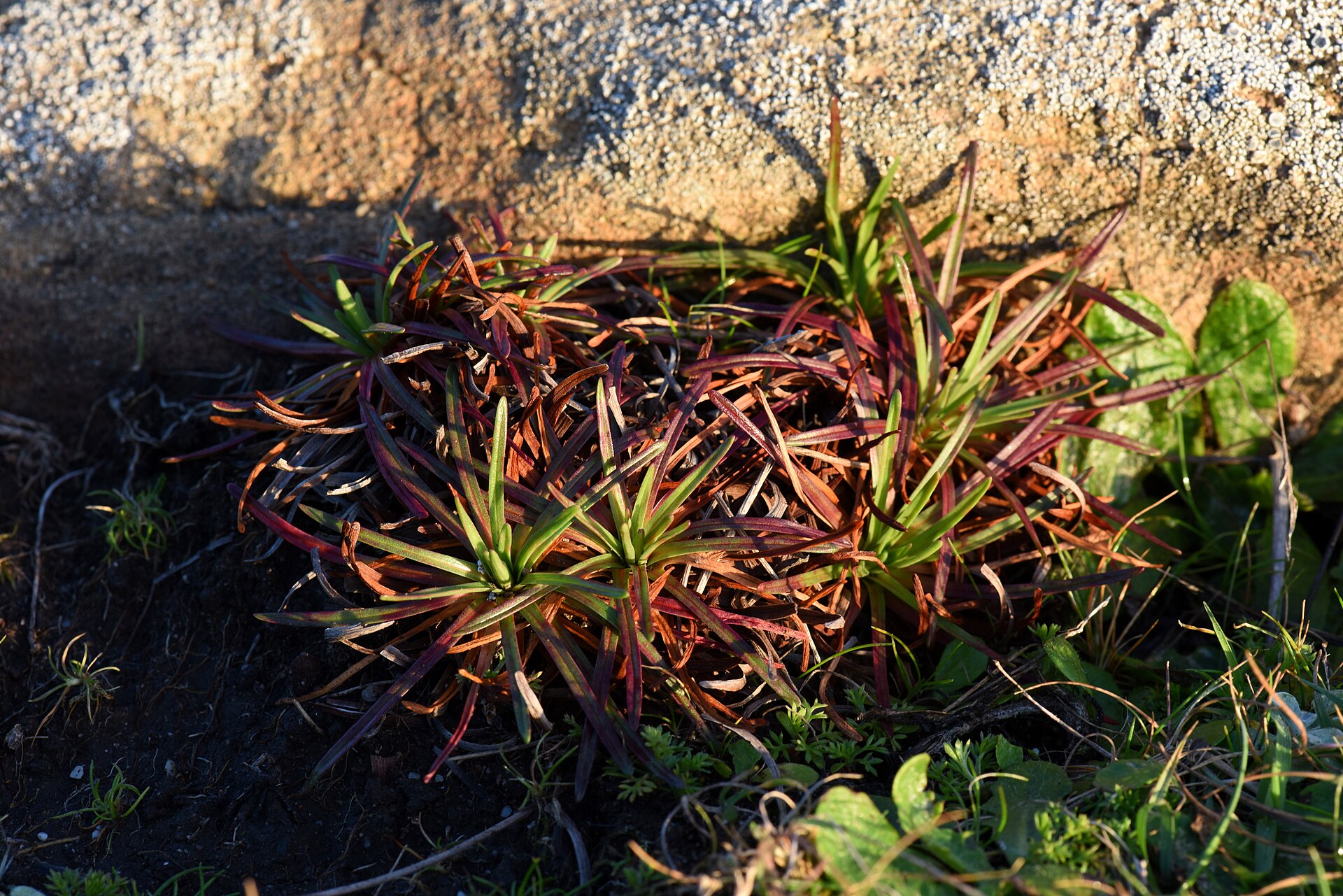
The leaves are simple, linear and grass-like, usually 2 to 6 inches long and only about 1⁄16 to 1⁄8 inch wide, growing in a tight basal rosette with no visible stem. They are a dull gray-green to blue-green through most of the year, and on exposed coastal bluff sites the older leaves often flush reddish-bronze or purple, especially after cold snaps or in strong sun and salt wind. The foliage is technically evergreen to semi-evergreen; in milder coastal climates clumps stay green year-round, while in colder or more exposed spots some leaves brown and persist as a dry thatch around the live new growth at the clump’s center.
Flowers
Each flowering stem (a leafless scape) rises straight up from the foliage clump and ends in a single, tight, ball-shaped flower head about 3⁄4 to 1 inch across, made up of many small, papery-bracted flowers packed together — the classic “pompom” that gives the plant its garden appeal. In the Pacific coast native populations the color is usually a clear rose-pink to deep pink, occasionally paling toward lavender-pink; the pure white and deep magenta cultivars sold in nurseries are garden selections, not what you will find on a wild California or Oregon bluff. Below each flower head is a dry, membranous, cone-shaped sheath where the stalk meets the stem. Bloom begins as early as February in mild coastal California sites and continues into June or July further north and at higher, cooler sites, with individual clumps often flowering on and off for weeks.
Fruit & Roots
After flowering, each small flower in the head matures into a tiny, dry, single-seeded fruit (a utricle) that is wind-dispersed once the papery bracts dry and loosen. Below ground, Sea Thrift relies on a dense mat of fibrous roots rather than a single taproot, which is exactly what lets it grip loose sand and weathered rock on an exposed bluff face.
Quick Facts
| Scientific Name | Armeria maritima (native West Coast populations: ssp. californica) |
| Family | Plumbaginaceae (Leadwort) |
| Plant Type | Evergreen to semi-evergreen tufted perennial |
| Mature Height | 4–6 in. foliage; flower stalks to 10–12 in. |
| Mature Spread | 6–12 in. clumps, slow to widen |
| Growth Rate | Slow |
| Sun Exposure | Full sun near the coast; part shade inland |
| Water Needs | Average on most sites; low on exposed coastal bluffs with fog |
| Soil Type | Sandy or rocky, well-drained; tolerates poor, infertile soil |
| Soil pH | About 5.0–8.0 (wide tolerance) |
| Bloom Time | February–July, varying with latitude and site |
| Flower Color | Rose-pink to deep pink (wild West Coast plants) |
| Fall/Winter Color | Foliage often bronzes to reddish-purple |
| Salt Tolerance | Excellent; grows within reach of salt spray |
| Deer Resistant | Yes |
| USDA Hardiness Zones | 4–9 |
Native Range
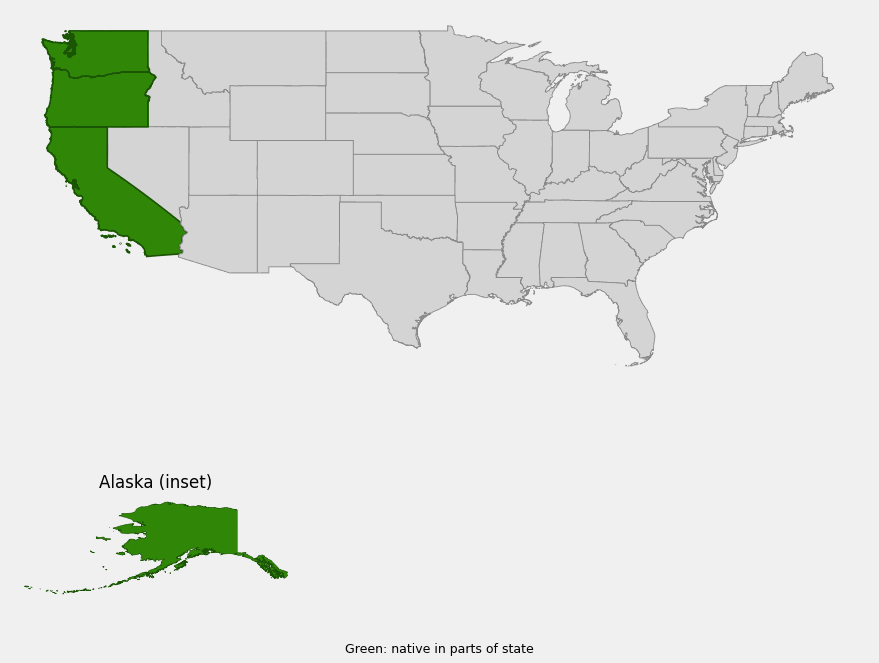
The U.S. native range of Sea Thrift is narrow and coastal. On the Pacific coast, the native subspecies Armeria maritima ssp. californica grows on ocean bluffs and headlands from roughly the Central Coast of California north through Oregon and into coastal Washington, generally within sight or smell of salt water and rarely more than a few hundred feet in elevation. Separately, true wild Sea Thrift also occurs across coastal and tundra habitats in Alaska, where it belongs to arctic-adapted subspecies rather than ssp. californica — the same species, but a different native population with a different story, tied to Alaska’s beaches, river bars and open tundra rather than warm-water bluffs.
It is worth being direct about what is not native: the Sea Thrift sold at most nurseries across the rest of the country, including many plants labeled simply “Armeria maritima” or “Common Thrift,” is typically propagated from European seed strains (ssp. maritima and garden-selected cultivars), descended from the species’ native range along the Atlantic and Mediterranean coasts of Europe. Outside California, Oregon, Washington and Alaska, Sea Thrift is a well-behaved but introduced garden plant, not a native one — useful to know if you are specifically building a native plant garden rather than a general rock garden.
On the coastal bluffs where it is native, Sea Thrift typically grows in open, low-growing plant communities on thin, well-drained, often sandy or rocky soils: coastal prairie, coastal bluff scrub, stabilized foredunes and the rock outcrops of closed-cone pine forest margins. It shares this harsh, wind-exposed habitat with other salt-tolerant coastal perennials and succulents, usually rooted directly in cracks of marine sandstone or shale, or in thin sandy soil over rock.
📋 Regional plant lists featuring Sea Thrift: Western Oregon & Western Washington · Alaska
Growing & Care Guide
Sea Thrift is an easy, low-maintenance perennial as long as you respect what it actually wants: excellent drainage and, ideally, the cool, bright, salt-tinged air of a coastal site. Inland gardeners can still grow it successfully, but it asks for a bit more care away from the coast’s natural fog and air movement.
Light
Right on the coast, where fog and onshore breezes keep conditions cool and humid, Sea Thrift wants full sun and will flower most heavily there. Moving inland, where summer heat and dryness intensify, give it part shade, especially in the hottest afternoon hours, to avoid stress and to keep the foliage cushion from scorching or fraying.
Soil & Water
Drainage is the single most important factor for success with Sea Thrift. It is naturally a plant of thin, gritty, often nutrient-poor soils, including pure sand and cracks in bare rock, and it struggles in heavy clay or anywhere water stands after rain. Sandy or rocky, well-drained soil suits it best, and it tolerates a wide pH range from somewhat acidic to mildly alkaline. On an actual coastal bluff, ocean fog and drizzle often supply enough moisture that established plants need little supplemental water; move the plant inland or away from fog influence, and it needs regular watering through the growing season like most other garden perennials, though it still will not tolerate standing water or poorly drained beds.
Planting Tips
Plant container-grown Sea Thrift in fall or early spring so roots can establish before the stress of summer heat. Space plants about 8 to 12 inches apart if you want a continuous edging or small-scale groundcover effect, or further apart if you prefer distinct individual tussocks. Raised beds, rock gardens, gravel gardens and the gritty, sharply drained strips along a walkway or driveway all mimic its native bluff-top conditions well. Avoid amending the planting hole with rich compost, which encourages soft, rot-prone growth; a lean, mineral soil is closer to what the plant expects.
Pruning & Maintenance
Deadhead spent flower stalks by snipping them off at the base to keep clumps tidy and to encourage further bloom through the season; left alone, the dry seed heads persist and can look scraggly. Every few years, established clumps can develop a dead, woody center as the live growth migrates outward; at that point, dig and divide the clump in early spring or fall, discarding the dead core and replanting the vigorous outer sections. Sea Thrift has very few pest or disease problems, and the main maintenance risk is the opposite of neglect — overwatering or planting in rich, slow-draining soil, which leads to crown rot.
Landscape Uses
Sea Thrift’s compact size, tidy evergreen foliage and tolerance for lean, rocky soil make it useful in several native-garden settings along the Pacific coast and in coastal Alaska:
- Coastal bluff and dune restoration, where its fibrous roots help stabilize loose sandy or rocky soil
- Rock gardens and gravel gardens, paired with other low, drought- and salt-tolerant perennials
- Path and border edging, used as a tidy, low-growing accent along walkways
- Containers and raised beds, where sharp drainage is easy to guarantee
- Seaside and exposed-wind gardens, where few other flowering perennials tolerate constant salt spray
- Pollinator plantings on the immediate coast, where its early bloom supports native bees before many other perennials flower
Wildlife & Ecological Value
Although it is a small plant of a harsh habitat, Sea Thrift plays a real supporting role in Pacific coastal and Alaskan plant communities.
For Pollinators
The globular flower heads produce nectar that attracts native bees, bumblebees and occasional butterflies, and the plant’s early, extended bloom period makes it a useful nectar source on exposed coastal bluffs where flowering perennials are otherwise scarce in late winter and early spring. Its tight, upright flower heads are well suited to short-tongued bees that can work across the many small flowers packed into each head.
For Soil & Habitat Stability
Sea Thrift’s dense mat of fibrous roots helps bind loose sand and weathered rock on bluffs and dunes, reducing erosion on sites that are otherwise difficult to stabilize with plants. Its low, evergreen cushions also provide some ground-level cover and microhabitat for small invertebrates on otherwise sparsely vegetated coastal rock and sand.
Ecosystem Role
As one of relatively few flowering perennials able to root directly in bare coastal rock and thin bluff-top soil, Sea Thrift helps colonize harsh, pioneer sites ahead of other, less salt- and wind-tolerant species, contributing to the patchwork of low coastal scrub and prairie vegetation that in turn supports a wider community of coastal insects and birds.
Cultural & Historical Uses
Sea Thrift has no significant history of food or medicinal use among Indigenous peoples of the Pacific coast or Alaska that is well documented in the literature, and none is implied here. Its main human story is horticultural and, in Europe, emblematic: the closely related European populations of Armeria maritima have been garden favorites since at least Elizabethan times, prized for edging beds and walkways, and the plant was once common enough on British coasts that its image appeared on the reverse of the British threepenny bit and, later, on a mid-20th-century farthing coin — a small piece of evidence for how familiar “thrift” was to ordinary people living along the coast.
In California, Oregon and Washington, Sea Thrift’s ornamental use in native plant gardens is a more recent development, growing alongside the broader native-plant gardening movement from the late 20th century onward, as gardeners sought bluff-and-dune-adapted perennials that could handle real coastal conditions without supplemental care.
Frequently Asked Questions
Is the Sea Thrift sold at my local nursery native to my state?
Probably not, unless you garden on the immediate Pacific coast of California, Oregon or Washington, or in Alaska. Most nursery “Armeria maritima” and “Common Thrift” sold elsewhere in the U.S. is propagated from European stock and is a fine garden plant, but not a native one outside those specific coastal areas.
Is Sea Thrift toxic to pets or people?
Sea Thrift is not commonly listed among seriously toxic ornamental plants, and most gardening references describe it as safe to have around pets. As with any ornamental plant, it is still good practice to keep pets and children from grazing on it out of general caution rather than any specific known hazard.
Can Sea Thrift handle salt spray and sandy soil?
Yes — this is exactly the environment the native Pacific coast populations evolved in. Direct salt spray, sandy or rocky soil, and constant coastal wind are all well tolerated, which is part of why Sea Thrift is such a useful plant for bluff and dune gardens where many other flowering perennials fail.
Why does my Sea Thrift die out in the middle?
This is normal aging in a clump-forming perennial: the center goes woody and stops producing new growth while the outer edge stays vigorous. Dig up the clump every few years, discard the dead center, and replant the healthy outer divisions to keep the planting looking full.
Does Sea Thrift need fertilizer?
No. It is adapted to thin, nutrient-poor coastal soils, and rich soil or heavy fertilizing tends to produce soft, floppy growth that is more prone to rot. Lean soil and good drainage matter far more than feeding.

Looking for a nursery that carries Sea Thrift?
Browse our native plant nursery directory: California · Oregon · Washington · Alaska