
Seaside Juniper (Juniperus maritima)
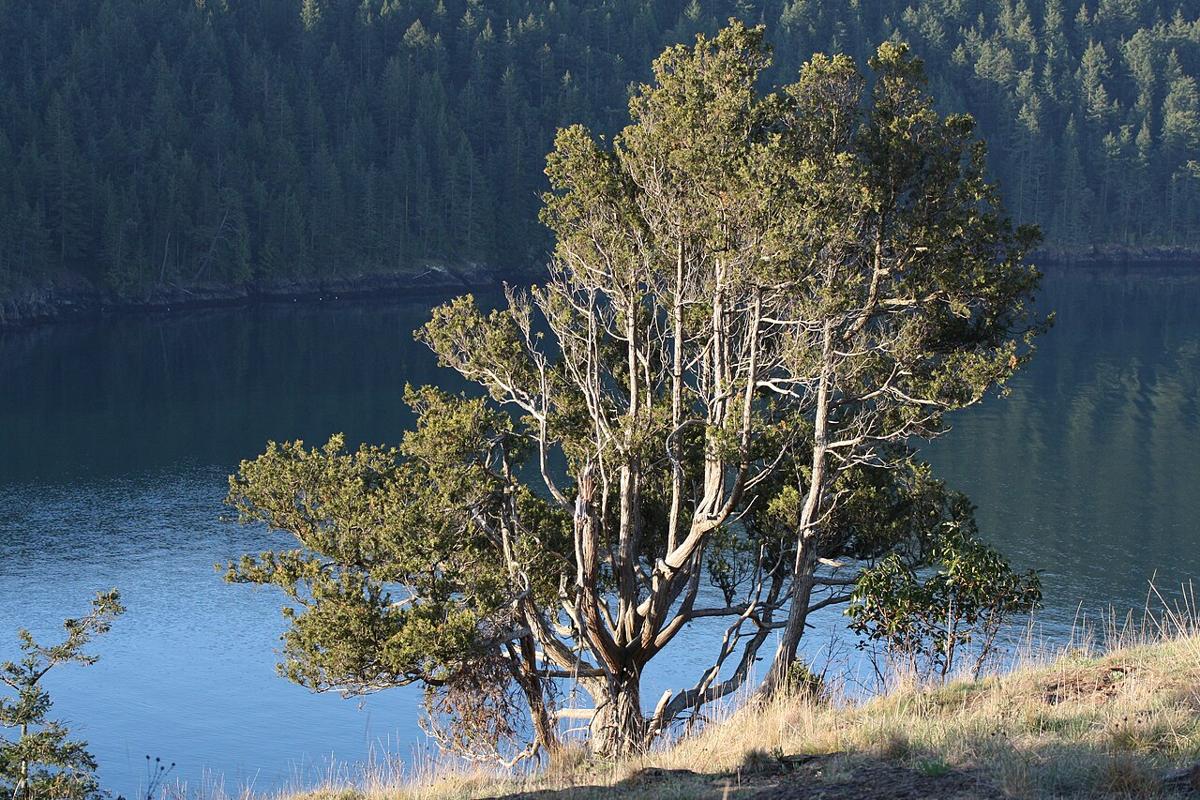
Juniperus maritima, the Seaside Juniper, is a small coniferous tree endemic to the shores of the Salish Sea — the inland marine waters of northwestern Washington and adjoining southwestern British Columbia. It was only formally recognized as a distinct species in 2007; before that, it had long been lumped together with the much more widespread Rocky Mountain Juniper (Juniperus scopulorum), which it closely resembles. Genetic and chemical (terpenoid) studies eventually confirmed that the coastal, maritime populations around Puget Sound and the San Juan Islands were distinct enough to warrant their own species.
True to its name, Seaside Juniper is a tree of rocky coastal bluffs, wind-exposed shorelines and dry rocky ridges, where it often grows as a gnarled, picturesque specimen shaped by onshore winds and thin, rocky soil. It is abundant within its narrow range and is a defining feature of the rocky bluff scenery found throughout the San Juan and Gulf Islands and the shores of the Olympic Peninsula and Puget Trough.
For Pacific Northwest gardeners within its native range, Seaside Juniper is an excellent low-water, salt- and wind-tolerant evergreen for coastal bluff gardens, rock gardens and other exposed sites where few other conifers thrive.
Identification
Seaside Juniper typically grows 20 to 40 feet tall, occasionally reaching 50 feet, with a stout trunk that often forks low into large, upswept branches, giving older trees a distinctive broad, irregular, wind-sculpted silhouette rather than the tidy spire shape of many cultivated junipers.
Bark
Bark on mature trees is grayish and fibrous, peeling in long strips — a texture typical of junipers in general and useful for confirming the genus even from a distance.
Foliage
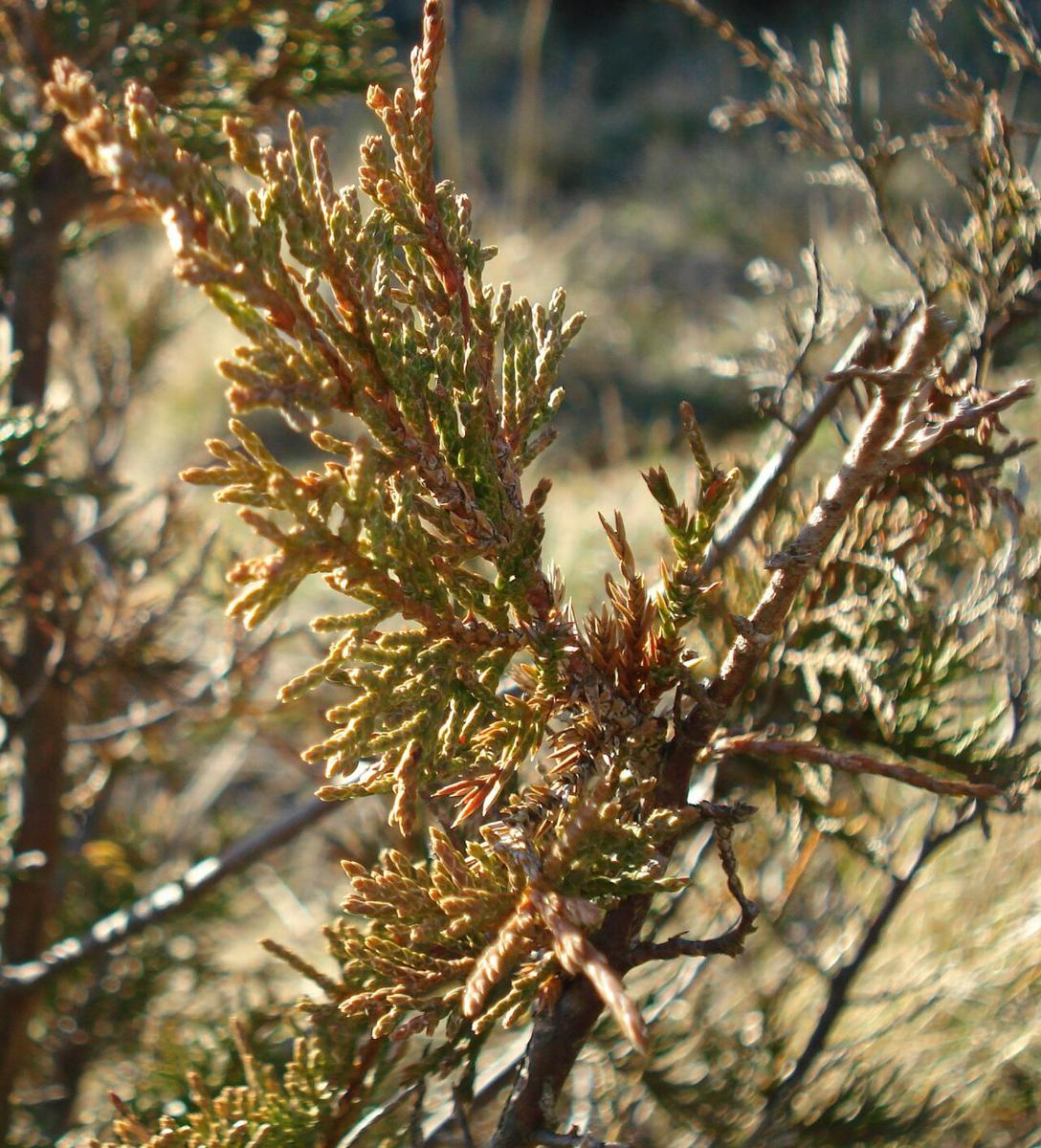
Like other junipers, Seaside Juniper has small, scale-like leaves pressed closely against the twigs, forming flattened, slightly drooping sprays of foliage. The foliage is a dull to yellowish green, sometimes taking on bronze tones in winter, and has the characteristic aromatic, resinous scent of the juniper genus when crushed.
Cones (“Berries”)
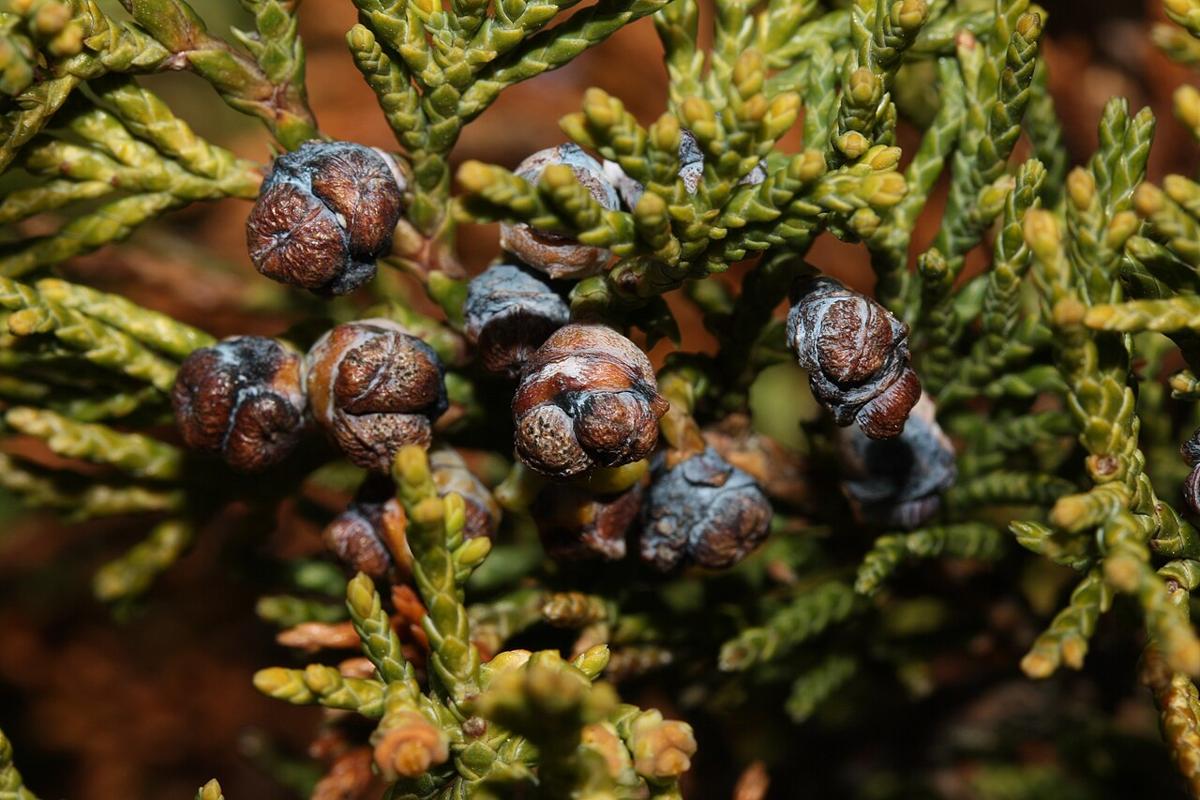
Like all junipers, the seed cones are fleshy and berry-like rather than woody, though botanically they are not true berries. They are bluish, maturing in a single year, and coated with a waxy bloom that gives them a frosted appearance. Flowering is inconspicuous, occurring in March and April, with male and female cones typically borne on separate trees (the species is dioecious, like most junipers).
Quick Facts
| Scientific Name | Juniperus maritima |
| Family | Cupressaceae (Cypress) |
| Plant Type | Evergreen coniferous tree |
| Mature Height | 20–40 ft (occasionally to 50 ft) |
| Growth Rate | Slow |
| Sun Exposure | Full Sun |
| Water Needs | Low; drought and salt-spray tolerant |
| Soil Type | Rocky, shallow, well-drained |
| Soil pH | Neutral to alkaline (tolerates rocky, thin soils) |
| Bloom Time | March – April |
| Flower Color | Inconspicuous |
| Fall Color | None (evergreen) |
| Fruit | Bluish, waxy-coated berry-like seed cones |
| Deer Resistant | Yes |
| USDA Hardiness Zones | 7b–9a |
Native Range
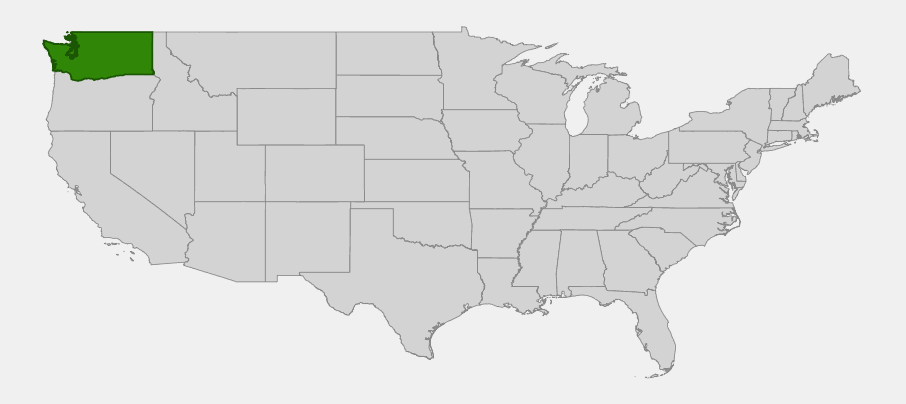
In the United States, Seaside Juniper is found only in northwestern Washington, centered on the Puget Trough and the San Juan Islands, with additional populations on the Olympic Peninsula’s dry mountain ridges. Its range continues north across the border into southwestern British Columbia, including southern Vancouver Island and the Gulf Islands, where it is also endemic to the broader Salish Sea region.
Typical habitat is rocky coastal bluffs directly above salt water, along with dry rocky ridges and balds further inland on the Olympic Peninsula, where similarly thin, well-drained, often rocky soils and strong exposure recreate conditions like those on the coast. The species is notably salt- and wind-tolerant, reflecting its long evolutionary association with the exposed shorelines of the Salish Sea.
Because Seaside Juniper’s range is tightly tied to the Puget Sound/Salish Sea region, it is best planted within northwestern Washington and should not be assumed hardy or appropriate much beyond that area; gardeners further south or east in Oregon and Washington’s interior should consider the related western juniper or Rocky Mountain juniper instead.
📋 Regional plant lists featuring Seaside Juniper: Western Oregon & Western Washington
Growing & Care Guide
Seaside Juniper is a tough, low-maintenance evergreen for coastal and rocky sites within its native Puget Sound range, but it specifically needs sharp drainage and full sun to perform well — qualities that distinguish its native bluff habitat from the moist, shaded conditions found in much of the rest of the maritime Pacific Northwest.
Light
Plant in full sun. In the wild, Seaside Juniper grows in fully exposed coastal and ridge settings, and it will become thin and open in shaded garden sites.
Soil & Water
This species thrives in rocky, shallow, sharply drained soils and is notably tolerant of both drought and salt spray, reflecting its coastal bluff origins. It does not tolerate heavy, poorly drained soils or consistently wet sites — good drainage is the single most important factor for long-term success. Once established, it needs no supplemental irrigation beyond the Pacific Northwest’s normal seasonal rainfall pattern.
Planting Tips
Choose an open, sunny, well-drained site, ideally one with some rock or gravel in the soil profile. Seaside Juniper is well suited to coastal bluff gardens, rockeries and slopes where salt spray or wind limit other conifer choices. Allow room for its eventual spreading, multi-trunked form rather than crowding it among taller, shade-casting trees.
Pruning & Maintenance
Minimal pruning is needed; the species’ naturally gnarled, wind-shaped form is part of its appeal and should generally be left alone rather than shaped into a formal shape. Remove only dead or damaged wood as needed. Established trees require very little ongoing maintenance.
Landscape Uses
- Coastal bluff and rock gardens within the Puget Sound and San Juan Islands region
- Windbreaks and screening on exposed shoreline properties where salt spray limits other conifers
- Xeriscaping on rocky, well-drained sites that need little supplemental water
- Naturalistic plantings alongside other regional conifers and native shrubs adapted to dry rocky ground
Wildlife & Ecological Value
Seaside Juniper supports a range of coastal and rocky-habitat wildlife throughout its narrow Puget Sound range.
For Birds
The waxy, bluish seed cones are eaten by a variety of birds, which disperse the seeds to new rocky sites along the coastline — a typical pattern among junipers, where bird-mediated seed dispersal is an important part of the species’ reproduction and spread to new outcrops.
For Pollinators & Insects
As a wind-pollinated conifer, Seaside Juniper does not rely on insect pollinators, but its dense, aromatic foliage provides shelter for a variety of small insects and the birds that feed on them.
Ecosystem Role
Seaside Juniper is a defining species of the rocky bluff and bald plant communities of the Salish Sea, often growing alongside Douglas fir, Garry oak and madrone in some of the Pacific Northwest’s driest, most exposed microhabitats. Its roots help stabilize thin soils on steep coastal bluffs, and its wind-sculpted form is part of the characteristic scenery of islands like the San Juans.
Taxonomy Notes
Seaside Juniper was formally described as a new species only in 2007, based on terpenoid chemistry and genetic (ITS) sequence data that clearly distinguished the maritime Puget Sound/Salish Sea populations from the closely related and far more widespread Rocky Mountain Juniper, with which it had previously been lumped. The two species remain nearly identical in general appearance, so range is often the most reliable guide: plants on the rocky shorelines and islands of the Puget Trough and Salish Sea are Seaside Juniper, while similar-looking junipers inland and at higher elevations across the Mountain West are typically Rocky Mountain Juniper.
Frequently Asked Questions
Where does seaside juniper grow naturally?
In the United States, it is native only to northwestern Washington, especially the Puget Trough, San Juan Islands and Olympic Peninsula. Its range also extends into southwestern British Columbia.
How is seaside juniper different from Rocky Mountain juniper?
The two are very similar in appearance and were only separated into distinct species in 2007, based on genetic and chemical differences. Seaside Juniper is restricted to the coastal Puget Sound/Salish Sea region, while Rocky Mountain Juniper occurs much more broadly across the interior West.
Is seaside juniper salt tolerant?
Yes. It grows naturally on exposed coastal bluffs directly facing salt water and tolerates salt spray well, making it a good choice for shoreline properties within its native range.
Can I grow seaside juniper away from the coast?
It can be grown inland within its general Puget Sound climate zone, but it is specifically adapted to full sun and sharply drained, often rocky soils; it is not a good match for shaded or consistently moist garden sites, regardless of location.

Looking for a nursery that carries Seaside Juniper?
Browse our native plant nursery directory: Washington

