Smooth Alder (Alnus serrulata)
Alnus serrulata, commonly known as Smooth Alder, Hazel Alder, or Tag Alder, is a distinctive native deciduous shrub or small tree that plays a crucial ecological role throughout the wetlands and streamside habitats of eastern North America. This member of the Betulaceae (birch) family is renowned for its ability to fix nitrogen in the soil through specialized root nodules, making it an invaluable pioneer species that enriches waterlogged soils and supports the establishment of entire riparian plant communities. From the coastal plains of Maine to the humid bottomlands of Florida, and westward to the prairie margins of Missouri and Oklahoma, Smooth Alder forms dense thickets along streams, swamps, and wet meadows where few other woody plants can survive the seasonal flooding and saturated conditions.
Growing typically as a multi-stemmed shrub reaching 10 to 20 feet tall, Smooth Alder is easily recognized by its smooth, gray-brown bark and distinctive serrated leaves that flutter in the slightest breeze. In early spring, before the leaves emerge, the bare branches come alive with showy clusters of dangling catkins — the male flowers that release clouds of pollen into the wind. These early-blooming flowers make Smooth Alder one of the first woody plants to signal spring’s arrival in wetland habitats, providing critical early-season pollen when little else is available for native bees and other pollinators. By mid-summer, the small cone-like fruits ripen to release tiny winged seeds that are quickly dispersed by wind and water to colonize new wetland areas.
Beyond its ecological importance as a nitrogen-fixer and wildlife food source, Smooth Alder has served Indigenous communities and early settlers for centuries. The inner bark was used medicinally by numerous Native American tribes, while the wood provided material for smoking fish and constructing fish traps. Today, Smooth Alder remains an essential species for wetland restoration projects, rain gardens, and naturalistic landscapes where its rapid growth, flood tolerance, and wildlife value make it irreplaceable. For gardeners seeking to create habitat in challenging wet sites, few native plants offer the combination of ecological benefits, rapid establishment, and year-round interest provided by this remarkable wetland species.
Identification
Smooth Alder typically grows as a multi-stemmed shrub or small tree reaching 10 to 20 feet (3–6 m) in height, occasionally growing taller in optimal conditions. The growth form is usually dense and thicket-forming, with multiple stems arising from the base and spreading by root suckers to form extensive colonies along streambanks and wetland edges. The overall appearance is somewhat open and irregularly branched, with a tendency to lean toward available light when growing in partial shade.
Bark
The bark of Smooth Alder lives up to its common name — it remains relatively smooth even on mature stems, developing only shallow furrows with age. Young twigs are reddish-brown to gray-brown and covered with small, light-colored lenticels (breathing pores) that appear as horizontal lines or oval spots. As stems mature, the bark becomes gray-brown to dark gray with a smooth to slightly scaly texture. Unlike many other trees, the bark rarely develops the deep ridges or plates typical of older woody plants, maintaining its relatively smooth appearance throughout the plant’s life.
Leaves
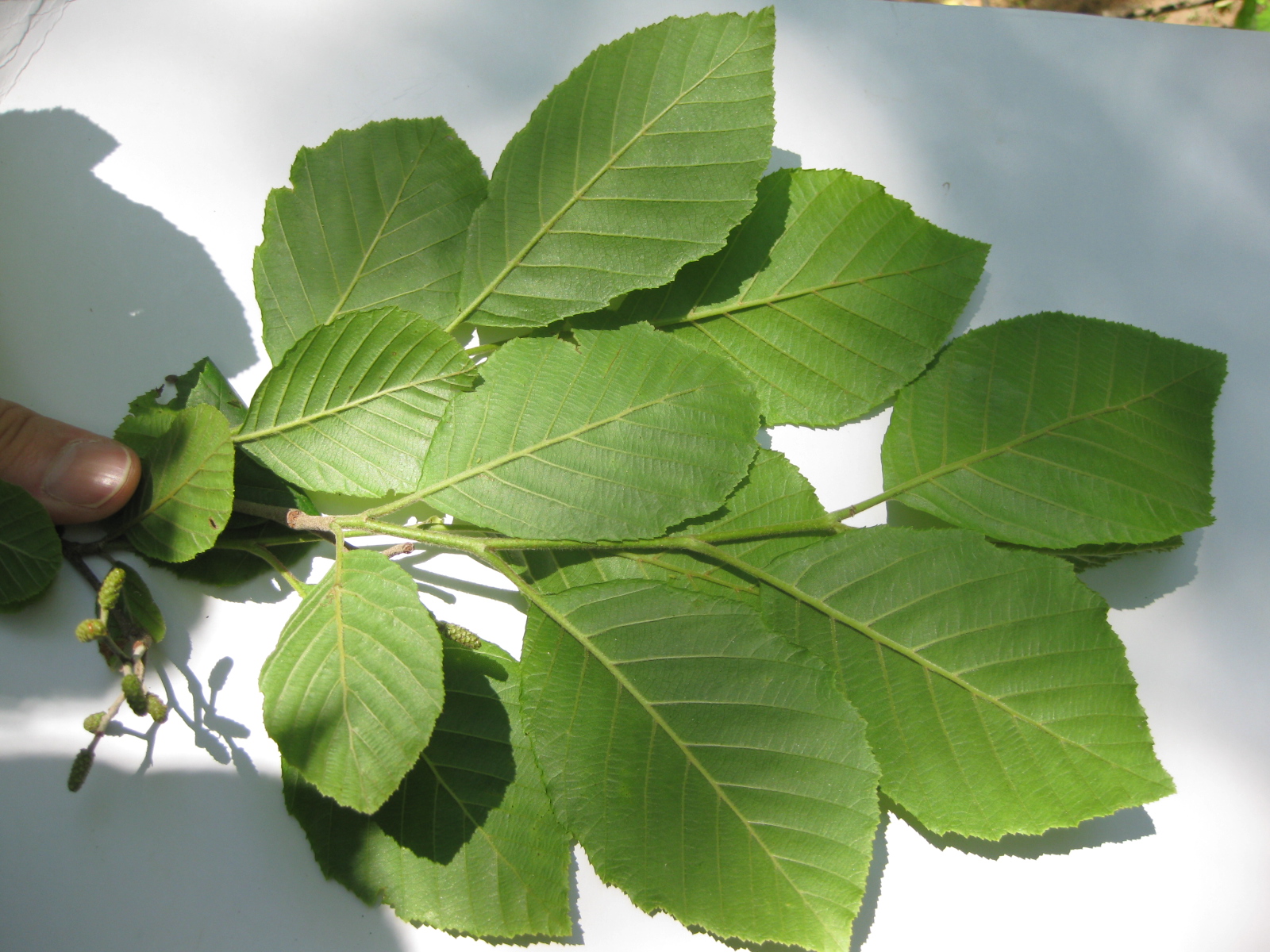
The leaves are simple, alternate, and oval to obovate in shape, measuring 2 to 5 inches (5–13 cm) long and 1.5 to 3 inches (4–8 cm) wide. The most distinctive feature is the sharply serrated (toothed) margin that gives the species its scientific name — serrulata means “finely serrated.” The teeth are fine, sharp, and point forward along the leaf edge. Leaves have a prominent midrib and 8 to 12 pairs of parallel secondary veins that create a distinctly ribbed texture on the upper surface. The upper surface is dark green and somewhat glossy, while the underside is paler green and may have fine hairs, particularly along the veins. Leaves emerge late in spring, after the flowers have finished blooming, and turn yellow to yellow-brown in autumn before dropping.
Flowers & Fruit
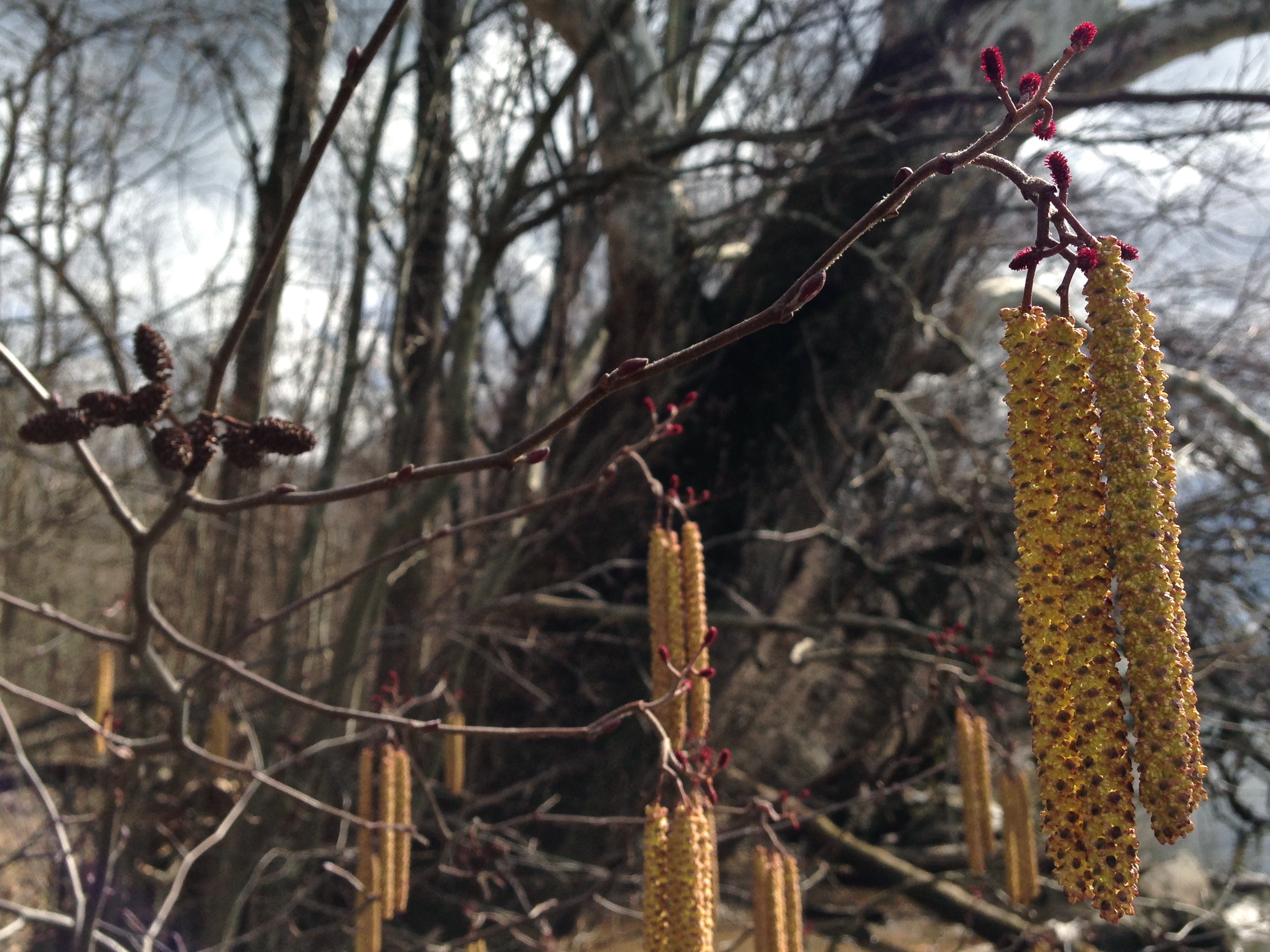
Smooth Alder is monoecious, producing separate male and female flowers on the same plant. The male flowers are organized into distinctive drooping catkins (aments) that are 2 to 4 inches (5–10 cm) long and appear in clusters at branch tips. These catkins are greenish to yellowish-brown and dangle conspicuously from bare branches in late winter to early spring, usually before the leaves emerge. The female flowers are much smaller and less conspicuous, appearing as small, reddish, cone-like clusters about ¼ inch (6 mm) long that develop into the woody fruiting structures.
The fruit is a small, woody cone-like structure (technically a strobile) that resembles a tiny pinecone, measuring ½ to ¾ inch (12–18 mm) long. These structures start green and ripen to brown by late summer or early fall. Each “cone” contains numerous tiny, flattened, winged seeds (nutlets) that are released when the cone opens. The seeds are extremely small and light, allowing them to be dispersed by wind and water to suitable wetland habitats. The empty cones often persist on the branches through winter, providing identification clues even during the dormant season.
Quick Facts
| Scientific Name | Alnus serrulata |
| Family | Betulaceae (Birch) |
| Plant Type | Deciduous Shrub / Small Tree |
| Mature Height | 10–20 ft (3–6 m) |
| Mature Spread | 8–15 ft (2.4–4.6 m) |
| Growth Rate | Fast |
| Sun Exposure | Full Sun to Part Shade |
| Water Needs | High (Wetland Species) |
| Soil Type | Wet to saturated; clay, loam, or sand |
| Soil pH | 5.0–8.0 (acidic to alkaline) |
| Bloom Time | March – May |
| Flower Color | Greenish-yellow (male catkins) |
| Fall Color | Yellow to yellow-brown |
| Fruit | Small woody cones with winged seeds |
| Deer Resistant | No (browsed by deer and livestock) |
| USDA Hardiness Zones | 4–9 |
Native Range
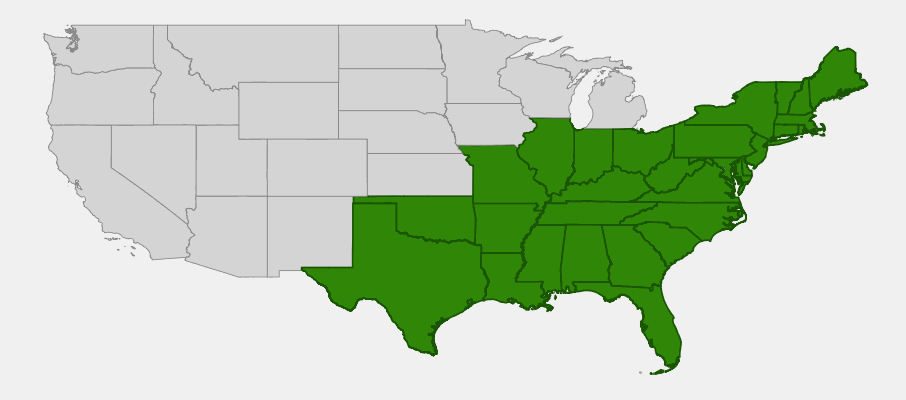
Smooth Alder has one of the most extensive native ranges of any North American alder species, stretching across much of eastern North America from southeastern Canada to the Gulf Coast states. In the north, it ranges from Nova Scotia and New Brunswick west through southern Quebec and Ontario, then south through New England and the Mid-Atlantic states. The species extends throughout the Appalachian Mountains and Piedmont regions, reaching its greatest abundance in the Coastal Plain from the Carolinas to northern Florida. Westward, Smooth Alder follows major river systems across the Interior Low Plateaus and into parts of the Great Plains, reaching its western limits in eastern Texas, Oklahoma, eastern Kansas, and Missouri.
Throughout this vast range, Smooth Alder shows remarkable adaptability to different climatic conditions while maintaining its fundamental requirement for consistent moisture. In the northern portions of its range, it grows primarily along streams, pond margins, and in seasonally flooded areas where winter freezing is common. In the warmer southeastern states, it thrives in permanently wet soils of swamps, bottomland hardwood forests, and the edges of freshwater wetlands. The species demonstrates particular abundance in the Coastal Plain, where it forms dense stands along countless streams, oxbow lakes, and seasonal wetlands that characterize this low-elevation landscape.
Ecologically, Smooth Alder serves as a keystone species in many wetland communities, with its nitrogen-fixing ability allowing it to colonize nutrient-poor, waterlogged soils where other woody plants struggle to establish. This pioneer role makes it one of the first shrubs to colonize disturbed wetland sites, from abandoned beaver ponds to areas recovering from logging or agricultural disturbance. Its extensive root system helps stabilize streambanks and prevents erosion, while the dense thickets it forms provide crucial habitat structure for wetland-dependent wildlife species throughout its range.
📋 Regional plant lists featuring Smooth Alder: North Carolina & South Carolina
Growing & Care Guide
Smooth Alder is one of the easiest native woody plants to grow, provided you can meet its primary requirement: consistent moisture. In the right conditions, it grows rapidly and requires minimal care, making it an excellent choice for challenging wet sites where many other plants fail to thrive.
Light
Smooth Alder performs best in full sun to partial shade, showing good adaptability to varying light conditions. In full sun with adequate moisture, plants develop a denser, more compact growth habit with abundant flowering and fruiting. In partial shade, they tend to grow taller and more open as they reach toward available light. While Smooth Alder can tolerate deeper shade, flowering and fruiting decrease significantly under these conditions. For optimal performance, choose sites that receive at least 4–6 hours of direct sunlight daily.
Soil & Water
The key to success with Smooth Alder is understanding its wetland nature — this species requires consistently moist to wet soil and cannot tolerate drought. In nature, it grows in soils that are seasonally flooded or permanently saturated, from clay to sandy soils, as long as moisture is constant. The plant is remarkably tolerant of soil compaction and poor drainage, conditions that would kill most other woody plants. Soil pH is flexible, with plants thriving in anything from moderately acidic (pH 5.0) to slightly alkaline (pH 8.0) conditions. The most important factor is maintaining soil moisture; if your site tends to dry out in summer, Smooth Alder is not a good choice.
Planting Tips
Plant Smooth Alder in early spring or fall when cooler temperatures reduce transplant stress. Choose container-grown plants, as this species is difficult to transplant from the wild due to its extensive, shallow root system. Dig planting holes only as deep as the root ball but twice as wide, and backfill with native soil — no amendments are necessary as long as drainage is poor. Water thoroughly after planting and maintain consistent moisture throughout the first growing season. Space plants 8–10 feet apart if creating a screen or naturalistic grouping.
Pruning & Maintenance
Smooth Alder requires minimal pruning and maintenance once established. Remove dead, damaged, or crossing branches in late winter while plants are dormant. If you want to maintain a more tree-like form, gradually remove lower branches to expose the smooth bark, but be aware that the plant naturally wants to sucker from the base. To control spread, remove unwanted suckers annually. Avoid heavy pruning, as Smooth Alder recovers slowly from major cuts. The plant has no serious pest or disease problems and rarely requires treatment for health issues.
Landscape Uses
Smooth Alder’s tolerance for wet conditions makes it valuable for sites where few other woody plants will grow:
- Wetland restoration and riparian buffer zones along streams and ponds
- Rain gardens and bioswales designed to handle stormwater runoff
- Low-lying areas with poor drainage or seasonal flooding
- Wildlife habitat — creates dense cover for birds and mammals
- Naturalistic screens along property boundaries in wet areas
- Erosion control on slopes and streambanks prone to washout
- Nitrogen fixation in nutrient-poor wetland soils
- Early successional habitat in disturbed wetland sites
Propagation
Smooth Alder can be grown from seed, cuttings, or by transplanting suckers. Seeds require no pretreatment but should be sown fresh in fall on moist soil surface — they need light to germinate. Softwood cuttings taken in early summer root easily under mist. The easiest method is to dig and relocate suckers from established plants in early spring, ensuring each division has adequate roots attached.
Wildlife & Ecological Value
Smooth Alder provides exceptional wildlife habitat and ecological services throughout its range, functioning as both a food source and critical structural component of wetland ecosystems.
For Birds
The small seeds produced by Smooth Alder are consumed by numerous bird species, including American Goldfinch, Pine Siskin, Common Redpoll, and various sparrow species. The dense, multi-stemmed growth habit provides excellent nesting sites for shrub-nesting birds such as Yellow Warbler, American Robin, Gray Catbird, and Red-winged Blackbird. The early-blooming catkins attract small insects that provide crucial protein for insectivorous birds during spring migration and breeding season. Woodpeckers often forage on the soft wood for insects, while the tangled branches offer secure roosting sites for numerous species throughout the year.
For Mammals
White-tailed deer browse the twigs and foliage of Smooth Alder, particularly during winter when other food sources are scarce. Beaver occasionally use the wood for dam construction and food, though they prefer other species when available. Small mammals such as mice and voles nest within the dense root systems and fallen debris beneath Smooth Alder thickets. The plants provide cover and travel corridors for various mammals moving through wetland habitats, while the streambank stabilization they provide maintains habitat quality for semi-aquatic species like muskrat and river otter.
For Pollinators
Smooth Alder’s early spring bloom makes it one of the most important early-season pollen sources in wetland habitats. The wind-pollinated catkins release enormous quantities of pollen that also feeds various species of native bees, particularly during years when other early flowers are scarce due to late freezes. While the flowers themselves don’t offer nectar, the pollen provides essential protein for developing bee larvae. The early timing — often March to April depending on location — fills a critical gap when few other woody plants are flowering in wetland environments.
Ecosystem Role
Perhaps most importantly, Smooth Alder functions as a nitrogen-fixing pioneer species in wetland ecosystems. Specialized root nodules containing Frankia bacteria convert atmospheric nitrogen into forms that plants can use, effectively fertilizing nutrient-poor wetland soils. This capacity allows Smooth Alder to colonize disturbed or recently created wetlands where other woody plants cannot establish, beginning the succession process toward more complex plant communities. The extensive, shallow root system provides crucial streambank stabilization, preventing erosion during flood events while creating the stable soil conditions necessary for other wetland plants to establish. Dense Smooth Alder thickets also filter runoff, removing sediments and excess nutrients before they reach streams and ponds, improving overall water quality in the watershed.
Cultural & Historical Uses
Smooth Alder has served human communities throughout its range for thousands of years, with Indigenous peoples developing numerous applications for this abundant wetland species. Cherokee, Creek, and other Southeastern tribes used the inner bark medicinally as an astringent for treating wounds, sore throats, and digestive ailments. The tannin-rich bark was particularly valued for its ability to reduce inflammation and stop bleeding. Northern tribes, including various Algonquian-speaking peoples, used Smooth Alder bark to create yellow and orange dyes for basketry and textile work, with different preparation methods producing a range of colors from pale yellow to deep rust-orange.
The wood of Smooth Alder, while not particularly durable, found numerous practical uses among Indigenous communities and early European settlers. Its resistance to rot when submerged made it ideal for constructing fish traps, weirs, and underwater pilings for primitive docks and bridges. The lightweight, easily worked wood was carved into bowls, spoons, and other small implements, while larger pieces were used for smoking fish and meat — the wood imparts a mild, pleasant flavor without the bitterness of some other species. Many tribes used Smooth Alder branches for constructing temporary shelters and fish-drying racks due to the wood’s flexibility when green and light weight when dry.
European settlers quickly adopted many Indigenous uses for Smooth Alder and developed additional applications. The bark became a popular folk remedy for fever, particularly during the widespread malaria outbreaks that plagued early settlements in swampy regions. Frontier doctors used preparations of Smooth Alder bark as a substitute for imported medicines, finding it effective for treating dysentery and other intestinal disorders. The early timber industry occasionally used Smooth Alder for making wooden shoes, tool handles, and rustic furniture, though its softness and tendency to warp limited broader commercial applications.
In modern times, Smooth Alder has gained recognition primarily for its ecological value rather than direct human uses. Environmental restoration specialists prize it for establishing vegetation in constructed wetlands, treating agricultural runoff, and stabilizing eroded streambanks. The species has become increasingly important in sustainable landscape design, particularly in rain gardens and green infrastructure projects designed to manage stormwater in developed areas. Some contemporary artisans still use Smooth Alder wood for rustic furniture, small carved objects, and smoking chips for barbecuing, appreciating its workability and mild flavor. Research into the medicinal properties of Smooth Alder bark continues, with studies investigating its anti-inflammatory and antimicrobial compounds, though traditional uses should not be attempted without proper medical supervision.
Frequently Asked Questions
Will Smooth Alder grow in regular garden soil, or does it really need wet conditions?
Smooth Alder absolutely requires consistently moist to wet soil conditions and will not survive in typical well-drained garden soils. This is a true wetland species that has evolved to thrive in saturated conditions that would kill most other plants. If your site doesn’t stay moist year-round, consider other native alternatives that are better suited to average garden conditions.
How quickly does Smooth Alder spread, and will it take over my yard?
Smooth Alder spreads moderately by root suckers, forming colonies over time but not aggressively invasive like some non-native species. In ideal wet conditions, a single plant can form a thicket 10–15 feet across within 5–7 years. You can control spread by removing unwanted suckers annually and by planting in areas where the natural moisture conditions limit its expansion.
Is Smooth Alder deer resistant?
No, deer readily browse Smooth Alder foliage and twigs, particularly during winter months when other food sources are limited. However, the plants typically recover well from browsing due to their rapid growth rate and ability to resprout from the base. In areas with heavy deer pressure, you may need to protect young plants until they’re large enough to withstand browsing.
Can I plant Smooth Alder near my septic system drain field?
This is generally not recommended. While Smooth Alder’s moisture-loving nature might seem appropriate, its extensive root system can potentially interfere with septic systems and drain lines. The roots actively seek out moisture and nutrients, which could lead to costly system damage. Choose plants specifically recommended for septic areas instead.
What’s the difference between Smooth Alder and other alder species?
Smooth Alder is distinguished from Speckled Alder (A. incana) by its smoother bark and finer leaf serrations, and from European Alder (A. glutinosa) by its smaller size and different leaf shape. The combination of smooth bark, finely serrated leaves, and preference for warmer wetland habitats helps separate Smooth Alder from its relatives throughout most of its range.

Looking for a nursery that carries Smooth Alder?
Browse our native plant nursery directory: North Carolina · South Carolina