
Wild Plum (Prunus americana)
Prunus americana, commonly known as Wild Plum, American Plum, or American Wild Plum, is a beautiful and versatile small native tree that has been a cherished part of North American landscapes and foodways for thousands of years. A member of the Rosaceae (rose) family, this deciduous tree bursts into spectacular clouds of fragrant white flowers in early spring — often before the leaves emerge — making it one of the most showy native flowering trees on the Great Plains. By late summer, the branches droop with clusters of plump, sweet-tart fruits that range from bright red to golden yellow, eagerly sought by wildlife and humans alike.
Growing 20 to 35 feet tall with a broad, spreading crown and thorny branches, Wild Plum is remarkably tough and adaptable. It thrives in the harsh conditions of the northern Great Plains — enduring bitter winters, scorching summers, drought, and alkaline soils that would defeat many ornamental trees. Its tendency to form dense thickets through root suckering makes it invaluable for windbreaks, hedgerows, and wildlife habitat, while its early spring flowers provide critical nectar for pollinators emerging from winter dormancy.
For gardeners and landowners in the Dakotas and across the Great Plains, Wild Plum offers a rare combination: spectacular spring beauty, delicious edible fruit, outstanding wildlife value, and virtually indestructible hardiness. Whether grown as a specimen tree, a wildlife hedge, or a source of homemade jelly, Wild Plum is one of the most rewarding native trees to plant in this region. Its cultural significance runs equally deep — Indigenous peoples across the continent relied on Wild Plum as a food source for millennia, and the tree remains a beloved part of rural traditions throughout the Midwest.
Identification
Wild Plum grows as a large shrub or small tree, typically reaching 20 to 35 feet (6–10 m) in height with a trunk up to 12 inches (30 cm) in diameter. The growth habit varies from a single-trunked tree with a broad, rounded crown to a multi-stemmed, thicket-forming shrub, depending on growing conditions and management. Left to its own devices, Wild Plum spreads by root suckers to form dense colonies that can cover significant areas over time.
Bark
Young bark is smooth, shiny, and reddish-brown to dark brown, developing a distinctive appearance with age. Mature bark becomes dark grayish-brown with prominent horizontal lenticels and eventually develops scaly, curling plates that peel away from the trunk. The twigs are slender, reddish-brown, and often armed with stout, sharp thorns — especially on vigorous young growth and sucker shoots. These thorns, while occasionally inconvenient for the gardener, make Wild Plum thickets nearly impenetrable refuge for nesting birds and small mammals.
Leaves
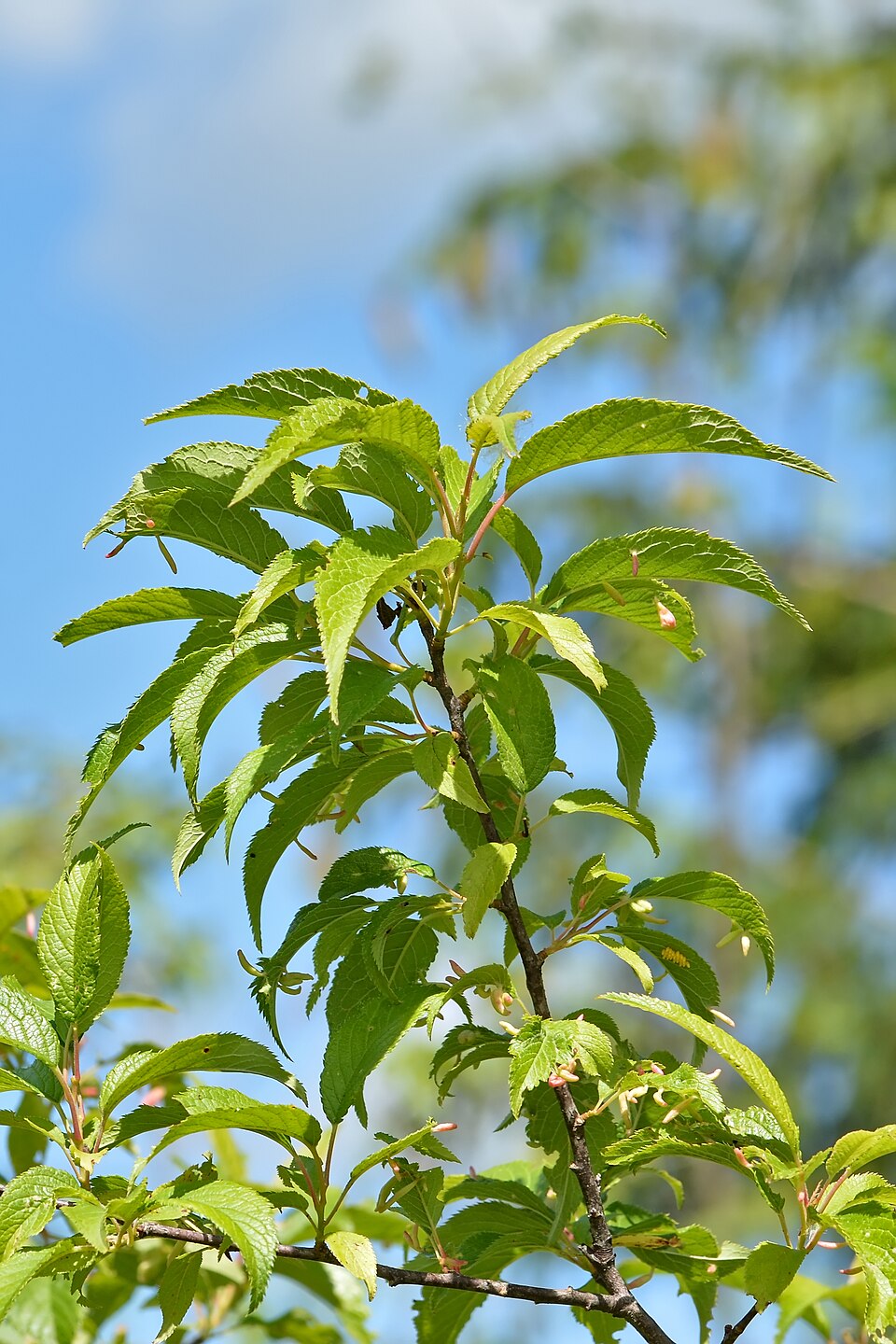
The leaves are simple, alternate, and deciduous, emerging after or during flowering in spring. Each leaf is oval to lance-shaped, 2 to 4 inches (5–10 cm) long and 1 to 2 inches (2.5–5 cm) wide, with a pointed tip, rounded base, and sharply serrated margins with fine, doubly-toothed edges. The upper surface is dark green and smooth; the underside is paler and may be slightly hairy along the veins. Fall color is variable but can be attractive, ranging from yellow to mild orange-brown.
Flowers & Fruit
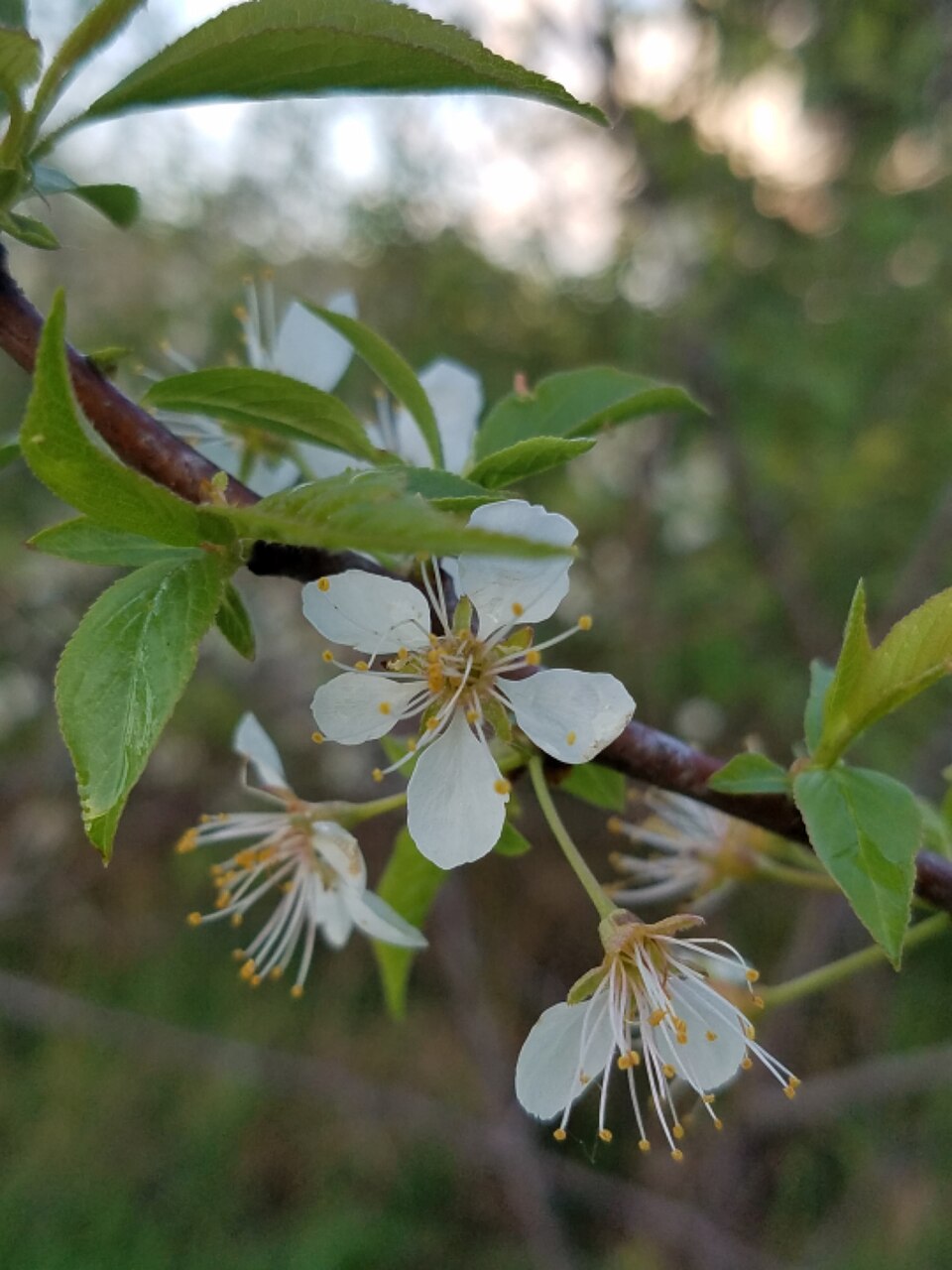
The flowers are Wild Plum’s most spectacular feature. They appear in mid to late spring (April to May in the Dakotas), erupting in dense clusters of 2 to 5 blooms before or just as the leaves begin to unfurl. Each flower is about 1 inch (2.5 cm) across with five pure white petals, a central cluster of yellow stamens, and a sweet, heady fragrance that can be detected from dozens of feet away. The flowering display typically lasts 7 to 14 days and attracts enormous numbers of native bees, honeybees, and other pollinators.
The fruit is a round drupe, ¾ to 1¼ inches (2–3 cm) in diameter, ripening in August and September. Color at maturity ranges from bright cherry-red to golden yellow, often with a dusky bloom. The flesh is juicy, sweet-tart, and excellent for eating fresh or making preserves. Inside is a single, flattened, oval stone (pit). Fruit production varies by year and depends on cross-pollination between genetically distinct trees — a single isolated tree may produce little fruit, while trees in a thicket or near other Wild Plum cultivars typically bear heavy crops.
Quick Facts
| Scientific Name | Prunus americana |
| Family | Rosaceae (Rose) |
| Plant Type | Deciduous Small Tree / Large Shrub |
| Mature Height | 20–35 ft |
| Sun Exposure | Full Sun to Part Shade |
| Water Needs | Low to Moderate |
| Bloom Time | April – May |
| Flower Color | White |
| USDA Hardiness Zones | 3–8 |
Native Range
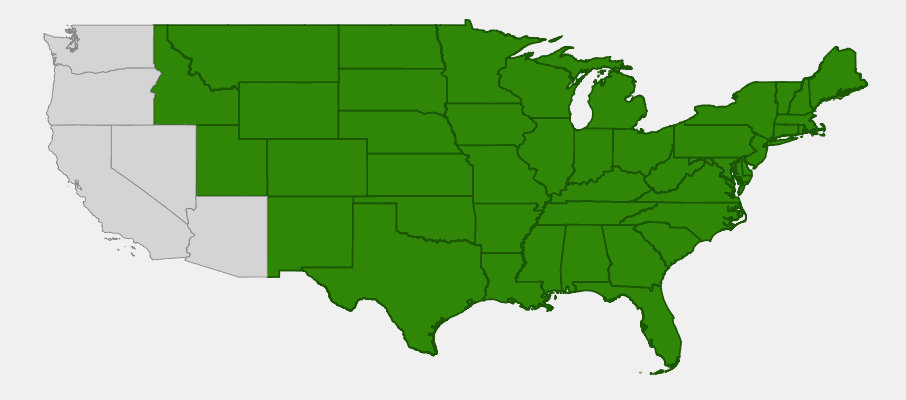
Wild Plum has one of the broadest native ranges of any North American Prunus species, extending from the Great Plains eastward across most of the eastern United States and northward into southern Canada. Its range stretches from Montana and the Dakotas in the northwest to Florida and Texas in the south, and from the Great Plains east to the Atlantic coast. It is found in every state from the Rockies to the Atlantic, making it one of the most widely distributed native fruit trees in North America.
In its natural habitat, Wild Plum colonizes a wide variety of open and semi-open sites: streambanks, fence rows, roadside ditches, prairie margins, woodland edges, pastures, and abandoned farmsteads. It is a pioneer species that quickly establishes on disturbed ground and is often among the first woody plants to appear in old fields and along new fence lines. On the Great Plains, Wild Plum thickets are characteristic features of creek bottoms and shelterbelts, where they provide critical wildlife habitat in otherwise open landscapes.
Wild Plum tolerates a remarkable range of soil conditions, from deep, rich bottomland soils to dry, rocky hillsides and alkaline clay. It is one of the few native fruit trees that genuinely thrives in the harsh continental climate of the northern Great Plains, withstanding temperatures from -40°F to over 100°F. This extreme adaptability explains its enormous native range and its success as both a wild tree and an early introduction to cultivation.
📋 Regional plant lists featuring Wild Plum: North Dakota, South Dakota & Western Minnesota
Growing & Care Guide
Wild Plum is one of the easiest native trees to establish and grow, requiring minimal care once its roots are established. Its natural toughness means it thrives with benign neglect in most situations — the biggest management decision is usually whether to let it sucker into a thicket or maintain it as a single-trunked specimen.
Light
Wild Plum performs best in full sun, where it produces the densest flower displays and heaviest fruit crops. It tolerates part shade but will flower and fruit less prolifically with reduced light. For maximum ornamental and fruit production, choose a site with at least 6 hours of direct sunlight. Trees growing in partial shade tend to be leggier and more open in habit.
Soil & Water
Wild Plum is remarkably adaptable to soil conditions. It grows well in clay, loam, sand, and rocky soils, and tolerates both slightly acidic and alkaline conditions (pH 5.5–8.0). While it prefers moderately moist, well-drained soils, established trees are impressively drought-tolerant thanks to extensive root systems. Avoid only the extremes: permanently waterlogged soils or extremely droughty, exposed sand dunes. For best fruit production, supplemental watering during prolonged dry spells in the fruiting season (July–August) will produce larger, juicier fruit.
Planting Tips
Plant Wild Plum in early spring or late fall. Container-grown or bare-root stock both transplant well. Space individual trees 15–20 feet apart for specimens, or 6–8 feet apart for hedgerows and windbreaks. For fruit production, plant at least two genetically distinct trees (from different seed sources) within 50 feet of each other to ensure cross-pollination. Wild Plum establishes quickly, often growing 2–3 feet per year in good conditions during the first several years.
Pruning & Maintenance
Pruning depends on your goals. For a single-trunked specimen tree, remove root suckers annually and prune out crossing branches in late winter. For a wildlife thicket or hedgerow, allow suckering and prune only to maintain desired boundaries. Remove any dead, damaged, or diseased wood whenever noticed. Wild Plum is susceptible to black knot fungus (Apiosporina morbosa) — prune out infected branches 6 inches below visible galls and dispose of them away from the tree. Tent caterpillars may defoliate branches in spring but rarely cause lasting harm; remove web tents by hand if desired.
Landscape Uses
Wild Plum’s versatility makes it valuable in many settings:
- Specimen tree — stunning spring flower display and attractive fruit
- Wildlife hedgerow — thorny thickets provide nesting cover and food
- Windbreaks & shelterbelts — dense growth breaks wind effectively
- Edible landscaping — excellent fruit for fresh eating, jelly, and preserves
- Erosion control — extensive root system stabilizes streambanks and slopes
- Pollinator gardens — early spring flowers are critical for emerging bees
- Naturalized plantings — ideal for property borders and disturbed areas
Wildlife & Ecological Value
Wild Plum is one of the most ecologically valuable small trees in the Great Plains and Midwest, providing food, shelter, and habitat structure that supports an extraordinary diversity of wildlife species.
For Birds
The fruit is consumed by over 30 species of birds, including American Robins, Cedar Waxwings, Northern Flickers, Red-headed Woodpeckers, Brown Thrashers, Gray Catbirds, Eastern Bluebirds, and various thrushes. The dense, thorny thickets provide some of the best nesting habitat available on the prairie — species like Brown Thrasher, Yellow-billed Cuckoo, and Bell’s Vireo preferentially nest in Wild Plum thickets where the thorns deter predators. In winter, the thickets provide thermal cover and shelter from wind for overwintering birds including Northern Cardinals, Dark-eyed Juncos, and American Tree Sparrows.
For Mammals
White-tailed deer browse the foliage and eat fallen fruit. Foxes, coyotes, raccoons, opossums, and skunks all consume the ripe plums and are important seed dispersers. Black bears eat the fruit where their range overlaps with Wild Plum. Cottontail rabbits shelter in the dense base of thickets, and small mammals like mice and voles find cover among the root suckers. The thorny, impenetrable nature of mature Wild Plum thickets makes them critical refuge habitat for small mammals and ground-nesting birds in agricultural landscapes.
For Pollinators
Wild Plum’s early spring flowering — occurring when few other nectar sources are available — makes it one of the most important native trees for pollinators. Mining bees (Andrena spp.) that specialize on Prunus flowers depend on Wild Plum and its relatives. Bumble bee queens emerging from hibernation visit the flowers heavily, as do honeybees, mason bees, and numerous other native bee species. Various butterflies and moths also visit the flowers, and the foliage serves as a larval host plant for several moth species.
Ecosystem Role
Wild Plum plays a critical role as a pioneer and nurse species in prairie and savanna ecosystems. Its thicket-forming habit creates sheltered microhabitats where shade-intolerant seedlings of taller trees — like Bur Oak and Green Ash — can establish protected from wind, sun, and browsing. Over time, these trees grow up through and eventually overtop the plum thicket, creating the woodland structure that characterizes prairie-forest transitions. Wild Plum’s extensive root system also stabilizes soil along streambanks and on slopes, preventing erosion and maintaining water quality.
Cultural & Historical Uses
Wild Plum holds a deep and rich place in the cultural history of North America. Indigenous peoples across the continent relied on Wild Plum as an important food source for thousands of years. The Lakota, Dakota, and Nakota peoples of the northern Great Plains called the fruit kȟaŋtá and gathered it in late summer for fresh eating and for drying into cakes that could be stored for winter use. The dried plum cakes were often mixed with dried meat and fat to make wasna (pemmican), a high-energy food essential for survival during the long Plains winters. The Pawnee, Omaha, Ponca, and many other Plains nations similarly gathered and preserved Wild Plum.
Beyond food, various Indigenous nations used Wild Plum medicinally. The inner bark was used to make a wash for skin abrasions and sores. The root bark was chewed or brewed into tea for mouth and throat ailments. Among the Cheyenne, the wood was preferred for making certain ceremonial items. The tree’s early spring blooming — one of the first signs of spring on the prairie — held seasonal and spiritual significance for many Plains peoples, marking the transition from winter to the growing season.
European settlers quickly adopted Wild Plum into their own foodways. Wild plum jelly, jam, butter, and wine became staples of frontier and rural kitchens throughout the Midwest, and the tradition continues today. Many farm families still have treasured jelly recipes passed down through generations. Wild Plum was also one of the first native fruits used in plant breeding — Luther Burbank and other early American horticulturists crossed Wild Plum with European and Japanese plums to create cold-hardy cultivated varieties suited to northern climates. Several important plum cultivars grown today carry Prunus americana genetics, including varieties developed specifically for the harsh growing conditions of the Dakotas and Minnesota.
Wild Plum thickets were also important landmarks and gathering places on the Great Plains. “Plum Creek,” “Plum Grove,” and “Plum Island” appear as place names across the Midwest — Laura Ingalls Wilder’s On the Banks of Plum Creek takes its name from a Wild Plum-lined creek in southwestern Minnesota. These thickets, often the only woody vegetation for miles on the open prairie, served as landmarks for travelers, camping spots for settlers, and critical sources of wood, fruit, and shelter.
Frequently Asked Questions
Can you eat wild plums?
Absolutely! Wild plums are delicious eaten fresh — they have a sweet-tart flavor that intensifies as they ripen. They are also excellent for making jelly, jam, preserves, syrup, wine, and fruit leather. The fruit varies in sweetness between individual trees, so taste-test before harvesting heavily. For jelly, slightly underripe fruit produces the best set due to higher pectin content.
How do I keep Wild Plum from suckering everywhere?
Wild Plum naturally spreads by root suckers to form thickets. If you want a single-trunked tree, mow or prune suckers annually. Installing a root barrier (rigid plastic edging buried 18 inches deep) around the planting can help contain spread. Alternatively, embrace the thicket habit — it’s the natural growth form and provides the best wildlife habitat.
Why does my Wild Plum tree not produce fruit?
Wild Plum requires cross-pollination between genetically distinct trees. A single tree or a clonal thicket (all from root suckers of one tree) may flower heavily but set little fruit. Plant at least two trees grown from different seed sources within 50 feet of each other. Late spring frosts can also kill blossoms and prevent fruit set in some years.
What is the black, warty growth on my Wild Plum branches?
That’s black knot fungus (Apiosporina morbosa), a common disease of plums and cherries. Prune out infected branches at least 6 inches below the visible gall during winter. Dispose of pruned material away from plum trees. Severe infections may require removing heavily affected trees, but most Wild Plum trees tolerate moderate black knot without serious harm.
Is Wild Plum a good choice for a shelterbelt?
Yes — Wild Plum is excellent for shelterbelts and windbreaks. Its dense, thorny, thicket-forming growth creates effective wind screening at the shrub layer. It is commonly planted in multi-row shelterbelts alongside taller species like Green Ash and Bur Oak, where it fills the lower level. Its extreme cold hardiness (Zone 3) makes it reliable throughout the Dakotas and northern Great Plains.

Looking for a nursery that carries Wild Plum?
Browse our native plant nursery directory: North Dakota · South Dakota · Minnesota