Wolfberry (Symphoricarpos occidentalis)
Symphoricarpos occidentalis, commonly known as Wolfberry or Western Snowberry, is a tough, adaptable native shrub of the central and northern prairies that offers year-round wildlife value and outstanding toughness in challenging landscape conditions. A member of the Caprifoliaceae (honeysuckle) family, Wolfberry is a compact, rhizomatous deciduous shrub growing to about 3 feet tall that spreads by underground runners to form dense, low thickets — an ecological strategy ideally suited to the windy, fire-prone prairie landscape of the Upper Midwest.
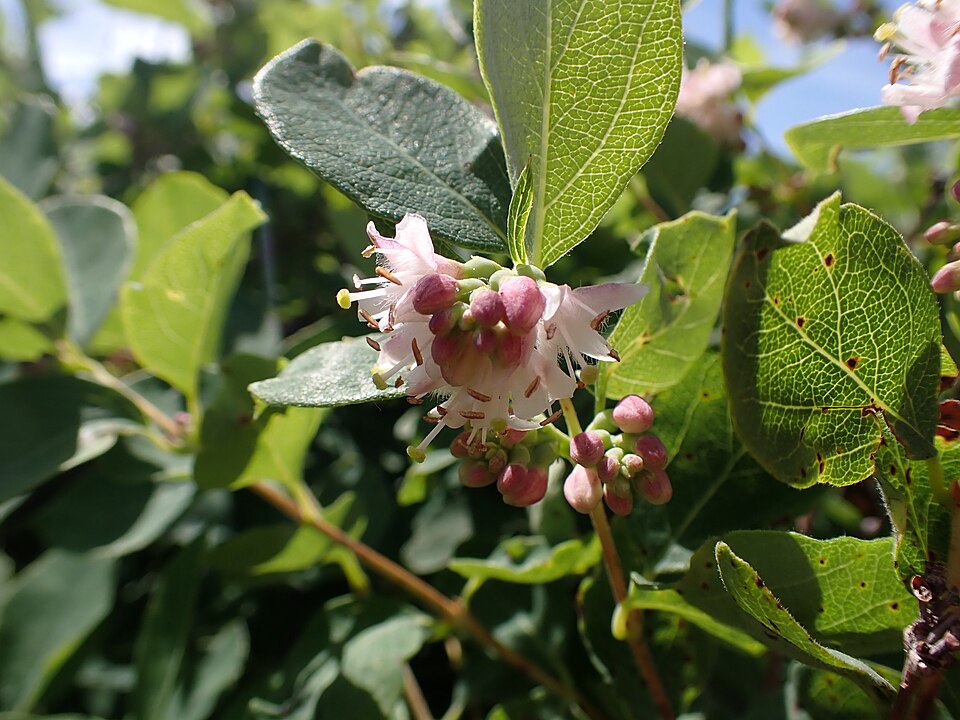
The flowers, which bloom from May through June, are small, bell-shaped, and pink to white, produced in short clusters in the leaf axils along the current year’s stems. Though individually inconspicuous, they attract a range of native pollinators including bumblebees and many smaller native bees. The flowers give way to the plant’s most distinctive ornamental feature: round, pea-sized white berries (technically drupes) that develop in late summer and persist well into winter, providing a vital late-season and overwinter food source for birds and small mammals. The berries ripen from August through November, with peak fruiting in September through October.
For gardeners in Michigan, Minnesota, and Wisconsin working on prairie restoration, wildlife habitat enhancement, or erosion control on challenging dry or rocky sites, Wolfberry is an excellent choice. Its exceptional cold hardiness (to Zone 3 or even Zone 2), drought tolerance, and ability to spread and stabilize soil through its rhizomatous root system make it ideal for difficult conditions where more ornamental native shrubs would struggle. Its white berries, while not palatable to humans, are important wildlife food during the lean months of late winter.
Identification
Wolfberry is a low to medium-height deciduous shrub with simple opposite leaves, small pink-white bell-shaped flowers, and distinctive round white berries. It is closely related to Common Snowberry (Symphoricarpos albus) and may be confused with it, but differs in several key features.
Leaves
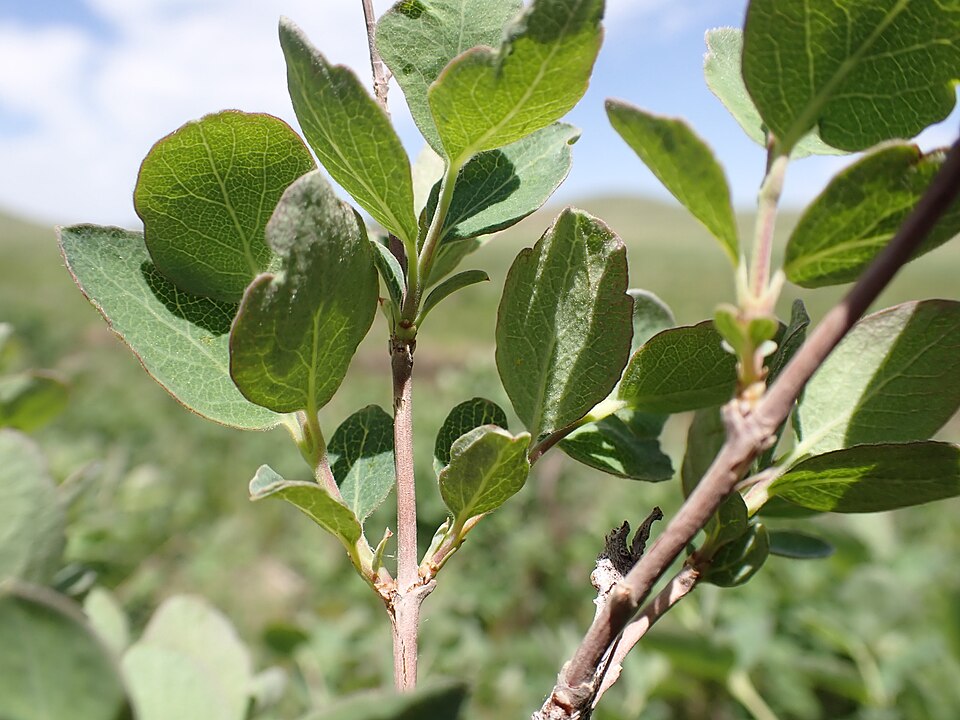
Leaves are simple, opposite, oval to broadly elliptic, 1 to 2.5 inches long, with smooth to slightly wavy margins (rarely with shallow lobes on vigorous shoots). The leaf surface is smooth to slightly hairy, dull blue-green above and paler below. The leaves are noticeably smaller and more consistently oval than those of Common Snowberry. Wolfberry leaves typically lack the lobed, irregular juvenile leaves often produced by Common Snowberry. Autumn leaf color is generally an inconspicuous yellowish before drop.
Flowers
Flowers are small (¼ inch), narrowly bell-shaped (tubular), with 5 pink to white lobes. They are borne in compact clusters (spikes) of 4–18 flowers in the leaf axils, primarily on older wood along the stem. Bloom time is May through June, producing flowers that are a moderate source of nectar for native bees. The corolla tube is densely hairy inside — a feature distinguishing this species from Common Snowberry, where the tube is less hairy.
Fruit
The fruit is a round to slightly oval drupe, ¼ to ½ inch in diameter, white to slightly bluish-white when ripe, with a mealy, seedy interior. Berries are borne in clusters along the stems, ripening from August through November. They persist through winter, providing food for wildlife long after most other fruits have been consumed. The fruit contains 2 seeds and contains saponins that make it unpalatable and mildly toxic to humans.
Quick Facts
| Scientific Name | Symphoricarpos occidentalis |
| Family | Caprifoliaceae (Honeysuckle) |
| Plant Type | Deciduous Shrub |
| Mature Height | 3 ft |
| Sun Exposure | Full Sun to Part Shade |
| Water Needs | Moderate |
| Bloom Time | May – June |
| Flower Color | Pink to white (small bell-shaped) |
| Fruit | White berries; ripen Sep–Nov; persist through winter |
| USDA Hardiness Zones | 2–8 |
Native Range
Wolfberry is native to the central and northern regions of North America, with its core range centered on the Great Plains and northern Midwest, extending northward into the Canadian prairie provinces. It is one of the characteristic shrubs of the mixed-grass and shortgrass prairie zones, thriving in the challenging combination of cold winters, hot summers, and periodic drought that defines the interior of the continent.
In the Great Lakes region, Wolfberry occurs naturally in the western portions of Michigan, throughout Wisconsin, and across much of Minnesota, where it grows in open prairies, dry roadsides, shrubby thickets, and disturbed upland habitats. It is particularly common in areas with calcareous (limestone-based) soils, where its tolerance for alkaline conditions gives it an advantage over many other native shrubs. It is one of the most cold-hardy of all native shrubs in the region, surviving temperatures well below those that damage or kill less hardy species.
Wolfberry has a stronger affinity for drier, more continental climates than its close relative Common Snowberry (S. albus), which tends to occur more frequently in moister, forested settings. The two species overlap in parts of the Great Lakes region and occasionally hybridize where their ranges meet. Wolfberry’s rhizomatous spreading habit makes it well-adapted to the fire-cycle of native prairies, where fire kills the above-ground stems but the underground rhizomes survive to resprout vigorously.
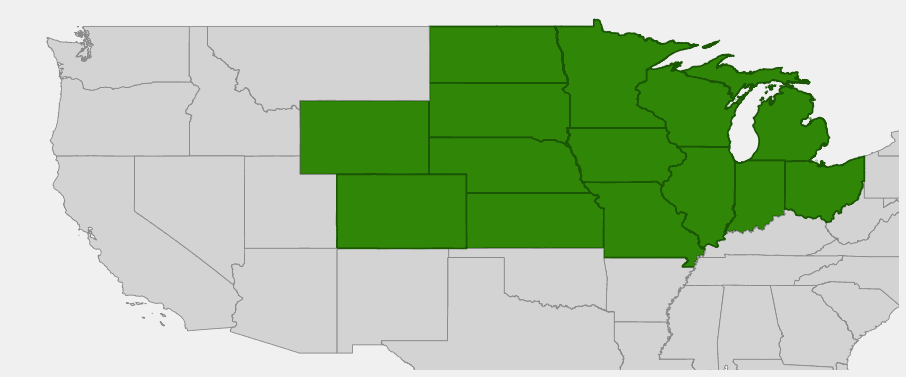
📋 Regional plant lists featuring Wolfberry: Michigan, Minnesota & Wisconsin
Growing & Care Guide
Wolfberry is one of the toughest native shrubs available for challenging northern prairie landscape conditions, combining cold hardiness, drought tolerance, and an ability to spread and stabilize difficult sites that few other ornamental shrubs can match.
Light
Wolfberry grows well in full sun to part shade. In full sun it produces the most compact growth, heaviest flowering, and best fruit production. In part shade it remains healthy and produces fruit, though somewhat less abundantly. It is more shade-tolerant than many prairie shrubs but performs best in open, sunny conditions that reflect its native prairie habitat.
Soil & Water
Wolfberry is adaptable to a wide range of soil types and conditions. It grows on dry to moderately moist soils — from sandy and rocky to clay — and is notably tolerant of calcareous (high-pH, limestone-based) soils where many other shrubs struggle. Once established, it is quite drought tolerant. The batch data indicates it prefers moderate moisture conditions for optimal landscape performance. Avoid consistently wet or poorly drained sites. Its extraordinary cold tolerance (Zones 2–8) makes it one of the most reliable shrubs for the most challenging northern Great Plains climates.
Planting Tips
Plant Wolfberry from container stock in spring or fall. Space plants 3–5 feet apart for a dense wildlife planting, or 5–8 feet apart if you want specimens that will spread individually. Be aware that Wolfberry spreads by underground rhizomes and will gradually form colonies over time — plan for this when siting the plant. It can be contained with a spade-cut edging or planted within a root-containment barrier if needed in formal settings. Plant in groups of 3 or more for the best fruit display and wildlife benefit.
Pruning & Maintenance
Wolfberry requires minimal maintenance. Remove dead or damaged stems in late winter. For rejuvenation of old, unproductive stands, cut to within 6–8 inches of the ground in late winter — the plant regenerates vigorously from rhizomes. To control spread, remove unwanted rhizome extensions at the soil line in spring. The plant is essentially pest-free and requires no fertilization. Leave the white berries standing through winter for wildlife; they persist well into late winter even in harsh conditions.
Landscape Uses
- Prairie restorations and meadow plantings — historically abundant prairie shrub species
- Wildlife hedgerows — white berries attract birds through winter
- Erosion control on dry slopes — rhizomatous roots stabilize challenging sites
- Roadside plantings — exceptional tolerance for compacted, dry, alkaline roadside soils
- Naturalized shrub borders — low-maintenance mass planting
- Cold-climate gardens (Zone 2–3) where few other flowering shrubs are hardy
Wildlife & Ecological Value
Wolfberry’s ecological value is centered on two key contributions: its flowers as a nectar source for native bees in late spring, and its persistent white berries as an important late-season and overwinter food source for birds and mammals.
For Birds
The white berries of Wolfberry are consumed by a variety of bird species in late fall and winter, particularly when other food sources have been depleted. Documented consumers include American Robin, Cedar Waxwing, Gray Catbird, Northern Mockingbird, various thrushes, and grouse species. The berries are especially important as a food source in prairie regions where other native fruiting shrubs may be scarce. Dense Wolfberry thickets also provide important nesting cover for prairie-edge birds including Yellow Warbler, American Goldfinch, and various sparrows.
For Pollinators
Wolfberry flowers attract a moderate diversity of native bees during their May–June bloom period. Bumble bees are the most common visitors, but smaller native bees including sweat bees and mining bees also visit. The tubular flower shape somewhat limits accessibility for very small insects, but bumble bees with their longer tongues can efficiently extract nectar. The flowers are a useful nectar bridge between the early spring bloom of native trees and shrubs and the peak summer bloom of prairie wildflowers.
For Mammals
The berries are consumed by various mammals including raccoons, skunks, foxes, and bears. White-tailed deer browse the stems and foliage in winter. Cottontail rabbits use dense Wolfberry thickets as critical escape cover and may consume twigs in harsh winter conditions. Prairie voles and other small rodents use the dense thickets for shelter.
Ecosystem Role
Wolfberry is an important native component of prairie shrub community ecology. Its rhizomatous spreading habit makes it an effective colonizer and stabilizer of disturbed prairie soils, and its ability to resprout vigorously from rhizomes after fire makes it a resilient participant in fire-dependent prairie ecosystems. Its dense thickets create structural complexity in the prairie landscape, harboring a diverse community of invertebrates, small mammals, and nesting birds. The persistent winter berries extend food availability well beyond the typical fruiting season of most shrubs.
Cultural & Historical Uses
Wolfberry was used by numerous Indigenous peoples of the Great Plains and northern prairies. The Sioux, Cheyenne, and Blackfoot peoples are among those documented as using the plant medicinally. The berries, while unpalatable and mildly toxic to humans due to their saponin content, were used in small quantities in some tribal preparations. The Blackfoot people used the stems to make arrow shafts, taking advantage of the plant’s straight young growth. The plant was also used by the Ojibwe and other Great Lakes tribes in medicinal preparations for treating skin ailments and eye problems.
In the context of Plains tribes, Wolfberry thickets were recognized as important ecological landmarks and food sources for wildlife. The dense, thorny (in some habitats) thickets provided cover for game animals that were hunted, and knowledge of where Wolfberry colonies grew was part of the accumulated ecological knowledge passed down through generations. The plant’s resilience after fire — its ability to resprout vigorously from underground rhizomes even after hot prairie fires — made it a reliable feature of the prairie landscape that Indigenous peoples could depend on year after year.
European settlers in the northern Great Plains found Wolfberry a useful hedgerow plant for prairie farmsteads, where it could establish windbreaks and wildlife corridors. In the 19th-century prairie era, native shrubs including Wolfberry, Lead Plant, and Prairie Rose were planted around homesteads to provide windbreaks, firewood, and wildlife habitat in the treeless prairie environment. Today, Wolfberry is used primarily in conservation plantings, prairie restorations, and wildlife habitat enhancement projects, where its toughness and ecological value make it a consistently reliable performer.
Frequently Asked Questions
Are Wolfberry berries edible?
No — Wolfberry berries (Symphoricarpos occidentalis) are mildly toxic to humans due to their saponin content and should not be eaten. They may cause stomach upset, vomiting, or dizziness if consumed in quantity. They are valuable food for wildlife but should be left for birds and mammals. Note that this species is unrelated to the “wolfberries” or goji berries marketed as a health food, which come from Lycium barbarum — a completely different plant.
How does Wolfberry differ from Common Snowberry?
Wolfberry (S. occidentalis) and Common Snowberry (S. albus) are closely related but differ in several ways. Wolfberry has more consistently oval leaves without the irregular lobing of Snowberry, a more densely hairy flower tube interior, tends to grow more erect, and prefers drier, more open prairie conditions. Snowberry prefers moister, more forested habitats. Their ranges overlap in the Great Lakes region, and they can hybridize where they co-occur.
Will Wolfberry spread aggressively in my garden?
Wolfberry does spread by underground rhizomes and will gradually expand its colony over time. In naturalized settings or wildlife plantings, this spreading habit is a feature that increases ecological value. In more formal garden settings, control spread by cutting back unwanted rhizome extensions at the soil line each spring. A root containment barrier (12 inches deep) can limit lateral spread if needed.
Is Wolfberry deer resistant?
Wolfberry has moderate deer resistance — deer will browse it but typically not heavily in seasons when other browse is available. In winter, when deer food is scarce in the northern range, they may browse Wolfberry more significantly. The plant’s rhizomatous root system ensures rapid recovery from browsing.
Can Wolfberry be grown from seed?
Yes, though seed requires cold stratification (60–90 days at refrigerator temperatures) before germination. Seed germinates erratically and plants are slow to establish in their first year. Division of established plants or transplanting rooted rhizome sections in spring is a more reliable and faster propagation method.