
Soaker Hoses vs. Drip Systems: Which Should You Choose? A Comparison of Efficient Garden Irrigation Methods
We independently select all products and services. If you click through links we provide, Plant Native may earn a commission with no extra cost to you.
Last updated: November 13, 2026
Efficient garden irrigation is crucial for maintaining healthy plants and conserving water. Two popular options for delivering water directly to plant roots are soaker hoses and drip systems.
These methods provide slow, targeted watering that reduces water waste and promotes deep root growth.
Soaker hoses are porous tubes that slowly seep water along their length. Drip systems use a network of tubes with small emitters to deliver water precisely where needed.
Both can be effective choices for gardens, raised beds, and landscaped areas. The best option depends on factors like garden layout, plant types, and water pressure.
When choosing between soaker hoses and drip systems, consider ease of installation, customization options, and long-term durability. Water flow control and even distribution are also important for optimal plant health.
We evaluated multiple soaker hoses and drip irrigation kits to determine which work best for different garden setups and watering needs.
Best Soaker Hoses and Drip Systems
We’ve compiled a comprehensive list of the top soaker hoses and drip systems to help you make an informed decision for your garden irrigation needs. Our selections cover a range of options suitable for different garden sizes, plant types, and watering requirements.
Our top pick

- Customizable with various fittings
- Listed as saving up to 70% water compared with ordinary hoses
- Ideal for targeted watering
Cons
- Small diameter may limit flow
- Setup can be time-consuming
- Inconsistent water distribution reported
The Lesimnky kit pairs a 100-foot roll of 1/4-inch recycled rubber and polyethylene soaker tubing with 30 connectors (straight barbs, tees, elbows and end plugs), so it can be cut and routed around raised beds and container gardens. The listing recommends running it at about 10 PSI so water seeps out slowly. When you weigh all the factors, this one rises above the rest.
Best budget option

- Gentle, even watering along entire length
- Flexible for curved or straight layouts
- Easy to install and customize
Cons
- May require pressure regulation
- Durability concerns over time
- Limited coverage area per hose
The Raindrip soaker tubing is a practical choice for targeted watering: per the listing, its porous material seeps water out along the entire 50-foot length, and it can be cut to length and connected to a 1/2-inch drip supply line with 1/4-inch fittings. It’s a well-earned pick that lives up to the promise.
Best for gardens

- Saves up to 70% water compared to traditional watering methods
- Includes multiple accessories for customizable setup
- Easy to install and use in different garden layouts
Cons
- Requires low water pressure (25 PSI or less) to prevent damage
- May need additional protection if used above ground
- Initial setup can be time-consuming for complex layouts
The Hkvoxim kit includes a 100-foot roll of 1/4-inch rubber soaker tubing plus an assortment of fittings, and the listing rates it at 0.75 gallons per hour for every 15 feet at 25 PSI. It can be installed above ground or buried under mulch for a neater appearance. For this particular need, it’s the clear frontrunner.
Most durable option
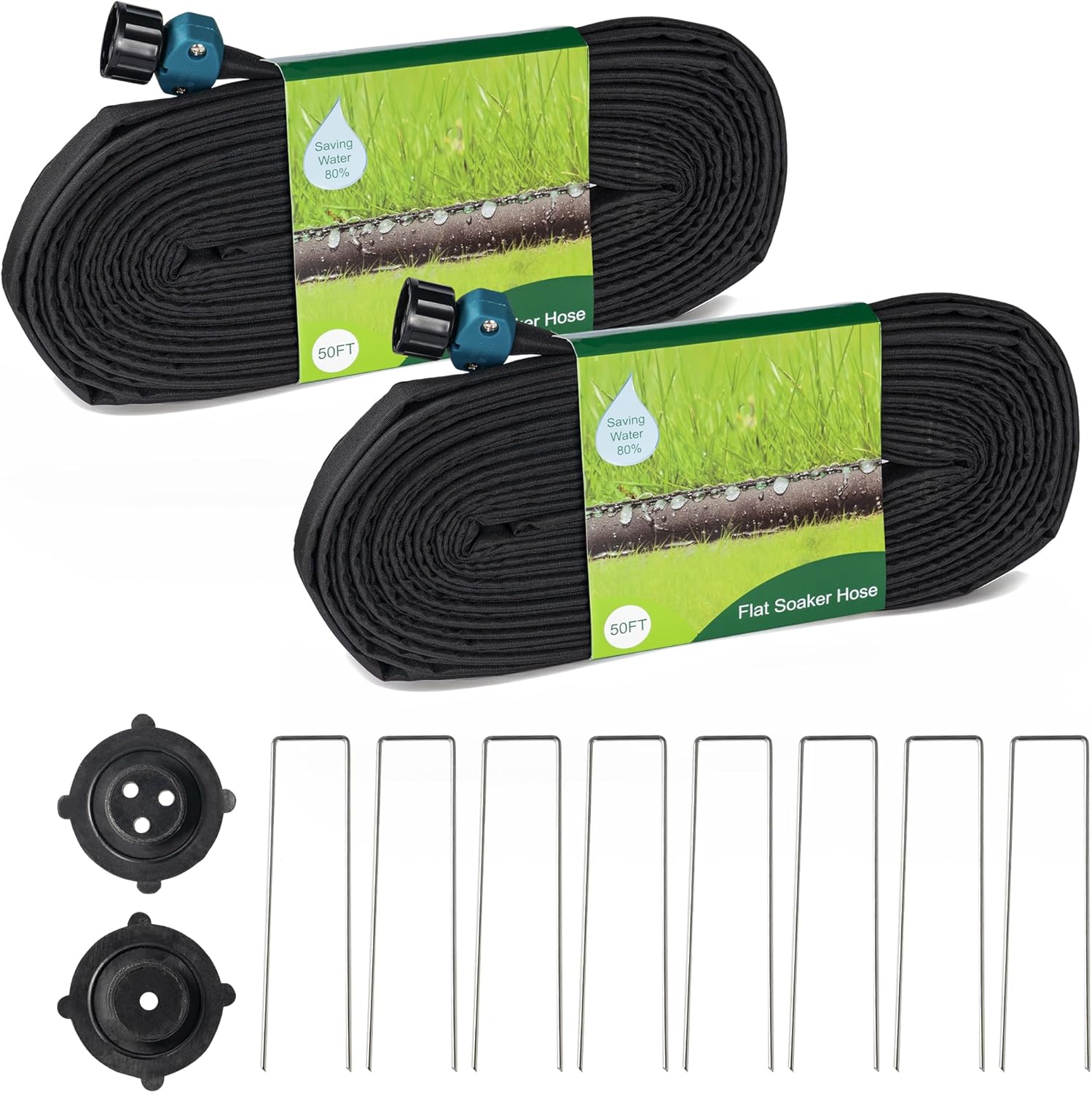
- Two linkable 50-foot sections for 100 feet of coverage
- Kink-resistant double-layer PVC and nylon construction
- Stakes included to hold the hose in place; works with hose timers
Cons
- Not for use with hot water
- Designed for typical household pressure (listing cites 60–80 PSI), so it is not a low-pressure option
- Flat profile is wider to hide than round 1/4-inch tubing
The Hourleey set covers 100 feet with two 50-foot flat soaker hoses that connect end to end. Evenly spaced holes spread water along the full length, and the double-layer, clog-resistant fabric cover is built to resist kinking above ground or beneath mulch. For tough jobs that demand durability, it’s hard to beat.
Best rubber option

- Durable recycled rubber construction
- End cap included for connecting additional hoses
- Saves up to 70% water compared to sprinklers
Cons
- May develop kinks over time
- Water distribution can be uneven in some cases
- Requires proper pressure management
The Rocky Mountain Goods hose is a 25-foot, 1/2-inch heavy-duty rubber soaker with reinforced fittings and an end cap that lets you link additional hoses. The listing claims up to 70% water savings by releasing water directly at plant roots, which reduces evaporation compared with sprinklers. For this particular need, it’s the clear frontrunner.
Buying Guide
When choosing between soaker hoses and drip systems, consider these key factors:
Water Efficiency
We recommend evaluating the water efficiency of each option. Drip systems typically offer more precise control over water flow and distribution.
Installation Complexity
Soaker hoses are generally easier to install, while drip systems may require more setup time and components.
Customization
Drip systems allow for greater customization to fit specific garden layouts and plant needs.
Durability
Consider the materials used and expected lifespan of each system. High-quality options in both categories can last several years with proper care.
Cost
Compare initial costs and long-term expenses, including potential water savings.
Maintenance Requirements
Evaluate the time and effort needed for upkeep. Soaker hoses usually require less maintenance than drip systems.
Garden Size and Layout
For smaller, linear gardens, soaker hoses may suffice. Larger or irregularly shaped areas often benefit from drip systems.
Plant Types
Consider the watering needs of your plants. Drip systems offer more precision for varied plant requirements.
Soil Type
Clay soils may benefit from slower water distribution of drip systems. Meanwhile, sandy soils might work well with soaker hoses.
We can make an informed decision on the best irrigation method for our specific garden needs by weighing these factors.
We independently select all products and services. If you click through links we provide, Plant Native may earn a commission with no extra cost to you. As an Amazon Associate I earn from qualifying purchases.
Interesting. My experience has been a little different but every garden is unique I guess.