
5 Best Automatic Fertilizer Spreaders for Large Gardens: Top Picks for Effortless Lawn Care
We independently select all products and services. If you click through links we provide, Plant Native may earn a commission with no extra cost to you. As an Amazon Associate I earn from qualifying purchases.
Last updated: November 7, 2026
Automatic fertilizer spreaders have revolutionized lawn and garden care for homeowners with large outdoor spaces. These tools distribute fertilizer evenly across expansive areas, saving time and effort compared to manual spreading methods. They ensure consistent coverage, promoting healthy plant growth and vibrant landscapes without the risk of over-fertilizing or missing spots.
For large gardens, automatic spreaders are particularly beneficial. They can cover more ground quickly and efficiently, making the task of fertilizing less daunting. These devices come in various sizes and styles, from walk-behind models to tow-behind attachments for riding mowers or tractors. Some even feature smart technology for precise application rates.
When choosing an automatic fertilizer spreader for a large garden, consider the capacity, spread width, and ease of use. The hopper size should be large enough to minimize refills, while the spread width determines how many passes you’ll need to make. Adjustable flow rates and user-friendly controls are also important features to look for. We tested numerous automatic fertilizer spreaders to find the best options for large gardens.
Best Automatic Fertilizer Spreaders for Large Gardens
We’ve researched and tested numerous automatic fertilizer spreaders to bring you the top choices for large gardens. Our selection focuses on models that offer excellent coverage, precise distribution, and ease of use to help you maintain a lush and healthy landscape with minimal effort.
Our top pick
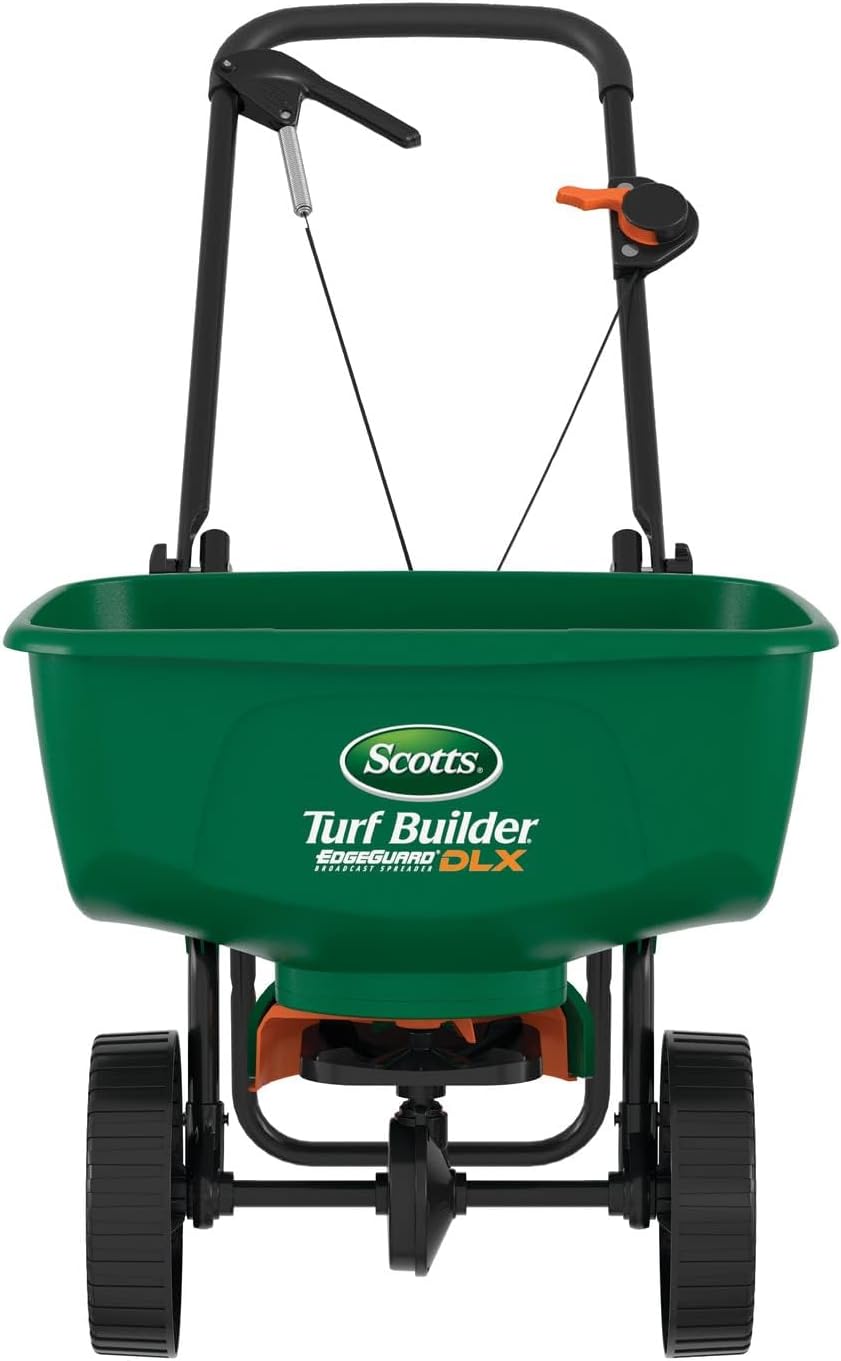
- Holds enough product for up to 15,000 sq. ft.
- Comes pre-calibrated with no assembly required
- EdgeGuard side shield keeps product off landscaping, driveways and sidewalks
Cons
- Bulkier and pricier than handheld spreaders
- Coverage and settings are geared to Scotts products
- Walk-behind design means pushing it over every pass
A hopper with an agitator keeps product funneling smoothly for consistent coverage, and you can use it year-round for fertilizer, grass seed, salt or ice melt. It checks every box and then some — a worthy top contender.
Best for small spaces
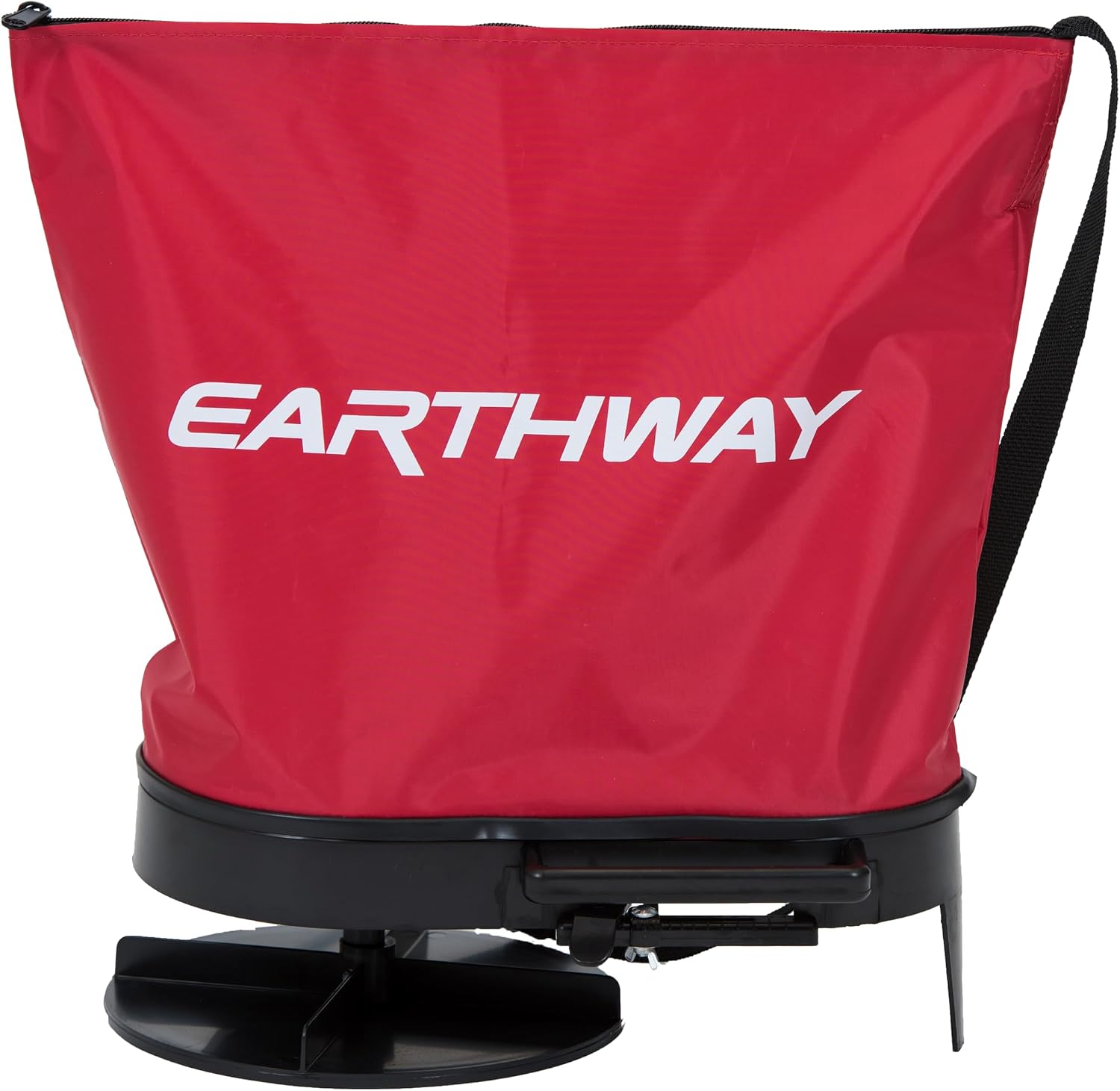
- 25 lb capacity in a water-resistant nylon bag
- Cross-shoulder strap and sealed gearbox
- Agitator, side spread control and spring-close shutoff
Cons
- Hand-cranked, so you supply the power
- You carry the full load on your shoulder
- Slower than a push spreader on open lawn
The EarthWay 2750 is handy for lawn care tasks where a wheeled spreader won’t fit. Its carry-anywhere design makes it easy to work around smaller yards and gardens. One standout feature is the side spread control, which keeps product off areas you don’t want covered.
Most versatile
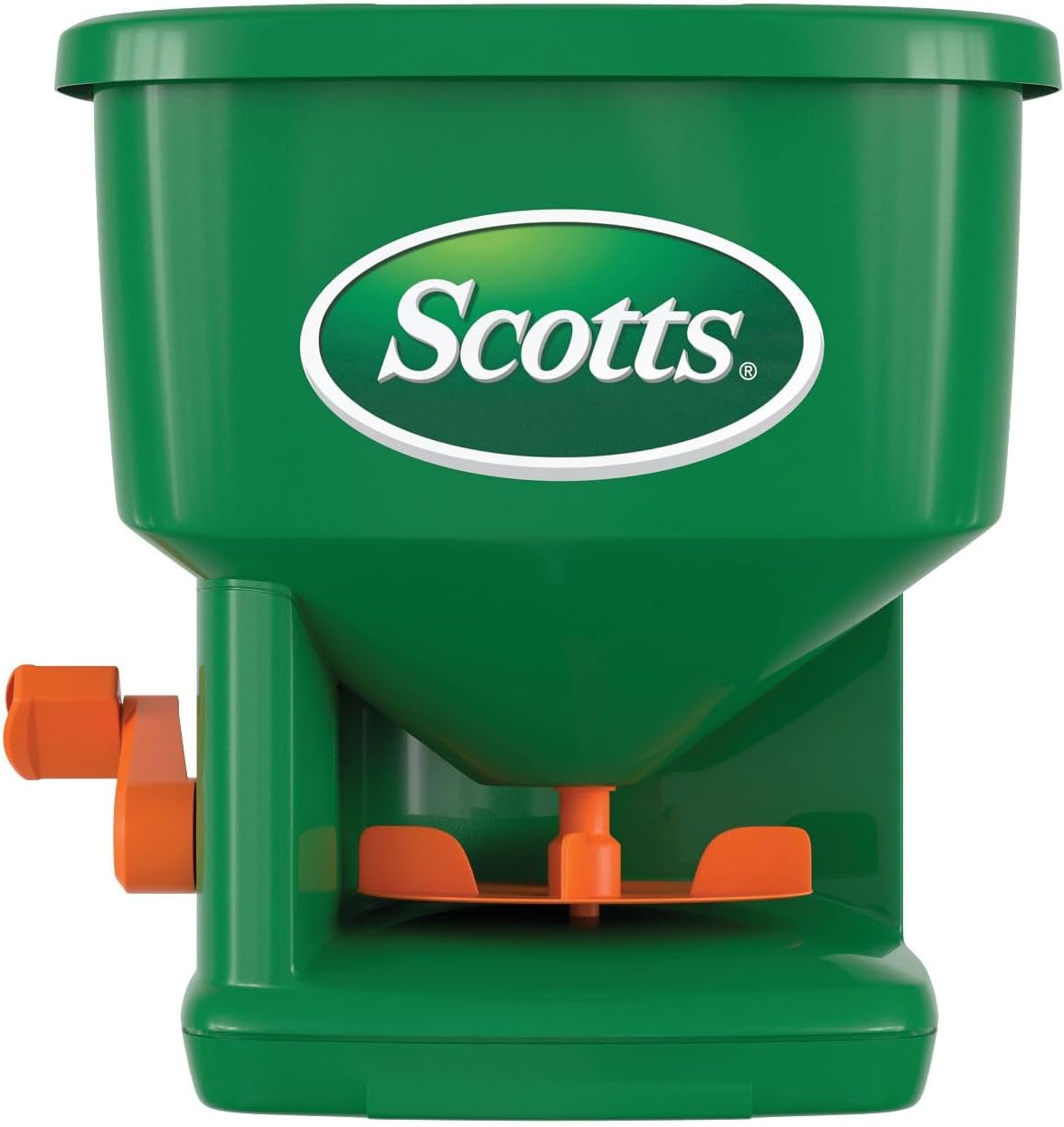
- Seeds, fertilizes, salts and spreads ice melt year-round
- Adjustable arm support for comfort
- Holds up to 1,500 sq. ft. of Scotts lawn products
Cons
- Hand-cranked, so you supply the power
- Small hopper means refills on a large garden
- Coverage figures are based on Scotts products
While ideal for small yards, larger areas will require multiple refills. The spreader holds enough product to cover about 1,500 square feet, which is perfect for most urban or suburban lots. Its versatility makes it a true Swiss Army knife for your garden.
Best electric option
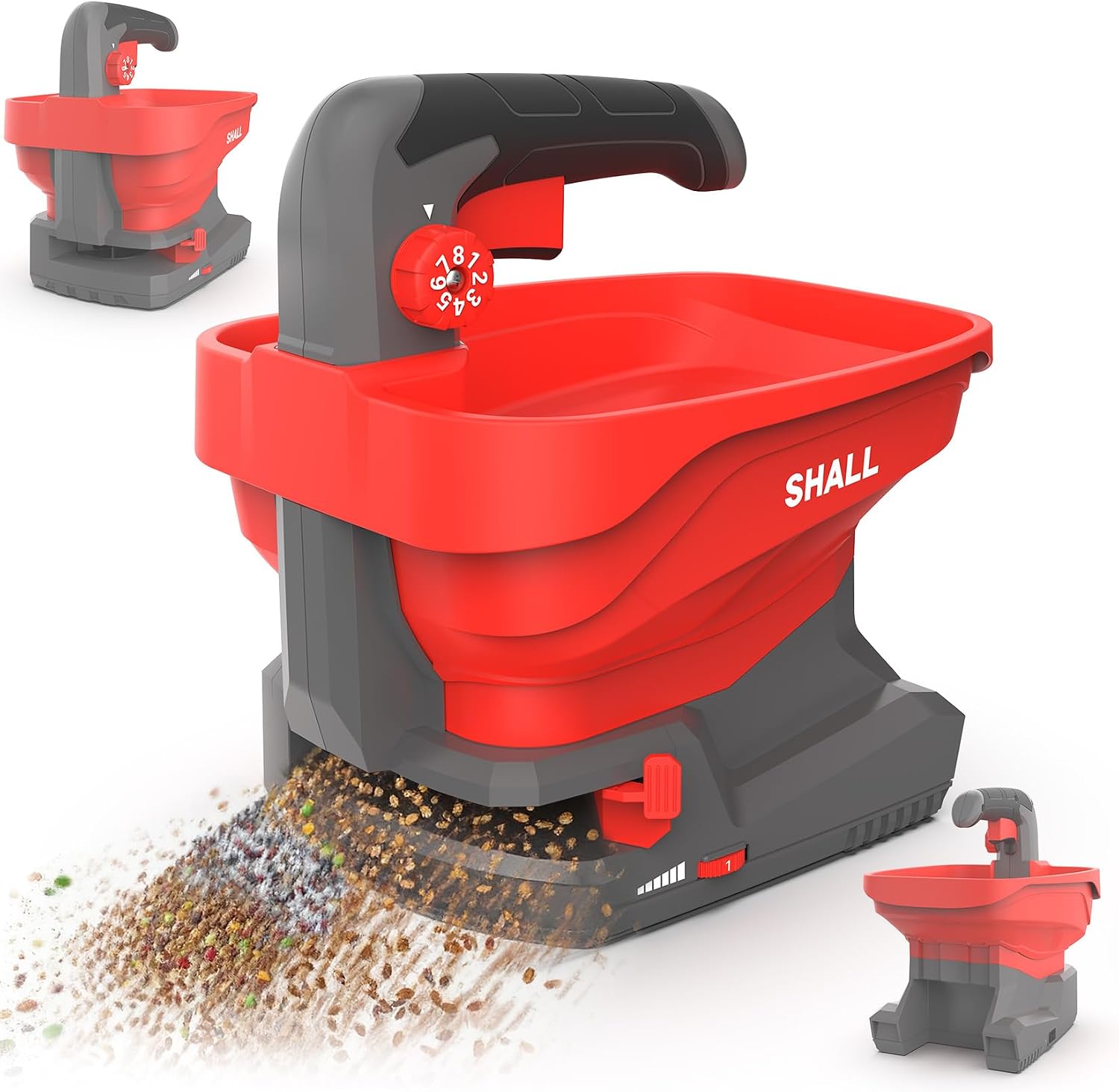
- 8 flow settings and 6 spread angles from 0° to 127°
- 3.3 L hopper covers up to about 6,450 sq. ft. of grass seed
- 2.0Ah battery drives the spinner at 900–2,200 rpm
Cons
- Not waterproof—store it dry
- Seeds can jam under the dispersing wheel
- Works best with a 30W or larger charging adapter
Its settings run from fine grass seed (levels 1–3) through fertilizer (4–6) to heavy rock salt (7–8). The maker warns that seeds stuck under the wheel can cause a blockage, so clear jams with a tool rather than forcing the width paddle. If this is what you’re looking for, you won’t find a better match.
Best compact option

- 5 lb. hopper with a contoured lip for quick scoop-and-fill
- Adjustable flow gate; spreads material up to 5 ft.
- Heavy-duty poly hopper with enclosed gears and steel-plated hardware
Cons
- Small capacity means frequent refills on a large garden
- Hand-cranked, so you supply the power
- 5 ft. maximum spread width
The Brinly HHS3-5BH handheld spreader is a compact tool that’s perfect for small gardening jobs. Its ultra-dense hopper, enclosed gears and steel-plated hardware are built to take abuse, and Brinly-Hardy has made lawn and garden products since 1839.
Buying Guide
When selecting an automatic fertilizer spreader for a large garden, we recommend considering several key factors.
Capacity
Look for a spreader with a large hopper capacity, typically 50 pounds or more. This reduces refill frequency and saves time.
Spread Width
Choose a model with an adjustable spread width. Wider spreads cover more ground quickly, while narrower settings allow precise application.
Wheels and Maneuverability
Opt for sturdy, large wheels that can handle uneven terrain. Pneumatic tires offer better shock absorption and traction.
Material Quality
Rust-resistant materials like stainless steel or powder-coated metal extend the spreader’s lifespan.
Flow Control
A precise flow control mechanism ensures even distribution and prevents over-fertilization.
Ease of Use
Look for user-friendly features such as:
- Simple assembly
- Clear calibration instructions
- Easy-to-clean design
Additional Features
Consider extras that enhance functionality:
- Edge guards for boundary spreading
- Rain covers to protect fertilizer
- Deflector kits for directional control
By prioritizing these features, we can select a spreader that offers efficiency, durability, and ease of use for large garden maintenance.
We have a big lawn and spreading by hand is exhausting, so even coverage from an automatic spreader sounds appealing.
Avoiding over-fertilizing is my main worry with a big lawn, so I’m glad the article mentions it.
Thanks Ed! Let us know how it goes. -Plant Native Team