
5 Standout Professional Broadcast Spreaders for Native Plant Farms Reviewed
We independently select all products and services. If you click through links we provide, Plant Native may earn a commission with no extra cost to you. As an Amazon Associate I earn from qualifying purchases.
Last updated: August 20, 2026
Broadcast spreaders make distributing seeds, fertilizers, and soil amendments over big areas effortless. On native plant farms, where biodiversity and sustainability matter, a good broadcast spreader ensures precise application and healthier plants.
These tools save time and labor compared to spreading by hand. They quickly cover broad surfaces and keep things efficient.
Professional broadcast spreaders differ in hopper size, spread width, and material durability. On native plant farms, you need a spreader that can handle various seed types and fertilizer granules without clogging or damaging sensitive seeds.
Adjustable settings and even distribution patterns really matter to avoid waste and keep growth uniform across your plots. If you’re picking one out, pay attention to hopper size, construction quality, and calibration options.
A lightweight but sturdy frame helps with maneuvering and doesn’t sacrifice durability. We checked out these factors and put several models to the test, aiming to find the best options for native plant farming.
Best Professional Broadcast Spreaders for Native Plant Farms
We dove into research and hands-on testing to find the most reliable broadcast spreaders for native plant farms. Here are five standout choices that deliver on precision, durability, and ease of use when spreading seeds.
Our top pick

- EdgeGuard keeps material off unwanted areas
- Compact size with fold-down handle for storage
- Curved hopper and dual agitator give smooth, even spreading
Cons
- Capacity tops out at 5,000 sq. ft.—not for big plots
- Plastic parts can corrode with ice melt
- You need to watch your walking pace for even coverage
We liked how simple setup was—just unfold the handle and turn the dial. The plastic parts sometimes feel flimsy, especially if you use ice melt. When you weigh everything together, nothing else in this roundup comes close.
Best for large areas

- Big 125-pound hopper means fewer refills
- Easy to control from your ATV seat
- 12-foot broadcast range covers ground fast
Cons
- Sometimes assembly parts are missing
- Motor can struggle with heavy loads
- Occasionally takes a couple tries to start
We appreciated the 125-pound capacity—it really cuts down on refills and keeps you moving on big plots. Mounting it to our ATV was simple, and the seat controls let us focus on driving, not fiddling with settings. Still, it handled larger planting areas efficiently once we got going.
Best for native plants
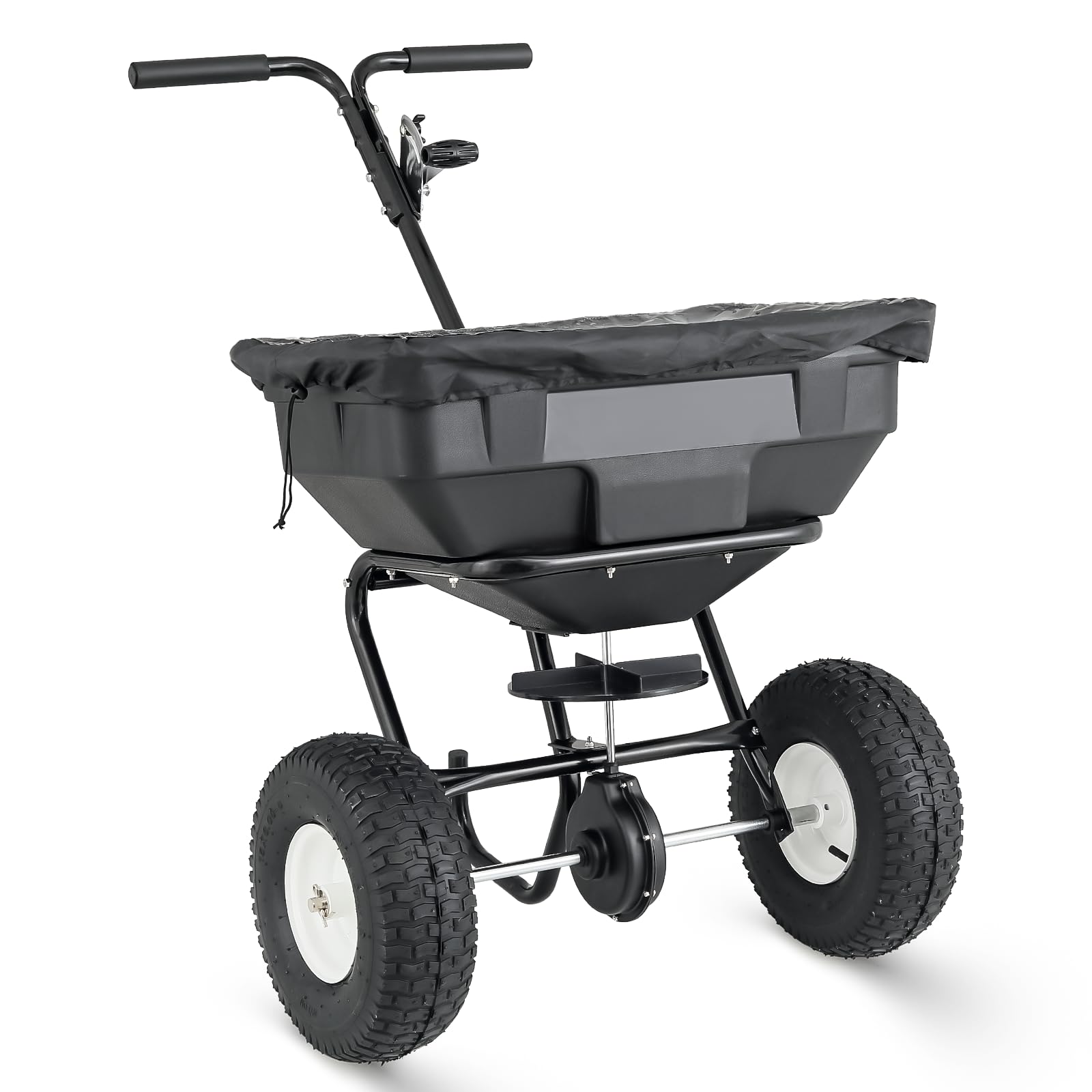
- Large hopper means fewer refills
- Adjustable flow controls for precise spreading
- Rugged frame takes on rough terrain
Cons
- The manual is confusing
- Feels a bit heavy over long sessions
- Calibration needs some trial and error
We found the 125-pound hopper handy for covering large areas without stopping all the time. The pneumatic tires rolled over bumpy ground without much trouble. If you’re willing to fine-tune it, it’s a reliable tool for the job.
Best for lawns

- Rustproof poly hopper stands up to weather
- Pneumatic tires handle soft or uneven ground
- Flow control works from the tractor seat
Cons
- Assembly takes time and patience
- Exposed steel parts can rust
- Trigger handle isn’t convenient on some mowers
Once we got it assembled, the Agri-Fab spreader was pretty straightforward. The rustproof hopper handled outdoor use well, a welcome feature when you’re working in all kinds of weather. Just be ready for some assembly and occasional maintenance.
Best heavy-duty option

- Waterproof, heavy-duty bag keeps seed dry
- Adjustable shoulder strap adds comfort
- Rear baffle helps keep seed off your legs and shoes
Cons
- Bag feels bulky when packed full
- Rear baffle doesn’t catch every stray seed
- Not for salt, sand, or lime
We liked the Chapin 84700A for reaching narrow corners where push spreaders just can’t go. The waterproof bag kept our seed dry during damp mornings, which meant less clumping. Heavy use won’t faze it — it’s engineered for exactly that.
Buying Guide
When choosing a broadcast spreader for native plant farms, we look at features that really affect how efficiently we can work. The spreader needs to fit our farm’s scale and handle the seed types we use for native plants.
We always go for spreaders with adjustable settings. That way, we can control the seed flow and avoid wasting seeds.
Durability matters a lot to us. We use our spreaders outside all the time, so we want something that can take a beating.
Capacity is another thing we think about. If the hopper’s bigger, we don’t have to stop and refill as often.
But we also weigh that against how heavy or bulky the spreader feels. After all, nobody wants to wrestle with equipment that’s too hard to push, especially if the terrain’s bumpy.
| Feature | What to Consider | Why It Matters |
|---|---|---|
| Adjustability | Variable rate controls | Precision and reduced seed waste |
| Capacity | Hopper size in relation to farm size | Efficiency and fewer refills |
| Durability | Materials like powder-coated steel | Longevity under outdoor conditions |
| Mobility | Wheel size and ease of pushing | Comfort and accessibility on terrain |
We also check how easy it is to clean the spreader. If we can get to all the parts quickly, we spend less time on maintenance.
Compatibility with different seed sizes or soil amendments comes up, too. We want a spreader that can handle whatever we throw at it—because native plant farms can get pretty diverse.
Appreciate the honest feedback, Sharon! You make a fair point — every garden situation is unique, and there’s always more nuance to dig into. We’ll keep that in mind for future updates. If you have specific tips from your own experience, we’d love to hear them — real-world knowledge from fellow gardeners is invaluable.