5 Top-Rated Advanced Field Roller for Professional Gardeners – Expert Reviews and Buying Guide
We independently select all products and services. If you click through links we provide, Plant Native may earn a commission with no extra cost to you.
Last updated: November 7, 2026
Field rollers are key for professional gardeners and landscapers. They compact soil, break up clumps, and help create a smooth, firm surface.
You’ll find them handy for prepping seedbeds and improving soil-to-seed contact. They’re also great for keeping outdoor areas even, especially in bigger spaces.
People use field rollers for all sorts of jobs—from turf care to farming. Consistent soil firmness can make a difference, whether you’re growing plants or running machinery.
Advanced field rollers offer features like adjustable weight and durable materials. They’re built for heavy-duty, frequent use and tend to be easier to handle than basic models.
You’ll notice these rollers are designed for different soil types and field conditions. The right choice can really boost both efficiency and how long your gear lasts.
If you’re picking out a field roller, think about weight, size, and what it’s made of—steel or poly are common. Make sure it works with your garden tractor or towing equipment.
Weight affects soil compaction depth, and size changes how much ground you can cover at once. Durability and easy maintenance matter too, especially if you’re using it a lot.
We tried out several advanced field rollers to find the five best for professionals who want something reliable and tough.
Top-Rated Advanced Field Rollers for Professional Gardeners
We picked out the best advanced field rollers that mix durability with efficiency. These are made to give you even soil compaction and better field conditions.
Our top pick

- Can be pushed manually or towed behind a tractor
- Durable polyethylene drum that resists rust and dents
- Convenient tethered plug for quick filling and emptying
Cons
- Assembly takes some mechanical skill and patience
- Check the handle bolts periodically so the handle stays snug
- Gets heavy when filled, so manual pushing isn’t for everyone
Per the listing, the 18 x 24 inch poly drum holds up to 28 gallons (about 270 lbs.) of water or sand, light enough to push and easy to maneuver in tight spots and rugged enough to tow behind a garden tractor for open areas. The drum won’t dent or rust, an extra-large fill opening takes a garden hose, and the Easy-Turn plug stays tethered to the drum so it doesn’t get lost between fills. Once full, pushing by hand takes real effort, so towing is the better option for big jobs.
Best runner-up

- Durable stainless steel with rust resistance
- Adjustable handle length for comfort
- Quick, tool-free assembly
Cons
- 17-inch head covers ground slowly on large lawns
- Lighter head can ride up on big piles of material
- Handle can flex when pushing hard
Per the listing, this 17 x 10 inch leveling rake has a stainless-steel head with an aluminum alloy roller-enhanced base that helps it glide and spread material evenly, and the integrated base and connector assemble without tools. The handle adjusts in length, and JouZYA also sells 30-inch and 40-inch heads for bigger yards. It suits topdressing and moderate leveling jobs rather than moving large volumes of soil.
Best budget option

- Sturdy steel build with reinforced spikes
- Adjustable, ergonomic handle
- You can fill it with sand or stones for deeper penetration
Cons
- Needs a pre-moistened lawn for best results
- Roller size limits weight, so it struggles on very hard soil
- Takes effort to push, not ideal for big areas
Per the listing, the Walensee aerator rolls 42 steel spikes set in a spiral pattern, which keeps it rolling smoothly instead of bouncing, and the drum can be filled with sand or stones for deeper penetration. The four-part handle adjusts in height and has a non-slip ergonomic rubber grip. It fits small to medium lawns best; for very dry, hard ground or large areas, a powered aerator is the better tool.
Best premium choice
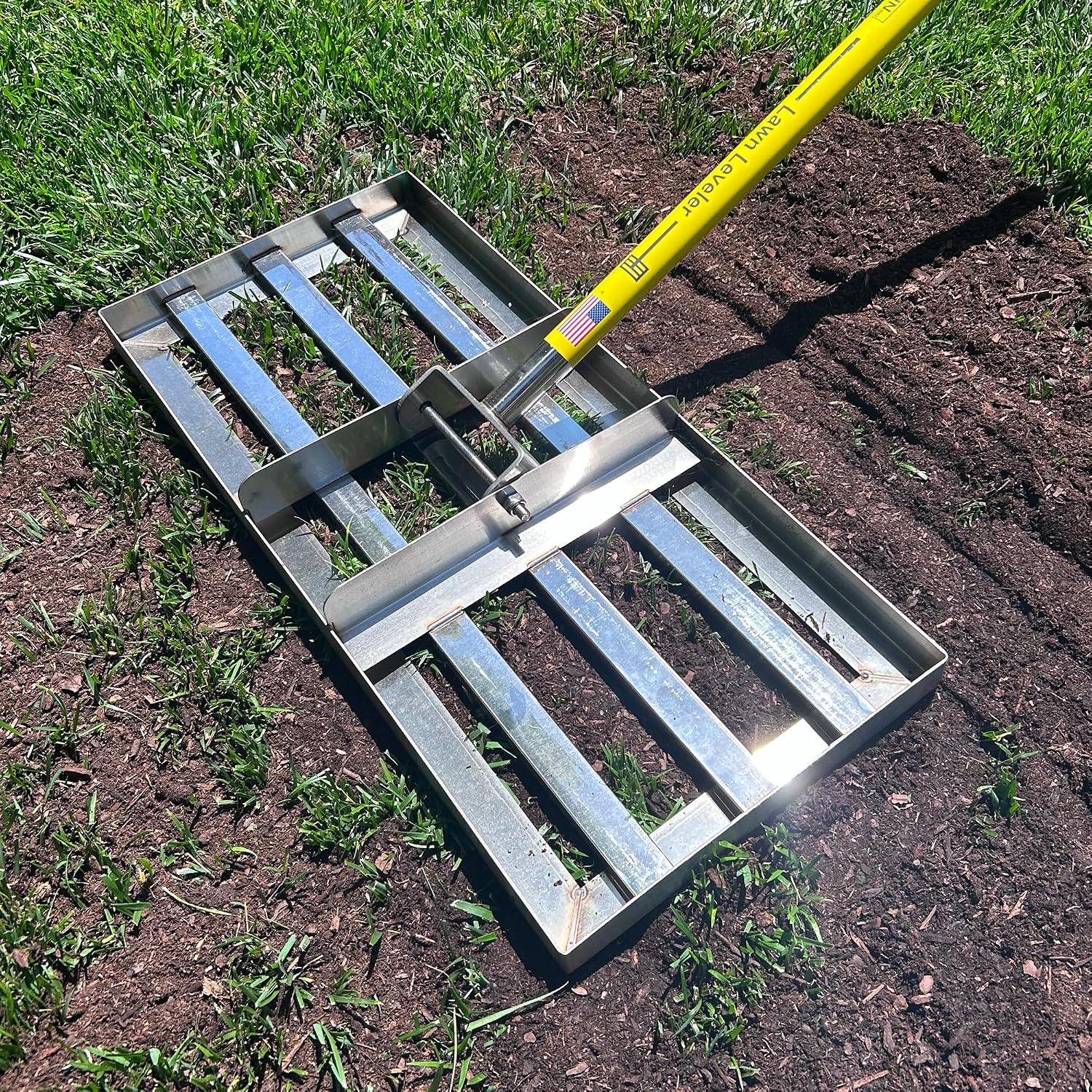
- 304 stainless steel head and handle resist rust and bending
- Center-mounted plate stays flat against the ground instead of flipping
- Long 78″ handle lets you work standing upright
Cons
- 22″ width covers ground slower than wider leveling rakes on large lawns
- Best suited to sand, compost and topsoil rather than heavy clay clumps
- Priced higher than basic powder-coated leveling rakes
The Rocklin 22″ rake is built for smaller yards and detail work: filling low spots before reseeding, smoothing topsoil around new sod edges and spreading compost along borders.
Both the head and the 78-inch handle are 304 stainless steel, and the center-mounted plate is designed to skim the surface while material settles into low spots.
Rocklin also makes 30″ and 48″ versions for open areas; this compact size pairs well with them for edges, beds and tight corners. It comes with a 12-month warranty.
Also great

- Holds up to 400 lbs of sand or water
- Heavy-duty steel frame keeps it stable and level
- Extended hook fits common tractors and ATVs; hangs up for storage
Cons
- Tow-behind only, so you need a tractor or ATV
- Light lawn tractors may struggle once it is filled
- Only about 90 ratings so far
Per the listing, the LLDPE drum holds up to 400 lbs of sand or water to press seed into the soil, and two water inlets with sealed plugs let you fill one or both sides to adjust weight. A heavy-duty steel frame keeps it balanced, the rounded drum edges help avoid scarring turf, and a metal scraper bar clears built-up soil. Match it to a tow vehicle that can handle the filled weight.
Honestly, it makes sense to focus on features that match our actual gardening habits. Picking a roller that fits what we do just feels more practical—and probably saves some headaches down the road.
Buying Guide
If you’re picking an advanced field roller, a few things matter more than others. First up, the roller type—solid, water-filled, or segmented—all have different perks depending on how much soil compaction you need.
The material makes a big difference too. Steel is strong but heavy, while plastic or composite rollers are lighter and won’t rust as easily.
Think about size and width. Bigger rollers cover more ground but can be a pain in small or awkward spaces.
Weight is key for soil compression. Some rollers let you add water or sand, so you can dial in the pressure for different jobs.
Lastly, check for attachment compatibility if you’re using a tractor or other equipment. Make sure the roller matches your hitch size and type.
Feature Comparison
| Feature | What to Look For | Impact |
|---|---|---|
| Roller Type | Solid, water-filled, segmented | Weight control and soil type |
| Material | Steel, plastic, composite | Durability and rust resistance |
| Size & Width | Based on field size | Efficiency and maneuverability |
| Weight | Fixed or adjustable | Soil compaction strength |
| Attachment Type | Hitch compatibility | Ease of use with equipment |
Honestly, it makes sense to focus on features that match our actual gardening habits. Picking a roller that fits what we do just feels more practical—and probably saves some headaches down the road.
We independently select all products and services. If you click through links we provide, Plant Native may earn a commission with no extra cost to you. As an Amazon Associate I earn from qualifying purchases.