Bitternut Hickory (Carya cordiformis)
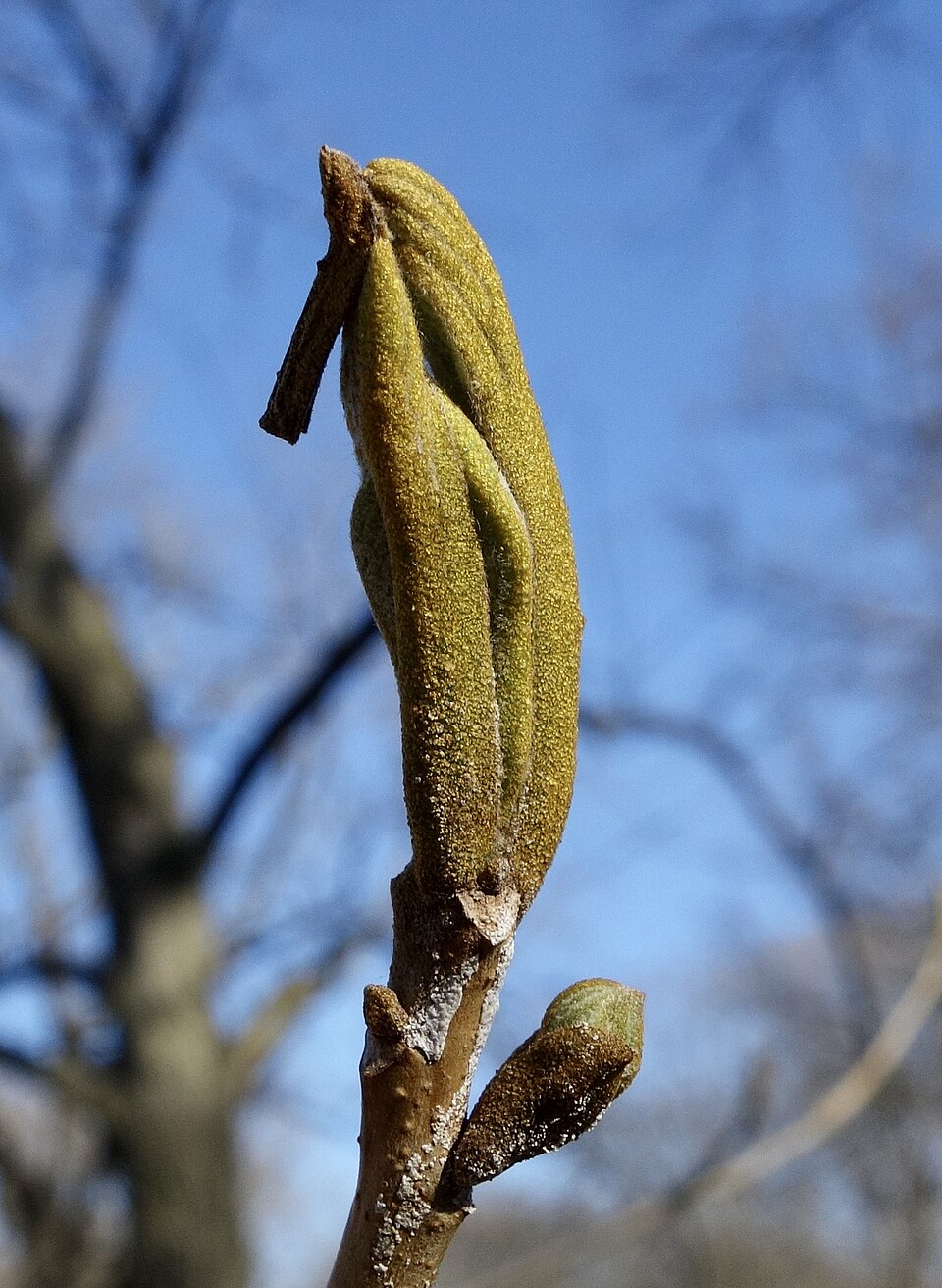
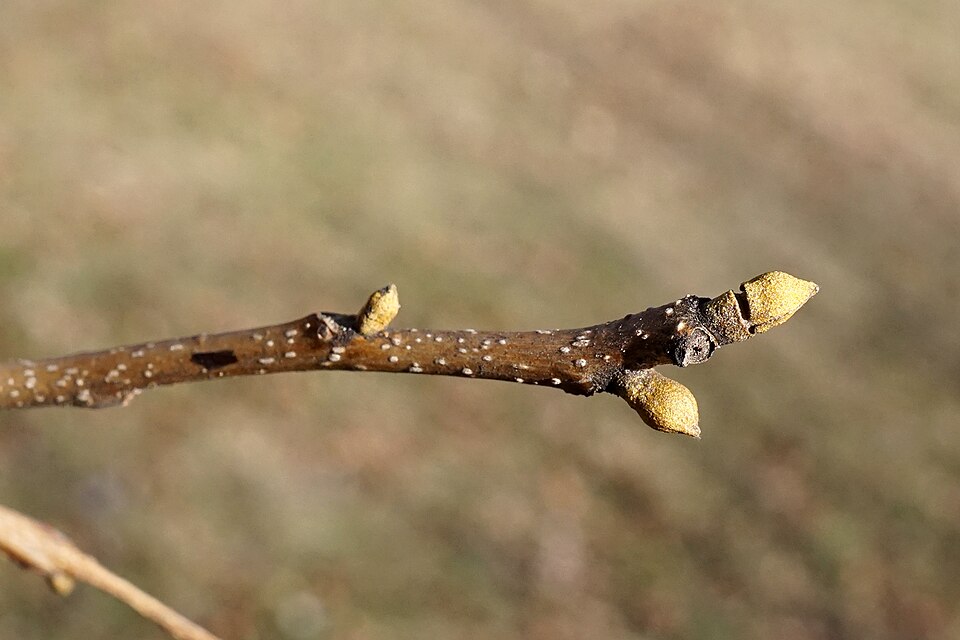
Carya cordiformis, commonly known as Bitternut Hickory or Swamp Hickory, is a fast-growing native deciduous tree that stands out among North America’s hickories for its distinctive bright yellow winter buds and heart-shaped nuts. This member of the Juglandaceae (walnut) family derives its species name “cordiformis” from the heart-shaped appearance of its nuts, while the common name reflects the bitter taste of the nut meat, which makes it less palatable to humans but still valuable to wildlife.
Native to much of eastern North America from southern Canada to the Gulf of Mexico, Bitternut Hickory demonstrates remarkable adaptability to diverse growing conditions, from wet bottomlands and swamp edges to well-drained upland sites. It’s the most moisture-tolerant of all hickories and often the fastest-growing, making it an excellent choice for restoration projects and naturalistic landscapes where rapid establishment is desired.
Beyond its ecological importance as a source of nuts for wildlife and lumber for human use, Bitternut Hickory offers outstanding ornamental qualities. Its graceful compound leaves create an elegant canopy that turns brilliant golden-yellow in fall, while its relatively rapid growth rate makes it one of the more practical hickory species for landscaping. The tree’s tolerance for wet soils and periodic flooding also makes it valuable for rain gardens and riparian restoration projects.
Identification
Bitternut Hickory typically grows as a large deciduous tree reaching 50 to 70 feet tall, occasionally up to 100 feet in optimal conditions, with a trunk diameter of 18 to 24 inches. The crown is typically narrow and oblong when young, becoming more rounded and open with age. It’s distinguished from other hickories primarily by its bright yellow winter buds — a unique identifying feature among North American trees.
Bark
The bark on young trees is smooth and gray, developing shallow furrows and a somewhat scaly texture with age. Mature bark becomes light gray to brownish-gray with narrow, shallow ridges and furrows that form a distinctive interwoven pattern. Unlike some hickories, the bark doesn’t develop the deep, prominent plates or “shaggy” appearance of species like Shagbark Hickory, remaining relatively tight to the trunk even on older specimens.
Leaves
The leaves are pinnately compound, 6 to 12 inches long, typically with 7 to 9 leaflets (occasionally 5 or 11). The leaflets are lanceolate to oblong-lanceolate, 3 to 6 inches long and 1 to 2 inches wide, with serrate margins and pointed tips. The terminal leaflet is usually the largest, while the basal leaflets are smallest. The upper surface is dark green and somewhat glossy, while the underside is paler and may have fine hairs along the veins. In fall, the foliage turns a beautiful clear golden-yellow, creating spectacular autumn color.
Flowers & Fruit
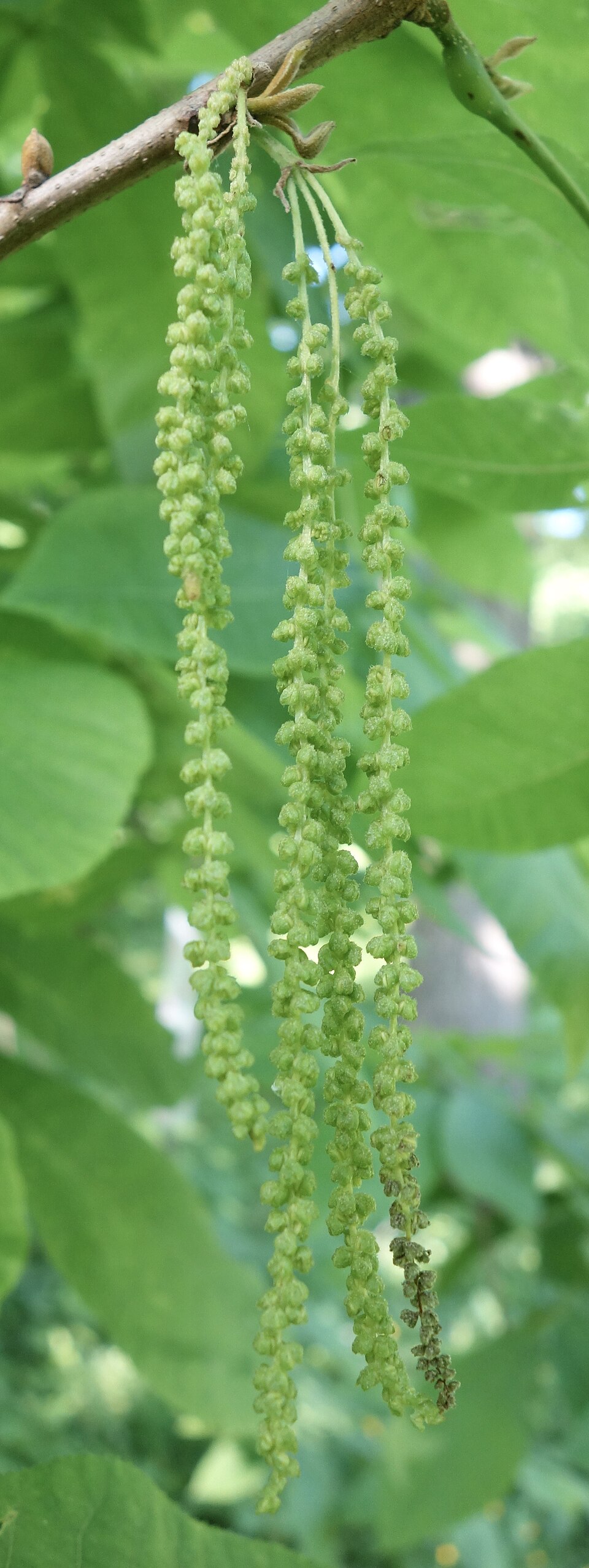
Bitternut Hickory is monoecious, producing both male and female flowers on the same tree. The male flowers appear in drooping catkins 3 to 4 inches long, usually in clusters of three, emerging in spring before or with the leaves. The female flowers are small, inconspicuous, and borne in short spikes at the tips of new growth. The trees are wind-pollinated and typically begin producing nuts around 20-25 years of age.
The fruit is a nut enclosed in a thin, four-valved husk that splits only partway to the base when mature. The husk is yellow-green and covered with tiny golden scales. The nut inside is distinctly heart-shaped (hence “cordiformis”), thin-shelled, and about 1 inch long. The kernel is extremely bitter, earning the tree its common name, but is consumed by various wildlife species.
Quick Facts
| Scientific Name | Carya cordiformis |
| Family | Juglandaceae (Walnut) |
| Plant Type | Deciduous Tree |
| Mature Height | 50–70 ft |
| Sun Exposure | Full Sun to Part Shade |
| Water Needs | Moderate |
| Bloom Time | April – May |
| Flower Color | Yellowish-green catkins |
| USDA Hardiness Zones | 4–9 |
Native Range
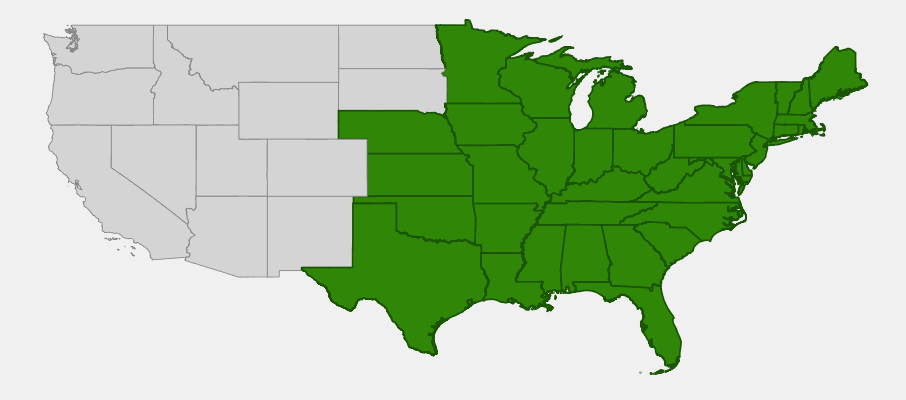
Bitternut Hickory has one of the most extensive native ranges of any hickory, naturally occurring from southern Ontario and Quebec south to northern Florida and eastern Texas, and from the Atlantic coast west to southeastern Minnesota, eastern Kansas, and eastern Oklahoma. This broad distribution reflects the species’ exceptional adaptability to diverse climates and growing conditions across eastern North America.
The species is particularly abundant in the Mississippi River valley and throughout the Great Lakes region, where it often grows in bottomland forests, floodplains, and along stream corridors. Unlike many hickories that prefer well-drained upland sites, Bitternut Hickory thrives in areas with seasonal flooding and high water tables, making it the most moisture-tolerant member of its genus.
Bitternut Hickory’s extensive range and habitat flexibility have allowed it to remain common and stable throughout most of its native territory. It’s considered a characteristic species of eastern deciduous forests and plays important ecological roles in forest succession, particularly in areas recovering from disturbance or along riparian corridors where its flood tolerance gives it competitive advantages over other tree species.
📋 Regional plant lists featuring Bitternut Hickory: North Carolina & South Carolina
Growing & Care Guide
Bitternut Hickory is one of the more adaptable and faster-growing native hickories, making it an excellent choice for restoration projects and naturalistic landscapes where a large shade tree is desired relatively quickly.
Light
This hickory performs best in full sun but tolerates partial shade, especially when young. In full sun, trees develop a denser crown and faster growth rate, while partially shaded specimens may become more open and tall as they reach for light. Young trees are particularly shade-tolerant, often growing in forest understories before eventually reaching the canopy.
Soil & Water
Bitternut Hickory is remarkably adaptable to soil conditions, thriving in everything from well-drained upland sites to seasonally flooded bottomlands. It prefers deep, fertile, moist soils but adapts to clay, loam, and sandy soils with varying drainage. The species is notably flood-tolerant, withstanding several weeks of standing water — unusual among hickories. It prefers slightly acidic to neutral pH (6.0-7.5) but adapts to a broader range. Once established, mature trees show good drought tolerance, though growth is faster with consistent moisture.
Planting Tips
Plant in fall or early spring from nursery stock, as hickories can be challenging to transplant due to their deep taproot. Choose a site with plenty of space for the mature tree — at least 40-50 feet from structures. The taproot makes container plants preferable to bare-root specimens. Water thoroughly after planting and maintain consistent moisture through the first 2-3 growing seasons while the extensive root system establishes.
Pruning & Maintenance
Bitternut Hickory requires minimal pruning once established. Remove dead, damaged, or crossing branches in late winter while dormant. Young trees may need light pruning to develop good structure, but mature trees rarely need intervention. The species is generally pest and disease resistant, though it may occasionally be affected by hickory bark beetles or various leaf spots during particularly wet seasons.
Landscape Uses
This versatile native tree excels in several landscape applications:
- Large shade tree — excellent for parks, large properties, and naturalized areas
- Riparian restoration — flood tolerance makes it ideal for stream corridors
- Wildlife habitat — nuts feed many species, leaves host butterfly caterpillars
- Rain gardens — handles both wet and dry periods well
- Reforestation projects — rapid growth and adaptability
- Windbreaks — when used in mixed native tree plantings
- Autumn color — reliable golden-yellow fall display
Wildlife & Ecological Value
Bitternut Hickory provides exceptional wildlife value throughout the year, supporting diverse food webs and serving as a keystone species in many forest ecosystems.
For Birds
Despite the bitter taste that deters human consumption, Bitternut Hickory nuts are eaten by numerous bird species including Pileated Woodpeckers, Red-bellied Woodpeckers, Blue Jays, Wild Turkeys, Wood Ducks, and various nuthatches and chickadees. The nuts are particularly important for wildlife because they’re produced more consistently than many other hickory species. Large trees provide excellent nesting cavities when they develop hollows, supporting cavity-nesting birds like Wood Ducks, various owl species, and woodpeckers.
For Mammals
Squirrels, chipmunks, and mice are major consumers of Bitternut Hickory nuts, often caching them for winter food supplies. White-tailed deer browse young shoots and leaves, while beavers occasionally cut down small trees for food and dam construction in riparian areas. Black bears may consume the nuts when available, and various small mammals shelter in the cavities that develop in older trees.
For Pollinators
While wind-pollinated, the male catkins provide pollen that’s collected by some native bee species for protein. More importantly, the leaves serve as host plants for several butterfly and moth species, including the Hickory Tussock Moth, Luna Moth, and various oak and hickory-feeding species. These caterpillars in turn support insectivorous birds during critical breeding seasons.
Ecosystem Role
Bitternut Hickory plays crucial ecological roles in forest succession and stability. Its flood tolerance makes it a pioneer species in bottomland areas, helping to stabilize soils and create conditions for other forest species to establish. The deep taproot mines nutrients from subsoil layers and brings them to the surface through leaf fall, enriching the forest floor. As one of the more rapidly growing hickories, it helps fill canopy gaps more quickly than slower species, maintaining forest cover and wildlife habitat during succession.
Cultural & Historical Uses
Throughout its extensive range, Bitternut Hickory has played important but somewhat limited roles in human cultures compared to other hickory species. Indigenous peoples across eastern North America recognized the tree but generally avoided the extremely bitter nuts, though they found other uses for the plant. Some tribes used the inner bark medicinally and crafted tools from the strong, flexible wood, particularly for handles that needed to absorb shock without breaking.
The bitter taste of the nuts, while deterring human consumption, was occasionally turned to advantage. Some Indigenous groups used powdered Bitternut Hickory kernel as a fish poison in small ponds and streams — a practice that temporarily stunned fish without permanently harming the ecosystem. The bright yellow winter buds were sometimes used as a natural dye, producing subtle golden colors for basketry materials and textiles.
European settlers quickly learned to distinguish Bitternut from the sweet-kerneled hickories, but found valuable uses for its wood. The timber shares the strength and shock-absorption qualities of other hickories, making it excellent for tool handles, wagon wheels, and agricultural implements. It was commonly used for axe handles, where its ability to absorb impact without splitting was crucial for both effectiveness and safety.
In modern times, Bitternut Hickory wood continues to be valued in specialized applications. It’s used for drumsticks, sporting goods, and ladder rungs where strength and flexibility are required. The wood burns hot and clean, making it excellent for smoking meats and providing high-quality firewood. However, the species is perhaps most valued today for its ecological benefits and its role in reforestation and habitat restoration projects across its extensive range.
Frequently Asked Questions
Why are the nuts so bitter, and can they be processed to remove the bitterness?
The bitter compounds in Bitternut Hickory nuts are natural chemical defenses that have evolved to deter overconsumption. Unlike the tannins in acorns that can be leached out, the bitter alkaloids in these nuts are difficult to remove and the nuts remain largely inedible to humans even after processing.
How can I tell Bitternut Hickory apart from other hickories?
The bright yellow winter buds are the most distinctive feature — no other hickory or common eastern tree has such prominently yellow buds. The heart-shaped nuts and the tree’s tolerance for wet soils are also identifying characteristics.
How fast does Bitternut Hickory grow?
This is the fastest-growing hickory, typically adding 12-18 inches per year in favorable conditions. Young trees can grow even faster — up to 2-3 feet annually — making it one of the more practical hickory species for landscaping where fairly quick results are desired.
Will Bitternut Hickory survive in wet areas where other trees struggle?
Yes, this is the most flood-tolerant hickory and can handle standing water for several weeks. It’s an excellent choice for rain gardens, pond edges, and areas with seasonal flooding or poor drainage where many other large trees would fail.
Do the nuts attract unwanted wildlife?
The nuts primarily attract native wildlife like squirrels, which is generally considered beneficial for biodiversity. While deer may browse young trees, this rarely causes significant damage and can actually improve the tree’s form by encouraging fuller branching.

Looking for a nursery that carries Bitternut Hickory?
Browse our native plant nursery directory: North Carolina · South Carolina