
Prairie Cordgrass (Spartina pectinata)
Spartina pectinata, commonly known as Prairie Cordgrass, Sloughgrass, or Freshwater Cordgrass, is a robust native perennial grass that serves as one of North America’s premier species for erosion control, wildlife habitat, and wetland restoration. This impressive grass can reach heights of 5 to 6 feet or more, forming dense, spreading colonies that provide exceptional habitat value while offering practical solutions for challenging wet sites where other plants struggle to establish.
Distinguished by its tall, arching stems and distinctive seed heads, Prairie Cordgrass once dominated millions of acres of prairie potholes, wet meadows, and marsh edges throughout the Great Plains and upper Midwest. The species derives its name from the cord-like appearance of its tough, fibrous leaves, which Indigenous peoples and early settlers used for thatching, basket-making, and other traditional crafts—uses that continue in some regions today.
In modern landscapes, Prairie Cordgrass has emerged as an invaluable tool for ecological restoration and sustainable landscaping. Its exceptional ability to tolerate both flooding and periodic drought, combined with its aggressive root system that can stabilize soil and filter runoff, makes it particularly valuable for rain gardens, bioswales, constructed wetlands, and streambank restoration projects throughout its extensive native range.
Identification
Prairie Cordgrass is unmistakable when mature, forming tall, dense colonies with distinctively arching growth habit and prominent seed heads. The species exhibits the typical characteristics of the Spartina genus while being uniquely adapted to freshwater environments, unlike its coastal relatives.
Stems & Leaves
The culms (stems) are robust, typically growing 4 to 8 feet tall, with a characteristic tendency to arch outward, giving established colonies a distinctive fountain-like appearance. The stems are solid and round, with prominent nodes and internodes that are clearly visible. Leaves are linear and flat, measuring ½ to ¾ inches wide and up to 4 feet long, with sharp, serrated edges that can cut skin if handled carelessly—hence the alternative common name “ripgut.”
The leaf blades have a distinct blue-green color during the growing season, transitioning to golden-tan or bronze in fall and winter. The leaf sheaths are smooth and tightly wrapped around the stem, and the ligule is a distinctive fringe of short hairs rather than a membrane, which helps distinguish Prairie Cordgrass from other tall grasses.
Inflorescence & Seeds
The seed head (inflorescence) is the most distinctive feature of Prairie Cordgrass, appearing from July through September. It consists of 10 to 30 spike-like branches arranged alternately along the main stem, creating a distinctive comb-like or bottle-brush appearance. Each branch is 2 to 6 inches long and densely packed with small, individual spikelets that contain the seeds.
The seed heads emerge purple or bronze, gradually fading to golden-tan as they mature. Each spikelet contains a single seed (caryopsis) that is oval-shaped and about ¼ inch long. The seeds have a distinctive pectinate (comb-like) arrangement on the branches, which gives the species its specific epithet “pectinata.”
Root System
Prairie Cordgrass has one of the most extensive and aggressive root systems of any North American grass. The plant spreads through thick, scaly rhizomes that can extend 10 feet or more from the parent plant, allowing it to form dense, nearly monotypic stands. The fibrous root system can extend 8 feet deep, making it exceptionally effective for soil stabilization and erosion control. This extensive root system also makes established colonies very difficult to eradicate.
Quick Facts
| Scientific Name | Spartina pectinata |
| Family | Poaceae (Grass) |
| Plant Type | Perennial Grass |
| Mature Height | 5–6 ft |
| Sun Exposure | Full Sun |
| Water Needs | Moderate to High |
| Bloom Time | July – September |
| Seed Head Color | Purple to golden-tan |
| USDA Hardiness Zones | 4–9 |
Native Range
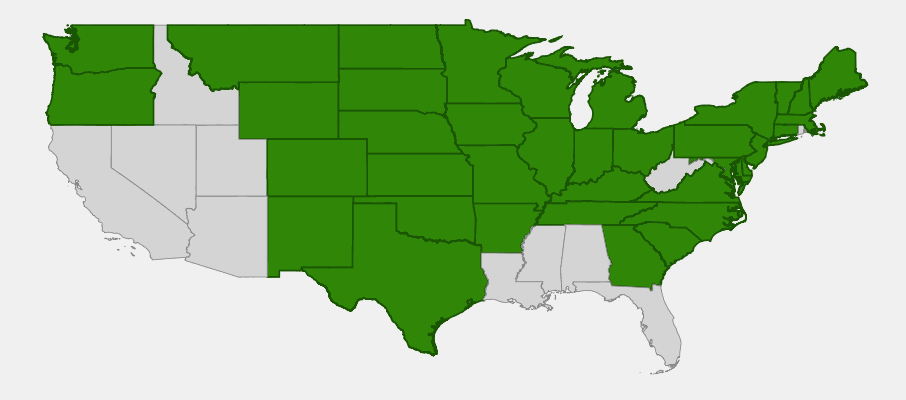
Prairie Cordgrass has one of the most extensive native ranges of any North American grass, originally occurring from southern Canada to the Gulf of Mexico and from the Atlantic coast to the Rocky Mountains. This enormous distribution reflects the species’ exceptional adaptability and its historical importance in several major North American ecosystems, particularly the Great Plains, tallgrass prairie, and Atlantic coastal plain regions.
The species reaches its greatest abundance and ecological significance in the prairie pothole region of the upper Midwest, where it once dominated millions of acres of wet prairie, sloughs, and marsh edges. In these areas, Prairie Cordgrass formed the foundation of one of North America’s most productive wildlife habitats, supporting countless waterfowl, mammals, and other wildlife species.
Throughout its range, Prairie Cordgrass typically occurs in areas with seasonally variable water levels—wet during spring and early summer, but often drying considerably by late summer and fall. This hydrology is crucial to the species’ ecology and helps explain its success in constructed wetlands and rain gardens that experience similar seasonal moisture patterns.
📋 Regional plant lists featuring Prairie Cordgrass: North Dakota, South Dakota & Western Minnesota
Growing & Care Guide
Prairie Cordgrass is one of the most low-maintenance native grasses once established, but its aggressive spreading habit requires careful site selection and management planning. Understanding its growth characteristics is essential for successful cultivation.
Light
Prairie Cordgrass requires full sun for optimal growth and seed production. It will tolerate partial shade but becomes less vigorous, produces fewer seed heads, and may be less effective for erosion control. In shaded conditions, the grass also tends to become more open and less dense, reducing its wildlife habitat value.
Soil & Water
This species is exceptionally adaptable to various soil types but performs best in heavy clay or clay-loam soils that retain moisture. It thrives in areas with seasonal flooding and can tolerate standing water for extended periods during spring and early summer. However, it also shows remarkable drought tolerance once established, making it suitable for areas with variable moisture conditions. Prairie Cordgrass tolerates alkaline soils better than most grasses and can grow in slightly saline conditions.
Planting Tips
Establish Prairie Cordgrass from seed in late fall or early spring, or from transplants in spring or early fall. Seeds require cold stratification, so fall seeding often produces better results. Plant seeds ¼ to ½ inch deep at a rate of 8-12 pounds per acre for pure stands. For erosion control plantings, consider mixing with other native grasses and forbs to create more diverse habitat. Be aware that this grass spreads aggressively—use root barriers or plan for long-term management if space is limited.
Pruning & Maintenance
Prairie Cordgrass requires annual cutting or burning to maintain vigor and prevent excessive thatch buildup. Cut or burn in late winter or early spring before new growth begins. The grass can be cut to 6-8 inches above ground level. Without regular management, dead material can accumulate and reduce the effectiveness of the planting. Established stands may require periodic thinning to prevent them from becoming monotypic.
Landscape Uses
Prairie Cordgrass is particularly valuable for functional landscaping applications:
- Erosion control — outstanding for streambanks and steep slopes
- Rain gardens and bioswales — excellent for stormwater management
- Constructed wetlands — helps filter nutrients and pollutants
- Wildlife habitat restoration — provides nesting cover and food
- Prairie restoration — essential component of wet prairie communities
- Buffer strips — creates transition zones between different habitats
- Phytoremediation — can help clean contaminated soils
Wildlife & Ecological Value
Prairie Cordgrass is one of North America’s most valuable native grasses for wildlife, providing critical habitat resources for dozens of species throughout its range.
For Birds
Prairie Cordgrass provides essential nesting habitat for numerous bird species, particularly waterfowl and marsh birds. Red-winged Blackbirds commonly build their nests in cordgrass stands, while Yellow Warblers and Marsh Wrens use the dense vegetation for both nesting and foraging. Waterfowl species including Blue-winged Teal, Mallards, and various diving ducks utilize cordgrass areas for nesting cover and brooding habitat. The seeds are consumed by numerous bird species, including various sparrows, finches, and game birds.
For Mammals
Muskrats frequently use Prairie Cordgrass for both food and nesting material, incorporating the tough leaves and rhizomes into their lodges and dens. White-tailed Deer browse the young shoots, while various small mammals including voles and shrews find shelter and foraging opportunities within the dense stands. The extensive root systems provide habitat for numerous soil-dwelling invertebrates that support larger wildlife food webs.
For Pollinators
While Prairie Cordgrass is wind-pollinated and doesn’t provide nectar, the diverse invertebrate communities that develop in cordgrass stands support many beneficial insects. The dense vegetation provides important overwintering habitat for native bees and other beneficial insects, while the seasonal flooding and drying cycles create habitat for various aquatic and semi-aquatic invertebrates.
Ecosystem Role
Prairie Cordgrass is a keystone species in wet prairie ecosystems, providing structural foundation for entire plant and animal communities. Its extensive root system helps build soil organic matter and improves soil structure, while its ability to tolerate both flooding and drought makes it crucial for ecosystem resilience. The species also plays an important role in nutrient cycling, taking up excess nitrogen and phosphorus from water and soil and helping prevent eutrophication in downstream water bodies.
Cultural & Historical Uses
Prairie Cordgrass has a rich history of traditional uses among Indigenous peoples throughout its range, with applications ranging from construction materials to food sources. The Dakota, Lakota, and other Plains tribes used the tough, durable leaves for thatching roofs and walls of earth lodges, creating weatherproof structures that could last for many years. The cord-like strength of the leaves, which gives the plant its common name, made them ideal for weaving baskets, mats, and other utilitarian items.
The seeds of Prairie Cordgrass were harvested and ground into meal by various tribal nations, providing an important carbohydrate source during late summer and fall. The young shoots were sometimes consumed as an emergency food source during times of scarcity, though they were not a preferred food due to their fibrous texture and mild flavor.
European settlers quickly recognized the value of Prairie Cordgrass for hay production, though its coarse texture made it less desirable than other prairie grasses. However, its reliability in wet areas where other hay crops failed made it valuable for livestock feed, particularly for winter fodder. The hay was typically cut in late summer after the seed heads had formed but before the plant became too woody.
In modern times, Prairie Cordgrass has found new importance in environmental restoration and sustainable agriculture. The U.S. Fish and Wildlife Service and various state agencies use it extensively in prairie pothole restoration projects, helping to recreate the wetland habitats that support millions of migrating waterfowl. The species is also increasingly used in constructed treatment wetlands for municipal and agricultural wastewater treatment, where its ability to absorb nutrients and tolerate fluctuating water levels makes it highly effective.
Contemporary artisans and craftspeople continue some traditional uses of Prairie Cordgrass, particularly basket-making and natural building techniques. The plant’s tough, durable fibers are valued for creating long-lasting, functional items that connect users with traditional ecological knowledge.
Frequently Asked Questions
Will Prairie Cordgrass take over my entire yard?
Prairie Cordgrass is an aggressive spreader and can quickly dominate areas where conditions are favorable. It’s best used in areas where you want extensive coverage or where you can install root barriers to contain its spread. Avoid planting it near other desirable plantings unless you’re prepared to manage its expansion through regular cutting or physical barriers.
How wet does the soil need to be for Prairie Cordgrass?
Prairie Cordgrass is very adaptable to moisture conditions. It thrives in seasonally wet soils and can tolerate standing water for weeks or months, but it also survives periodic drought once established. Ideal conditions include spring flooding or saturation followed by gradual drying through the summer, but it will grow in consistently moist soils as well.
When should I cut Prairie Cordgrass?
Cut Prairie Cordgrass annually in late winter or very early spring before new growth begins, typically in March or early April depending on your location. Cutting can be done with a brush cutter, sickle bar mower, or even a string trimmer for small areas. Leave 6-8 inches of stubble to protect the growing points.
Can Prairie Cordgrass be used for erosion control on steep slopes?
Yes, Prairie Cordgrass is excellent for erosion control, particularly on slopes that receive periodic moisture. Its deep, fibrous root system stabilizes soil very effectively. However, establishment on steep slopes can be challenging, so consider seeding with a temporary cover crop or using erosion control matting until the cordgrass becomes established.
Is Prairie Cordgrass good for wildlife food plots?
Prairie Cordgrass is excellent for wildlife habitat but is primarily valuable for cover and nesting rather than food. While some birds do eat the seeds, it’s not considered a high-value food plot species. It’s better used as part of a diverse habitat planting that includes other grasses and forbs that provide more wildlife food value.

Looking for a nursery that carries Prairie Cordgrass?
Browse our native plant nursery directory: North Dakota · South Dakota · Minnesota