
Green Ash (Fraxinus pennsylvanica)
Fraxinus pennsylvanica, commonly known as Green Ash, is one of North America’s most adaptable and widely distributed native deciduous trees. This hardy member of the olive family (Oleaceae) has earned its reputation as a “pioneer species” due to its exceptional ability to thrive in challenging conditions where many other trees fail. From prairie wetlands to urban sidewalks, Green Ash demonstrates remarkable resilience and rapid growth that has made it both an ecological cornerstone and a popular landscape tree throughout much of the central and eastern United States.
The common name “green ash” distinguishes it from its close relative, White Ash, by referencing the green color of the undersides of its compound leaves — though this distinction can be subtle and requires careful observation. More reliable identification comes from Green Ash’s preference for moist, low-lying areas and its superior tolerance of challenging soil conditions including clay, compacted soil, and periodic flooding. These characteristics have made Green Ash invaluable for riparian restoration, urban forestry, and naturalized landscaping in difficult sites.
Growing typically 50-75 feet tall with a rounded to oval crown, Green Ash offers excellent shade, attractive fall color ranging from clear yellow to rich golden-bronze, and exceptional adaptability to both drought and wet conditions once established. While the species has faced significant challenges from the invasive Emerald Ash Borer in recent decades, healthy populations persist across much of its range, and the tree remains an important choice for restoration work and sustainable landscaping, particularly when sourced from local, genetically diverse seed sources.
Identification
Green Ash is a medium to large deciduous tree that typically develops a straight trunk with an oval to rounded crown. Young trees often have a more upright, narrow form that broadens with age into the characteristic rounded canopy. The overall growth habit is generally more compact and symmetrical than the closely related White Ash.
Bark
The bark of young Green Ash is relatively smooth and light gray to brown. As trees mature, the bark develops shallow, diamond-shaped furrows with narrow, interlacing ridges that create a distinctive pattern. Unlike some ash species, Green Ash bark tends to remain relatively smooth even on older trees, with less pronounced furrowing than species like White Ash. On very old specimens, the bark becomes darker gray-brown with deeper furrows.
Leaves
Green Ash leaves are pinnately compound, typically 6–9 inches long, with 5–9 leaflets (usually 7). Each leaflet is 2–5 inches long, lance-shaped to oval, with a pointed tip and finely serrated margins. The leaflets are attached directly to the rachis (central stem) without individual stalks, except for the terminal leaflet. The key identification feature is the green color of the leaf undersides — in contrast to the whitish undersides of White Ash. Fall color is typically a clear, bright yellow to golden-yellow.
Flowers & Seeds
Green Ash is typically dioecious (separate male and female trees), though some trees may be monoecious or change sex over time. The flowers appear in early spring before the leaves, in dense clusters (panicles) emerging from the previous year’s wood. Male flowers are purple to reddish and quite showy, while female flowers are greenish and less conspicuous. The seeds are single-winged samaras (often called “helicopter seeds”) that ripen in late summer to fall, hanging in dense clusters that persist into winter.
Distinguishing from White Ash
While Green Ash and White Ash can hybridize and sometimes appear similar, several features help distinguish them: Green Ash has green leaf undersides (vs. whitish in White Ash), leaflets attached directly to the rachis without stalks (vs. stalked in White Ash), and typically grows in moister, lower-lying areas (vs. well-drained upland sites for White Ash).
Quick Facts
| Scientific Name | Fraxinus pennsylvanica |
| Family | Oleaceae (Olive) |
| Plant Type | Deciduous Tree |
| Mature Height | 50–75 ft |
| Growth Rate | Fast (2–3 ft/year) |
| Sun Exposure | Full Sun |
| Water Needs | Moderate |
| Soil Type | Adaptable; moist to wet soils preferred |
| Soil pH | 5.5–8.0 (slightly acidic to alkaline) |
| Bloom Time | March – May |
| Flower Color | Purple to Green |
| Fall Color | Bright Yellow to Golden |
| USDA Hardiness Zones | 3–9 |
Native Range
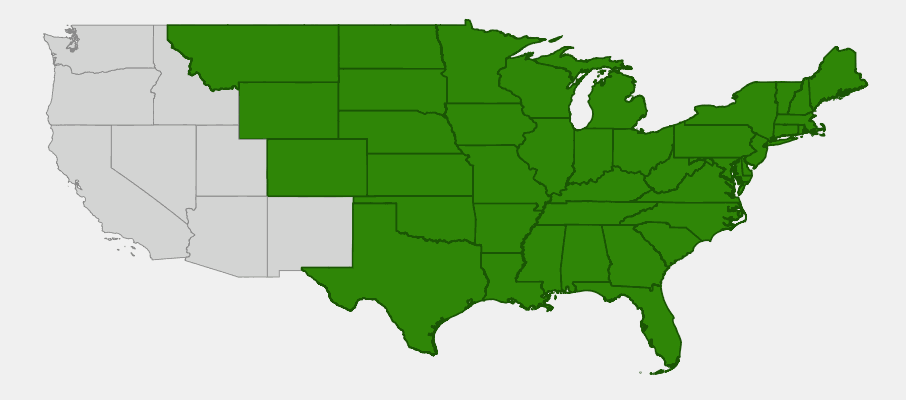
Green Ash boasts one of the most extensive native ranges of any North American ash species, naturally occurring from southeastern Canada south to northern Florida and from the Atlantic coast west to Alberta, eastern Colorado, New Mexico, and central Texas. This remarkable distribution spans diverse climatic zones from the cold continental climate of the northern Great Plains to the humid subtropical conditions of the Gulf Coast, demonstrating the species’ exceptional adaptability to varying temperature and moisture regimes.
Throughout this vast range, Green Ash characteristically inhabits floodplains, stream corridors, prairie potholes, and other wetland margins where seasonal flooding and consistently moist soils create ideal growing conditions. The species is particularly prominent in the Great Plains region, where it forms extensive riparian forests along major river systems and provides crucial habitat in otherwise tree-scarce landscapes. In eastern regions, Green Ash often grows alongside American Elm, Silver Maple, and Eastern Cottonwood in bottomland hardwood forests.
Climate change and altered hydrology from dam construction and agricultural drainage have affected some Green Ash populations, but the species’ adaptability and rapid reproduction have helped maintain stable populations across most of its historic range. The introduction of Emerald Ash Borer has significantly impacted some areas, making conservation of remaining healthy populations and genetic diversity increasingly important for the species’ long-term survival.
📋 Regional plant lists featuring Green Ash: North Dakota, South Dakota & Western Minnesota
Growing & Care Guide
Green Ash is one of the most forgiving and adaptable native trees, making it an excellent choice for challenging planting sites where other species might struggle. Its exceptional tolerance of adverse conditions, combined with relatively fast growth, makes it valuable for both restoration projects and traditional landscaping.
Light Requirements
Green Ash performs best in full sun, where it develops its most symmetrical form and densest foliage. While the tree can tolerate partial shade, especially when young, full sun exposure produces the strongest wood, best fall color, and most attractive overall form. In shaded conditions, the tree may become more open and less compact.
Soil Adaptability
One of Green Ash’s greatest strengths is its remarkable soil tolerance. The tree thrives in consistently moist to wet soils but also adapts to clay, compacted soils, and even periodic drought once established. It tolerates a wide pH range from slightly acidic to moderately alkaline (5.5–8.0) and can handle soil conditions that defeat many other large shade trees. This adaptability makes it particularly valuable for urban environments and restoration sites with challenging soil conditions.
Water Requirements
While Green Ash naturally occurs in moist environments and performs best with consistent moisture, established trees demonstrate good drought tolerance during typical dry periods. Young trees benefit from supplemental watering during extended dry spells, but mature specimens typically survive on natural rainfall across most of their range. The species’ ability to handle both wet and moderately dry conditions makes it versatile for various landscape situations.
Planting & Establishment
Plant Green Ash in spring or fall when cooler temperatures and higher moisture support root establishment. Choose a location with adequate space for the mature canopy — typically 40–50 feet wide. While the tree tolerates poor soil, improving soil organic matter and ensuring good drainage (while maintaining moisture) will promote faster growth. Mulch around young trees to retain moisture and suppress competition.
Pruning & Maintenance
Green Ash requires minimal pruning beyond removing dead, damaged, or crossing branches. Prune during dormancy to avoid attracting wood-boring insects. The tree develops a naturally attractive form with little intervention. Avoid heavy pruning, which can stimulate excessive water sprout growth and create weak wood structure.
Landscape Applications
Green Ash serves multiple landscape functions:
- Urban shade tree — excellent tolerance of compacted soils and pollution
- Riparian restoration — stabilizes streambanks and provides wildlife habitat
- Wetland margins — thrives in seasonally wet areas where other trees struggle
- Windbreaks and screens — fast growth and dense foliage provide effective protection
- Naturalized landscapes — fits well in prairie edge and savanna restoration
- Difficult sites — performs where soil compaction, poor drainage, or other challenges limit tree options
Emerald Ash Borer Considerations
The invasive Emerald Ash Borer (EAB) poses a significant threat to all North American ash species, including Green Ash. In areas where EAB is established, preventive treatments may be necessary to protect valuable trees. For new plantings in affected regions, consider consulting local extension services about EAB status and management recommendations. Diversifying plantings with other native species reduces landscape vulnerability to this pest.
Wildlife & Ecological Value
Green Ash provides exceptional wildlife value throughout its extensive range, supporting diverse animal communities from the canopy to the forest floor. Its role as a dominant riparian species makes it particularly crucial for wildlife in prairie and plains regions where tree habitat is naturally limited.
For Birds
Green Ash forests support an impressive diversity of bird species. Cavity-nesting birds including woodpeckers, chickadees, and nuthatches utilize hollow branches and trunks, while the dense foliage provides nesting sites for numerous songbirds. The seeds are consumed by finches, grosbeaks, cardinals, and other granivorous species, particularly during fall and winter when other food sources become scarce. Migratory birds rely heavily on the insect populations that Green Ash foliage supports during spring and fall passage periods.
For Mammals
Various mammals depend on Green Ash for both food and shelter. Squirrels and chipmunks cache the seeds for winter food, while deer and elk browse young twigs and bark, especially during harsh winter conditions. The tree’s riparian habitat association makes it valuable for semi-aquatic species like beavers, which sometimes utilize ash wood for dam construction, and muskrats that benefit from the protective cover of ash-dominated wetland edges.
For Pollinators & Beneficial Insects
Green Ash flowers provide early-season pollen for native bees and other pollinators when few other food sources are available. The tree supports over 40 species of moths and butterflies as larvae, including several specialist feeders found only on ash species. This insect diversity creates a complex food web that supports insectivorous birds, bats, and other predators throughout the growing season.
Ecosystem Functions
Beyond direct wildlife support, Green Ash provides critical ecosystem services, particularly in riparian zones. The extensive root system helps prevent streambank erosion while filtering runoff and reducing nutrient loading to waterways. The tree’s tolerance of flooding makes it valuable for flood control and water quality improvement. In prairie regions, Green Ash groves create habitat islands that support forest species far from their typical range, significantly increasing regional biodiversity.
Cultural & Historical Uses
Green Ash holds significant cultural and practical importance in North American history, serving Indigenous peoples and European settlers as both a vital resource and a marker of valuable land. For Plains tribes, the appearance of ash groves along watercourses indicated reliable water sources and good camping sites, making these trees crucial for navigation and survival across vast grassland landscapes. The Lakota and Dakota peoples called Green Ash “t’áspan,” incorporating it into place names and traditional stories that recognized its importance in their homeland’s ecology.
Traditional uses of Green Ash were diverse and sophisticated. The wood, prized for its strength, flexibility, and straight grain, was the preferred material for tool handles, bows, arrows, and spear shafts. The inner bark provided emergency food and medicine, while the leaves were used in traditional remedies for various ailments. Indigenous peoples also utilized ash wood for basket weaving and container making, taking advantage of the wood’s ability to be split cleanly along its grain lines.
European settlers quickly recognized Green Ash’s exceptional utility, using it extensively for agricultural tools, vehicle construction, and general carpentry. The wood’s shock resistance made it ideal for tool handles, baseball bats, and other applications requiring durability under stress. During the settlement period, Green Ash provided crucial timber resources in regions where other suitable trees were scarce, supporting the agricultural development of the Great Plains and prairie regions.
In modern times, Green Ash wood continues to be valued for specialty applications including tool handles, sporting goods, and furniture components. The species has played an important role in urban forestry programs throughout the Midwest, providing shade and environmental benefits in cities across the prairie states. However, the introduction of Emerald Ash Borer has highlighted the ecological and economic importance of maintaining healthy, genetically diverse ash populations for future generations.
Frequently Asked Questions
How can I tell Green Ash from White Ash?
The most reliable difference is leaf color: Green Ash has green undersides on its leaflets, while White Ash leaflets are whitish underneath. Green Ash leaflets attach directly to the central stem (sessile), while White Ash leaflets have small individual stalks. Green Ash also typically grows in moister sites, while White Ash prefers well-drained upland soils.
Is Green Ash threatened by Emerald Ash Borer?
Yes, Emerald Ash Borer (EAB) is a serious threat to all North American ash species, including Green Ash. However, EAB has not reached all areas where Green Ash grows naturally. In regions where EAB is present, treatments are available to protect valuable trees. Check with local extension services for current EAB status and management recommendations in your area.
How fast does Green Ash grow?
Green Ash is considered a fast-growing tree, typically adding 2–3 feet of height per year under favorable conditions. Young trees in ideal sites (full sun, moist soil) may grow even faster. Growth rate depends on soil moisture, fertility, and growing conditions, with slower growth in drought-stressed or poor soil conditions.
Can Green Ash handle wet soils?
Yes, Green Ash is one of the best native trees for sites with seasonal flooding or consistently moist soils. It naturally grows in floodplains and wetland margins, making it an excellent choice for rain gardens, streambank stabilization, and other wet-soil applications where many trees would struggle.
What’s the best way to use Green Ash in landscaping?
Green Ash works well as a shade tree, especially in challenging sites with clay or compacted soils. It’s particularly valuable for urban environments, riparian restoration, and naturalized landscapes. Give it plenty of space (40–50 foot spread) and consider its wildlife value when planning the overall landscape. In EAB-affected areas, consult professionals about protection strategies.

Looking for a nursery that carries Green Ash?
Browse our native plant nursery directory: North Dakota · South Dakota · Minnesota