Groundsel Tree (Baccharis halimifolia)
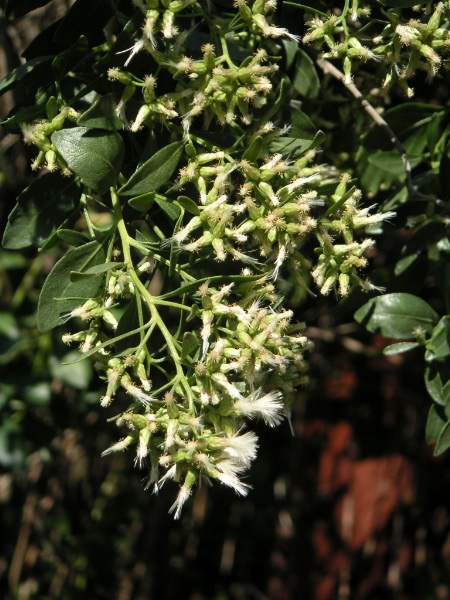
Baccharis halimifolia, commonly known as Groundsel Tree, Eastern Baccharis, Sea Myrtle, or Consumption Weed, is one of the most striking native shrubs of the Atlantic and Gulf coastal regions. A member of the aster family (Asteraceae), it is the only dioecious (male and female plants separate) woody member of its genus in eastern North America. From late September through November, female plants erupt in a spectacular display of thousands of brilliant white, silky seed heads — a show that rivals any ornamental plant in the autumn landscape and that feeds countless birds and insects.
Groundsel Tree is a remarkably tough and adaptable native shrub, thriving in coastal salt marshes, tidal flats, brackish wetlands, sandy uplands, disturbed roadsides, and inland thickets. Its salt tolerance is extraordinary — few other shrubs can survive the combination of salt spray, periodic flooding, and nutrient-poor coastal soils that Groundsel Tree handles with ease. This toughness, combined with its exceptional wildlife value and outstanding fall ornamental interest, makes it one of the most valuable and underappreciated native shrubs for challenging landscape sites in the Northeast and mid-Atlantic.
The plant grows 3 to 10 feet tall (occasionally to 12 feet) and is semi-evergreen in mild winters, holding its gray-green foliage through December or even January in the Carolinas and south. In New York, New Jersey, and Pennsylvania it is deciduous, dropping leaves after frost. Despite its sometimes weedy appearance in disturbed habitats, Groundsel Tree is a legitimate keystone plant of coastal ecosystems that provides structure, food, and shelter at a critical time of year when most other shrubs have finished their season.
Identification
Groundsel Tree is a multi-stemmed, loosely branched shrub or small tree reaching 3 to 12 feet (1–3.7 m) in height. The overall form is irregular and somewhat open, with ascending branches and a tendency to spread by root sprouts in favorable conditions. It is most easily identified in fall when female plants produce their distinctive white cottony seed heads.
Leaves
The leaves are simple, alternate, thick, and succulent-textured — an adaptation to coastal salt spray and summer drought. Leaf shape is variable: lower leaves are oval to obovate, 1 to 2.5 inches (2.5–6 cm) long, with a few coarse teeth; upper leaves are smaller and often entire (untoothed). The upper surface is dull gray-green; the underside is paler. Leaves have a distinctive resinous, slightly aromatic scent when crushed. In mild climates, many leaves persist through winter; in cold climates all leaves drop after frost. The semi-evergreen, gray-green foliage is attractive and salt-tolerant.
Flowers
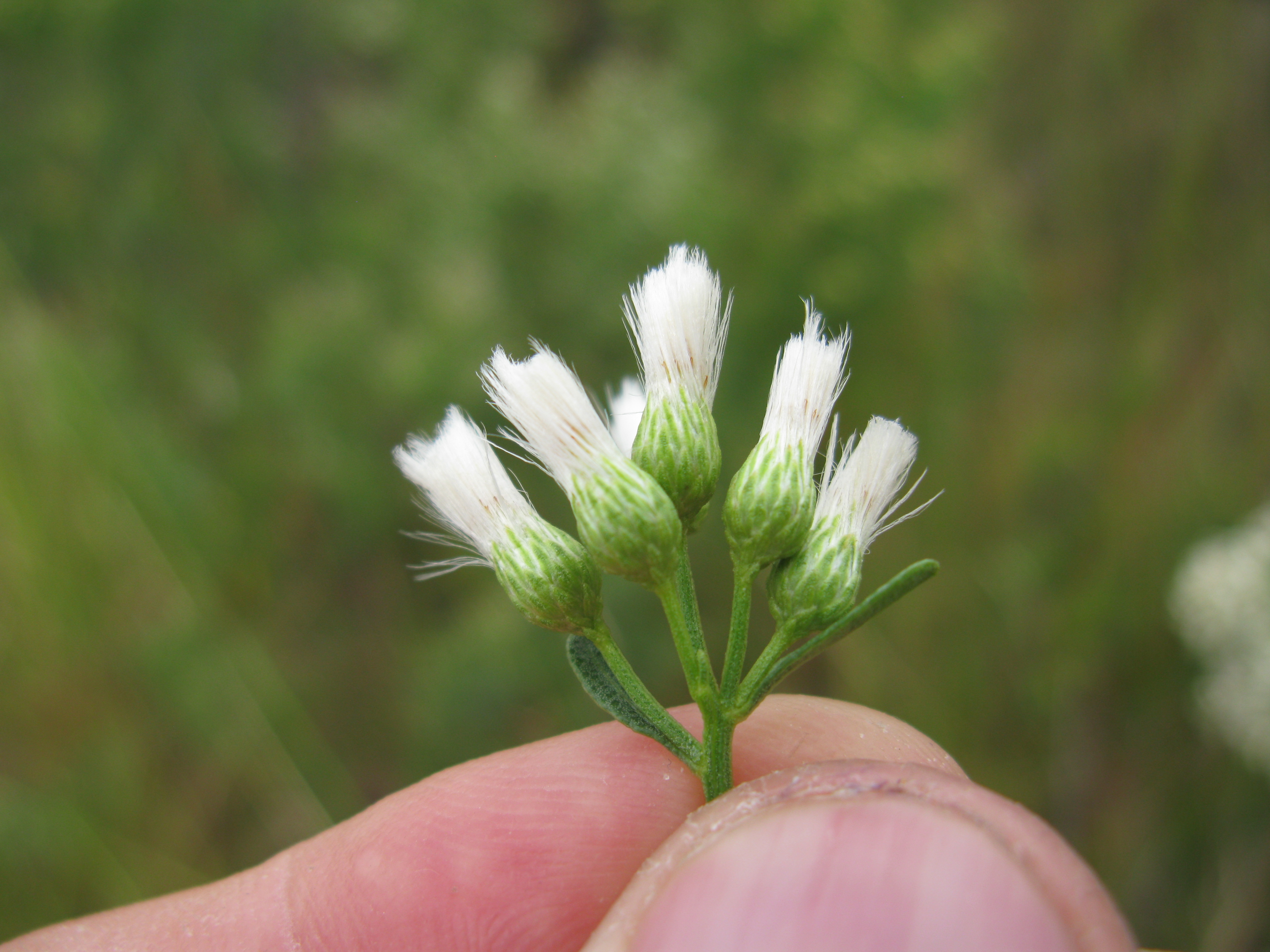
Groundsel Tree is dioecious — male and female flowers are borne on separate plants. Both sexes produce small, tubular, white to creamy flower heads in terminal clusters from September through November. Male flower heads are about ¼ inch across, producing abundant pollen. Female flower heads are slightly smaller and, after fertilization, develop into the showy, white-silky seed heads. The flowers are wind-pollinated but also attract a variety of insects seeking late-season nectar.
Fruit & Seeds
The fruiting display of female Groundsel Trees is spectacular and unmistakable. After fertilization, each female flower head develops a cluster of tiny achenes (seeds) topped with long, white, silky bristles (the pappus) that aid wind dispersal. A single large female shrub can produce tens of thousands of these seed heads, covering the plant in a mass of brilliant white from September through January — a breathtaking sight in coastal landscapes and one that provides enormous wildlife value through the fall and winter.
Quick Facts
| Scientific Name | Baccharis halimifolia |
| Family | Asteraceae (Aster/Daisy) |
| Plant Type | Deciduous to Semi-evergreen Shrub |
| Mature Height | 3–10 ft |
| Sun Exposure | Full Sun to Part Shade |
| Water Needs | Moderate |
| Bloom Time | September – November |
| Flower Color | White (female seed heads spectacular) |
| Salt Tolerance | Excellent — salt spray and brackish soils |
| Deer Resistance | Good (aromatic foliage, less preferred) |
| USDA Hardiness Zones | 5–9 |
Native Range
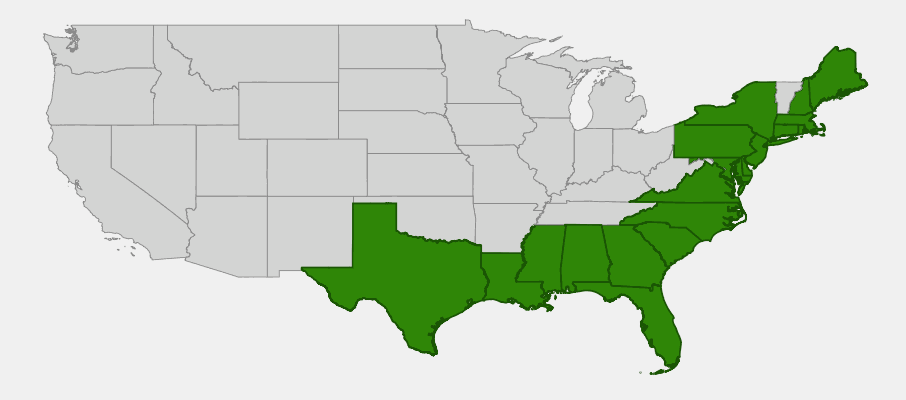
Groundsel Tree is native to the Atlantic and Gulf coastal regions of the eastern United States, ranging from southern Maine south through New England, the mid-Atlantic states, and the Southeast to Texas, and extending inland in the Southeast to Tennessee and Arkansas. It is most abundant and ecologically dominant in the coastal plain region — from Long Island through New Jersey, Delaware, Maryland, Virginia, and the Carolinas — where it is a characteristic shrub of salt marshes, tidal edges, dune swales, and coastal thickets.
In the mid-Atlantic region (New Jersey, New York, Delaware, and Pennsylvania), Groundsel Tree reaches the northern limit of its natural range and is a protected or monitored species in some states. It naturally occupies brackish and salt marsh edges, coastal swales, bay edges, and the transition zones between upland and wetland along the Atlantic Coast. Further south it becomes more abundant and common inland, colonizing disturbed sites, roadsides, and old fields throughout the Coastal Plain.
Although widely considered a coastal species, Groundsel Tree has naturalized inland in many areas far from the coast, particularly along roadsides and disturbed habitats in the Southeast. Outside its native range — particularly in Europe and Australia — it has become an invasive species, demonstrating the vigorous colonizing ability that makes it such an effective pioneer plant in disturbed coastal environments within its native range.
📋 Regional plant lists featuring Groundsel Tree: New York, Pennsylvania & New Jersey
Growing & Care Guide
Groundsel Tree is one of the toughest native shrubs available for difficult coastal and disturbed-site landscapes. It thrives where most shrubs struggle and requires minimal care once established. Its primary value is ecological and visual — the fall fruiting display is exceptional and rivals ornamental grasses for late-season interest.
Light
Full sun to part shade — Groundsel Tree performs best in full sun, producing the densest form and most prolific fruiting display in open sites. It tolerates part shade but becomes more open and less floriferous in shadier conditions. In coastal plantings, full sun exposure is typically not a limiting factor, and the plants thrive in exposed, wind-swept sites where their deep roots and salt tolerance give them a competitive advantage.
Soil & Water
Groundsel Tree is remarkably tolerant of a wide range of soil conditions: sandy, loamy, or clay soils; wet or dry; saline or fresh; acidic or slightly alkaline. This adaptability makes it one of the most site-flexible native shrubs available. It tolerates seasonal flooding, salt spray, salt soil, and periodic drought once established. For coastal gardens, it is one of the most reliably salt-tolerant native shrubs available — surviving conditions that would kill most other plants. Average moisture is optimal, but it adapts well to extremes.
Planting Tips
Plant in spring or fall in full sun to part shade. Space plants 4 to 6 feet apart for screening or mass plantings; 6 to 8 feet apart if individual specimens are desired. Both male and female plants are needed for the spectacular seed head display on females — plant at least one male for every three to five females. Container stock transplants readily. Groundsel Tree grows 2 to 3 feet per year and establishes quickly.
Pruning & Maintenance
Groundsel Tree benefits from periodic hard pruning to maintain a dense, compact form and prevent it from becoming leggy. Prune in late winter or early spring before growth begins. It can be cut to within 6 to 12 inches of the ground every 3 to 4 years to rejuvenate old shrubs. Avoid pruning in fall, as this removes next season’s flower buds. Groundsel Tree spreads by root sprouts and wind-dispersed seed — remove unwanted seedlings and sprouts as they appear to prevent spreading beyond the intended planting area.
Landscape Uses
- Coastal shrub border — excellent salt tolerance for oceanfront plantings
- Salt marsh restoration — a native component of coastal marsh edges
- Wildlife habitat — exceptional fall and winter bird food source
- Screening and windbreak in exposed coastal sites
- Stormwater / rain garden — tolerates periodic flooding
- Fall ornamental — white seed head display rivals ornamental grasses
- Disturbed-site stabilization — a pioneer species for revegetation
Wildlife & Ecological Value
Groundsel Tree is an ecologically invaluable native shrub, particularly in coastal regions where it provides late-season food and habitat at a critical time when other resources are diminishing.
For Birds
The white seed heads of female Groundsel Trees are a major fall and winter food source for many bird species. American Goldfinches, Purple Finches, Common Redpolls, Tree Sparrows, Song Sparrows, Yellow-rumped Warblers, and other seed-eating birds feed heavily on Baccharis seeds from October through January. The dense thicket structure provides excellent cover for sparrows, wrens, and other thicket-dwelling birds. In coastal regions, Groundsel Tree thickets are important stopover habitat for migrating songbirds in fall, providing both food and shelter.
For Pollinators
Groundsel Tree’s late-season blooming (September–November) makes it one of the most valuable nectar plants for fall pollinators. Monarch Butterflies, Painted Ladies, American Ladies, Eastern Commas, and many other late-flying butterflies depend on it for nectar during fall migration. Native bees — particularly sweat bees, bumblebees, and mining bees — feed heavily on both the pollen of male plants and nectar of females. In coastal regions, Groundsel Tree in bloom is often surrounded by clouds of insect activity at a time when few other flowering shrubs are available.
For Mammals
White-tailed Deer avoid Groundsel Tree due to its aromatic, resinous foliage — a valuable quality in deer-heavy suburban landscapes. Small mammals such as rabbits and mice use the dense thicket structure for cover, and the seeds are consumed by various small rodents.
Ecosystem Role
In coastal salt marsh edge communities, Groundsel Tree is a structural keystone — one of few woody plants that can stabilize and colonize the transition zone between upland and tidal marsh. Its roots help prevent shoreline erosion, and its dense thicket structure creates habitat structure that would otherwise be absent in flat coastal landscapes. The enormous seed output of female plants dispersed by wind creates a natural seeding mechanism that supports recovery of disturbed coastal areas.
Cultural & Historical Uses
Groundsel Tree was known to various Indigenous peoples of the Atlantic coast, though its uses were limited. Various Algonquian-speaking nations along the Atlantic coast were familiar with the plant, which was a prominent feature of coastal landscapes. The plant’s common name “Consumption Weed” reflects a historical belief — largely unfounded — that it had uses in treating tuberculosis (then called consumption). Early colonial-era herbalists experimented with various plants for this purpose, and Baccharis was among them.
In the 19th century, some herbalists and physicians investigated Groundsel Tree for medicinal uses. The plant was reported to have been used as a febrifuge (fever reducer) and vulnerary (wound healer) by some practitioners, though none of these uses became mainstream. The plant contains sesquiterpene lactones and other compounds with demonstrated biological activity, but it has not been developed into any significant medicinal product.
In the landscape industry, Groundsel Tree was recognized relatively late as an outstanding ornamental native shrub. It began appearing in native plant nursery catalogs in the 1980s and 1990s as interest in native coastal plants grew. Today it is widely recommended by coastal landscape architects and native plant enthusiasts throughout the mid-Atlantic and Southeast for its combination of toughness, salt tolerance, ecological value, and striking fall display. In the UK and Australia, where it has naturalized as an invasive species, it is managed as a noxious weed — a reminder of the ecological power that makes it so valuable within its native range.
Frequently Asked Questions
Is Groundsel Tree invasive?
Within its native range in eastern North America, Groundsel Tree is not considered invasive — it is a native species playing its natural ecological role. However, outside its native range (particularly in Europe and Australia), it has become an invasive species due to its prolific seed production and adaptability. Within its native Atlantic and Gulf Coast range, it is a valuable native shrub. Be mindful of its vigorous seeding in planting areas where you don’t want it to spread.
Do I need both male and female plants?
Only female plants produce the spectacular white seed heads that make Groundsel Tree famous as a fall ornamental. Male plants produce small, unremarkable flower heads with abundant pollen. For the best display, plant a ratio of approximately 1 male to 3–5 females. If you buy multiple plants from a nursery, select stock in bloom in fall so you can identify the sex of each plant.
How large does Groundsel Tree get?
Groundsel Tree typically grows 3 to 10 feet tall and wide, with occasional specimens reaching 12 feet in ideal conditions. Growth rate is fast — 2 to 3 feet per year in full sun with adequate moisture. It can be maintained at 4 to 6 feet by annual pruning in late winter. Without pruning, older specimens become quite large and somewhat leggy.
Is Groundsel Tree salt tolerant?
Yes — extremely so. Groundsel Tree is one of the most salt-tolerant native woody plants in eastern North America. It grows naturally in coastal salt marsh edges, brackish tidal zones, and sites with salt spray and salt-affected soils. This exceptional salt tolerance makes it a top choice for coastal landscapes, beachside plantings, and sites where de-icing salt is a concern.
What birds eat Groundsel Tree seeds?
Many species consume Groundsel Tree seeds in fall and winter: American Goldfinches, Purple Finches, Common Redpolls, Yellow-rumped Warblers, Tree Sparrows, Song Sparrows, White-throated Sparrows, and various other sparrows and finches. In coastal areas during fall migration, Groundsel Tree thickets are often productive spots for birdwatching. The seeds remain available on the plant from October through January — an important extended food source during the lean winter months.

Looking for a nursery that carries Groundsel Tree?
Browse our native plant nursery directory: New York · Pennsylvania