Marsh Elder (Iva frutescens)
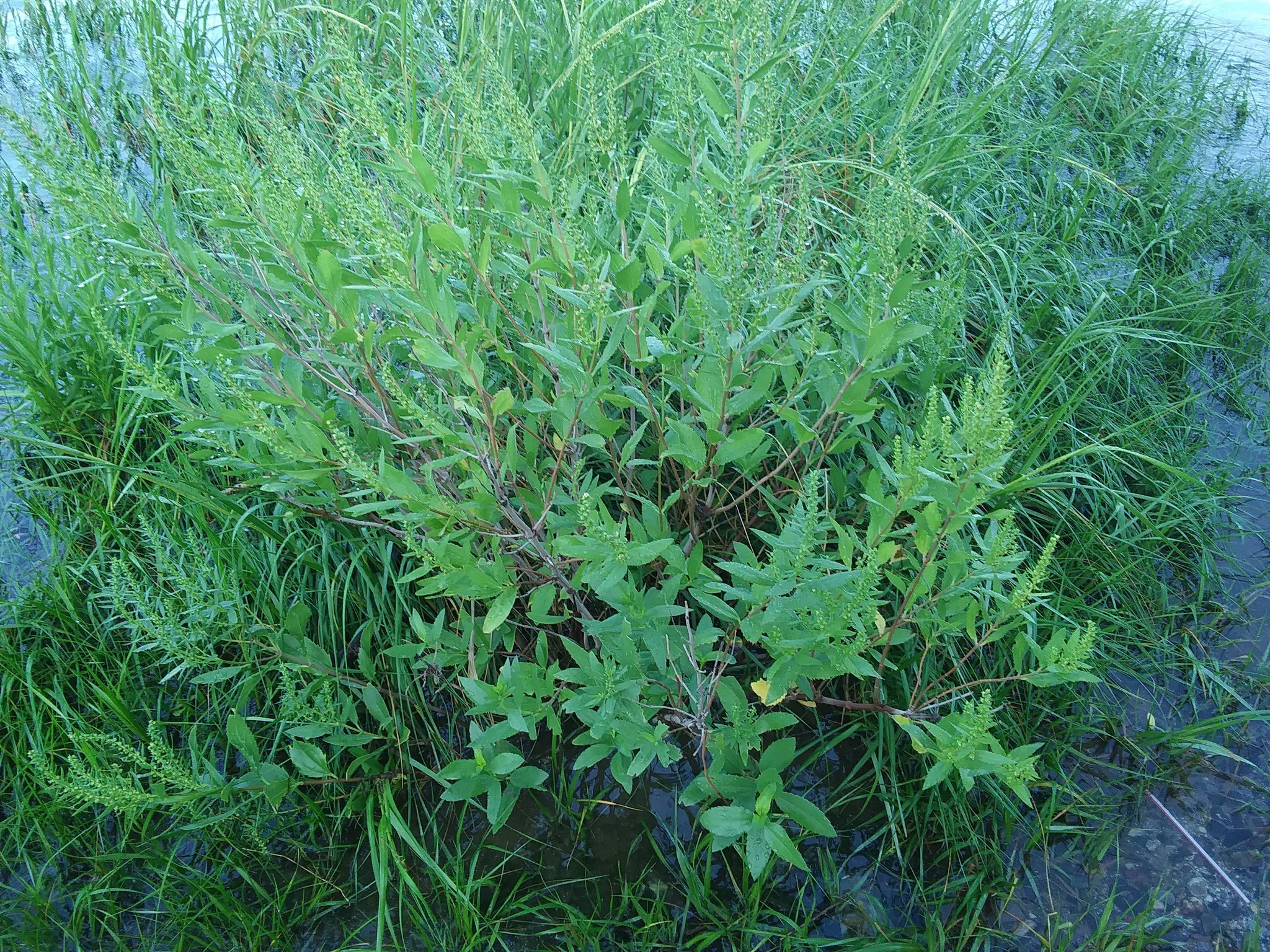
Iva frutescens, commonly known as Marsh Elder or High-Tide Bush, is a native shrubby perennial of the Atlantic and Gulf coastal zones — a tough, unassuming, but ecologically critical plant that defines the upper margins of salt marshes from Maine to Florida. Despite its modest appearance — no showy flowers, no brilliant fall color, evergreen foliage that stays green through winter — Marsh Elder performs an outsized ecological role as structural habitat, seed food plant, and coastal stabilizer. Its scientific name reflects its nature: frutescens means “shrubby,” and it is indeed a shrub of the first order in its native habitat.
Growing to 8 feet tall, Marsh Elder forms dense, rounded thickets at the high-tide line and on salt marsh borders, wrack lines, and coastal disturbed areas. It is semi-evergreen to evergreen, retaining most of its foliage through winter — a significant ecological advantage in habitats where food and cover are otherwise scarce. The tiny, inconspicuous flowers produce small achene seeds that are rich in oils and consumed by a wide variety of migrating and resident birds, particularly during fall migration, when Marsh Elder provides critical refueling stops along the Atlantic Flyway.
Though rarely featured in mainstream gardening literature, Marsh Elder is an important species for coastal restoration and is increasingly recognized as a useful native plant for difficult coastal situations — sites with salt spray exposure, tidal flooding, poor sandy soils, and brackish water — conditions that eliminate most alternative native shrubs. For restoration practitioners, coastal land managers, and native plant gardeners working in coastal habitats, Marsh Elder is an essential component of the ecological palette.
Identification
Marsh Elder is a semi-woody, multi-stemmed shrub typically 3–8 feet tall, though plants in favorable conditions can approach 10 feet. The overall form is rounded to mounded, dense, and bushy — often forming colonies through basal sprouting and vegetative spread. The plant has a somewhat coarse, rough texture due to the sandpapery surface of its leaves and stems.
Stems & Bark
Young stems are green, herbaceous, and square in cross-section (a family characteristic of the Asteraceae alliance). As the plant ages, lower stems become woody, grayish-brown, and irregularly furrowed. The overall growth habit is upright to slightly arching. Stems are opposite, reflecting the opposite leaf arrangement throughout the plant.
Leaves
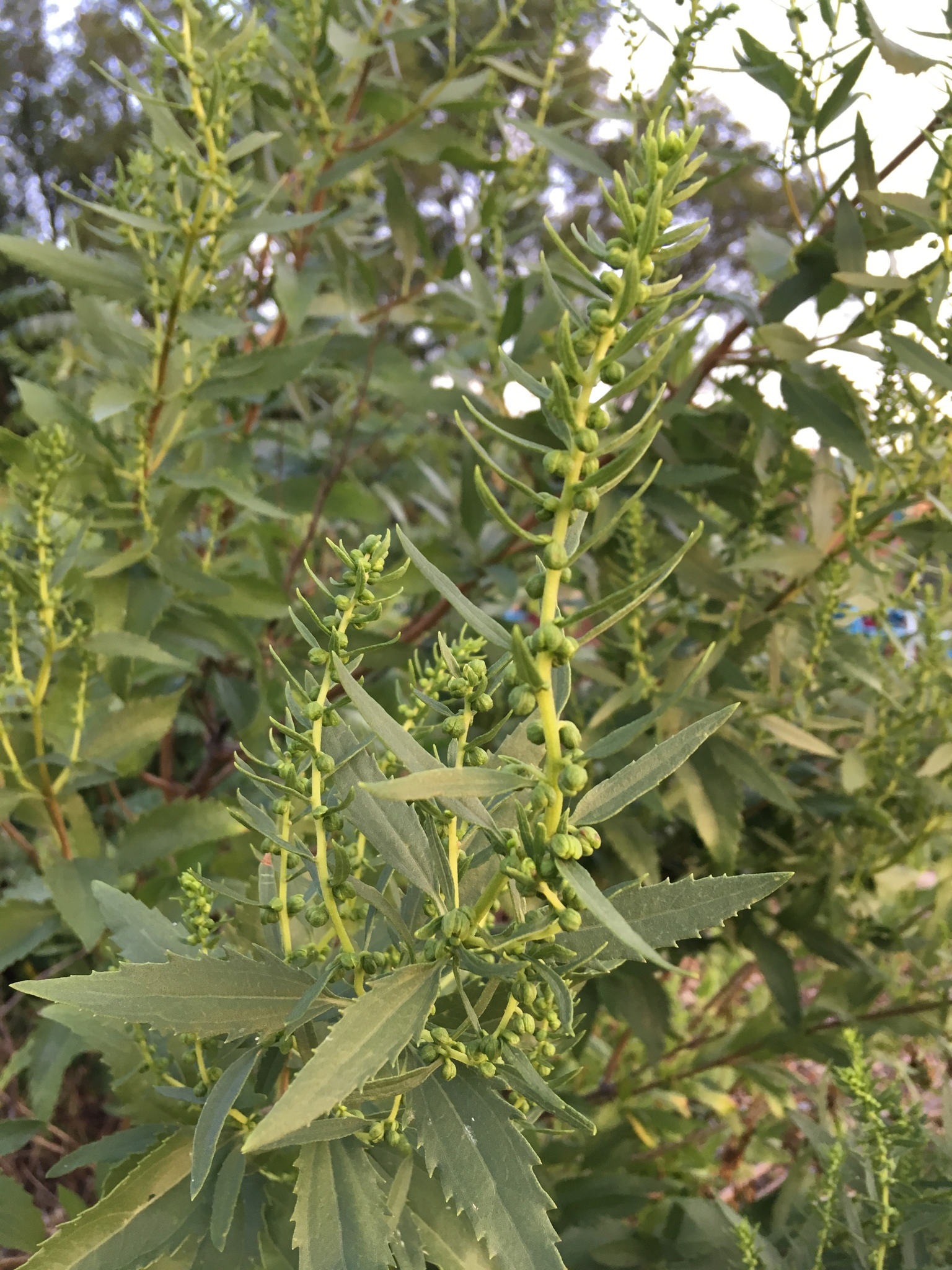
The leaves are one of Marsh Elder’s most distinctive features. They are simple, opposite (lower leaves) to alternate (upper leaves), oblong-lanceolate to spatulate, typically 1.5–4 inches long. The leaf surface is rough and sandpapery to the touch — covered with minute stiff hairs (scabrous) — which is an effective adaptation to reduce water loss and resist salt deposition. Margins are coarsely toothed. The leaves are semi-evergreen, remaining on the plant through much of winter before dropping in late winter or early spring. They are not particularly ornamental — dark grayish-green — but function importantly as structural habitat year-round.
Flowers & Fruit
The flowers are tiny, greenish-white, and highly inconspicuous — typical of wind-pollinated plants in the aster family. They appear in late summer and early fall (August–October) in small, drooping heads clustered along the upper stems. Individual flower heads are only about 3–4 mm wide. The fruit is a small, hard, one-seeded achene, about 2–3 mm long, produced in large quantities. These oil-rich seeds are a critical food source for migrating and resident birds along the Atlantic coast during fall migration.
Quick Facts
| Scientific Name | Iva frutescens |
| Family | Asteraceae (Aster) |
| Plant Type | Semi-evergreen Shrub |
| Mature Height | 8 ft |
| Sun Exposure | Full Sun |
| Water Needs | Moderate to High |
| Bloom Time | August – October |
| Flower Color | Greenish-white (inconspicuous) |
| USDA Hardiness Zones | 5–9 |
Native Range
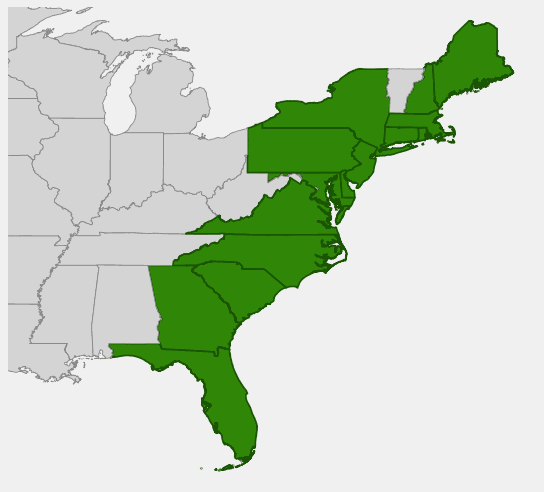
Marsh Elder is native to the Atlantic and Gulf coastal zones of eastern North America, ranging from coastal Maine south through all the Atlantic seaboard states to Florida, and continuing along the Gulf Coast to Texas. Its distribution closely tracks the distribution of Atlantic and Gulf coastal salt marshes — it is an obligate coastal species strongly associated with the upper salt marsh zone and the transition from marsh to upland. It rarely occurs more than a mile or two inland except along tidal rivers and estuaries.
In the Mid-Atlantic region — New York, New Jersey, Delaware, Pennsylvania (tidal Delaware River), Maryland, Virginia — Marsh Elder is a common and ecologically important component of coastal shrubland and high-marsh communities. It characteristically occupies the upper intertidal zone at or just above the high-tide line, where it grows in a distinctive belt above the cordgrass (Spartina alterniflora) zone and below the zone of true upland vegetation. This high-tide zone is frequently covered by storm tides and subject to intense salt spray — conditions that Marsh Elder tolerates better than virtually any other native shrub in the region.
Along the Atlantic Flyway, dense stands of Marsh Elder growing in large coastal marshes provide critical food and shelter for millions of migrating birds during fall migration. The species is particularly abundant in the great coastal marshes of New Jersey — Barnegat Bay, Delaware Bay — and the Long Island coast, where it forms extensive thickets that are essential habitat for migrating songbirds including warblers, sparrows, and thrushes.
📋 Regional plant lists featuring Marsh Elder: New York, Pennsylvania & New Jersey
Growing & Care Guide
Marsh Elder is not commonly grown as a garden ornamental — its value is primarily ecological and restorative. However, for naturalistic coastal gardens, restoration projects, and coastal land management, it is a superb choice for challenging sites that other native shrubs cannot tolerate. Its requirements are specific but, once met, it thrives with almost no care.
Light
Marsh Elder is a full-sun plant, requiring at least 6 hours of direct sunlight daily. It does not tolerate shade. In its natural habitat it grows in open, sun-exposed coastal margins and marshes. Site it in the most exposed, sunniest location available.
Soil & Water
Marsh Elder’s outstanding attribute is its tolerance of coastal and brackish conditions: salt spray, periodic tidal flooding, sandy or silty coastal soils, and high soil salinity. It grows in soils that would kill most other shrubs. It prefers moderately moist to wet soils and is not particularly drought tolerant for an upland site — it is adapted to the high moisture conditions of coastal marshes. Avoid planting in heavy clay that does not drain between floods. Moderately moist sandy or silty soils with access to occasional tidal or storm flooding are ideal.
Planting Tips
Marsh Elder is best established from container-grown stock. Plant in spring, ensuring good contact between roots and moist soil. For coastal restoration, space plants 3–5 feet apart to form a continuous thicket at the high-tide line. Minimal fertilization is needed — coastal soils naturally supply adequate nutrients. Water regularly the first growing season until established. After that, it is largely self-sufficient.
Pruning & Maintenance
Marsh Elder requires minimal maintenance. Cut back hard (to 12–18 inches) in early spring if the plant becomes too rank or leggy — it will regenerate vigorously. In natural settings, storm tides and wrack deposition naturally prune and manage the plant. It has no significant pest or disease problems in its natural habitat. It can spread by suckering to form large colonies — a desirable trait for restoration but something to manage in a defined garden setting.
Landscape Uses
- Salt marsh restoration — highest-priority use for this species
- Coastal erosion control at the upper marsh/upland interface
- Wildlife habitat planting along Atlantic Flyway migration corridors
- High-tide line stabilization on coastal properties
- Naturalistic coastal gardens where salt spray tolerance is required
Wildlife & Ecological Value
Despite its modest ornamental qualities, Marsh Elder is among the most ecologically important coastal shrubs of the Atlantic seaboard. Its seeds, structure, and coastal distribution make it irreplaceable for coastal wildlife, particularly migrating songbirds along the Atlantic Flyway.
For Birds
The oil-rich seeds of Marsh Elder are consumed by an impressive array of birds during fall migration: Tree Swallows, Yellow-rumped Warblers, Palm Warblers, Myrtle Warblers, White-throated Sparrows, Seaside Sparrows, Nelson’s Sparrows, Savannah Sparrows, and Swamp Sparrows all feed on Marsh Elder seeds. The dense thickets provide essential shelter and roosting habitat for migrants, particularly during northwesterly wind events that force coastal migrants to concentrate along the shore. In coastal marshes, Marsh Elder thickets are often the only available upland cover within extensive open-water and marsh habitats.
For Mammals
Marsh Elder provides cover for marsh-associated mammals including muskrats, marsh rabbits, and meadow voles. In coastal areas, white-tailed deer occasionally browse the foliage. The dense thickets provide shelter from tidal flooding for small mammals that inhabit the upper marsh zone.
For Pollinators
Marsh Elder’s tiny, wind-pollinated flowers are not significant nectar sources. However, the plant supports a modest diversity of salt-marsh insects, and the flowers provide pollen for some specialist native bees. Its primary ecological value is seed production and structural habitat rather than pollinator support.
Ecosystem Role
Marsh Elder plays a critical structural role at the upper salt marsh/upland interface — one of the most productive and sensitive ecological zones on the Atlantic coast. Its dense root systems help stabilize the high-tide zone against erosion, its structural complexity provides habitat diversity that the relatively monotonous cordgrass marsh cannot offer, and its seed production fuels the energetics of fall migration along one of the busiest bird migration corridors in the world. As sea levels rise and coastal marshes migrate landward, maintaining the Marsh Elder zone at the upland-marsh interface will become increasingly important for ecosystem resilience.
Cultural & Historical Uses
Marsh Elder has a modest but interesting ethnobotanical history. Various Indigenous peoples of the northeastern coast, including the Algonquian-speaking tribes of New England and the Mid-Atlantic, used Marsh Elder medicinally. Root preparations were used to treat fevers and skin conditions, and the plant was recognized as a distinctive coastal landmark — its prominent position at the high-tide line made it a reliable indicator of tidal reach and safe passage on coastal journeys.
Historically, ecologists and naturalists used Marsh Elder as an indicator species: the presence of its distinctive thickets at the upper marsh boundary was a reliable marker of high-tide position, useful for mapping tidal zones and predicting storm surge risk. This ecological precision — Marsh Elder marks the exact boundary between the tidal and upland zones — made it valuable for coastal surveying and mapping long before modern elevation data was available.
Today, Marsh Elder is increasingly important in coastal restoration ecology. As sea level rise accelerates and salt marsh habitats migrate landward, the re-establishment of the high-marsh shrub zone — dominated by Marsh Elder and Groundsel Tree (Baccharis halimifolia) — is recognized as a critical component of functional marsh restoration. Native plant nurseries specializing in coastal restoration plants have increased production of Marsh Elder in response to growing demand from restoration practitioners working on Atlantic coast projects.
Frequently Asked Questions
Is Marsh Elder the same as Groundsel Tree?
No — they are different species, though both are coastal shrubs often found together. Groundsel Tree is Baccharis halimifolia (aster family), a larger shrub with showy white fall seed heads. Marsh Elder (Iva frutescens) has smaller, rougher leaves and inconspicuous flowers. Both are valuable natives for coastal restoration.
Can Marsh Elder grow in regular garden soil?
Marsh Elder prefers moist to wet coastal soils and may not perform as well in typical well-drained garden soil, especially in dry summers. It does best in moist, somewhat saline conditions. In non-coastal gardens it tends to be less vigorous and more drought-stressed. It is best suited to coastal restoration projects rather than inland ornamental gardens.
Does Marsh Elder spread aggressively?
Marsh Elder spreads by both seed and root suckers, and in favorable coastal conditions can form large colonies. In restoration plantings this is desirable, but in managed landscape settings, spreading should be monitored. It does not generally become invasive or spread into non-coastal habitats.
Why is Marsh Elder called “High-Tide Bush”?
The common name “High-Tide Bush” refers to its characteristic position at or just above the high-tide line in coastal marshes. It marks the upper limit of regular tidal flooding — a position so consistent that the plant has been used as an ecological and historical indicator of high-tide elevation in mapping and land use records.
Does Marsh Elder have any ornamental value?
Marsh Elder is not typically grown for ornamental purposes — its flowers are inconspicuous and it has no fall color. Its value is primarily ecological: for coastal erosion control, wildlife habitat, and salt marsh restoration. In coastal naturalistic gardens, however, its year-round evergreen foliage and dense structure provide useful screening and habitat value.

Looking for a nursery that carries Marsh Elder?
Browse our native plant nursery directory: New York · Pennsylvania