Jacob’s Ladder (Polemonium reptans)
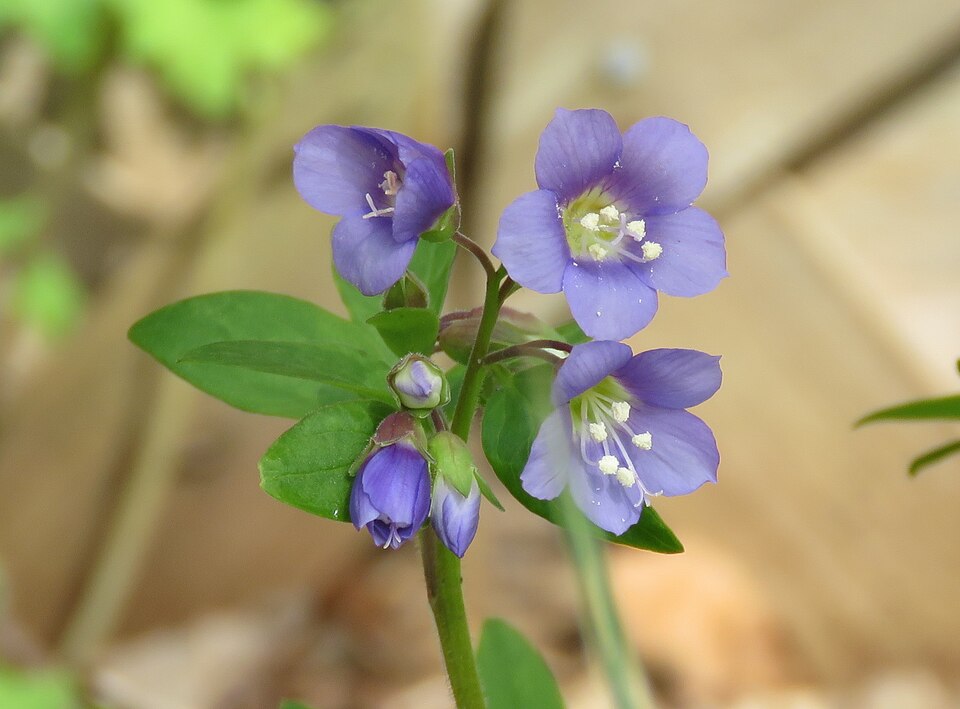
Polemonium reptans, commonly known as Jacob’s Ladder or Spreading Jacob’s Ladder, is a charming native spring wildflower that brightens shaded gardens with clusters of delicate blue to pale violet bell-shaped flowers in April and May. A member of the phlox family (Polemoniaceae), it takes its evocative common name from the distinctive, ladder-like arrangement of its pinnately compound leaves, which resemble the rungs of a ladder ascending the stem — a visual that resonated deeply with early European settlers familiar with the biblical story of Jacob’s heavenly ladder.
Jacob’s Ladder is a low, mounding plant reaching only about 12 to 18 inches tall in bloom, making it ideal for the front of shaded borders, the edges of woodland gardens, and naturalistic plantings beneath deciduous trees. Its finely textured, attractive foliage remains ornamental from spring through summer, and the plant spreads gently by rhizomes to form loose colonies in suitable conditions. Unlike many shade plants that offer only foliage interest, Jacob’s Ladder provides a genuine spring floral display that rivals any cultivated shade perennial in delicacy and charm.
For gardens in New York, Pennsylvania, and New Jersey with shaded conditions — under large deciduous trees, on the north side of buildings, or in woodland garden settings — Jacob’s Ladder is a reliable, adaptable, and ecologically valuable native perennial that requires minimal care once established and rewards with a beautiful annual spring display.
Identification
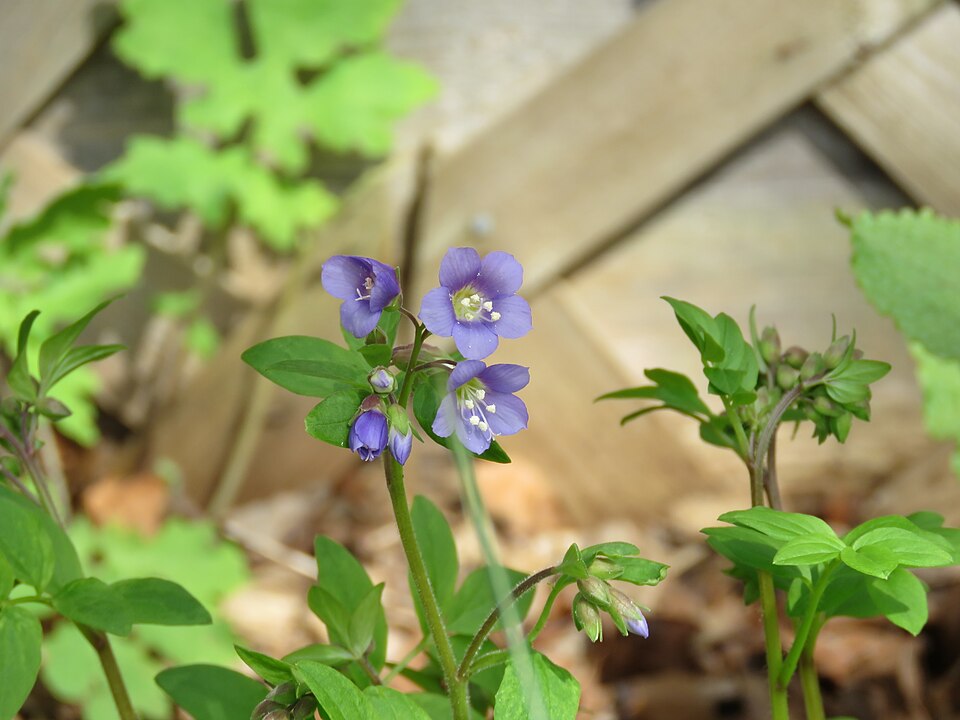
Jacob’s Ladder grows as a low, spreading mound, reaching 8 to 18 inches tall in bloom and spreading 12 to 18 inches wide. The stems are slender, somewhat spreading to ascending (giving the species its epithet “reptans,” meaning “creeping”), and may root at nodes in moist conditions. The most distinctive feature is the pinnately compound leaves with 5 to 19 paired leaflets arranged along the central stalk — the “rungs” of the ladder that give the plant its common name. The leaflets are oval to lance-shaped, about ½ to 1 inch long, smooth, and bright green.
Flowers
The flowers are produced in loose, nodding terminal clusters (cymes) at the tips of the branching stems. Each flower is broadly bell-shaped to rotate, about ½ inch in diameter, with five fused petals in light blue to pale violet-blue with a white center. The stamens have distinctive hairy filaments that are a useful identification feature. Bloom occurs from April through May, and individual plants may bloom for 3–4 weeks. After blooming, the attractive foliage remains through summer, though the plant may go semi-dormant in hot, dry conditions. The fruit is a small, three-parted capsule containing a few seeds.
Quick Facts
| Scientific Name | Polemonium reptans |
| Family | Polemoniaceae (Phlox) |
| Plant Type | Herbaceous Perennial |
| Mature Height | 1 ft |
| Sun Exposure | Part Shade to Full Shade |
| Water Needs | Moderate |
| Bloom Time | April – May |
| Flower Color | Light blue to pale violet with white center |
| USDA Hardiness Zones | 3–8 |
Native Range
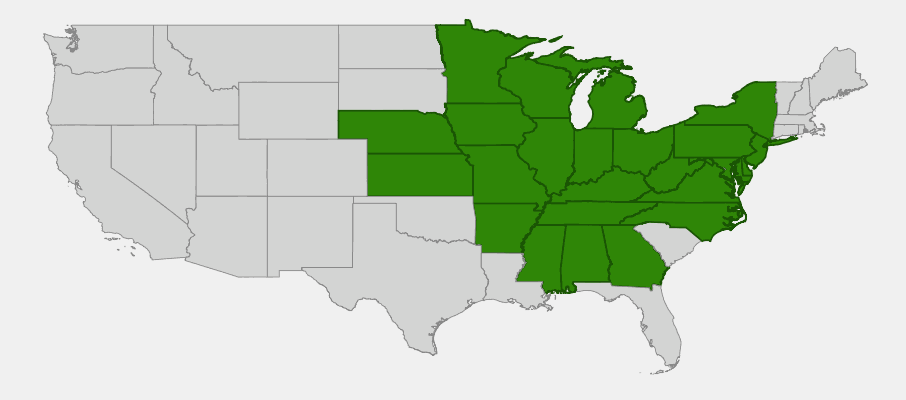
Jacob’s Ladder is native to a broad swath of the eastern and central United States, ranging from New England west to the Great Plains and south to the Gulf states. Its natural range includes New York, New Jersey, Pennsylvania, Ohio, Indiana, Kentucky, Tennessee, Virginia, West Virginia, and south to Georgia and Alabama, as well as westward through Missouri, Arkansas, and into Kansas and Nebraska. The species is most abundant in rich, moist deciduous forests — particularly in bottomland and mesophytic forest habitats — though it also occurs in upland wooded slopes with adequate moisture.
In the northeastern states, Jacob’s Ladder is found most commonly in rich woodland understories, particularly in beech-maple-basswood forests and along shaded, moist slopes. It grows alongside bloodroot, trillium, wild ginger, and Virginia bluebells in these rich forest communities, typically in soils with high organic matter content and consistent moisture. The species tolerates more shade than many native wildflowers, making it valuable for deeply shaded garden situations where other plants struggle to bloom.
Jacob’s Ladder is not rare, but it is rarely dominant — it tends to occur in scattered individuals or small colonies rather than forming large stands. Its ability to spread gently by rhizomes and self-sow makes it a good colonizer of disturbed but moist, shaded areas, and it is commonly seen spreading into shaded garden paths and borders where conditions suit it. The related Polemonium caeruleum, native to Europe and Asia, is commonly sold in nurseries but is not native to North America — when purchasing, verify that you are getting the North American native P. reptans.
📋 Regional plant lists featuring Jacob’s Ladder: New York, Pennsylvania & New Jersey
Growing & Care Guide
Jacob’s Ladder is an easy, adaptable shade garden perennial that rewards minimal care with reliable annual bloom. Its main requirements are shade, consistent moisture, and rich, humus-rich soil — conditions that mimic its natural woodland habitat.
Light
Jacob’s Ladder performs best in part shade to full shade — typically 2 to 4 hours of dappled sunlight per day, such as the light found beneath deciduous trees or on the north side of structures. In deep shade it will grow but bloom less prolifically. In too much sun, particularly afternoon sun, the foliage scorches and the plant declines, especially in the heat of summer. This makes it excellent for those challenging shaded garden spots where few other flowering perennials thrive.
Soil & Water
Consistent moisture is important — Jacob’s Ladder dislikes drought and may go partially dormant in dry summers. It thrives in moist, well-drained soil rich in organic matter, with a slightly acidic to neutral pH (5.5–7.0). Amending planting beds with compost significantly improves performance. Mulching with 2 inches of leaf litter or shredded bark (mimicking the natural forest floor) helps retain soil moisture and keeps the shallow roots cool and moist. In heavy clay soils, improve drainage by incorporating organic matter before planting.
Planting Tips
Plant Jacob’s Ladder in spring or fall. Space plants 12 to 18 inches apart for a woodland groundcover effect, or 18 to 24 inches apart for specimen plantings. The plant self-sows gently and will spread gradually to fill available space in suitable conditions. Divide clumps every 3–4 years in early spring to maintain vigor and increase your planting. Jacob’s Ladder is excellent for combining with other shade-tolerant native wildflowers — try it with wild ginger as groundcover, bleeding heart for color contrast, and Solomon’s seal for vertical interest.
Pruning & Maintenance
After the spring bloom, deadhead spent flowers to prevent excessive self-sowing (unless you want the plant to naturalize). The attractive foliage typically remains green through summer, though in hot, dry conditions the plant may become ragged — cutting back the foliage in midsummer encourages fresh new growth in fall. In very hot regions (Zone 7 and south), Jacob’s Ladder may go dormant in summer heat and re-emerge in fall. Cut the entire plant back in late fall or early winter after frost, and mulch the crown for winter protection in Zone 4 and below.
Landscape Uses
- Woodland garden — naturalizes beautifully in the shaded understory
- Front-of-border perennial — low, tidy mound with spring bloom
- Shaded path edging — spreads gently into path margins
- Ground cover under trees — fills shaded areas with attractive foliage
- Rain garden shade zone — tolerates moist conditions
- Native plant starter garden — easy, rewarding, and forgiving
Wildlife & Ecological Value
Though small and unassuming, Jacob’s Ladder provides important ecological services in the shaded garden environment, particularly for early spring pollinators.
For Birds
Jacob’s Ladder’s small seeds attract finches and sparrows, and the dense, low mounding growth provides cover and nesting material for ground-nesting birds. The insects attracted to the flowers — especially small native bees and flies — are important food sources for breeding songbirds in spring, when protein-rich insect food is critical for raising nestlings.
For Mammals
Jacob’s Ladder is generally not a significant mammal food source. It has some deer resistance due to slightly aromatic foliage, though young plants may be browsed in high-deer-pressure areas. The dense colonies provide cover for small mammals including salamanders, toads, and woodland mice.
For Pollinators
The bell-shaped flowers of Jacob’s Ladder provide nectar and pollen for native bees, particularly small mining bees (Andrena species) and mason bees that are active in April and May. Bumblebee queens — just emerged from winter hibernation — also visit the flowers. The blooming period in April coincides with a critical nectar dearth in the woodland garden, making Jacob’s Ladder an important early-season pollen and nectar source. Various small flies and beetles also visit the flowers, contributing to pollination.
Ecosystem Role
In the woodland understory, Jacob’s Ladder contributes to the spring wildflower community that takes advantage of the brief window of light before the forest canopy closes in. As part of the diverse woodland ground layer, it stabilizes soil, cycles nutrients, and supports the food web through its insect associations. The spring ephemeral community of which Jacob’s Ladder is a part plays a disproportionately important role in eastern forest ecosystems relative to the brief period during which it is active.
Cultural & Historical Uses
The genus Polemonium has a long history of medicinal use. Indigenous peoples of North America used various Polemonium species for medicinal preparations, including root decoctions to treat fevers, coughs, and skin complaints. The Cherokee used P. reptans root preparations for nervous conditions and as a general tonic. The Iroquois used the plant for venereal diseases, and various preparations were used as diuretics and to treat bites and stings. The roots have an unpleasant skunk-like odor when fresh, which may have contributed to the folk name “Abscess Root” for the closely related P. van-bruntiae.
In the European tradition, the related Polemonium caeruleum (Greek Valerian) was extensively used in herbal medicine and was included in medieval pharmacopeias as a treatment for epilepsy, fevers, and various nervous conditions. The American species P. reptans was adopted into the American Eclectic medical tradition and was included in the U.S. Pharmacopeia for a period in the 19th century as a treatment for pleurisy, pneumonia, and febrile conditions, where it was used to promote sweating and reduce fever.
The common name “Jacob’s Ladder” was applied to this plant and to the related European species by early European settlers in North America, drawing on the biblical imagery of the ladder ascending to heaven described in Genesis 28:12. The distinctive pinnate leaves, with their paired leaflets arranged like the rungs of a ladder, made the connection immediate and memorable. Today, Jacob’s Ladder is grown primarily as an ornamental native perennial, valued for its early spring bloom, attractive foliage, shade tolerance, and gentle naturalizing habit in woodland gardens throughout the eastern United States.
Frequently Asked Questions
Is Polemonium reptans the same as the Jacob’s Ladder sold in garden centers?
Not always — many garden centers sell the European Polemonium caeruleum, which is not native to North America. Look for P. reptans specifically when buying for a native plant garden. Native plant nurseries and specialty native plant sales are the best sources. The two species look similar but P. caeruleum is taller and slightly different in flower form.
Why is my Jacob’s Ladder disappearing in summer?
Jacob’s Ladder may go partially or fully dormant in summer heat, especially in warmer zones or during drought. This is normal behavior — the plant will return in fall with new foliage and again in spring. Consistent moisture and mulching help keep it active through summer in cooler climates. In Zone 7 and warmer, summer dormancy is common.
Can Jacob’s Ladder grow in deep shade?
It can survive in deep shade but performs best in dappled or part shade with 2–4 hours of indirect light. In very deep shade it produces fewer flowers and grows more sparsely. The ideal location is beneath high-canopy deciduous trees where filtered light reaches the forest floor.
Does Jacob’s Ladder self-seed?
Yes, modestly. Jacob’s Ladder self-sows gently and produces seedlings that can be left to naturalize or transplanted when small. The self-seeding is not aggressive enough to be a nuisance in most garden situations, and in a woodland setting the naturalized colony creates a beautiful spring display. Deadheading after bloom reduces but does not eliminate self-seeding.
How do I propagate Jacob’s Ladder?
The easiest method is division in early spring, before or just as growth begins. Lift the clump, divide it into sections with at least one or two growing points each, and replant. Self-sown seedlings can also be transplanted when small. Growing from seed is possible — seeds need a cold, moist stratification period of 60–90 days before they will germinate, simulating the natural overwintering process.

Looking for a nursery that carries Jacob’s Ladder?
Browse our native plant nursery directory: New York · Pennsylvania