Swamp Sunflower (Helianthus angustifolius)
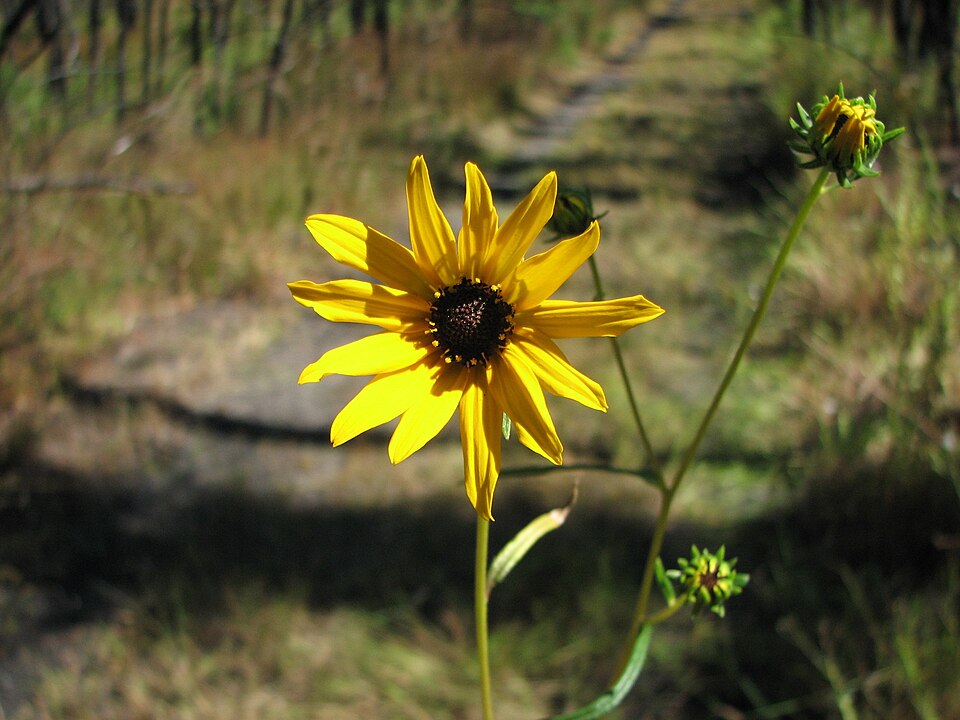
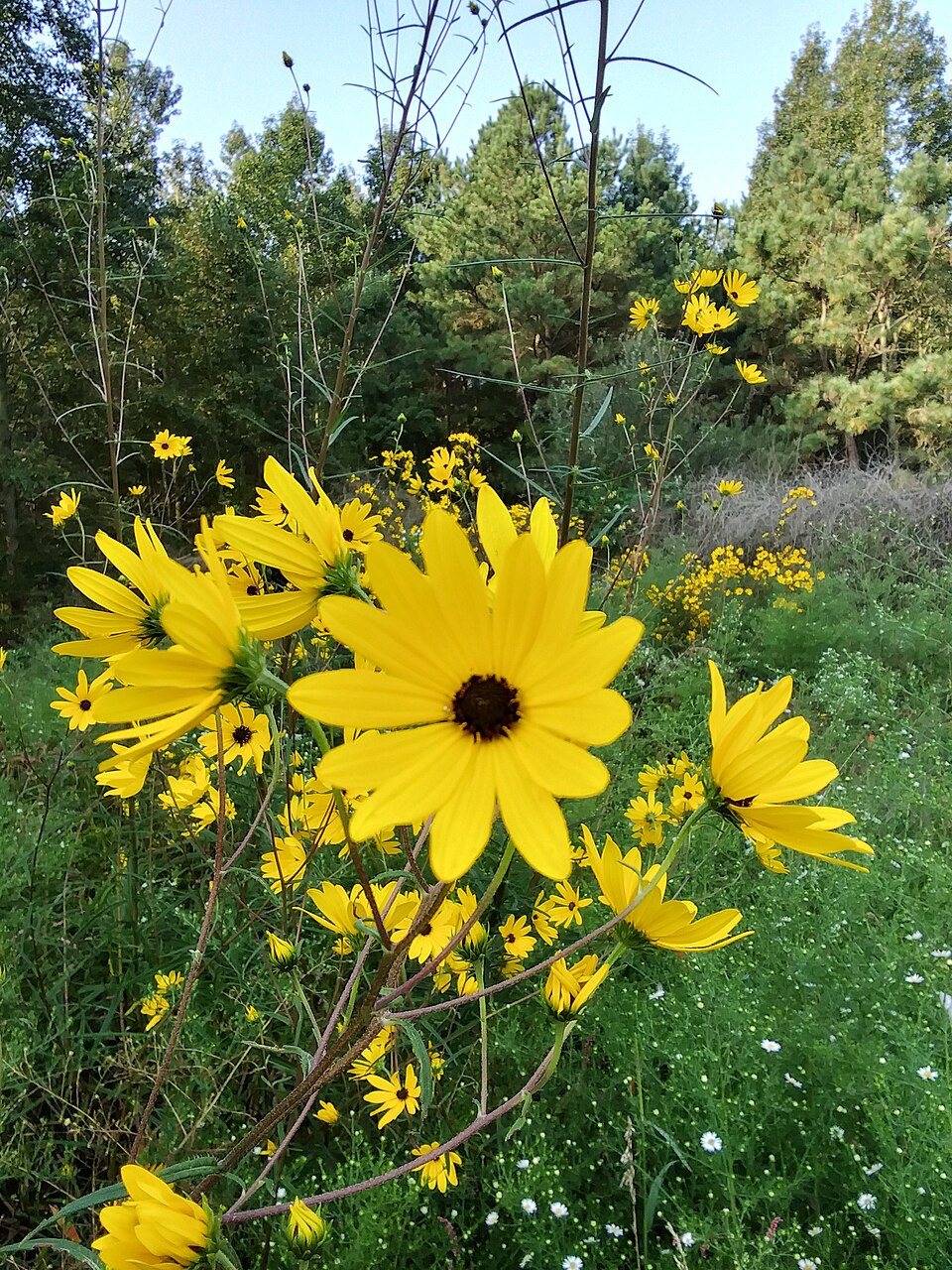
Helianthus angustifolius, commonly known as Swamp Sunflower or Narrow-Leaf Sunflower, is one of the most spectacular native perennials for the late-season garden. A member of the aster family (Asteraceae), it produces a breathtaking display of bright yellow, 2- to 3-inch daisy-like flowers with distinctive dark reddish-purple central discs from September through November — precisely when most other garden plants are winding down for the season. At the peak of bloom, a mature Swamp Sunflower plant literally glows with color, its deep yellow rays catching the low-angled autumn sun in a way that makes the whole garden come alive.
Swamp Sunflower grows vigorously, reaching 5 to 8 feet tall in rich, moist soils, with narrow, dark green leaves that give the species its botanical name (angustifolius = “narrow-leaved”). Despite the name “Swamp” Sunflower, this plant is remarkably adaptable — it thrives in average garden soil with moderate moisture just as well as in wetter sites, and once established develops good drought tolerance. In New York, Pennsylvania, and New Jersey it is an excellent choice for the back of a sunny border, as a naturalized meadow plant, or anywhere you need a tall, bold, wildlife-supporting native perennial with a spectacular fall show.
For wildlife gardeners, Swamp Sunflower is especially valuable: its flowers support an extraordinary diversity of native bees, butterflies, and other pollinators during the critical fall migration period, while its abundant seed production feeds finches, sparrows, and other seed-eating birds through fall and winter. Combined with its striking ornamental appeal, rugged adaptability, and long bloom season, Swamp Sunflower is an indispensable native plant for gardens throughout the Mid-Atlantic and northeastern states.
Identification
Swamp Sunflower is a tall, upright perennial herb that grows from a fibrous root system with rhizomes that allow it to form spreading clumps over time. In garden conditions, plants typically reach 5 to 8 feet tall at bloom (September–November), with sturdy, rough-hairy stems that branch in the upper third to carry numerous flower heads. The rough, hairy texture of stems and leaves is characteristic of Helianthus species and helps distinguish them from similar composites like Rudbeckia and Boltonia.
Leaves
The leaves are the key identification feature that distinguishes Swamp Sunflower from other native sunflowers — they are distinctly narrow and lance-shaped, typically 3 to 7 inches long but only ½ to ¾ inch wide, with entire or slightly toothed margins and a rough, sandpaper-like texture on both surfaces. This narrow leaf shape (captured in the name angustifolius) is very different from the broad, heart-shaped leaves of other sunflowers. The leaves are dark green above and paler below, arranged alternately on the stem.
Flowers & Fruit
The flower heads are 2 to 3 inches in diameter, with 10 to 20 bright yellow ray florets surrounding a small, rounded, dark reddish-purple to chocolate-brown central disc of tiny disc florets. The contrast between the vivid yellow rays and the dark disc is particularly striking in this species — more dramatic than most other sunflowers. Blooming begins in late August in the warmest parts of the range and peaks in September and October in New York, New Jersey, and Pennsylvania, continuing until the first hard frost. After flowering, the disc develops seeds (achenes) that are consumed by birds through fall and winter. The plant self-sows from these seeds and also spreads vegetatively by rhizomes.
Quick Facts
| Scientific Name | Helianthus angustifolius |
| Family | Asteraceae (Aster / Composite) |
| Plant Type | Herbaceous Perennial |
| Mature Height | 6 ft |
| Sun Exposure | Full Sun |
| Water Needs | Moderate |
| Bloom Time | September – November |
| Flower Color | Bright yellow with dark reddish-purple center |
| USDA Hardiness Zones | 5–9 |
Native Range
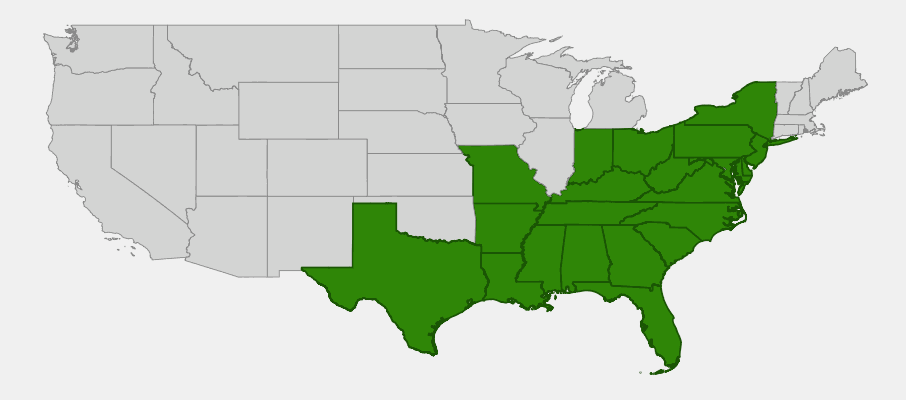
Swamp Sunflower is native to the eastern United States, ranging from New York and New Jersey south through the Coastal Plain and Piedmont to Florida, and westward through the Gulf States to Texas, north to Missouri and Arkansas, and into parts of the Midwest including Ohio and Indiana. It is most abundant in the southeastern states and along the Atlantic Coastal Plain, where it grows in wet meadows, pocosins, flatwoods, and roadside ditches. In the northern part of its range — including New York, New Jersey, and Pennsylvania — it tends to grow in full sun in seasonally moist meadows and along streams.
Despite its name, Swamp Sunflower is not strictly confined to swampy habitats. In its natural range it grows in a variety of moist to average soil conditions — wet meadows, roadsides, pond edges, and disturbed areas along streams — and it is quite adaptable in cultivation. The “swamp” in its common name refers to its tolerance of wet conditions and its preference for moister soils than most other native sunflowers, not to a requirement for standing water or saturated soils. Established plants in average garden soil can survive extended drought periods, making them more versatile than their common name implies.
In the northeastern states, Swamp Sunflower is at the northern edge of its natural range, and garden populations may represent both truly native plants and naturalized escapes from cultivation. The species has become increasingly popular in northeastern gardens due to its spectacular fall display and wildlife value, and it has naturalized beyond its original range in many areas. It is not considered invasive, and its value for native pollinators and seed-eating birds makes it a welcome addition wherever it appears.
📋 Regional plant lists featuring Swamp Sunflower: New York, Pennsylvania & New Jersey
Growing & Care Guide
Swamp Sunflower is a vigorous, adaptable perennial that delivers a stunning fall display with minimal care. Its main requirements are full sun and adequate moisture; once established it is tough, drought tolerant, and reliably spectacular year after year.
Light
Full sun is essential — Swamp Sunflower is a sun lover that does not compromise well on light. In full sun (6+ hours of direct sun daily) it produces compact, sturdy stems and abundant flowers. In less than 5 hours of direct sun, the plant becomes tall and floppy, producing fewer flowers on weaker stems. The contrast between the vivid yellow flowers and the low-angled autumn sun is most dramatic when the plant is sited where it catches the morning or late afternoon light.
Soil & Water
Swamp Sunflower is more adaptable in the garden than its common name suggests. It performs well in average, moderately moist garden soil as well as in wetter conditions. It tolerates clay soils, sandy soils, and periodic flooding. In rich soils, it may grow exceptionally tall (7–8 feet) and may need support — lean or average soils produce more compact plants. Once established, it develops reasonable drought tolerance and requires little supplemental irrigation in most northeastern gardens. For the wettest sites — pond edges, rain gardens, and seasonally flooded areas — it is one of the best tall native perennials available.
Planting Tips
Plant Swamp Sunflower in spring or fall. Space plants 3 to 4 feet apart to allow for spread — the rhizomes spread moderately and the plant will form an expanding clump over time. To control height and prevent flopping in rich soils, cut the stems back by one-third in June (“Chelsea chop”) to produce bushier, shorter plants that bloom slightly later but stand more firmly. Swamp Sunflower self-sows and spreads by rhizomes — manage the spread by removing seedlings and dividing clumps every 3–4 years in spring.
Pruning & Maintenance
Leave the seed heads standing through winter to feed birds. Cut back to the ground in late winter or early spring before new growth emerges. Swamp Sunflower spreads vigorously by rhizomes and can become invasive in small, formal gardens — divide regularly or plant in areas where spreading is acceptable. It is generally free of serious pests and diseases, though aphids may appear on new growth in spring (natural predators typically control them without intervention). Deer occasionally browse the foliage but rarely severely damage established plants.
Landscape Uses
- Back-of-border specimen — dramatic height and color in the fall garden
- Prairie and meadow planting — naturalizes beautifully in sunny meadow gardens
- Rain garden — excellent for seasonally wet areas
- Wildlife garden anchor — superb pollinator and bird seed plant
- Wetland margin planting — stabilizes pond edges and stream banks
- Cut flower garden — long-lasting in fresh and dried arrangements
Wildlife & Ecological Value
Swamp Sunflower is one of the most ecologically productive native perennials for fall wildlife support, providing nectar, pollen, and seeds at a time of critical need for migrating and wintering wildlife.
For Birds
The seeds of Swamp Sunflower are eagerly consumed by American Goldfinches, House Finches, Purple Finches, Pine Siskins, Dark-eyed Juncos, and various sparrows through fall and winter. Goldfinches in particular are devoted foragers at sunflower seed heads, clinging acrobatically while extracting seeds. The tall, stout stems provide perches for birds scanning for insects and predators, and the dense clumps provide protective cover for ground-nesting and ground-foraging birds including sparrows and wrens. Leaving the seed heads standing through winter provides months of bird feeding value with no effort required.
For Mammals
White-tailed deer occasionally browse Swamp Sunflower foliage, particularly on young plants in spring. Chipmunks and field mice consume fallen seeds from the ground. Small mammals use the dense clumps as cover. The spreading rhizomes of established plants are rarely disturbed by mammal activity.
For Pollinators
Swamp Sunflower is an exceptional late-season pollinator plant, providing nectar and pollen during the September–October period when most other wildflowers have finished blooming and pollinators are most desperate for fuel. Bumble bees — especially Bombus impatiens, B. griseocollis, and B. pensylvanicus — are frequent and enthusiastic visitors, collecting both nectar and pollen. Native sweat bees, mining bees, and leafcutter bees also visit regularly. Migrating monarch butterflies nectar heavily at fall-blooming wildflowers including Swamp Sunflower as they make their way south. Painted Ladies, Sulphurs, and various skipper butterflies are also common visitors during peak bloom. The sunflower bee (Diadasia species) is a specialist on Helianthus flowers and relies heavily on native sunflowers for its reproduction.
Ecosystem Role
In meadow and wetland margin communities, Swamp Sunflower plays an important role in the late-season plant community — one of the last native plants to bloom before winter arrives, it serves as a critical “fuel stop” for southward-migrating pollinators and a food reservoir for resident seed-eating birds. Its vigorous spreading habit and tall stature allow it to compete successfully in moist, open habitats, while the dense clumps it forms provide cover and nesting habitat for small wildlife. The decaying stems provide overwintering habitat for native bees that nest in hollow or pithy stems — an often overlooked but ecologically important function.
Cultural & Historical Uses
Native sunflowers — the genus Helianthus, which contains approximately 70 species all native to North America — have a long and important history of human use. The genus is named from the Greek helios (sun) and anthos (flower), capturing the characteristic bright yellow color and sun-facing habit of the flowers. While H. angustifolius was not as widely used as the annual common sunflower (H. annuus), various Indigenous peoples across the southeastern United States used native perennial sunflowers as food sources. The starchy tuberous roots of some perennial sunflower species were roasted and eaten, though H. angustifolius roots are not notably palatable.
The Cherokee used various Helianthus species medicinally — root preparations were used for kidney problems, and seeds were consumed as food. The Choctaw and other southeastern nations used sunflower seeds and oil in food preparation. The seeds of native sunflowers were important in trade networks among Indigenous peoples, and sunflower cultivation was among the earliest plant domestication efforts in eastern North America, predating European contact by thousands of years. Archaeological evidence suggests that sunflowers were cultivated in the eastern United States as early as 2800 BCE, making them among the oldest cultivated crops on the continent.
In contemporary horticulture, Swamp Sunflower has gained significant recognition as a valuable garden plant, particularly for late-season interest and wildlife gardens. It was selected as a Perennial Plant of the Year by the Perennial Plant Association and is now widely available at native plant nurseries and mainstream garden centers throughout the eastern United States. Selected cultivars including ‘First Light,’ which blooms earlier and more compactly, have made it more accessible for smaller garden spaces. Despite the appeal of compact cultivars, the straight species remains the best choice for maximum wildlife value, as cultivar selection can affect nectar and pollen availability for pollinators.
Frequently Asked Questions
Does Swamp Sunflower really need wet soil?
Despite its common name, Swamp Sunflower grows well in average, moderately moist garden soil. It tolerates wet conditions and seasonally flooded areas, but does not require standing water. In dry summers, established plants may show some stress but typically recover well once rainfall returns. For best results in drier gardens, plant in the lowest available areas where moisture naturally collects.
Why is my Swamp Sunflower so tall and floppy?
Rich, fertile soil and too much shade both cause excessively tall, weak-stemmed growth. Solutions include: planting in leaner soil without fertilization, ensuring at least 6 hours of direct sun, and cutting the stems back by one-third in early June (“Chelsea chop”) to produce shorter, bushier plants. Dividing the clump regularly also helps maintain vigor and compact habit.
How do I control the spreading?
Swamp Sunflower spreads by rhizomes and self-seeding. Control the spread by dividing the clump every 2–3 years in spring — this also rejuvenates the plant and maintains vigor. Remove self-sown seedlings when small. In formal garden settings, install root barrier around the planting to contain rhizome spread. In naturalistic and wildlife gardens, the spreading habit is often welcome as it fills space and produces more flowers and wildlife habitat.
When does Swamp Sunflower start blooming?
In New York, New Jersey, and Pennsylvania, Swamp Sunflower typically begins blooming in late August to mid-September, with peak bloom in late September through mid-October. The bloom season continues until the first hard frost. This late timing makes it one of the most valuable fall-blooming plants in the garden, providing color and pollinator support after most other species have finished.
Is Swamp Sunflower invasive?
No — Swamp Sunflower is a native plant, not an invasive species. It can spread vigorously in favorable conditions, which is desirable in naturalistic gardens and ecological plantings. In formal gardens where spread needs to be controlled, divide the clump regularly and remove unwanted seedlings. The plant does not out-compete established native plant communities and is not listed as invasive in any northeastern state.

Looking for a nursery that carries Swamp Sunflower?
Browse our native plant nursery directory: New York · Pennsylvania