Blue Camas (Camassia quamash)
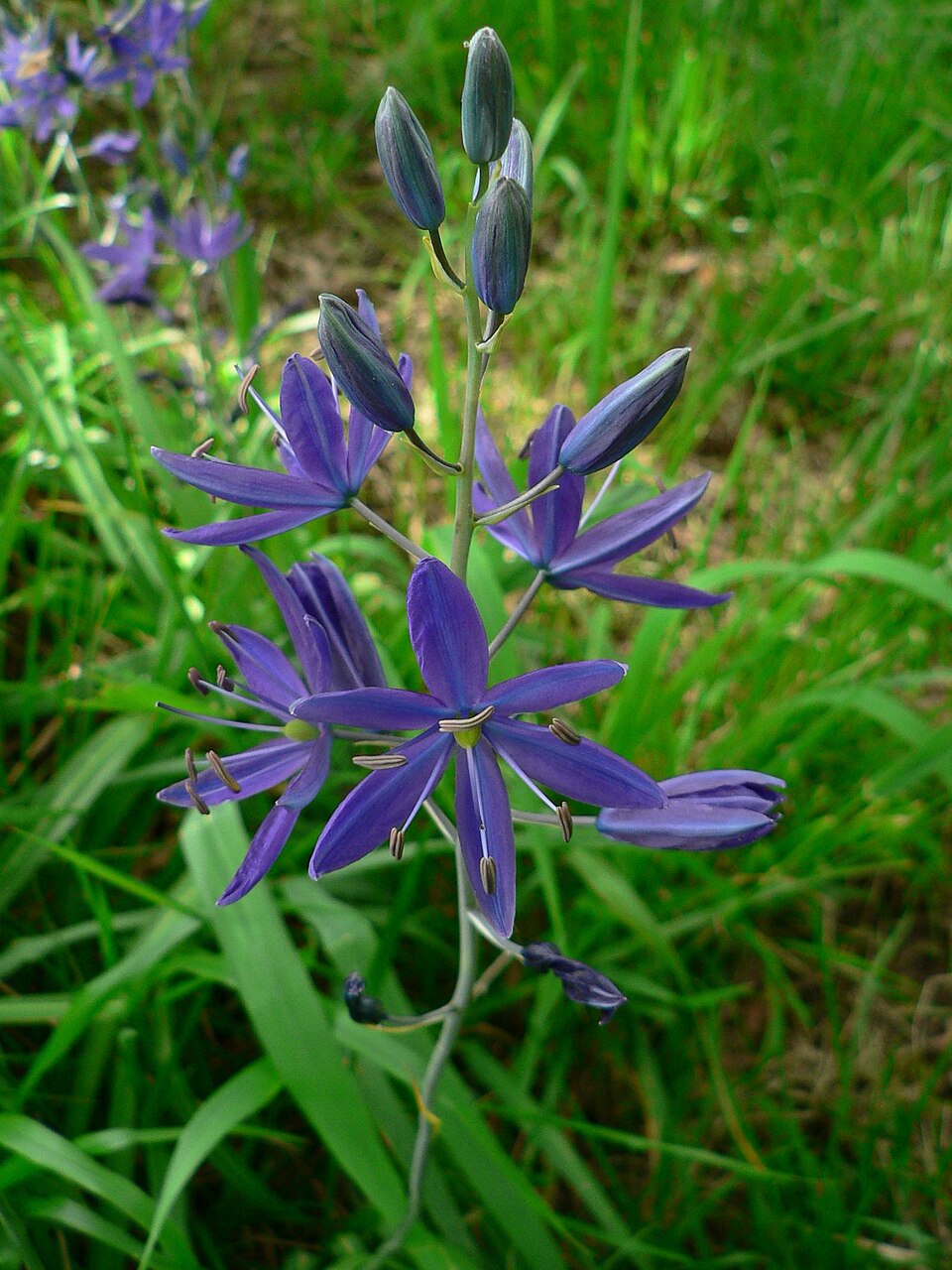
Camassia quamash, commonly known as Blue Camas, Common Camas, or Quamash, is one of the most ecologically and culturally significant native wildflowers of the Pacific Northwest and Intermountain West. A member of the Asparagaceae family (formerly Liliaceae), this stunning bulbous perennial produces vivid blue-violet flower spikes in late spring that historically turned entire meadows into shimmering blue-purple seas. For countless generations, Blue Camas was a cornerstone of Indigenous food systems across the region — its starchy bulbs were a critical staple, traded widely and celebrated in ceremony.
Blue Camas grows naturally in seasonally moist meadows, grasslands, and open woodlands, thriving in areas that are wet in spring and dry in summer. It reaches 1 to 2 feet in height, producing a basal rosette of long, grass-like leaves topped by a tall spike of star-shaped flowers with six bright blue-to-violet petals and conspicuous yellow stamens. Each bulb is about the size of a small onion and was prepared by Indigenous peoples through long pit-roasting or steaming, converting inulin into digestible sugars and creating a sweet, slightly sticky food. Dried, the bulbs were also ground into flour for bread and porridge.
Beyond its deep cultural heritage, Blue Camas is an outstanding garden plant for native landscapes, rain gardens, and wetland-edge plantings. Its dramatic spring display, wildlife value, and ease of care make it a favorite among native plant gardeners throughout the Pacific Northwest, northern Rockies, and Great Basin. It naturalizes readily in moist turf and meadow areas, blooming alongside Death Camas (Zigadenus spp.) — which it closely resembles before flowering, requiring careful identification when harvesting.
Identification
Blue Camas grows from a dark-coated bulb (1–2 inches in diameter) that closely resembles an onion but lacks any onion scent. The plant produces a basal cluster of narrow, grass-like leaves (up to 18 inches long) and a single erect flowering stem topped with a loose raceme of star-shaped flowers. At its peak bloom in May–June, the flower spike stands 12–24 inches tall.
Leaves
The leaves are linear, grass-like, and keeled (folded along the midrib), typically 6–18 inches long and ¼ to ½ inch wide. They are smooth, slightly blue-green, and emerge directly from the basal rosette. The leaves persist through the growing season and die back in summer as the plant enters dormancy. Caution: Before flowering, Blue Camas leaves are nearly identical to Death Camas (Anticlea elegans or Zigadenus spp.); never harvest bulbs before the blue flowers confirm identity.
Flowers & Fruit
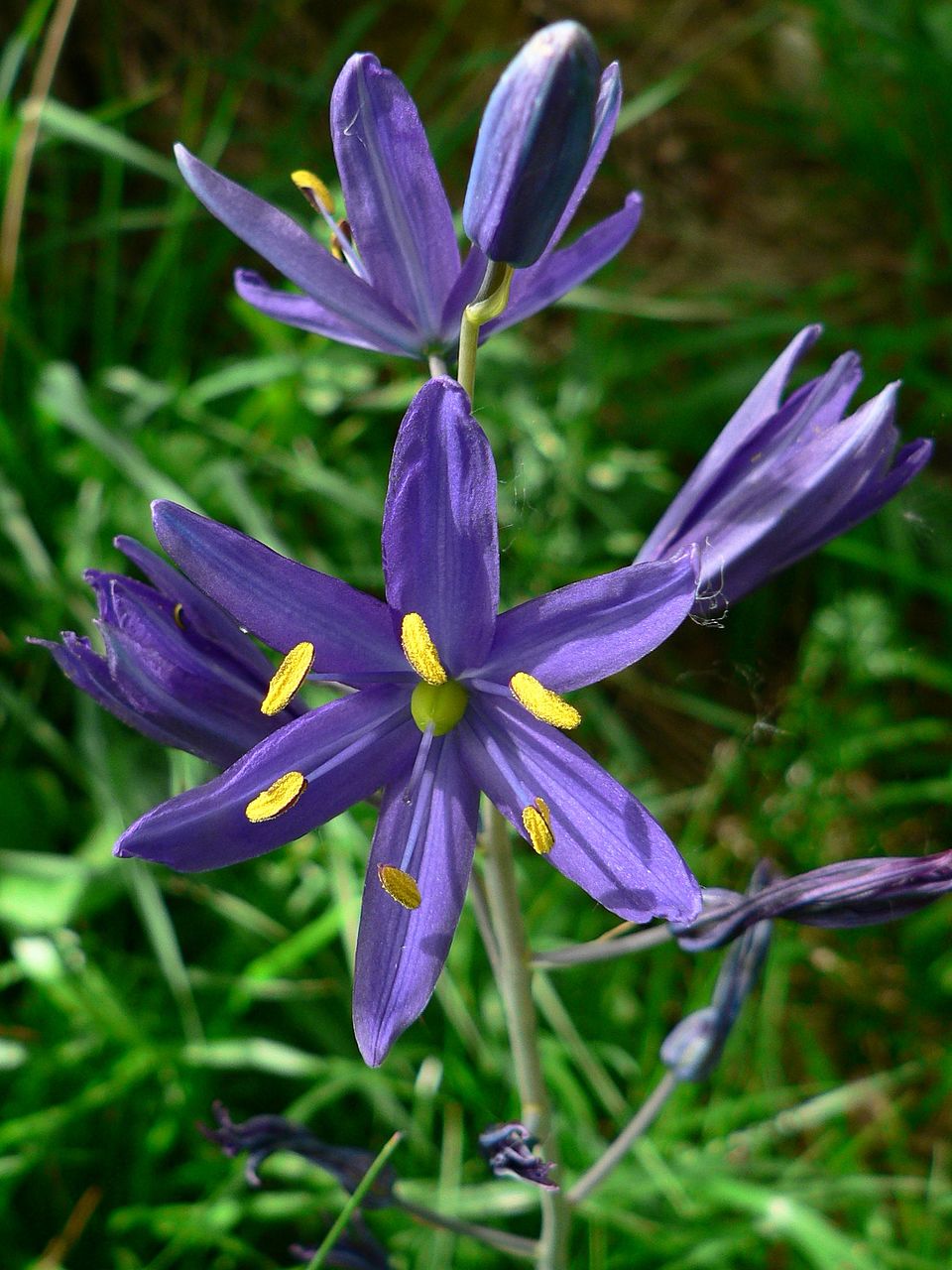
The flowers are star-shaped with six bright blue-to-violet tepals (petals and sepals appearing alike), each ½ to ¾ inch long, with six prominent yellow anthers forming a golden center. Flowers open progressively from bottom to top along the raceme. A diagnostic feature of Camassia quamash is the slightly irregular arrangement — one tepal often curves away from the others after flowering. The bloom period is May–June, lasting 2–3 weeks at a given location. After flowering, the plant produces ovoid green seed capsules containing 2–6 shiny black seeds. The fruit is not significant for wildlife, but bulb offsets naturalize slowly in favorable conditions.
Quick Facts
| Scientific Name | Camassia quamash |
| Family | Asparagaceae (formerly Liliaceae) |
| Plant Type | Perennial Bulb / Wildflower |
| Mature Height | 1–2 ft |
| Sun Exposure | Full Sun |
| Water Needs | High |
| Bloom Time | May – June |
| Flower Color | Blue to blue-violet (with yellow stamens) |
| Soil Type | Moist, clay to loamy; seasonally wet |
| Deer Resistant | Moderately (bulbs protected underground) |
| USDA Hardiness Zones | 4–9 |
Native Range
Blue Camas is native to western North America, extending from southern British Columbia and Alberta in Canada south through Washington, Oregon, Idaho, and Montana, and reaching into northern California, Nevada, Utah, and Wyoming. The species achieves its greatest abundance in the Willamette Valley of Oregon and the Camas Prairie of Idaho, where it historically formed vast monocultures of blue-flowering meadows covering thousands of acres during peak bloom in late May.
In its natural habitat, Blue Camas grows in seasonally flooded grasslands, wet prairies, and moist mountain meadows — areas that are inundated or waterlogged in winter and spring, then dry out as summer progresses. It is especially abundant in areas with heavy clay soils that retain winter moisture but drain adequately by summer. Blue Camas meadows are ancient features of the Pacific Northwest landscape, shaped over millennia by Indigenous burning and harvesting practices that maintained open grassland conditions.
The historical distribution of Blue Camas has been significantly reduced by land conversion — particularly the draining of seasonal wetlands for agriculture and urban development. Many of the great camas prairies of Oregon’s Willamette Valley have been replaced by farmland and cities. Conservation efforts by tribal nations and land trusts work to preserve and restore remaining camas meadows, recognizing their irreplaceable ecological and cultural value.
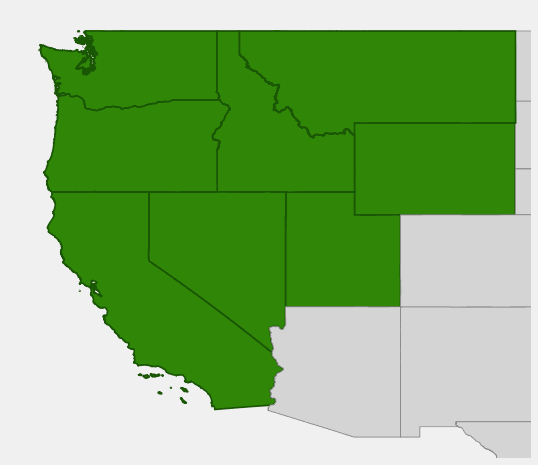
📋 Regional plant lists featuring Blue Camas: Intermountain West
Growing & Care Guide
Blue Camas is a rewarding and relatively easy native perennial for gardeners who can provide the key ingredient it needs: reliable moisture in spring. Once established, it naturalizes readily and rewards growers with spectacular blue-violet flower spikes that no other spring bulb can match.
Light
Blue Camas thrives in full sun, which drives the most prolific flowering and strongest bulb development. It can tolerate light shade — particularly from deciduous trees that leaf out after the camas blooms — but deep shade significantly reduces flowering. In the wild, camas meadows are typically open, sun-drenched grasslands, and garden plantings should mimic these conditions for best results.
Soil & Water
The key to success with Blue Camas is understanding its seasonal water cycle: wet in spring (when it’s actively growing and blooming), drier in summer and fall (when it’s dormant). Heavy clay soils that hold winter and spring moisture work especially well. Sandy, fast-draining soils are less suitable unless supplemental irrigation is provided in spring. Avoid planting in areas where summer irrigation is unavoidable — standing water in summer encourages bulb rot. Rain gardens, pond margins, and naturally moist meadows are ideal placements.
Planting Tips
Plant camas bulbs in fall (September–November), about 3–4 inches deep and 4–6 inches apart. Place them in informal drifts of 25 or more for the most dramatic effect — isolated single plants look sparse at bloom time. Camas also establishes well from seed but requires 3–4 years to reach flowering size. When transplanting established clumps, do so in summer after the foliage has died back completely. Mark planting locations carefully to avoid accidental disturbance when the plant is dormant.
Pruning & Maintenance
Blue Camas requires virtually no maintenance once established. After bloom, allow the seed capsules to mature and shatter naturally to encourage self-seeding. Cut back or leave the yellowing foliage to die back on its own — the bulbs need this period to photosynthesize and store energy for next spring. Division of large clumps every 5–7 years rejuvenates blooming and provides additional bulbs for naturalizing in new areas.
Landscape Uses
Blue Camas is a versatile plant for naturalistic Pacific Northwest and Intermountain West gardens:
- Native meadow and prairie plantings — mass plantings create stunning blue-violet sweeps in spring
- Rain gardens and bioswales — thrives in seasonally wet areas that drain by summer
- Pond and stream margins — excellent for wet edges above the waterline
- Oak savanna restoration — historically grew beneath Garry Oak canopy
- Traditional food gardens — for Indigenous cultural landscapes and heritage gardens
- Mixed bulb borders — combines beautifully with native buttercups, shooting stars, and camas
Wildlife & Ecological Value
Blue Camas provides critical early-season resources for pollinators and contributes to the structure of the seasonally wet meadow ecosystems it inhabits.
For Pollinators
The large, open, bright blue flowers of Blue Camas are among the most effective pollinator attractors of any native spring bulb. Bumble bees are the primary pollinators, vibrating the anthers to release pollen (buzz pollination) — a technique uniquely effective on camas flowers. Many solitary native bee species, including mining bees (Andrena spp.) and sweat bees (Lasioglossum spp.), also visit for nectar and pollen. The flowering period in May–June coincides with peak queen bumble bee activity, making camas especially valuable for newly emerged colonies building their populations.
For Birds
While Blue Camas is not a primary food source for birds, its meadow habitat supports ground-nesting species including Western Meadowlarks, Savannah Sparrows, and Horned Larks. The structural diversity of camas meadows provides foraging habitat for many insectivorous birds during the breeding season, as the moist grassland supports abundant invertebrate populations.
For Mammals
Historically, Black Bears and Grizzly Bears dug camas bulbs extensively, particularly in Idaho and Montana. Roosevelt Elk consume the leaves and flowers in spring. Pocket gophers and voles eat the bulbs, and their tunneling inadvertently aerates and redistributes bulbs, contributing to the spread of camas populations across meadows. Indigenous peoples across the region maintained and expanded camas populations through intentional cultivation and harvesting — a form of land stewardship that shaped the landscape for thousands of years.
Ecosystem Role
Blue Camas meadows represent a distinct and increasingly rare ecosystem type in the Pacific Northwest — the seasonally flooded grassland. These meadows support extraordinary biodiversity, from specialized camas-associated pollinators to rare plant communities. The seasonal flooding cycle that camas requires also provides important water storage and filtration services. Camas meadows are among the most threatened grassland types in the Pacific Northwest, with less than 5% of historical Willamette Valley prairie habitat remaining.
Cultural & Historical Uses
Few plants in North America can match the cultural significance of Blue Camas to the Indigenous peoples of the Pacific Northwest and Intermountain West. For the Nez Perce (Nimiipuu), Shoshone-Bannock, Yakama, Kalapuya, and many other nations, camas was a dietary staple of immense importance — arguably the most significant food plant of the entire region. The word “quamash” itself is derived from Nez Perce, meaning “camas” or “sweet,” and the name was recorded by the Lewis and Clark Expedition in 1805 when they encountered enormous camas meadows in the Clearwater River region of Idaho. Captain Meriwether Lewis wrote that viewed from a distance, the camas fields resembled a lake of fine, clear water.
The preparation of camas bulbs required considerable labor and specialized knowledge. Bulbs were harvested using digging sticks in summer after the seeds had matured, when the leaves had yellowed — the timing was critical to distinguish the edible Blue Camas from the poisonous Death Camas (Anticlea elegans), which shares similar habitat. The harvested bulbs were pit-roasted in stone-lined pits over 2–3 days, a process that converted the inulin-rich starch into digestible fructose and gave the bulbs a sweet, molasses-like flavor and a dark, sticky texture. Cooked bulbs were eaten fresh, dried in cakes for winter storage, or traded widely across the region. Archaeological evidence indicates that camas has been a major food source in the Pacific Northwest for at least 3,500–4,000 years.
The Camas Prairie of Idaho holds particular historical significance — it was a major gathering ground for multiple tribes and the site of extensive camas harvesting and trade. The conflict over this prairie contributed directly to the Nez Perce War of 1877: when the U.S. government attempted to confine the Nez Perce to a reduced reservation and white settlers began plowing the camas fields and introducing hogs that rooted up the bulbs, tensions escalated into the tragic series of events that forced Chief Joseph’s band to attempt their 1,170-mile flight toward Canada. Today, the Camas Prairie of Idaho is still named for the plant that was at the heart of this history. Today, Blue Camas restoration is an important element of tribal cultural revitalization programs throughout its native range.
Frequently Asked Questions
Is Blue Camas poisonous?
Blue Camas bulbs are edible when properly prepared, but they must not be confused with Death Camas (Anticlea elegans or Zigadenus spp.), which is highly toxic. The two plants look nearly identical before flowering. Always wait until the blue flowers are fully open to confirm identity before harvesting. Once blooming, Blue Camas has distinctive blue-violet flowers; Death Camas flowers are creamy white. Never harvest camas bulbs without expert confirmation of identity.
Can Blue Camas grow in a regular garden?
Yes, with the right conditions. Blue Camas needs full sun and moist-to-wet soil in spring, but can tolerate dry summer conditions once dormant. Rain gardens, pond margins, and naturally moist areas of the garden work best. Avoid sandy, fast-draining soils or areas with summer irrigation that could rot the dormant bulbs.
When do Blue Camas bulbs bloom?
Blue Camas typically blooms May through June, depending on elevation and latitude. At low elevations in the Willamette Valley, peak bloom may occur as early as late April. At higher elevations (4,000–7,000 ft) in the Rocky Mountains, blooming can extend into July. The bloom period at a single location lasts 2–3 weeks.
How do I grow Blue Camas from bulbs?
Plant bulbs 3–4 inches deep in fall (September–November) in moist, clay-loamy soil in full sun. Space bulbs 4–6 inches apart and plant in groups of 25 or more for the best visual effect. Keep soil moist through spring bloom, then allow to dry as the plant enters summer dormancy. Bulbs naturalize slowly, forming expanding clumps over time.
What is Camas Prairie, Idaho?
Camas Prairie is a large volcanic-formed plateau in north-central Idaho (Camas, Idaho, and Lewis Counties) where Blue Camas historically grew in enormous abundance, creating spectacular blue-flowering meadows each spring. It was a critical gathering and trading site for Nez Perce and other tribes. Today, much of the prairie has been converted to wheat farming, but the name — and the plant — remain deeply significant to tribal nations of the region.