Pala Palai (Microlepia strigosa)
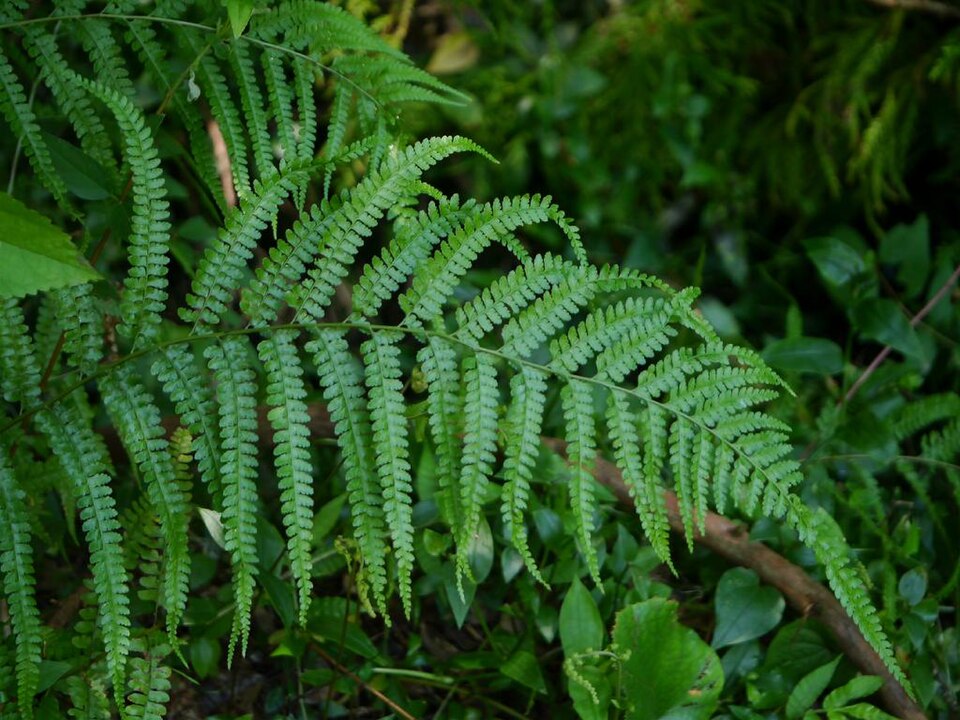
Microlepia strigosa, known in Hawaiian as Pala Palai, is one of the most culturally significant native ferns in Hawaiʻi — a graceful, lacy-fronded fern of the Dennstaedtiaceae (bracken fern) family that holds deep sacred associations with the hula tradition and the goddess Laka. The name pala palai is the Hawaiian term for this fern, and it translates loosely to the idea of fronds scattered or spread about — evoking the way Pala Palai’s arching, feathery fronds cascade and spread across the forest floor and hillsides where it grows.
Pala Palai is an indigenous fern in Hawaiʻi, occurring naturally across the main Hawaiian Islands in mesic (moderately moist) to wet forest environments from sea level to moderate elevations. It grows in dense, elegant clumps with 2 to 4-foot arching fronds that are distinctively soft and hairy to the touch — the specific epithet strigosa refers to this covering of stiff hairs (trichomes) on the frond surfaces and rachis (stem). In the forest, Pala Palai creates verdant, layered groundcover beneath native trees, contributing to the lush aesthetic that characterizes Hawaiian rainforest.
In Hawaiian cultural tradition, Pala Palai is one of the plants considered sacred to Laka, the goddess of hula, and it was traditionally gathered from the forest and placed on the hula altar (kuahu) where it was offered as a symbol of the forest’s beauty and of the dancer’s connection to the natural world. It is also woven into hula regalia (lei worn in the hair or around limbs during hula performance) and used in ceremony and lei-making. Unlike many hula plants that are endangered, Pala Palai remains relatively accessible in cultivation, making it a popular choice for traditional gardens and hula programs.
Identification
Pala Palai is a medium to large terrestrial fern that grows in spreading clumps. The fronds arise from a creeping, branching rhizome just below or at the soil surface. Individual fronds are erect to arching, typically 2 to 4 feet (60–120 cm) long, with an overall triangular to ovate outline. The texture of the fronds — soft, hairy, and somewhat delicate — distinguishes Pala Palai from other Hawaiian ferns at first touch.
Fronds & Pinnae
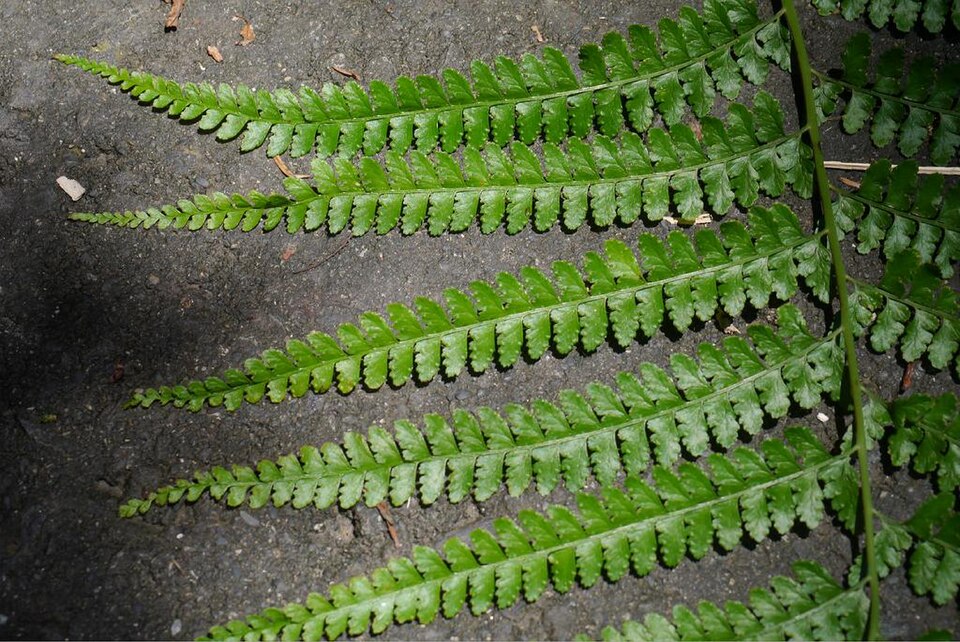
The fronds are 2 to 3 times pinnately compound (divided into pinnae, which are in turn divided into pinnules). The overall frond outline is elongated-triangular. Pinnae (primary divisions) are lanceolate, 4 to 8 inches long, with opposite arrangement along the frond rachis (main stem). Each pinna is divided into oblong pinnules with blunt, toothed margins. The texture throughout is soft and herbaceous rather than leathery, and both the rachis (stem) and pinna surfaces are covered with fine, stiff whitish hairs — giving the whole plant a slightly fuzzy or bristly texture and a grayish-green cast compared to many other ferns.
Sori & Reproduction
Like all ferns, Pala Palai reproduces by spores rather than seeds. The spore-bearing structures (sori) are small and marginal — located along the edges of the pinnule lobes, partially protected by a tiny flap of tissue (indusium) that folds over them. The sori appear as small brown dots or short lines along the margins of fertile pinnules. Fertile fronds are otherwise indistinguishable from sterile fronds. Pala Palai can also spread vegetatively through its spreading rhizome system, forming colonies over time.
Quick Facts
| Scientific Name | Microlepia strigosa |
| Family | Dennstaedtiaceae (Bracken Fern) |
| Plant Type | Terrestrial Fern (evergreen) |
| Mature Height | 2–4 ft (frond length) |
| Sun Exposure | Part Shade to Full Shade |
| Water Needs | Moderate to High |
| Cultural Use | Used in ceremonies and in making leis; sacred to Laka (hula) |
| Frond Texture | Soft and hairy (strigose) |
| Spread | Spreading via rhizomes; forms colonies |
| USDA Hardiness Zones | 9–12 |
Native Range
Pala Palai (Microlepia strigosa) is indigenous to the Hawaiian Islands, occurring on all of the main islands — Kaua’i, O’ahu, Moloka’i, Lāna’i, Maui, and Hawai’i. In its native range, it grows from near sea level up to approximately 4,000 feet elevation, with the greatest density in mesic forest zones in the 500 to 2,500 foot elevation band. It is especially common in moist ravines, stream valleys, and the edges of forested areas where shade and moisture are consistently available.
Beyond Hawaiʻi, Microlepia strigosa occurs across a broad range in the Indo-Pacific — including Japan, China, Southeast Asia, the Pacific Islands (Fiji, Polynesia), and Australia — making it one of the wider-ranging fern species found in Hawaiʻi. This broad distribution is typical of fern species whose spores can be dispersed by wind over very long distances, allowing colonization of island groups far from continental landmasses. In Hawaiʻi, the plant is considered indigenous (naturally arrived) rather than endemic, though it is as deeply embedded in Hawaiian ecology and culture as any strictly endemic species.
Within the Hawaiian forest landscape, Pala Palai contributes significantly to the ground and lower understory layer in native mesic forest communities. It is a common companion to ‘ōhi’a lehua trees, tree ferns (hāpu’u, Cibotium spp.), and a rich diversity of other native ferns and understory shrubs. The moist, shaded hillsides and gulches of each Hawaiian island support thriving communities of native ferns in which Pala Palai is often a conspicuous and dominant element.
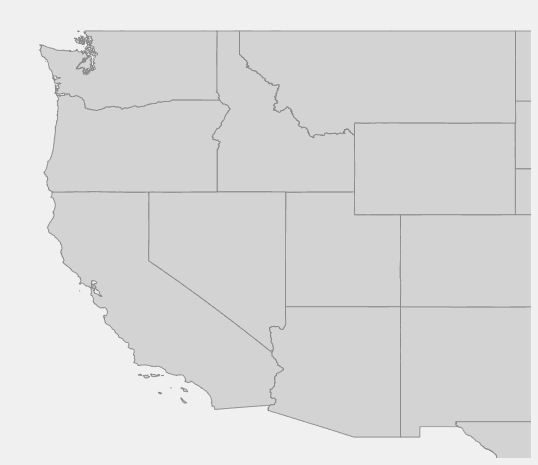
📋 Regional plant lists featuring Pala Palai: Hawaii
Growing & Care Guide
Pala Palai is one of the more accessible Hawaiian native ferns for home cultivation — easier to establish than many specialized forest ferns, and a beautiful addition to shaded, moist gardens throughout Hawaiʻi. Its cultural significance as a hula plant also makes it a rewarding choice for anyone interested in Hawaiian ethnobotany.
Light
Pala Palai thrives in partial to full shade, mimicking its natural forest understory habitat. Direct afternoon sun will scorch and dry the delicate fronds. Morning light or filtered, dappled shade throughout the day produces the best growth — vigorous fronds with good color and texture. Under deep shade with minimal light, growth is slower but healthy. This makes Pala Palai an excellent choice for north-facing slopes, the shade of buildings or walls, and under the canopy of established native or ornamental trees.
Soil & Water
Pala Palai prefers consistently moist, well-drained, humus-rich soil. In its native forest habitat, it grows in soils rich with organic matter from leaf litter and decomposing wood. In the garden, amend planting areas generously with compost, aged bark, or leaf mold. Mulching with organic material helps maintain soil moisture and mimic forest floor conditions. Regular watering is important — the plant should never dry out completely, especially in the first year. However, avoid waterlogging, which can cause rhizome rot.
Planting Tips
Plant Pala Palai from containers or rhizome divisions. Ensure the rhizome crown is at or just below the soil surface. Space plants 2–3 feet apart; as the rhizomes spread, they will gradually fill the space between plants. Water thoroughly after planting and maintain consistent moisture. Established clumps spread slowly by rhizome extension and can form attractive naturalistic groundcovers under trees. Pala Palai is available at Hawaiian native plant nurseries and from specialists in native ferns.
Pruning & Maintenance
Remove old, brown, or damaged fronds at the base as they die back. New fronds emerge continuously through the growing season, unfurling in the characteristic fiddlehead form of ferns. No heavy pruning is needed — the plant manages itself naturally in appropriate conditions. Occasional slug and snail damage may occur on young fronds; treat with iron phosphate bait if necessary. Scale insects can occasionally affect Pala Palai in enclosed garden situations — treat with horticultural oil if needed.
Landscape Uses
- Shade garden groundcover — excellent beneath native trees and large shrubs
- Hawaiian cultural garden — hula plant with deep ceremonial significance
- Streamside and ravine plantings — perfect for moist, shaded slopes
- Native forest understory restoration
- Container fern — adapts to large containers on shaded lanais
- Lei and ceremony plants — fronds are used in hula lei and altar arrangements
Wildlife & Ecological Value
In Hawaiian native forest ecosystems, Pala Palai contributes significantly to the structural complexity and biodiversity of the ground and understory layer.
For Birds
The dense frond cover of Pala Palai provides concealment and nesting habitat for ground-nesting birds and small forest species. The sheltered ground layer created by Pala Palai colonies also provides foraging habitat for native birds that probe leaf litter for invertebrates. In Hawaiian mesic forests, the fern understory — including Pala Palai — is essential habitat for the ‘Elepaio flycatcher and other ground-foraging native birds.
For Invertebrates
Native Hawaiian invertebrates, including endemic moths, beetles, and other arthropods, use Pala Palai fronds as food and habitat. The hairy frond surfaces may harbor small invertebrate communities. Fern fronds are also important egg-laying sites for some native Hawaiian insects. The decay of old Pala Palai fronds contributes to soil organic matter and supports the invertebrate decomposer community.
Ecosystem Role
As a spreading ground fern, Pala Palai plays an important role in native forest floor ecology. It reduces soil erosion on shaded slopes, retains soil moisture, and contributes significantly to leaf litter and organic matter cycling. In intact native Hawaiian forest, the fern understory — of which Pala Palai is a key component — supports the moisture regime, invertebrate diversity, and soil health that make Hawaiian mesic forest one of the most biologically rich environments in the Pacific.
Cultural & Historical Uses
Pala Palai is one of the plants most closely associated with Laka, the Hawaiian goddess of hula, beauty, and the wilderness. In the hula tradition, Pala Palai fronds are placed on the hula altar (kuahu Laka) as offerings alongside other sacred plants including Maile, ‘Ōhi’a lehua blossoms, and ‘Ie’ie vine. The fern’s delicate, spreading fronds — gracefully arching over the forest floor — evoke the flowing movement of hula itself, and wearing Pala Palai lei during hula is considered a way of embodying the forest’s beauty and invoking the presence of Laka.
Pala Palai lei are traditionally made by stringing individual pinnae (leaflets) or by braiding whole frond sections into garlands. Unlike some hula plants that are rare and difficult to obtain, Pala Palai can be cultivated relatively easily in appropriate garden settings, making it one of the more accessible hula plants for home growers. Many hula hālau (hula schools) maintain Pala Palai gardens to ensure a sustainable supply of this sacred fern for ceremonial and educational purposes.
Beyond the hula tradition, Pala Palai was used in Hawaiian traditional medicine (lā’au lapa’au) in preparations for treating various ailments, though detailed ethnobotanical records are less comprehensive for ferns than for flowering plants. The fern was also recognized as a landscape indicator species by Hawaiian farmers and resource managers — its presence indicating moist, productive soils suitable for cultivation and reliable water sources nearby.
Frequently Asked Questions
Why is Pala Palai sacred in the hula tradition?
Pala Palai is sacred as one of the plants associated with Laka, the goddess of hula. Its presence on the hula altar connects hula practitioners to the forest, to divine beings, and to the tradition’s deep spiritual roots. The graceful movement of the fronds in the forest breeze is seen as embodying the spirit of dance, and wearing Pala Palai lei during hula performance honors this connection.
Is Pala Palai easy to grow in Hawaiian gardens?
Yes — Pala Palai is one of the more accommodating Hawaiian native ferns for home gardening. Given shade, moisture, and rich organic soil, it establishes readily and spreads slowly over time. It is more forgiving than many other native Hawaiian plants and makes an excellent starting point for those new to growing native Hawaiian ferns.
Can Pala Palai tolerate dry conditions?
No — Pala Palai requires consistent moisture to thrive. It is not a drought-tolerant plant. If you are gardening in a dry area of Hawaiʻi, you will need regular irrigation and mulching to create suitable conditions, and a shaded location is essential to reduce water stress. It is best suited to naturally moist, shaded garden sites.
How do I use Pala Palai in a lei?
For a Pala Palai lei, harvest fresh, unblemished fronds — or individual pinnae (leaflets) from the fronds. Pinnae can be strung on a needle and thread to create a fragrant, delicate lei. Alternatively, long frond sections can be folded and braided into open lei worn around the neck or used in hula head and wrist adornments. Harvest in the morning for freshness and keep in cool, damp conditions until use.
What is the difference between Pala Palai and other Hawaiian ferns?
Pala Palai (Microlepia strigosa) is distinguished by its soft, hairy fronds with a somewhat grayish-green cast — the stiff hairs are visible and tactile. It is less leathery than some other Hawaiian ferns (such as the tree fern, hāpu’u) and more finely divided than Uluhe (Dicranopteris linearis). In the forest, the hairy texture and somewhat lacy frond division pattern are the most reliable field identification features.

Looking for a nursery that carries Pala Palai?
Browse our native plant nursery directory: Hawaii