Leatherwood Fern (Dryopteris marginalis)
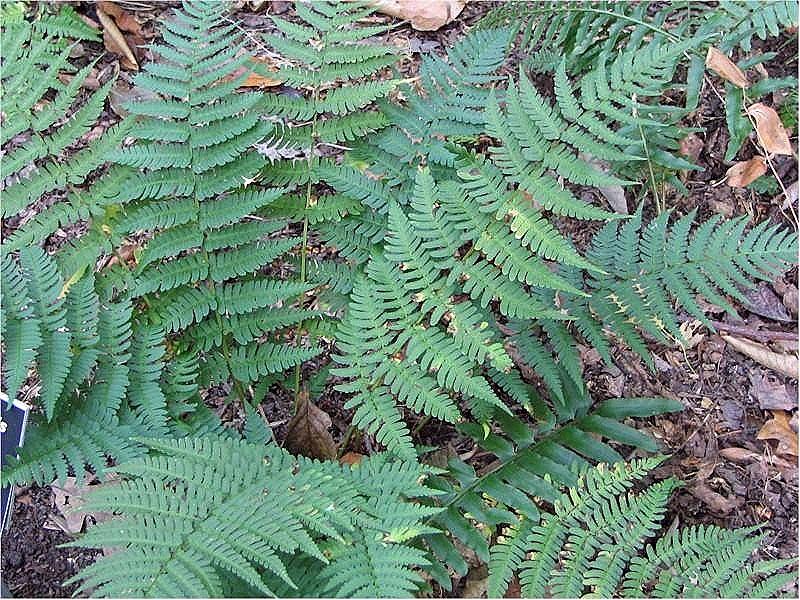
Dryopteris marginalis, commonly known as Leatherwood Fern, Marginal Wood Fern, or Marginal Shield Fern, is one of the most reliable, beautiful, and ecologically valuable native ferns for woodland gardens throughout Indiana, Ohio, and the eastern United States. Unlike many ferns that die back completely in winter, Leatherwood Fern is evergreen (technically semi-evergreen to evergreen depending on winter severity), maintaining its rich, dark green, leathery fronds through cold weather and providing color and texture in the winter woodland garden when little else is growing.
The species name marginalis refers to the distinctive placement of the sori (spore-producing structures) along the margins of the leaflets — a diagnostic feature that immediately identifies this fern and gives rise to its alternative common name “Marginal Wood Fern.” Growing in elegant, symmetrical vase-shaped clumps from 1 to 3 feet tall, Leatherwood Fern forms the quintessential carpet of a mature eastern woodland — arching dark fronds creating a lush green layer beneath towering oaks, maples, and beeches. Its leathery texture, darker and more lustrous than most ferns, allows it to resist desiccation better than its more delicate relatives.
Leatherwood Fern is a woodland specialist, native to shaded, rocky, and moist forests throughout much of eastern North America. In Indiana and Ohio, it grows naturally on north-facing ravine slopes, rocky forest floors, and stream bluffs — sites with consistent moisture, shade, and a rock or root substrate that its rhizomes can grip. In the garden, it adapts well to the challenging dry shade beneath mature deciduous trees, making it one of the most garden-worthy native ferns for sites where other plants struggle.
Identification
Leatherwood Fern forms a graceful, upright to slightly arching vase-shaped clump 1.5 to 3 feet tall and 2 to 3 feet wide. The fronds emerge in spring from a central crown (caudex) covered with tawny-brown scales. Fronds are produced in clusters, giving mature plants a full, fountain-like appearance.
Fronds
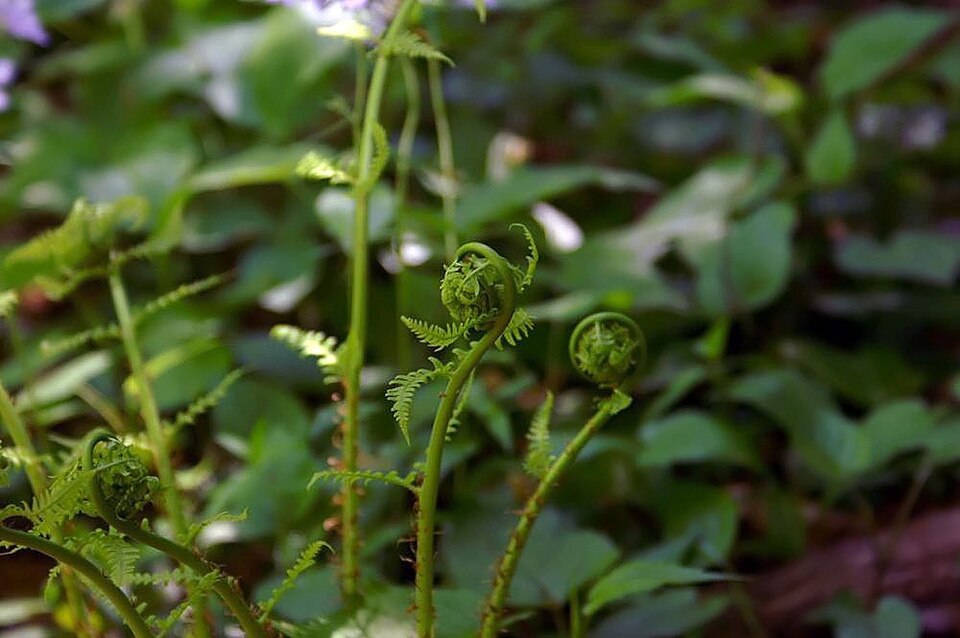
The fronds are the key to this fern’s identity and appeal. They are bipinnate (each leaflet itself is once-cut into sub-leaflets), dark blue-green, and distinctly leathery in texture — thicker and more substantial than most ferns. The individual pinnules (sub-leaflets) are rounded, with fine, barely-toothed margins. In full sun, fronds may be slightly paler; in deep shade, they reach their characteristic deep blue-green. New fronds emerge in spring with attractive croziers (fiddleheads) coated in the same tawny scales that cover the caudex.
Sori (Spore Clusters)
The sori of Leatherwood Fern are its most diagnostic feature: they are located precisely at or near the margins of the leaflets — hence “marginal.” Each sorus is covered by a kidney-shaped indusium (protective cover) that is green when young, turning brown as the spores mature. The spores ripen in summer and fall, and the pattern of these brown dots near the leaflet margins is a reliable identification aid even without magnification.
Caudex and Stipes
The stipes (stalks) are green, covered in attractive brown scales, and remain attached to the compact, upright caudex that slowly expands over years. Unlike many other native ferns, Leatherwood Fern does not spread aggressively by rhizome runners — it stays in a compact, slowly expanding clump, making it an exceptionally well-behaved garden plant.
Quick Facts
| Scientific Name | Dryopteris marginalis |
| Family | Dryopteridaceae (Wood Fern) |
| Plant Type | Evergreen to Semi-Evergreen Fern |
| Mature Height | 2–3 ft |
| Sun Exposure | Full Shade |
| Water Needs | Moderate |
| Frond Color | Dark blue-green (leathery, lustrous) |
| Growth Habit | Clump-forming (non-invasive) |
| Evergreen? | Yes (semi-evergreen in severe winters) |
| Deer Resistant | Yes (generally avoided by deer) |
| USDA Hardiness Zones | 3–8 |
Native Range
Leatherwood Fern is broadly distributed across eastern North America, from Maine and Newfoundland south to Georgia and Alabama, and west through the Appalachians and Ohio Valley to the Ozarks and Arkansas. In Indiana and Ohio, it is native to a variety of forested habitats — primarily mesic (moderately moist) second-growth and old-growth deciduous forests, particularly on north and east-facing slopes, rocky ravines, and stream bluffs where moisture and shade are reliably available.
Within its range, Leatherwood Fern shows a strong preference for rocky, well-drained sites in partial to full shade — perhaps reflecting the rocky, shaded ravines of the Appalachians that represent its optimal habitat. It is often found growing from crevices in bedrock outcrops, from the bases of large boulders, and along the edge of sandstone and limestone ledges. In Indiana and Ohio, look for it on north-facing ravine slopes, in beech-maple forest understories, and on rocky wooded hillsides — the kinds of places where moisture accumulates but drainage prevents waterlogging.
Leatherwood Fern is not found in open, dry uplands or in frequently flooded bottomlands — it occupies the intermediate, moist-but-well-drained woodland niche. This habitat specificity means it has become less common in areas where woodland fragmentation, deer browse, and invasive species have degraded the quality of native forest understories.
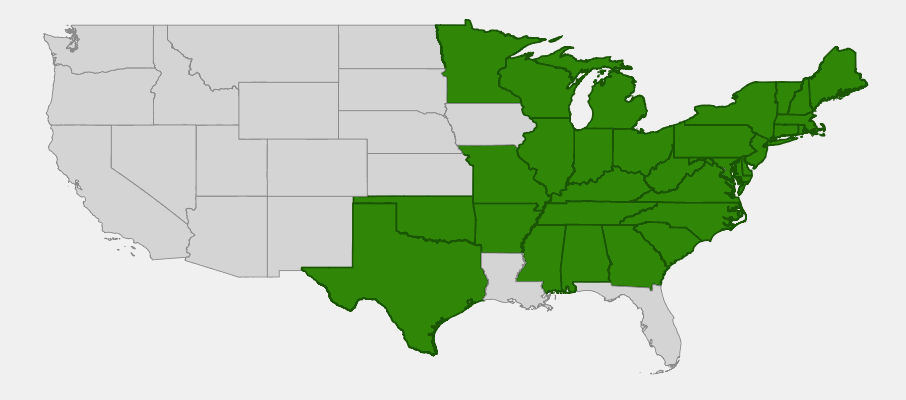
📋 Regional plant lists featuring Leatherwood Fern: Indiana & Ohio
Growing & Care Guide
Leatherwood Fern is one of the most garden-adaptable of all native eastern ferns. Its tolerance of dry shade, dense tree root competition, rocky soils, and winter cold make it applicable in challenging situations that would defeat most shade plants. Once established, it is essentially self-maintaining — one of the most low-maintenance native perennials available.
Light
Leatherwood Fern is a full shade specialist. It performs best under dense woodland canopy — the kind of light found under mature oaks, beeches, or maples where little direct sun penetrates. It will tolerate part shade (2 to 4 hours of sun), but fronds may become paler and less lustrous in brighter exposures, especially in combination with dry conditions. Unlike some ferns, it does not thrive in open sun and may decline rapidly if exposed to more than 3 to 4 hours of direct afternoon sun without compensating moisture.
Soil & Water
Leatherwood Fern prefers moist, humus-rich, well-drained soils — the kind found naturally on rocky forest floors with deep leaf litter. It is more drought-tolerant than most native ferns (reflecting its rocky, well-drained native habitats), and adapts well to the dry-shade conditions found under mature deciduous trees. However, it performs best with consistent moisture, particularly during summer heat. Amend planting beds with generous quantities of composted leaf litter or aged wood chips to create the humus-rich, moisture-retentive conditions it prefers. Avoid planting in wet, poorly drained soils.
Planting Tips
Plant in spring or fall from container stock. Dig a hole twice as wide as the root ball and amend with generous quantities of compost and leaf mold. Set the crown (caudex) at or slightly above soil level — planting too deep can cause crown rot. Space plants 2 to 3 feet apart for a naturalistic ground cover effect; they will slowly fill in over 3 to 5 years. Mulch with 2 to 3 inches of shredded leaves or fine bark to retain moisture and suppress weeds. The old fronds can be left through winter for texture and to protect the crown; remove in early spring as new croziers emerge.
Pruning & Maintenance
Leatherwood Fern is essentially maintenance-free. Remove dead or winter-damaged fronds in early spring to allow new fronds a clean start. Do not cut back the evergreen fronds in fall — they are doing photosynthetic work even in winter and protect the crown from freeze-thaw cycles. No division is typically needed, as the plants are slow to spread and benefit from competition reduction rather than division. If desired, the caudex can be divided in early spring, but the plants resent disturbance and divisions may take 2 to 3 years to regain full vigor.
Landscape Uses
- Dry shade ground cover under mature trees where grass struggles
- Woodland garden and naturalistic forest floor planting
- Evergreen texture in winter woodland compositions
- Slope stabilization on north-facing, shaded slopes
- Rock garden in shaded, rocky sites
- Companion planting with other woodland natives: trilliums, wild ginger, Solomon’s seal, hepatica
- Deer-resistant ground cover — one of the few truly deer-resistant shade plants
Wildlife & Ecological Value
Leatherwood Fern’s ecological contributions are less obvious than those of fruiting shrubs or flowering trees, but no less real or important. As a foundational element of the native forest floor, it supports a web of life that depends on the physical structure and biological outputs of native fern communities.
For Birds
Several bird species use dense fern fronds for nest concealment. Ovenbird, Hermit Thrush, and Veery regularly nest in or near fern clumps in eastern woodlands, using the dense foliage as visual screening. The leaf litter accumulating beneath fern colonies supports the earthworms and invertebrates that ground-feeding birds (American Woodcock, Hermit Thrush) depend upon.
For Mammals
Leatherwood Fern is generally avoided by deer — a significant virtue in landscapes with high deer pressure. Small mammals including chipmunks, shrews, and woodland voles use fern colonies for cover and nesting sites. The complex root and rhizome structure of dense fern colonies creates physical habitat that supports a rich community of ground-dwelling invertebrates that feed many mammal species.
For Pollinators and Invertebrates
Ferns produce spores rather than flowers, so they do not directly support pollinators. However, the moist, shaded microhabitat beneath fern colonies supports a rich diversity of invertebrates — beetles, millipedes, springtails, isopods, and salamanders — that are critical components of forest floor food webs. Several moth species in the genera Callopistria and Papaipema use native ferns as larval host plants.
Ecosystem Role
Leatherwood Fern’s primary ecological role is as a structural and biogeochemical component of the forest floor. Its evergreen fronds persist through winter, providing insulating cover for soil organisms and reducing soil erosion during winter rain and snowmelt. The decaying fronds add organic matter to the forest floor, supporting the fungal networks and decomposer communities that recycle nutrients back into forest soils. Dense, well-established fern colonies can effectively suppress invasive exotic species like garlic mustard and Japanese barberry in shaded woodland settings.
Cultural & Historical Uses
Leatherwood Fern has a modest but interesting ethnobotanical history. Several Native American nations, including the Cherokee and Iroquois, used the fronds and roots of Dryopteris species medicinally. The Iroquois used preparations of wood fern roots as a treatment for intestinal worms. The Cherokee used Dryopteris species to treat ailments ranging from rheumatism to fevers, typically prepared as a decoction of the rhizome. The strong, leathery fronds were also used for lining baskets and food storage containers.
In colonial American medicine, the roots of “male fern” (a European relative of Leatherwood Fern, Dryopteris filix-mas) were a well-known treatment for intestinal tapeworms — one of the oldest documented anthelmintic remedies in Western medicine, known since ancient Greece. American practitioners sometimes substituted native Dryopteris species where the European species was unavailable. This usage persisted into the 19th century and was listed in early American pharmacopoeias, though it has since been supplanted by safer and more effective treatments.
In modern horticulture, Leatherwood Fern has become increasingly prized as a low-maintenance, deer-resistant, evergreen ground cover for the challenging dry-shade conditions common under mature deciduous trees in residential landscapes. It is recommended by native plant advocates and landscape architects throughout the eastern United States as one of the most reliable and beautiful of the native ferns for cultivated settings. Its relative drought tolerance compared to other shade ferns, combined with its year-round evergreen texture, make it a superior choice for landscapes seeking low-maintenance beauty with high ecological value.
Frequently Asked Questions
Is Leatherwood Fern truly evergreen?
It is considered evergreen to semi-evergreen. In mild winters (as are increasingly common in Indiana and Ohio), the fronds remain green and upright through winter. In severe cold or heavy ice and snow, fronds may flatten and some damage can occur, but the plant recovers vigorously in spring. For practical purposes, in the Indiana-Ohio region, expect attractive evergreen fronds through most winters with some tip-burning in the coldest years.
Will deer eat Leatherwood Fern?
Generally, no. Leatherwood Fern is considered one of the more deer-resistant native ground covers, and in most regions deer leave it alone even when other plants are heavily browsed. This is a major practical advantage for gardeners in areas with high deer pressure.
How is Leatherwood Fern different from Christmas Fern?
Both are evergreen native ferns common in eastern woodland settings, but they are easily distinguished. Christmas Fern (Polystichum acrostichoides) has pinnate (once-cut) fronds with small ear-like auricles (lobes) at the base of each leaflet, and sori that cover the entire underside of fertile fronds. Leatherwood Fern has bipinnate (twice-cut) fronds that are slightly more finely textured, and sori that appear only near the margins of leaflets. Leatherwood Fern tends to grow in more moisture-dependent rocky sites; Christmas Fern is equally common in drier woodland.
Can Leatherwood Fern grow in dry shade?
Better than most ferns, yes. Its natural habitat on rocky, well-drained ravine slopes and forest floors means it has adapted to conditions that are drier than the swampy margins preferred by Ostrich Fern or Cinnamon Fern. However, “dry shade” is a relative term — Leatherwood Fern still needs some moisture, and will decline in extremely dry summer conditions without supplemental water in the first year or two. Once deeply rooted, established plants are remarkably resilient to moderate summer drought.
How fast does Leatherwood Fern spread?
Slowly. Unlike ostrich fern, which spreads aggressively by stolons and can become invasive in garden settings, Leatherwood Fern forms a compact, slowly expanding clump and never becomes weedy. Expect individual plants to increase their diameter by 6 to 12 inches per year once established. For a ground cover effect, space plants 2 feet apart; they will fill in within 5 to 7 years.