Maximilian Sunflower (Helianthus maximiliani)
Helianthus maximiliani, commonly known as Maximilian Sunflower, is one of the most dramatic and ecologically important native perennial wildflowers of the North American Great Plains and prairie. Named in honor of Prince Maximilian of Wied-Neuwied, the German naturalist and explorer who traveled through the Great Plains in 1833–1834 and documented this spectacular plant, Maximilian Sunflower reaches 4 to 6 feet tall (occasionally exceeding 10 feet in rich bottomland soils) and produces masses of bright golden-yellow flowers in late summer and fall — precisely when most other prairie wildflowers have finished blooming.
Unlike the annual common sunflower (Helianthus annuus), Maximilian Sunflower is a long-lived perennial that spreads by both underground rhizomes and self-seeding to form dense, glorious colonies. A single plant can eventually spread to form a clump several feet across over the years. In optimal prairie and meadow conditions, Maximilian Sunflower creates sweeping stands of golden yellow that dominate the late-season landscape from August through October, providing one of the most spectacular fall wildflower displays in North America. The tall stalks, each bearing 5 to 25 bright flowers, sway together in the prairie wind in a mesmerizing golden wave.
From an ecological standpoint, Maximilian Sunflower is extraordinarily valuable. Its late-season bloom provides critical nectar and pollen when most other flowers have finished, supporting large numbers of native bees, butterflies, and other pollinators before winter. The abundant seeds nourish finches, sparrows, juncos, and many other seed-eating birds throughout fall and winter. The tall stems provide nesting structure and overwintering habitat for native bees and beneficial insects. And the dense rhizome system is exceptionally effective at stabilizing soil and suppressing weeds — making it an excellent choice for erosion control and prairie restoration.
Identification
Maximilian Sunflower is an upright, robust perennial herb that grows 4 to 6 feet (1.2–1.8 m) tall in average prairie conditions, occasionally reaching 10 to 12 feet (3–3.7 m) in rich, moist bottomland soils. New growth emerges from a thick clump of underground rhizomes each spring, producing multiple tall, mostly unbranched or lightly branched stems. The plant spreads gradually to form multi-stemmed colonies that can reach 3 to 6 feet in diameter after several years. The overall appearance is bold, upright, and architectural in the landscape.
Stems & Leaves
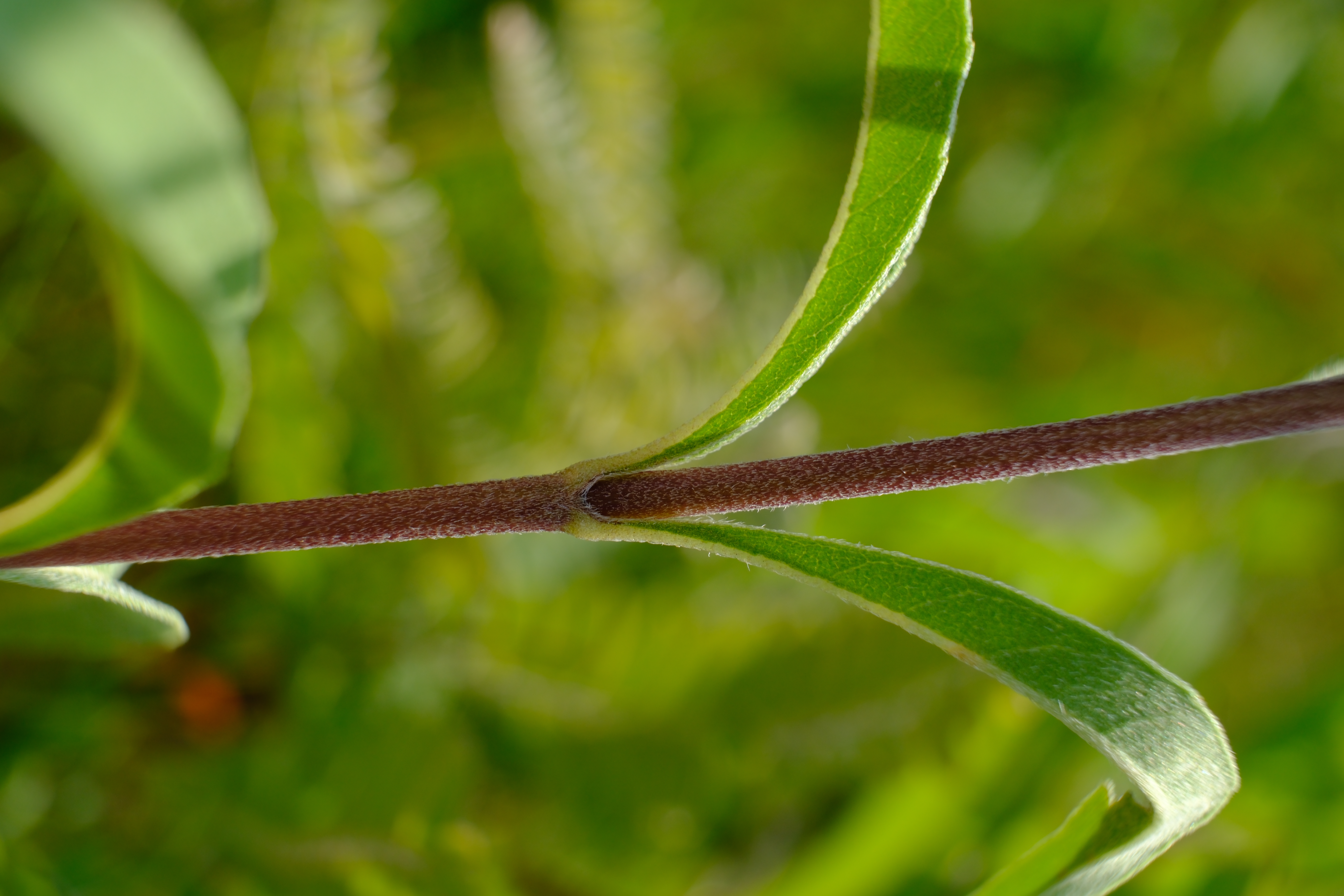
The stems are stout, erect, and rough-hairy — covered with stiff, scratchy hairs that are sometimes irritating to sensitive skin. Leaves are alternate, lance-shaped to narrowly ovate, 3 to 8 inches (8–20 cm) long, with a distinctive tendency to fold along the midvein — clasping or arching like a folded piece of paper. This folded leaf is one of the key identification features distinguishing Maximilian Sunflower from other tall prairie sunflowers. Leaf surfaces are rough and scratchy on both sides with prominent veins. The foliage is gray-green in color, giving the pre-blooming plant an attractive, textured appearance.
Flowers
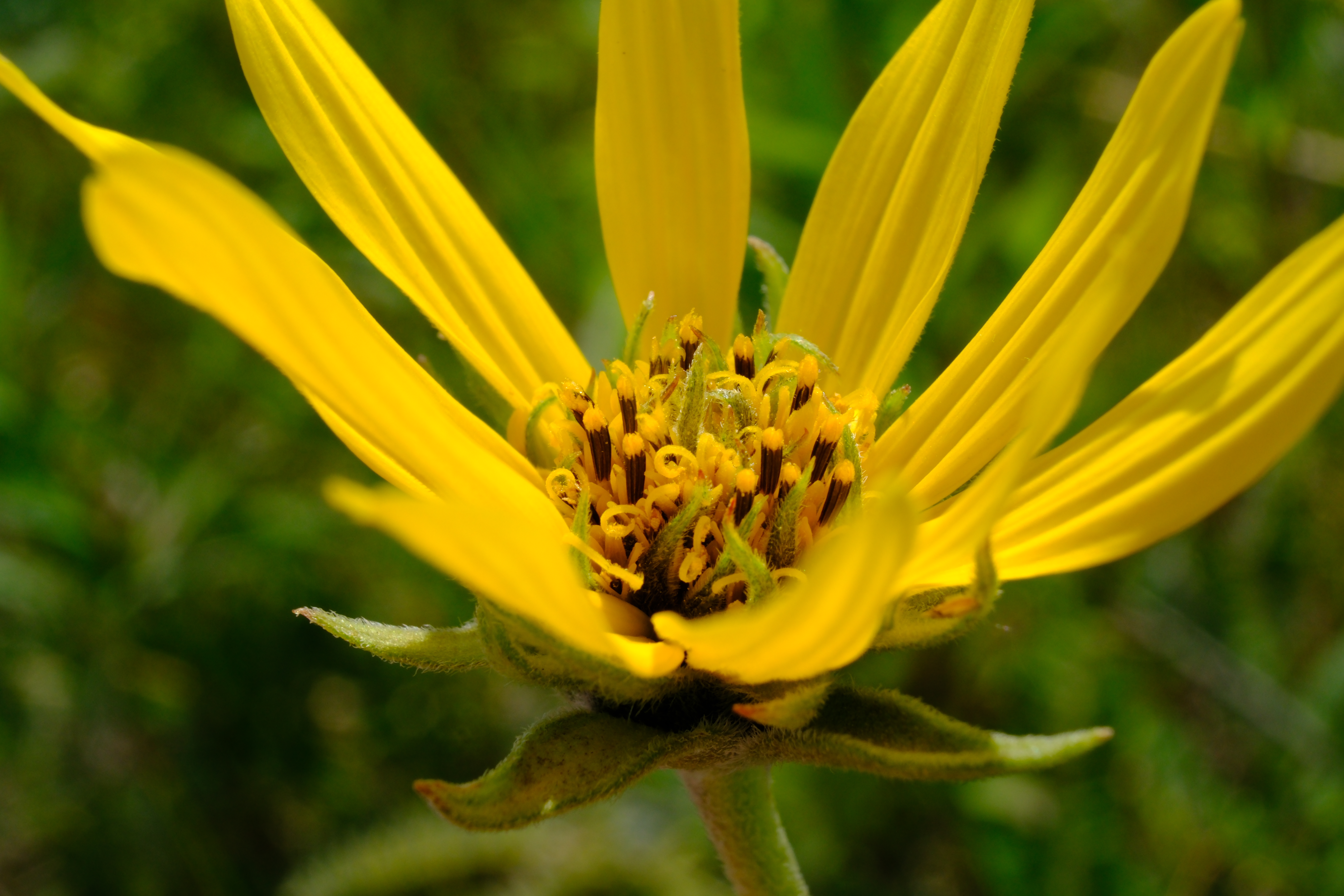
The flowers are the plant’s most spectacular feature: bright golden-yellow composite heads, 2 to 3 inches (5–8 cm) in diameter, with 10 to 25 ray florets surrounding a central disk of many small, tubular, yellow-brown to dark brown disk flowers. Unlike common sunflower, which typically produces one or a few heads per stem, Maximilian Sunflower produces 5 to 25 or more flower heads per stem in the leaf axils along the upper portion of each stalk. This creates a spectacular floral display that lasts from late August through October — peaking in September in most of its range. The flowers are excellent for cutting and arrangements.
Seeds & Root System
The seeds are small, flat achenes, grayish-black, produced in abundance from the disk flowers. They are an important food source for seed-eating birds in fall and winter. The root system consists of thick, fleshy rhizomes from which new stems emerge each spring; these rhizomes store energy that allows the plant to survive drought and grow vigorously from a well-established root system. The tubers produced on the rhizomes are edible — historically used by Indigenous peoples as food, similar to Jerusalem Artichoke (Helianthus tuberosus).
Quick Facts
| Scientific Name | Helianthus maximiliani |
| Family | Asteraceae (Composite / Daisy family) |
| Plant Type | Perennial Wildflower / Prairie Herb |
| Mature Height | 4–6 ft |
| Sun Exposure | Full Sun |
| Water Needs | Moderate |
| Bloom Time | August – October |
| Flower Color | Bright golden-yellow |
| Spread | 3–6 ft (slowly by rhizomes) |
| USDA Hardiness Zones | 3–9 |
Native Range
Maximilian Sunflower is native to the central North American Great Plains and adjacent prairies, ranging from the Canadian prairies south through the Dakotas, Nebraska, Kansas, Iowa, Missouri, and Oklahoma to Texas, and east into Minnesota, Wisconsin, Illinois, and Indiana. Its primary range coincides with the tallgrass and mixed-grass prairie belts of the central continent, where it is one of the most characteristic and abundant late-season wildflowers. The plant reaches its greatest abundance in the transition zones between tallgrass and mixed-grass prairie, where soil moisture is moderate and disturbance (fire, grazing) periodically resets succession.
In Montana and Wyoming, Maximilian Sunflower occurs on the eastern plains, along creek drainages, and in moist swales within the mixed-grass prairie zone. It is less abundant here than in the core of its range farther south but provides the same spectacular late-season floral display wherever it grows. It is commonly found along fence lines, roadsides, and in disturbed areas where competition from tall grasses is reduced. The plant’s adaptation to periodic fire and grazing disturbance makes it particularly well-suited to the dynamic ecosystems of the northern Great Plains.
Beyond its natural range, Maximilian Sunflower is widely planted in prairie restoration projects, wildlife habitat programs, and naturalistic gardens across a much broader area of North America. It has proven adaptable to a wide range of climates and soil types outside its native range, making it one of the most popular native sunflowers for gardeners throughout the country.
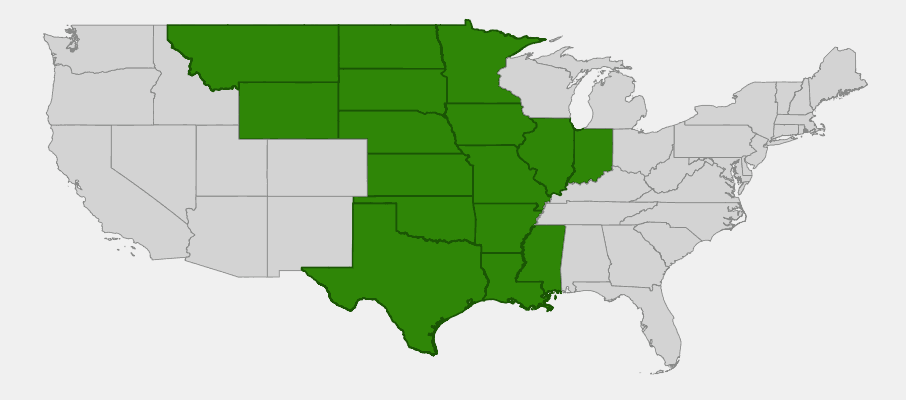
📋 Regional plant lists featuring Maximilian Sunflower: Montana & Wyoming
Growing & Care Guide
Maximilian Sunflower is a vigorous, easy-to-grow perennial that rewards minimal care with a spectacular annual display. Once established, it is one of the most self-sufficient prairie plants available for gardens in the Great Plains and beyond.
Light
Maximilian Sunflower requires full sun for best performance — 6 or more hours of direct sunlight daily. In partial shade, plants grow taller and leggier, produce fewer flowers, and may flop without support. Full sun sites produce compact, upright plants with the most prolific bloom. This is a strictly sun-loving species, so don’t compromise on light requirements.
Soil & Water
Maximilian Sunflower is adaptable to a wide range of soil types but performs best in well-drained to moderately moist soils. It tolerates clay, loam, and sandy soils equally well and is reasonably drought-tolerant once established, though it grows more vigorously with moderate soil moisture. In very dry conditions, plants may be shorter and produce fewer flowers; in rich, moist bottomland soils, they can reach extraordinary heights. Avoid waterlogged conditions, which can cause root rot. Water weekly during the first growing season; once established, rainfall is typically sufficient in most of the plant’s range.
Planting Tips
Plant divisions, transplants, or seeds in spring. For seed: plant ¼ inch deep in a prepared seedbed in fall or early spring; seeds germinate readily without stratification. For divisions: divide established clumps in early spring before new growth emerges, ensuring each division has several rhizome segments and at least one growing bud. Space transplants or divisions 2 to 3 feet apart — the plant will fill in through rhizome spread. Be aware that Maximilian Sunflower can be aggressive in small garden beds; provide adequate space or use edging barriers to contain the rhizomes.
Pruning & Maintenance
In early summer (late May to mid-June), cutting plants back by half — a technique called “Chelsea chop” — delays bloom by 2–3 weeks and produces shorter, sturdier stems that are less likely to flop in late summer. Leave the seed heads standing through fall and winter for bird feeding value. Cut plants back to the ground in late winter before new growth begins. Division every 3–5 years keeps colonies vigorous and prevents overcrowding. Maximilian Sunflower is generally pest- and disease-free, though powdery mildew can occur in humid conditions.
Landscape Uses
- Prairie and meadow gardens — a classic component of tallgrass and mixed-grass prairie plantings
- Back-of-border plantings — tall, bold texture provides structural backdrop
- Wildlife habitat gardens — exceptional seed, nectar, and cover value
- Naturalized areas — spreads gradually to form self-sustaining colonies
- Erosion control — dense rhizome system stabilizes slopes and banks
- Cut flowers — excellent vase life; the stems can be cut without harming the plant
Wildlife & Ecological Value
Maximilian Sunflower is one of the most wildlife-valuable wildflowers of the Great Plains, providing food and habitat across multiple seasons.
For Birds
The seeds are consumed by an impressive array of seed-eating birds. American Goldfinches, House Finches, Pine Siskins, Dark-eyed Juncos, various sparrows, and Mourning Doves all feed on the seeds in fall and winter. The tall, sturdy stems provide excellent perching structure for birds to cling to while feeding. The plant’s dense, multi-stemmed growth also provides nesting cover for ground-nesting birds in adjacent areas.
For Pollinators
The late-season bloom of Maximilian Sunflower (August–October) is critically important for pollinators preparing for winter. Dozens of native bee species, including specialist sunflower bees (Diadasia spp. and others), bumble bees, sweat bees, and mining bees visit the flowers for nectar and pollen. Monarch Butterflies, on their fall migration south, depend heavily on late-blooming composite flowers like Maximilian Sunflower for nectar to fuel their long journey to Mexico. Other butterflies — Painted Ladies, Common Checkered-Skippers, and sulphurs — are also frequent visitors.
For Mammals
Deer browse the young shoots in spring, though established plants tolerate this well. Ground squirrels and other small rodents cache the seeds. The dense stem colonies provide shelter for cottontail rabbits, pheasants, and other animals seeking concealment from predators.
Ecosystem Role
In prairie ecosystems, Maximilian Sunflower plays an important role in community structure and biodiversity. Its late bloom season extends the nectar-producing season and supports pollinators at a critical time. The dense rhizome network sequesters carbon, holds soil, and maintains habitat continuity across disturbance events. As a fire-adapted species, it sprouts vigorously from rhizomes after prairie fires, contributing to rapid post-fire recovery of the plant community.
Cultural & Historical Uses
Maximilian Sunflower was used as a food plant by numerous Great Plains tribes. The Lakota, Arikara, Hidatsa, and other Plains peoples harvested the edible tubers (rhizome thickenings) as a starchy food, prepared similarly to potatoes — boiled, roasted, or dried and stored for winter use. The seeds, like those of other sunflowers, were also gathered and ground into a meal or pressed for oil. Among the Lakota, the plant had both practical and ceremonial significance, appearing in traditional stories and healing practices.
Prince Maximilian of Wied-Neuwied, for whom the species is named, first documented the plant during his famous 1833–1834 expedition up the Missouri River. Accompanied by Swiss artist Karl Bodmer — whose paintings of Plains Indian life remain some of the most valuable historical records of the era — Maximilian collected botanical specimens and described the plant in his published journals. The species was later formally described by the botanist Torrey and Gray in their definitive Flora of North America (1840).
Today, Maximilian Sunflower is widely cultivated for wildlife habitat, prairie restoration, and ornamental use. It is also grown as a biomass energy crop in some research trials, given its high productivity and low input requirements. The seeds contain oil that can be used for cooking and industrial purposes. Its extraordinary value to pollinators has made it a staple of pollinator habitat programs sponsored by conservation organizations across the Great Plains and Midwest.
Frequently Asked Questions
Will Maximilian Sunflower take over my garden?
It can be aggressive in small, confined garden beds, spreading steadily by underground rhizomes. For smaller gardens, plant it in areas where it has room to spread (at least 4–6 feet in all directions) or install a root barrier to contain the rhizomes. Dividing the clump every few years also controls spread. In large naturalistic gardens, meadows, and prairie plantings, its spreading habit is a feature, not a problem.
How is Maximilian Sunflower different from common sunflower?
Common sunflower (Helianthus annuus) is an annual that grows from seed each year, producing typically one to a few large flower heads per plant. Maximilian Sunflower (H. maximiliani) is a long-lived perennial that spreads by rhizomes, produces many smaller (2–3 inch) flowers along the upper portion of each stem, blooms later in the season (August–October), and forms persistent colonies. It is also substantially taller when well-established.
When does Maximilian Sunflower bloom?
Typically from late August through October, with peak bloom in September in most of its range. This late-season bloom is one of the plant’s most valuable qualities, providing nectar and pollen when most other wildflowers have finished. In very warm climates, bloom may begin in July; at higher elevations or latitudes, it may not begin until September.
Can I grow Maximilian Sunflower from seed?
Yes — seeds germinate readily without stratification when planted in a prepared seedbed in spring or fall. Direct sow seeds ¼ inch deep in full sun. First-year plants focus on root development and may not bloom; most plants begin blooming in their second year. Transplants from nurseries or divisions from established plants bloom sooner.
Is Maximilian Sunflower deer-resistant?
Not reliably. Deer browse the young spring shoots, though established plants can sustain some browsing without permanent damage. The rough, scratchy stems and leaves are less palatable to deer than many other garden plants, but in areas with high deer pressure, protection may be needed for young plants.