Spiny Phlox (Phlox hoodii)
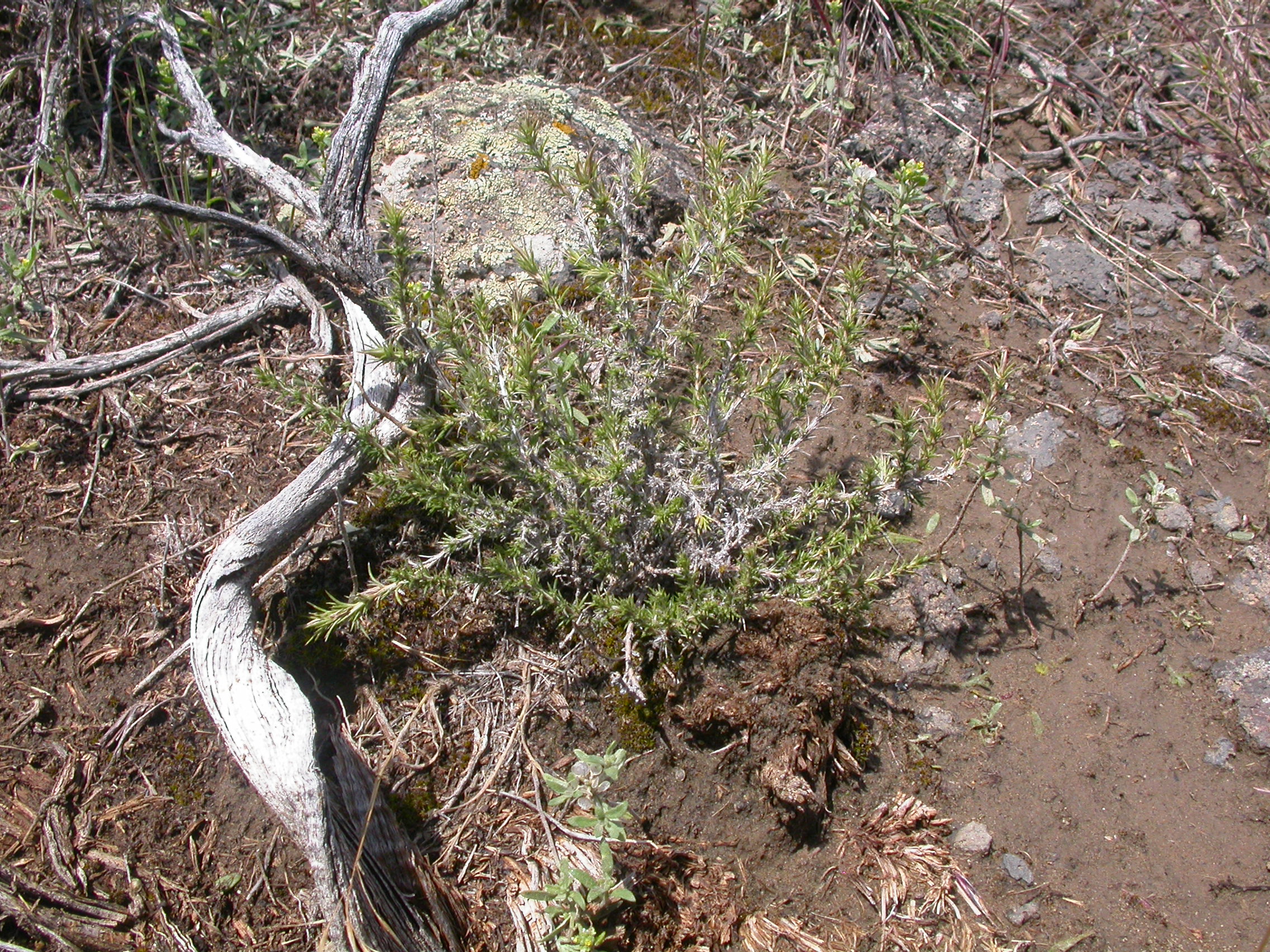
Phlox hoodii, commonly known as Spiny Phlox, Hood’s Phlox, or Prairie Phlox, is one of the earliest and most distinctive native wildflowers of the North American Great Plains and Rocky Mountain foothills. A low-growing, mat-forming perennial that rarely exceeds 2 to 4 inches in height, Spiny Phlox spreads outward to form dense, moss-like cushions of tiny, needle-like, spine-tipped leaves. In early spring — often before any other wildflower has opened — these flat-topped cushions explode into bloom, covering themselves so completely in white to lavender to pale blue flowers that the foliage is entirely hidden beneath a solid sheet of color. The display lasts only 2–3 weeks but is among the most dramatic early-spring wildflower events on the northern plains.
Named in honor of British Vice-Admiral Samuel Hood, Phlox hoodii belongs to the large and beautiful phlox genus (Polemoniaceae), which contains over 60 native North American species ranging from creeping groundcovers to tall perennial border plants. Spiny Phlox is adapted to some of the harshest habitats in the West: dry, rocky, gravelly, or sandy soils in full exposure to wind, intense sun, and extreme temperature fluctuations. Its tiny, spine-tipped leaves (the “spiny” of its common name) minimize water loss and deflect wind, while its low, cushion-like growth form hugs the ground to avoid the worst effects of prairie winds and temperature extremes near the soil surface.
Ecologically, Spiny Phlox is an important early-season nectar source for the native bees and butterflies that emerge in early spring when food is scarce. As a pioneer plant on disturbed, rocky, or sandy ground, it plays a role in soil stabilization and provides cover for small invertebrates in the open prairie environment. In Montana and Wyoming, it is one of the most characteristic plants of dry, exposed prairie, shortgrass grassland, and rocky foothills, often the first wildflower of the year to bloom in any given landscape.
Identification
Spiny Phlox is among the easiest native plants to identify when in bloom — no other early-spring prairie wildflower forms such low, dense, spine-leaved cushions covered in small, 5-petaled flowers. Non-blooming plants may require closer examination, but the combination of the tiny spine-tipped leaves, dense mat growth form, and preference for dry, exposed habitats is distinctive.
Growth Form & Leaves
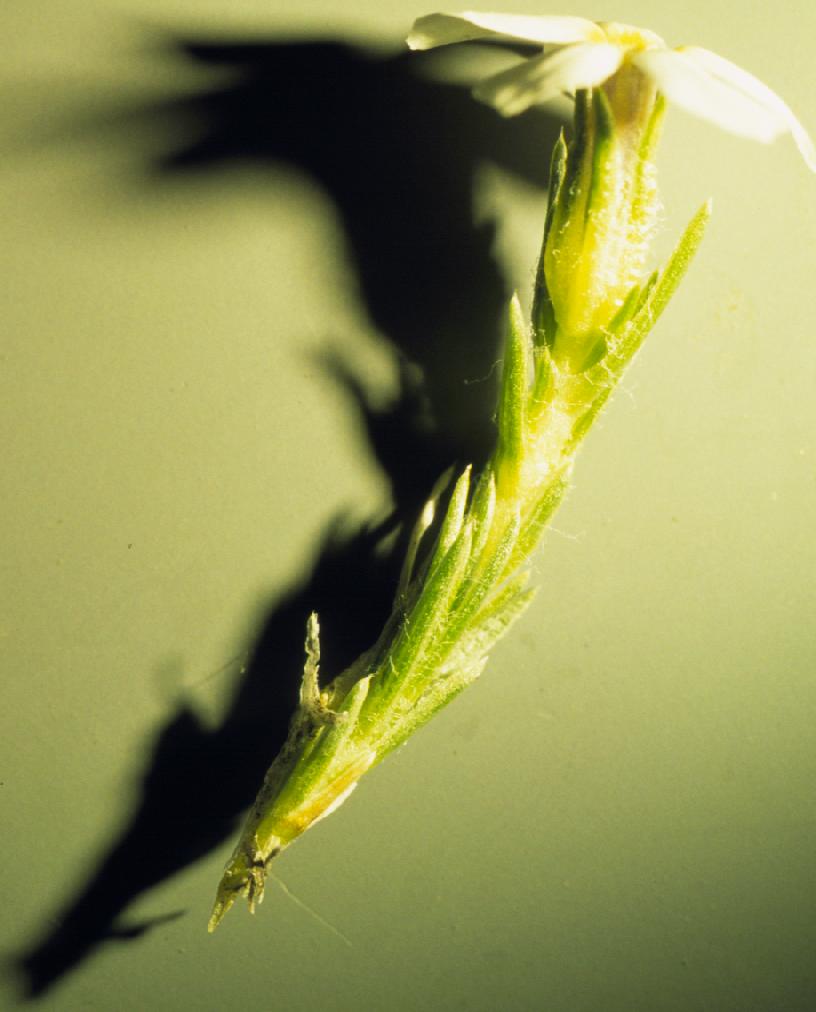
The plant forms a dense, spreading mat or cushion, typically 2 to 4 inches (5–10 cm) tall and spreading 6 to 18 inches (15–45 cm) or more in diameter. Individual stems are short, intricately branched, and closely overlapping, creating an almost moss-like texture. The leaves are tiny — 0.25 to 0.5 inches (6–12 mm) long — needle-like (linear to subulate), stiff, and tipped with a sharp, rigid point that can scratch the skin (the “spiny” characteristic). Leaves are arranged densely and alternately along the stems, often giving the non-blooming plant a resemblance to a cushion moss or small conifer. The leaves are dark green to gray-green and do not have the hairs found on some other phlox species, though they may have tiny marginal cilia.
Flowers
The flowers are typical phlox flowers — 5-petaled, salverform (flat-faced with a narrow tube behind the petals), 0.5 to 0.75 inches (12–18 mm) in diameter. The petals are white, lavender, pale blue, or very pale pink, often with a darker eye in the center. Each flower tube is narrow and about as long as the petals are wide. The flowers are fragrant — a faint, sweet, honey-like scent — and bloom profusely enough to completely obscure the foliage. Blooming typically begins in March to May, depending on elevation and latitude, and lasts 2 to 4 weeks. Early blooming is key to Spiny Phlox’s ecological role: it provides one of the very first nectar sources available to early-season pollinators emerging from winter dormancy.
Distinguishing Features
Spiny Phlox is distinguished from other mat-forming phloxes in its region by its spine-tipped leaves (a feature not shared by many other species in the genus), its extremely low, flat cushion form, and its very early bloom time. It can be confused with Phlox austromontana (Southern Mountain Phlox) in more southern areas, but that species has somewhat softer, less sharply-tipped leaves and different distribution. In Montana and Wyoming, Phlox hoodii is the mat-forming phlox most likely to be encountered on dry, open prairie and gravelly slopes.
Quick Facts
| Scientific Name | Phlox hoodii |
| Family | Polemoniaceae (Phlox family) |
| Plant Type | Perennial Groundcover / Cushion Plant |
| Mature Height | 2–4 in (mat-forming) |
| Mature Spread | 6–18 in (slowly expanding) |
| Sun Exposure | Full Sun |
| Water Needs | Low (Drought Tolerant) |
| Bloom Time | March – May (among the earliest) |
| Flower Color | White to lavender to pale blue-violet |
| USDA Hardiness Zones | 3–8 |
Native Range
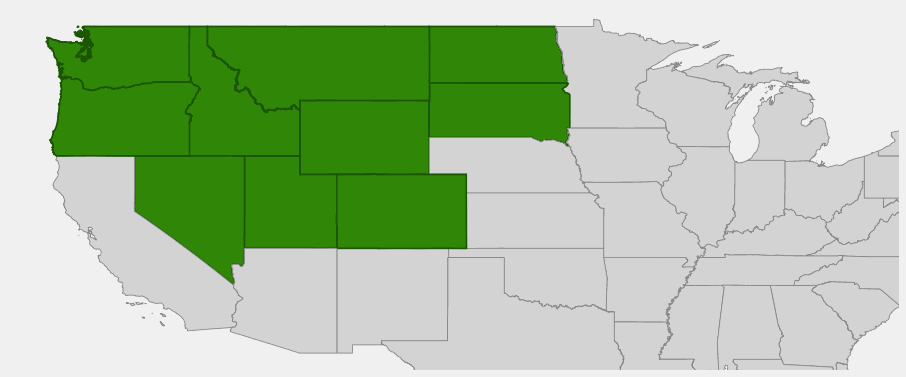
Spiny Phlox is native to a broad swath of western North America, from British Columbia and Alberta south through Montana, Idaho, Wyoming, Colorado, Utah, Nevada, Oregon, and Washington to northern California, and east through the Dakotas and Nebraska. Its range spans from the Pacific Northwest east across the Intermountain West and northern Great Plains, making it one of the most widespread cushion phloxes in North America. It is adapted to dry, exposed, often windy habitats at a wide range of elevations — from the sagebrush steppe at 2,000 feet to alpine tundra at over 10,000 feet.
In Montana and Wyoming, Spiny Phlox is among the most common early-spring wildflowers and occurs virtually statewide. It thrives on dry, rocky, sandy, or gravelly soils in full sun — south-facing hillsides, open prairies, ridge tops, road cuts, and exposed slopes. In the shortgrass prairie of eastern Montana and Wyoming, it forms a characteristic element of the early-spring wildflower community, blooming before most other species have emerged from dormancy. In the mountains, it extends up into the foothills and lower alpine zone, where it forms low, wind-pruned cushions in exposed rocky sites.
Spiny Phlox shows considerable ecological plasticity — the same species that forms tight, compact 2-inch cushions on windswept ridges can grow into looser, more open mats in more sheltered or slightly moister conditions. This adaptability allows it to occupy a wider range of habitats than many other cushion plants. It is an important early-successional species on disturbed, bare ground, and plays a role in the recovery of plant communities following disturbances such as fire or overgrazing.
📋 Regional plant lists featuring Spiny Phlox: Montana & Wyoming
Growing & Care Guide
Spiny Phlox is a rewarding, low-maintenance native groundcover that earns its place in any western garden with its spectacular early spring bloom, attractive cushion form, and exceptional drought tolerance. It requires minimal care once established and thrives in conditions that challenge most other plants.
Light
Full sun is essential for Spiny Phlox. It is a plant of open, exposed habitats and requires at least 6 hours of direct sunlight daily to maintain its compact growth form and bloom prolifically. In shade, plants open up, produce fewer flowers, and lose the tight cushion form that makes them so distinctive and attractive. Plant on south or west-facing slopes or in the most open, exposed areas of your garden.
Soil & Water
Well-drained to dry soils are critical. Spiny Phlox is highly drought-tolerant but will rot quickly in poorly drained or constantly moist soils. Sandy loams, gravelly soils, and rocky substrates are ideal. In heavier soils, amend with coarse grit or fine gravel before planting. Once established, it requires little to no supplemental irrigation in its native range — rely on natural rainfall. During establishment, water every 10–14 days in summer, then taper off as the plant matures.
Planting Tips
Transplant container-grown plants in spring or early fall, handling the root system carefully to minimize disturbance. Space plants 12–18 inches apart to allow cushions to expand naturally. For a naturalistic look, plant in groups of 3 to 5 plants. Spiny Phlox does not transplant well from the wild — always use nursery-grown stock or grow from cuttings. Seed germination requires cold stratification; fall sowing directly into a prepared seedbed is the most reliable approach for starting from seed.
Pruning & Maintenance
Spiny Phlox requires almost no pruning. After blooming, some gardeners lightly shear the plants to encourage denser growth and better appearance, but this is optional. The needle-like leaves remain attractive throughout the growing season. Remove any dead or diseased cushion sections if they appear. Division is rarely needed but can be done in early fall if a plant is declining at the center; divide into sections with roots attached and replant immediately.
Landscape Uses
- Rock gardens — the classic location for cushion phlox; provides spectacular spring color
- Dry slopes and banks — spreads slowly to stabilize erodible soils
- Front of the border — low stature makes it ideal as an edging plant in xeriscape borders
- Prairie meadow plantings — authentic component of dry prairie communities
- Groundcover under open canopy — works well beneath widely-spaced trees in dry situations
- Between paving stones — tolerates light foot traffic and thrives in warm pavement gaps
- Stepable groundcover — the low, dense mat withstands occasional light foot traffic
Wildlife & Ecological Value
Spiny Phlox provides ecological value disproportionate to its small stature, particularly as an early-season resource for pollinators emerging from winter dormancy.
For Pollinators
The early bloom time of Spiny Phlox — often one of the very first wildflowers of spring — makes it critically important for pollinators. Early-emerging native bees, including queen bumble bees, mining bees (Andrena spp.), and mason bees (Osmia spp.), visit the flowers for nectar and pollen when few other resources are available. Butterflies, particularly early-flying species like Spring Azure (Celastrina ladon), Mourning Cloaks, and early fritillaries, also visit for nectar. The fragrant flowers attract pollinators from a considerable distance on sunny spring days.
For Birds
The dense cushion growth of Spiny Phlox provides a small but valued habitat element in the open prairie — sheltering insects and providing nesting material. Horned Larks and other ground-nesting prairie birds may use clumps as micro-cover. The seeds, though small, are consumed by small ground-feeding birds including sparrows and juncos.
For Mammals
Pronghorn and deer occasionally browse the spring foliage, though Spiny Phlox is generally not a preferred forage species. Small mammals including pikas (at higher elevations) and voles use the dense cushion growth as cover. The plant’s value to invertebrates — as shelter, nesting substrate, and host plant — makes it indirectly important to the insectivorous mammals and birds that depend on prairie invertebrate communities.
Ecosystem Role
As an early-successional species and pioneer on disturbed ground, Spiny Phlox plays an important role in soil stabilization and restoration following disturbance. Its low cushion form creates a sheltered microclimate at the soil surface — temperatures under the cushion are significantly moderated compared to bare soil, allowing other plant seedlings and small invertebrates to survive that would not otherwise persist in harsh exposed conditions. The plant’s organic matter contribution, though small, improves soil structure in the lean, rocky substrates it typically occupies.
Cultural & Historical Uses
Spiny Phlox, while less prominently featured in ethnobotanical literature than some larger, more productive native plants, was known and used by Indigenous peoples throughout its range. Its early spring bloom made it a seasonal marker — its flowering signaled the beginning of the warm season and the availability of the first fresh plant foods after winter. For many Plains and Plateau tribes, the flowering of Spiny Phlox in early spring was an important ecological calendar event, indicating when certain plant and animal resources would become available.
Among the Blackfoot and other northern Plains tribes, some species of mat-forming phlox were used as a perfume — the fragrant flowers were rubbed on clothing or hair. The plant was also used medicinally by some groups: a tea of the leaves was used as an eye wash, and the crushed plant was applied topically for skin irritations. The Blackfoot name for a related phlox species translates roughly as “soft weed” or “fragrant cushion,” reflecting its tactile and olfactory qualities.
Today, Spiny Phlox is primarily valued as an ornamental and ecological plant. It is among the most highly recommended native plants for rock gardens and dry, difficult sites in the western United States and Canada. Its spectacular early-spring bloom, compact form, extreme drought and cold hardiness, and minimal maintenance requirements make it a top choice for native plant enthusiasts seeking authentic, tough, beautiful groundcovers for challenging western landscapes. It is becoming increasingly available at native plant nurseries throughout its range and through specialty perennial growers serving rock garden enthusiasts.
Frequently Asked Questions
Does Spiny Phlox stay green all year?
Yes — Spiny Phlox is semi-evergreen to evergreen, retaining its needle-like leaves through the winter in most climates. In very harsh winters, the foliage may turn slightly bronze or brownish but recovers its green color in spring. This year-round foliage interest, combined with the spectacular spring bloom, makes it an attractive groundcover in all seasons.
How do I tell Spiny Phlox from moss or other mat-forming plants?
When not in bloom, Spiny Phlox can resemble moss phlox (Phlox subulata) or other cushion plants, but its sharply spine-tipped, stiff, needle-like leaves distinguish it from true mosses (which have soft, non-vascular leaves) and from most other groundcovers. In bloom, the classic 5-petaled phlox flowers are unmistakable. The spine-tipped leaves (carefully touch a stem to feel the sharp tip) are the definitive non-blooming identification feature.
Will Spiny Phlox grow in my lawn as a groundcover substitute?
Not in a traditional lawn situation — it does not tolerate regular foot traffic, mowing, or the consistently moist soil that grass requires. However, it makes an excellent groundcover substitute in dry, rocky areas where lawn grass cannot be established, such as steep slopes, rocky banks, and xeriscape areas. Space plants 12–18 inches apart and they will slowly fill in to create a low, flowering mat.
Why does my Spiny Phlox have dead patches in the center?
Center die-out in established cushions is natural, usually caused by the plant’s spreading growth habit outpacing its ability to regenerate at the center. It can also be exacerbated by poor drainage, fungal disease, or pest damage. Remedy by dividing the plant — remove the dead center and replant vigorous outer sections with roots attached. Ensure excellent drainage to prevent recurrence.
Can I propagate Spiny Phlox from cuttings?
Yes — stem cuttings are the most reliable propagation method. Take 2- to 3-inch stem tip cuttings in late spring to early summer after bloom, dip in rooting hormone, and insert in a very well-drained rooting medium (half perlite, half peat or coconut coir). Keep moist but not wet; roots develop in 4–8 weeks. Grow on in a cool, bright location before transplanting. This method maintains the genetic characteristics of a particularly attractive plant and is more reliable than growing from seed.