Tree Huckleberry (Vaccinium arboreum)
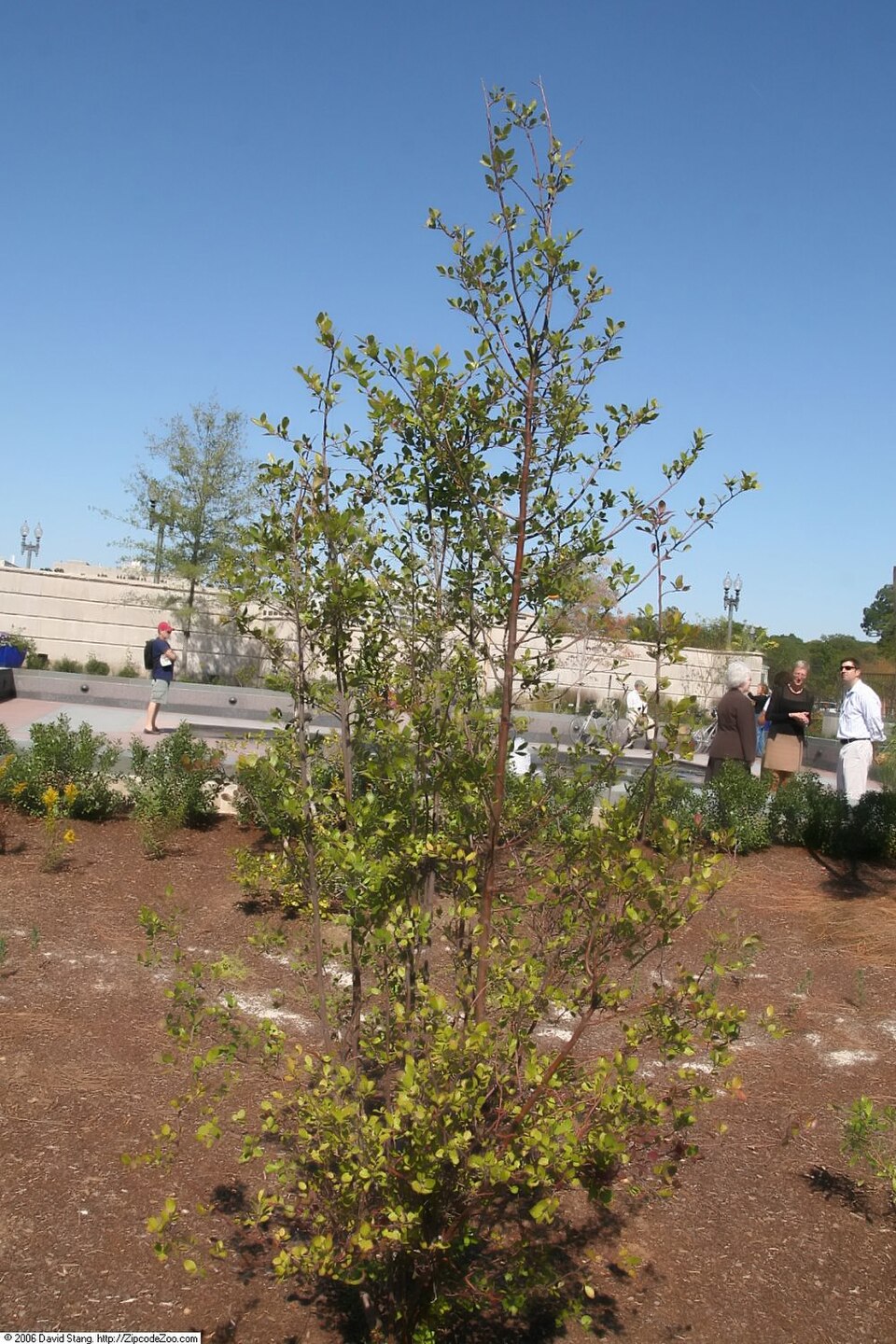
Vaccinium arboreum, commonly known as Tree Huckleberry, Farkleberry, or Sparkleberry, holds a unique distinction among North American blueberries and huckleberries: it is the largest native species in the genus Vaccinium on the continent, capable of growing as a substantial shrub or even a small tree reaching 20 feet in height, with a trunk several inches in diameter. Unlike its cultivated cousins — highbush and lowbush blueberries — Tree Huckleberry produces fruit that is dry and seedy, better suited for wildlife than human consumption, but invaluable as a food source for dozens of species of birds and mammals throughout the Southeastern United States.
Tree Huckleberry is a remarkable plant for all seasons. In spring, it produces delicate, urn-shaped white flowers similar to other Vaccinium species, attracting native bees and early pollinators. In summer, its small, glossy, dark green leaves provide a clean, refined appearance. In fall, it puts on one of the best autumn color displays of any native southeastern shrub — vivid scarlet to deep red, often persisting well into winter. And in all seasons, the attractive, twisted, multi-stemmed trunks with their distinctive reddish-brown exfoliating bark add sculptural winter interest. Unlike most huckleberries and blueberries, Tree Huckleberry is semi-evergreen to evergreen in mild winters, holding its leaves until new growth pushes them off in spring.
In Kentucky and Tennessee, Tree Huckleberry grows primarily on dry, rocky, acidic soils — sandstone outcrops, chert-bearing uplands, and dry pine-oak ridges — where its drought tolerance gives it a competitive advantage over many other native shrubs. Its combination of beauty, resilience, wildlife value, and adaptability to difficult sites makes it one of the most valuable native shrubs available to gardeners in the region who have dry, acidic, or rocky soil conditions where other plants struggle.
Identification
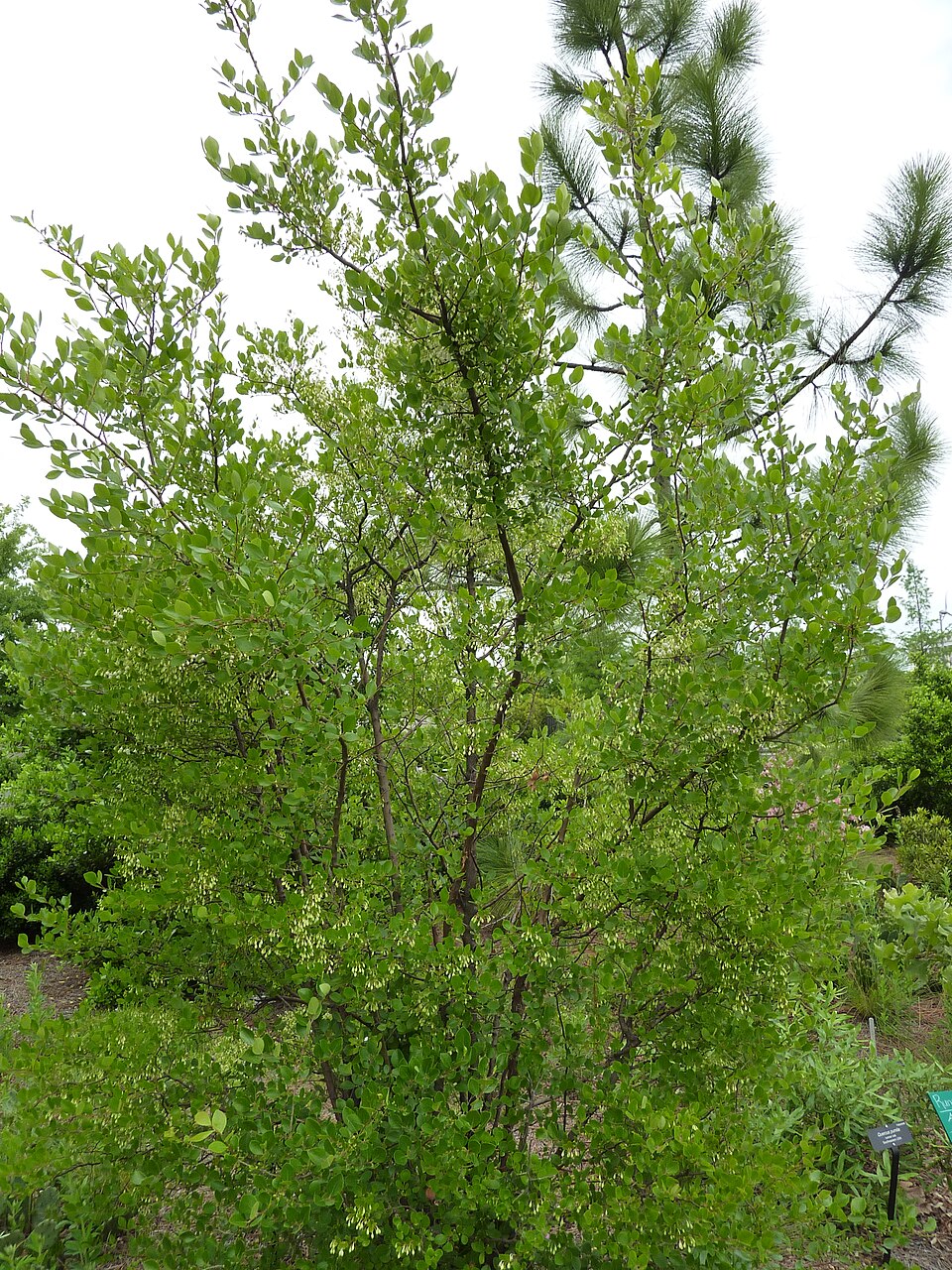
Tree Huckleberry is the most tree-like member of the genus Vaccinium in North America. It typically grows as a large multi-stemmed shrub 6 to 15 feet tall, occasionally reaching 20+ feet in ideal conditions with a single-trunk tree form. The highly branched, crooked, picturesque growth habit and exfoliating bark are among its most distinctive features at any season.
Bark
The bark is one of Tree Huckleberry’s most ornamental features — on mature stems and trunks, it is reddish-brown to grayish-brown and exfoliates (peels) in thin, papery strips and plates, exposing smooth reddish inner bark beneath. This shredding bark gives mature specimens a distinctive, gnarled, sculptural quality particularly appreciated in winter when the plant is leafless or semi-leafless. Young stems are reddish-green. The trunk and main stems often develop picturesque, twisted forms in response to rocky, dry growing conditions.
Leaves
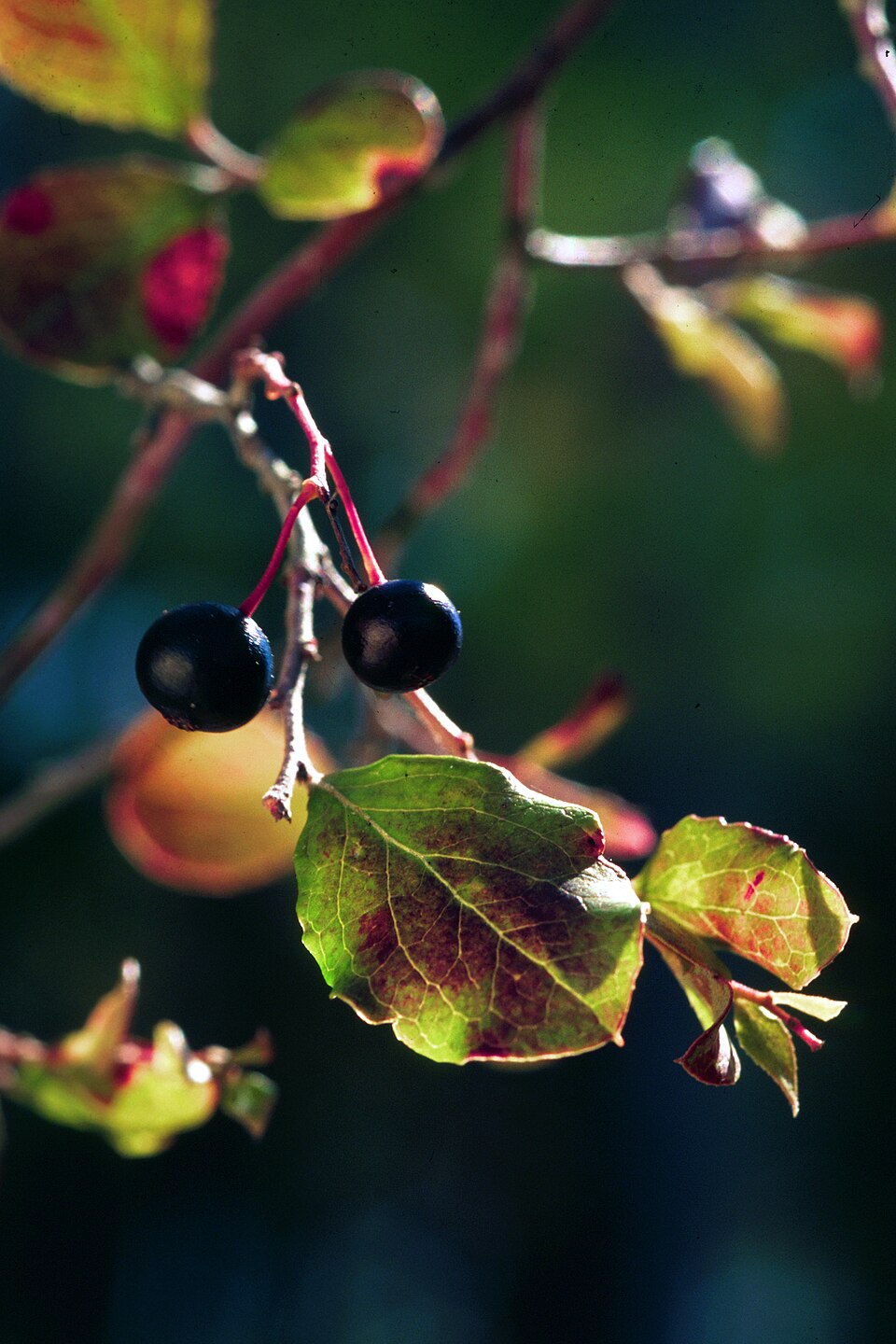
The leaves are small — typically ¾ to 1½ inches long — oval to elliptic, with entire (untoothed) to finely toothed margins. The upper surface is shiny, dark green; the lower surface is paler. Unlike most Vaccinium species, which are entirely deciduous, Tree Huckleberry is semi-evergreen to nearly evergreen in its southern range — the leaves may persist through winter, turning dark red-purple in cold weather, and are pushed off by new growth in spring. In Kentucky and Tennessee, the leaves typically turn brilliant scarlet to deep red in autumn and may persist through part or all of winter depending on the severity of cold.
Flowers & Fruit
The flowers are small, white, urn-shaped (urceolate), typical of the blueberry/huckleberry tribe within Ericaceae. They appear in spring (April–May), often before or with the new leaves, in racemes along the previous year’s stems. Each flower is about ¼ inch long with a reflexed corolla tip. The flowers attract native bees, including specialist bees in the Andrena group that are obligate pollinators of Vaccinium species.
The fruit is a small, round berry approximately ¼ to ⅜ inch in diameter, ripening from green to shiny black in late summer (August–October). Unlike most cultivated blueberries, the fruit of Tree Huckleberry is dry, seedy, and mealy in texture — edible but not particularly palatable to humans. However, the berries are consumed eagerly by wildlife. The fruit may persist on the plant into winter if not eaten by wildlife, extending its food value through the cold months.
Quick Facts
| Scientific Name | Vaccinium arboreum |
| Family | Ericaceae (Heath family) |
| Plant Type | Deciduous to Semi-evergreen Shrub / Small Tree |
| Mature Height | 8–15 ft (2.5–4.5 m), rarely to 30 ft |
| Sun Exposure | Full Sun to Part Shade |
| Water Needs | Low to Moderate |
| Bloom Time | April – May |
| Flower Color | White (urn-shaped) |
| Fruit | Shiny black berries (wildlife value) |
| Fall Color | Brilliant scarlet to deep red (exceptional) |
| Bark Interest | Exfoliating reddish-brown (ornamental) |
| Deer Resistant | Moderately |
| USDA Hardiness Zones | 7–9 |
Native Range
Tree Huckleberry has a broad native range across the Southeastern and South-Central United States, extending from Virginia and North Carolina south through the Coastal Plain to Florida, west through the Gulf states to Texas, and north through the Mississippi Valley to southern Illinois and Indiana. It is most abundant on the sandy, acidic soils of the Southeastern Coastal Plain, where it is a common component of longleaf pine savannas, sandhill oak communities, and dry pine-oak woodlands. In Kentucky and Tennessee, it represents the northern edge of the species’ range, typically found on the dry, acidic, rocky sandstone ridges of the Cumberland Plateau and Western Kentucky coalfields.
Within its range, Tree Huckleberry is strongly associated with dry, acidic, nutrient-poor soils — sandy soils over the Coastal Plain, sandy loams in the Piedmont, and thin soils over sandstone in the Appalachian Plateau. It thrives in longleaf pine ecosystems, scrub oak woodlands, and sandy barrens where its deep root system allows it to access water in the driest conditions. It also occurs on more mesic sites in mixed pine-hardwood forests, but its competitive advantages are most apparent on the driest, poorest soils where other shrubs cannot establish.
The species is fire-adapted, resprouting vigorously from the root crown following fire. In longleaf pine systems, frequent fire historically maintained the open conditions that Tree Huckleberry requires — preventing the growth of larger shrubs and trees that would shade it out. Fire suppression has led to its decline in many areas, making restoration of fire-maintained longleaf pine communities a priority for its conservation.
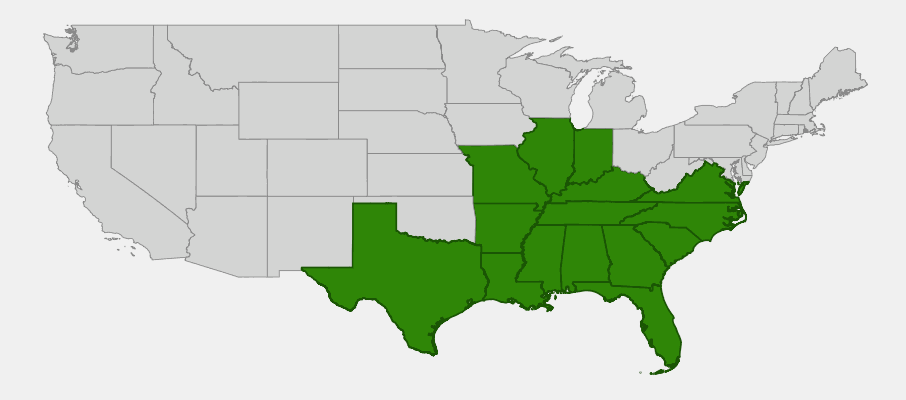
📋 Regional plant lists featuring Tree Huckleberry: Kentucky & Tennessee
Growing & Care Guide
Tree Huckleberry is an outstanding choice for gardeners with dry, acidic, or rocky soils where many other native shrubs struggle. Once established, it is extremely drought tolerant and requires minimal care — making it ideal for low-maintenance native landscapes.
Light
Tree Huckleberry performs best in full sun to part shade. In full sun on well-drained, acidic soils, it develops the most compact form and the best fruit production. In part shade, it grows more open and produces fewer berries but maintains its ornamental appeal through foliage, bark, and autumn color. In deep shade, growth is poor and fruit production minimal. For the best multi-season performance in Kentucky and Tennessee gardens, choose a site with at least 4–6 hours of direct sun.
Soil & Water
The most critical requirement for Tree Huckleberry is acidic soil — it must have a soil pH of 4.5–6.0 to thrive. Like all Vaccinium species, it depends on mycorrhizal fungi that are adapted to acidic conditions; in neutral to alkaline soils, the necessary fungal associations cannot form and the plant will fail. Sandy or rocky, well-drained soils are ideal. Tree Huckleberry is highly drought tolerant once established and is one of the best native shrubs for dry, sandy, or rocky sites with acidic soils. It does not tolerate waterlogged soils or high pH. If your soil is neutral to alkaline, amend the planting area with sulfur to lower pH before planting and mulch heavily with pine straw or wood chips to maintain acidity.
Planting Tips
Plant in fall or early spring. Tree Huckleberry can be slow to establish from container stock — patience is required. Do not overfertilize, as this encourages excessive vegetative growth at the expense of fruit production and can damage the mycorrhizal associations. Mulch with pine straw or shredded oak leaves to maintain soil acidity and moisture. It performs well alongside other acid-loving native shrubs such as Blueberries (Vaccinium spp.), Mountain Laurel (Kalmia latifolia), Leucothoe (Leucothoe spp.), and native azaleas.
Pruning & Maintenance
Tree Huckleberry requires minimal pruning. It naturally develops a picturesque, multi-stemmed form that is ornamentally attractive without intervention. Remove dead or crossing branches in late winter. If training as a small tree, selectively remove competing stems to develop one to three main trunks, gradually exposing more of the attractive exfoliating bark. Avoid heavy pruning, which reduces that year’s fruit crop. The plant fruits on previous year’s wood, so timing of any necessary pruning (immediately after fruit production) is important.
Landscape Uses
- Dry, rocky, acidic site specialist — thrives where other shrubs fail
- Multi-season specimen shrub — spring flowers, summer berries, fall color, winter bark interest
- Wildlife garden anchor — berries support dozens of bird species
- Native garden structure plant — gradually develops small-tree stature over years
- Longleaf pine savanna companion — authentic Southeast Coastal Plain composition
- Slope and erosion control on dry, acidic banks
- Woodland edge planting at the transition between pine forest and open areas
Wildlife & Ecological Value
Tree Huckleberry is one of the most wildlife-productive native shrubs in the Southeastern United States, providing food, shelter, and insect habitat across all four seasons.
For Birds
The black berries are consumed by a wide range of birds, including American Robin, Northern Mockingbird, Gray Catbird, Brown Thrasher, Cedar Waxwing, Eastern Bluebird, Northern Flicker, Yellow-bellied Sapsucker, and many species of warblers and thrushes during migration. Because the fruit is dry and persists on the plant longer than juicier berries, it is particularly valuable as a late-season and winter food resource when other berries have been consumed. The dense branching structure provides excellent nesting sites and cover for songbirds.
For Mammals
White-tailed deer browse both the foliage and berries. Black bears consume the fruit where their ranges overlap in the Southern Appalachians. Raccoons, gray foxes, opossums, skunks, and squirrels all consume the berries. The woody thicket structure provides important cover for rabbits, woodchucks, and other small mammals.
For Pollinators
The spring flowers are important early-season nectar and pollen sources, particularly for specialist native bees in the Andrena (mining bee) group that have evolved to depend on Vaccinium species. Bumble bees, mason bees, and sweat bees also visit the flowers. Because Tree Huckleberry flowers earlier in spring than many other shrubs, it fills a critical early-season nectar gap for queen bumblebees emerging from winter dormancy.
Ecosystem Role
In longleaf pine and sandhill ecosystems, Tree Huckleberry is a keystone shrub species — one of the most abundant and important mid-layer plants in these highly diverse, fire-maintained communities. Its fire adaptability (rapid resprouting after fire), drought tolerance, and deep root system make it a resilient, persistent component of the ecosystem structure. As a Vaccinium species, it also supports a rich community of specialist insects including the bees that coevolved with the genus over millions of years, many of which are now experiencing population declines as their host plants disappear from the landscape.
Cultural & Historical Uses
Tree Huckleberry (commonly called “Farkleberry” or “Sparkleberry” throughout much of the South) has been known by those names because the shiny black berries seem to sparkle in sunlight. The origin of “farkleberry” is obscure but may derive from a corruption of “whortleberry,” an old English name for huckleberries and blueberries generally.
Indigenous peoples of the Southeast consumed Tree Huckleberry fruits, though the dry, seedy texture limited their culinary appeal compared to sweeter blueberry species. The Catawba, Cherokee, and other nations cooked the berries to make sauces, or dried them for preservation. More significantly, various parts of the plant — including bark, roots, and leaves — were used medicinally. Bark decoctions were used to treat diarrhea and dysentery, leveraging the astringent tannins in the bark. Root decoctions were used for kidney ailments and skin conditions. These medicinal applications are consistent with the chemistry of the bark, which contains relatively high concentrations of tannins and anthocyanins with genuine antimicrobial and astringent properties.
European settlers adopted Tree Huckleberry sparingly as a medicinal plant but found little culinary use for the fruit beyond wildlife attractant. The plant’s main historical significance in European-American culture was as a marker of soil type — its presence indicated dry, sandy, acidic soil conditions — and as browse for game animals. Today, Tree Huckleberry has attracted growing interest from native plant enthusiasts, restoration ecologists, and wildlife gardeners who recognize its extraordinary multi-season ornamental value and ecological importance. It is increasingly available from native plant nurseries specializing in Southeastern species, though supply remains limited relative to demand.
Frequently Asked Questions
Can you eat Tree Huckleberry berries?
The berries are technically edible and are not toxic, but the texture is dry, mealy, and seedy — quite unlike sweet blueberries. They were consumed by Indigenous peoples, typically cooked into sauces or dried rather than eaten fresh. Most gardeners today plant Tree Huckleberry for wildlife rather than human food production.
How fast does Tree Huckleberry grow?
Tree Huckleberry is a slow-growing plant, especially in its first few years while it establishes its root system. Expect modest above-ground growth in years one and two. After establishment, growth accelerates but remains moderate — perhaps 6–12 inches per year in ideal conditions. The slow growth is a feature, not a bug: it produces the dense, finely branched, picturesque structure that makes the plant ornamentally attractive over time.
Why does my Tree Huckleberry look like it’s dying in winter?
Tree Huckleberry is semi-evergreen — in colder parts of its range (zones 7), it may drop most or all of its leaves in winter. The dark red to nearly black coloration the leaves turn before dropping can make the plant look stressed. This is normal. New growth will emerge in spring. In milder winters (zones 8–9), it may retain most leaves, which remain dark red-purple until pushed off by new growth.
What is the difference between Tree Huckleberry and blueberry?
Both are in the genus Vaccinium, but Tree Huckleberry (V. arboreum) produces dry, seedy, less sweet fruit compared to highbush blueberry (V. corymbosum) and other blueberry species. Tree Huckleberry also grows much larger (up to 20 ft), has smaller leaves, exfoliating bark, and is significantly more drought tolerant. The name “huckleberry” in the South often refers specifically to V. arboreum, while “blueberry” refers to the sweeter, cultivated relatives.
Will Tree Huckleberry grow in my clay soil?
Heavy clay is challenging for Tree Huckleberry, which naturally grows in sandy, well-drained, acidic soils. If your soil is clay, improving drainage by raising the planting bed and incorporating coarse sand and pine bark into the planting hole will help. Acidifying the soil to pH 5.0–5.5 is essential. In very heavy clay with poor drainage, Tree Huckleberry is not recommended; consider other native shrubs better adapted to clay conditions.