Large-tooth Aspen (Populus grandidentata)
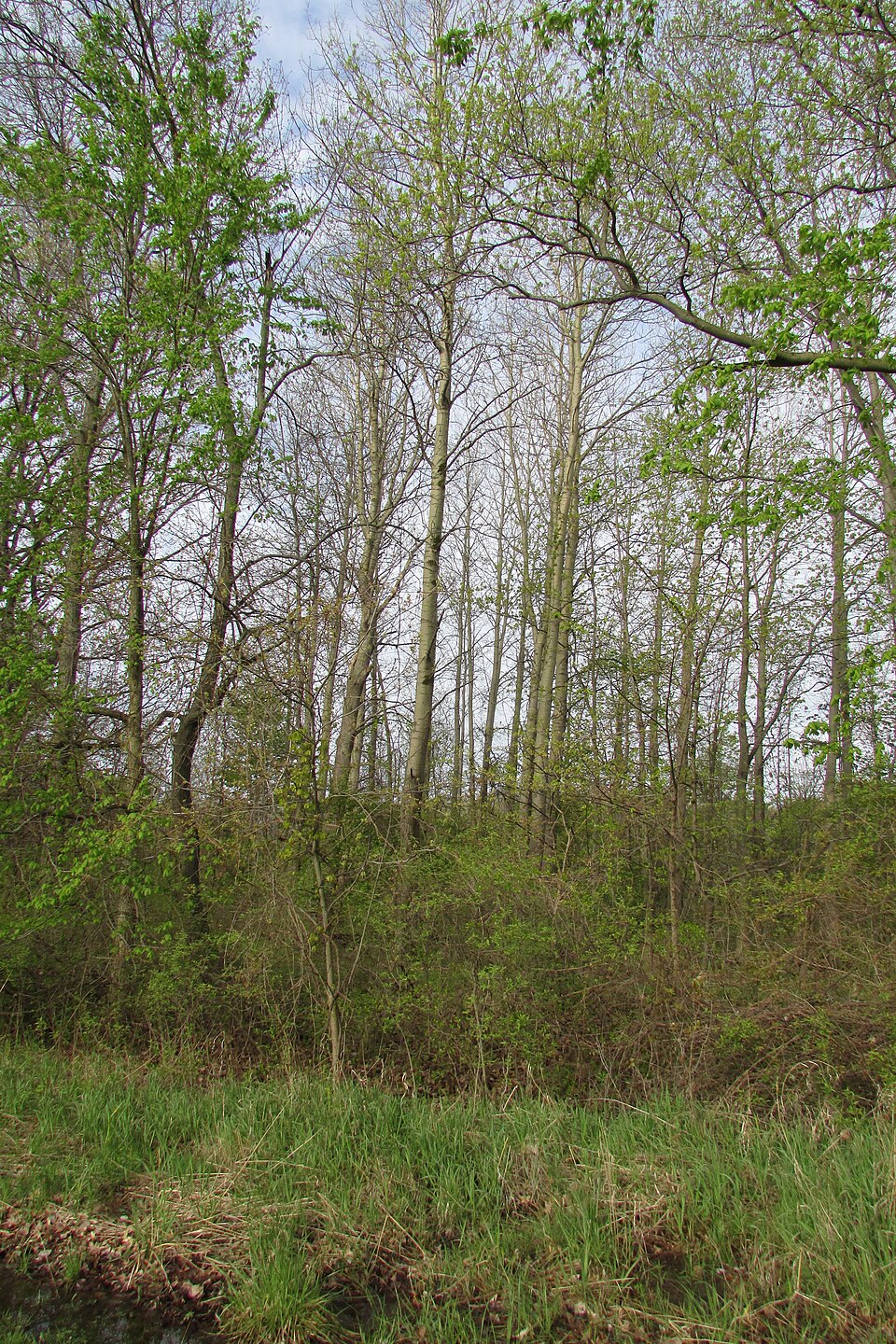
Populus grandidentata, commonly known as Large-tooth Aspen or Bigtooth Aspen, is a native deciduous tree of extraordinary ecological and aesthetic value throughout northeastern and north-central North America. Like its close relative the Quaking Aspen (Populus tremuloides), its leaves tremble and shimmer in the slightest breeze — a magical quality created by the flattened leaf stalks (petioles) that allow the leaves to swing freely on the lightest air current. But the Bigtooth Aspen stands apart with its larger leaves bearing coarser, more pronounced teeth along the margins — the characteristic that gives the species its name.
One of the fastest-growing native trees in the Northeast, Large-tooth Aspen is a pioneer species that quickly colonizes disturbed areas, abandoned fields, and forest clearings. It forms both single-trunked trees and clonal colonies connected by a shared root system — allowing a single genetic individual to persist for thousands of years, even as individual trunks live and die on a cycle of decades. The tree’s striking white to greenish-gray bark, golden autumn foliage, and graceful dancing leaves make it one of the most beautiful large native trees for the New England landscape.
Beyond its beauty, Large-tooth Aspen is a keystone species in the forest ecosystem. Its leaves, bark, twigs, and buds support an extraordinary number of wildlife species — more than almost any other northeastern tree species. It is one of the most important trees for moose, beaver, White-tailed Deer, snowshoe hares, and a stunning diversity of butterflies and moths. For anyone building a wildlife habitat garden or naturalizing a meadow or forest edge, Large-tooth Aspen belongs at the top of the list.
Identification
Large-tooth Aspen is a medium to large deciduous tree, reaching 50 to 70 feet (15–21 m) in height with a slender to oval crown. In forest conditions it develops a straight, tall trunk with a narrow crown; in the open it spreads more broadly. Like all aspens, it tends to grow in clonal colonies of multiple stems connected by a shared root system, often creating thickets or groves. The tree grows fast — sometimes 2–4 feet per year when young — making it one of the quickest-establishing large native trees.
Bark
The bark is one of the most striking features of Large-tooth Aspen. Young trees have smooth, greenish-white to yellowish-white bark that shimmers in sunlight. The pale color comes from a waxy powder coating — the bark actually photosynthesize, providing additional energy to the tree even in winter through a process called stem photosynthesis. As the tree matures, the lower bark darkens to gray-brown and becomes rough, furrowed, and dark — almost black at the base of old trees. The contrasting pale upper trunk and dark lower trunk is characteristic of mature Large-tooth Aspens. The bark has a distinctive fresh, slightly medicinal scent, containing salicin — the compound that was the basis for the development of aspirin.
Leaves
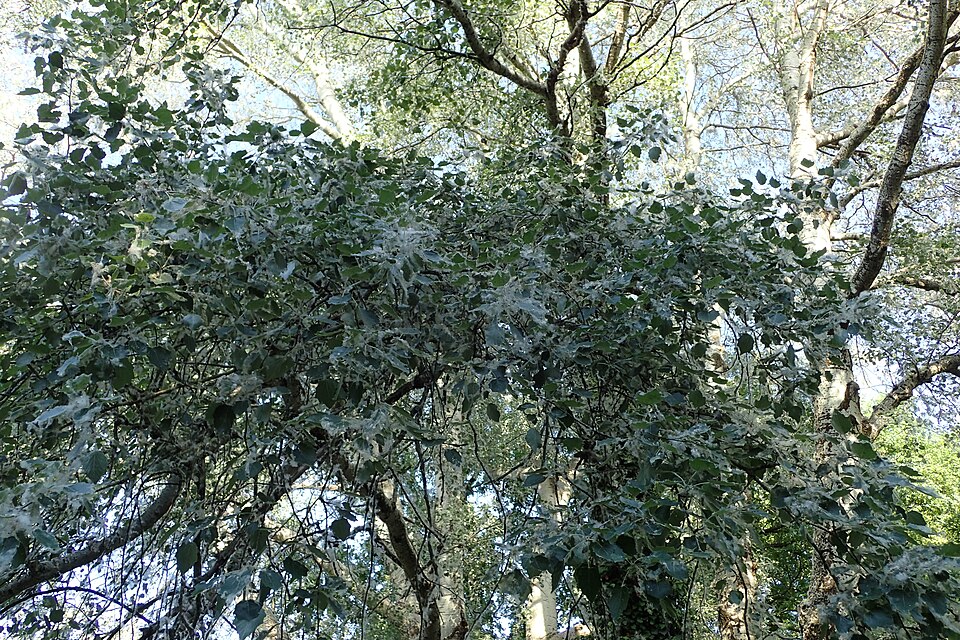
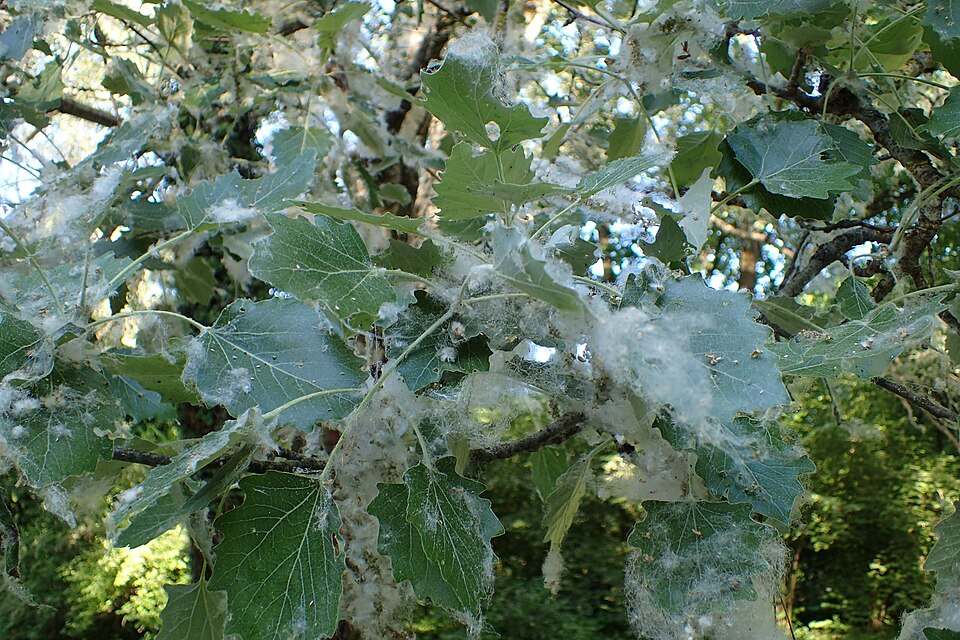
The leaves are the plant’s defining feature and primary identification characteristic. They are broadly ovate (egg-shaped), 2 to 4 inches (5–10 cm) long, with large, coarse, rounded teeth along the margins — 5 to 15 teeth per side, noticeably larger and more irregular than the fine teeth of Quaking Aspen. This coarse toothing is the key distinction from its close relative. The leaves are deep green and shiny above, slightly paler beneath. The petiole (leaf stalk) is flattened in a plane perpendicular to the leaf blade — the feature that causes the characteristic trembling motion in any breeze. In autumn the leaves turn brilliant yellow to golden, occasionally orange, creating spectacular fall color displays. Young leaves in spring are woolly and whitish — another distinguishing feature from Quaking Aspen.
Flowers & Fruit
Large-tooth Aspen is dioecious — male and female flowers are on separate trees. Both sexes produce drooping catkins that emerge before the leaves in early spring (March–April). Male catkins are 2 to 4 inches long, grayish, and densely packed with stamens; female catkins are similar in length but produce small capsule fruits. The fruits are small (½ inch) capsules containing numerous tiny seeds wrapped in cottony white fluff — the characteristic cottony fluff of aspen seed dispersal that covers the ground and air in early summer like snow. The seeds are tiny, lightweight, and require exposed mineral soil for germination; vegetative reproduction (root sprouting) is far more important for population persistence and expansion.
Quick Facts
| Scientific Name | Populus grandidentata |
| Family | Salicaceae (Willow Family) |
| Plant Type | Deciduous Tree (clonal) |
| Mature Height | 50–70 ft |
| Sun Exposure | Full Sun |
| Water Needs | Moderate to High |
| Growth Rate | Fast (2–4 ft/year when young) |
| Bloom Time | March – April (before leaves) |
| Flower Color | Grayish catkins (wind-pollinated) |
| Fall Color | Brilliant yellow to golden |
| Special Notes | Fast growing; fall color; leaves flutter in wind |
| USDA Hardiness Zones | 3–7 |
Native Range
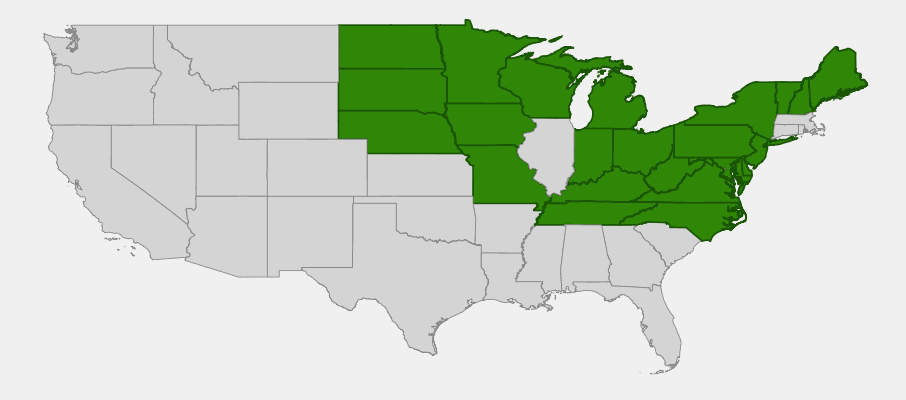
Large-tooth Aspen is native to eastern North America, ranging from Nova Scotia and New Brunswick in the northeast west through southern Quebec and Ontario to Manitoba, and south through the northeastern United States from Maine and New England south through the Appalachian Mountains to North Carolina and Tennessee, and west through the Great Lakes states to the Midwest. It is one of the most widespread deciduous trees in the northern hardwood forest zone, occupying a broad latitudinal band from the boreal south through the mixed hardwood forest.
In New England, Large-tooth Aspen grows throughout the region — from coastal lowlands to mountain valleys — wherever there are openings and disturbed sites. It is particularly abundant in second-growth forests on abandoned agricultural land, roadsides, forest edges, and any area where soil has been disturbed. It often grows in mixed stands with Quaking Aspen, Paper Birch, and Red Maple, forming the characteristic early-successional forest that follows disturbance throughout the Northeast.
The species’ range extends through the Mid-Atlantic states (New Jersey, Delaware, Maryland, Virginia) and Appalachian chain. It is less common in the southern Appalachians than its northern relatives but is present at higher elevations in suitable forest openings. In the Midwest, it reaches Minnesota, Iowa, Nebraska, and Missouri, forming large clonal colonies on well-drained soils. Its remarkable moisture adaptability — tolerating both dry and wet conditions — gives it an unusually broad habitat tolerance across its range.
📋 Regional plant lists featuring Large-tooth Aspen: New England
Growing & Care Guide
Large-tooth Aspen is one of the easiest native trees to establish. It is fast-growing, tough, and adaptable to a wide range of soil conditions. The primary consideration is that it needs full sun and adequate space — it is not a tree for small urban lots.
Light
Large-tooth Aspen is a full-sun species that performs best with 6 or more hours of direct sunlight daily. As a pioneer tree, it is naturally adapted to open, disturbed conditions with abundant light. It will grow in light shade but becomes leggy, produces less vibrant fall color, and is more susceptible to disease. For the best form, fall color, and fastest growth, plant in full sun.
Soil & Water
One of Large-tooth Aspen’s greatest assets is its exceptional moisture adaptability — tolerating dry, sandy soils on one extreme and seasonally moist or wet soils on the other. It performs well in a wide range of soil types from sandy loams to clay loams, as long as drainage is not permanently impeded. It prefers slightly acidic to neutral pH (5.5–7.0). While drought-tolerant once established, young trees benefit from regular watering during their first growing season. The species naturally spreads through root suckering — new shoots will emerge from the lateral roots — so plant where you have room for a natural grove to develop over time.
Planting Tips
Plant Large-tooth Aspen as bare-root stock in early spring or fall for best establishment. Choose a site with full sun and adequate space — allow at least 20–30 feet of clearance from structures, as the root system spreads widely and root suckers can emerge at considerable distances from the parent tree. Plant in groups of 3–5 or more for the best aesthetic effect and to create a naturalistic grove. Avoid planting near septic systems or underground utilities, as aspen roots can be invasive in confined spaces. Container-grown stock is available from specialty native plant nurseries.
Pruning & Maintenance
Large-tooth Aspen requires minimal pruning. The tree’s natural form is part of its beauty, and heavy pruning is unnecessary. Remove dead or damaged branches as needed in late winter. If you wish to control root suckering, mow or cut root sprouts repeatedly during the growing season. The tree is relatively short-lived (50–100 years for individual stems) but the clonal colony it creates can persist indefinitely. Aspen is susceptible to several canker diseases (including Cytospora canker), which can kill individual stems; affected stems should be removed and destroyed.
Landscape Uses
- Naturalistic groves — stunning fall color and shimmering summer foliage
- Fast screening — one of the quickest-establishing native screens available
- Meadow edges and field margins
- Wildlife habitat plantings — exceptional value for a wide range of species
- Erosion control on disturbed slopes and stream banks
- Reclamation planting on former agricultural or industrial land
- Clonal colony feature — a living grove connected by shared roots is a remarkable ecological feature
Wildlife & Ecological Value
Large-tooth Aspen is widely regarded as one of the most ecologically valuable native trees in the Northeast. Its importance to wildlife is extraordinary — virtually every part of the tree is consumed by some wildlife species at some time of year, making it one of the most productive native plants per unit of space in the landscape.
For Birds
Ruffed Grouse — one of the most iconic upland game birds of northeastern forests — depends on aspen more than any other tree species. Grouse eat the winter buds, catkins, and leaves of aspen virtually year-round; male grouse “drum” on fallen aspen logs during spring display; and dense young aspen stands provide the cover these birds require for nesting and escaping predators. American Woodcock nest in young aspen thickets and feed in the surrounding wet areas. Yellow-bellied Sapsuckers — the woodpecker most dependent on aspen — excavate nest cavities in aspen trunks and drill characteristic rows of sap wells in the bark. The sap wells attract not just the sapsucker but hummingbirds and dozens of insect species. Over 300 species of birds have been documented using aspen forest habitats across the species’ range.
For Mammals
Beaver depend on aspen more than any other tree — they eat the bark, build dams and lodges from the wood, and cache aspen branches underwater as winter food stores. Moose browse aspen twigs and bark heavily in winter, when other food sources are buried under snow. White-tailed Deer browse aspen twigs and leaves. Snowshoe Hares eat the bark and twigs of young aspens and use dense stands as escape cover. Porcupines girdle aspen bark in winter. Black Bears eat catkins, young leaves, and inner bark in spring. The combination of food value and cover structure makes Large-tooth Aspen arguably the single most important tree species for large mammal wildlife in northeastern North America.
For Pollinators
As a wind-pollinated species, Large-tooth Aspen does not produce nectar, but its early-spring catkins produce abundant pollen that is gathered by early-emerging native bees. The catkins appear before most other spring flowers, making this pollen an important food source for queen bumblebees and other early-season pollinators emerging from winter dormancy. The tree also supports a remarkable diversity of caterpillars — over 300 species of Lepidoptera (moths and butterflies) feed on aspen, making it second only to oaks in total moth and butterfly species supported among northeastern trees.
Ecosystem Role
Large-tooth Aspen plays a critical role in northeastern forest succession. As a fast-growing pioneer, it quickly establishes on disturbed sites and creates conditions — partial shade, leaf litter, stable soil — that allow more shade-tolerant forest species to establish beneath it. It serves as a nurse tree for a host of other species, accelerating the recovery of diverse forest after disturbance. The hollow trunks of aging aspen are among the most important nest cavity sites in the forest, used by Wood Ducks, Hooded Mergansers, Barred Owls, and many species of woodpecker, which in turn create cavities used by dozens of other species. The clonal root system makes aspen groves highly resilient — when fire, ice storms, or disease kills the aboveground trunks, the shared root system rapidly sprouts new trunks from lateral roots, regenerating the grove within a few growing seasons.
Cultural & Historical Uses
Large-tooth Aspen has been used by Indigenous peoples throughout its range for thousands of years. The inner bark was eaten as emergency food — scraped from the tree, dried, and ground into flour, or eaten fresh in spring when it is sweetest. The inner bark contains salicin, a glycoside related to aspirin that has mild anti-inflammatory and analgesic properties. Various Indigenous nations prepared infusions from aspen bark to treat pain, fever, and inflammation — uses that anticipated the development of modern aspirin (acetylsalicylic acid) by centuries.
The wood of Large-tooth Aspen is light, soft, and relatively weak, but its properties made it useful for specific purposes: excelsior (wood shavings used for packing), matches, paper pulp, particle board, and plywood. Aspen-based paper and particleboard are produced in large volumes in the Great Lakes states and Canada, where large aspen forests support significant pulp and wood products industries. The wood burns quickly and was considered a poor fuel compared to denser hardwoods, but was used in situations where quick, hot fires were needed (particularly by smiths and bread bakers).
The trembling of aspen leaves has deep cultural resonances. In Indigenous oral traditions across North America, the trembling aspen was associated with communication between the living world and the spirit world — its constant movement suggested that the tree was always listening, always in dialogue with unseen forces. In European-American folk tradition, the aspen’s trembling was sometimes explained by the legend that the cross of the Crucifixion was made of aspen wood, causing all aspen trees to tremble with perpetual shame. The Latin species name grandidentata simply means “large-toothed,” referring to the coarse leaf margins.
In the garden tradition, aspen groves are celebrated as places of particular beauty and atmosphere. The quivering curtain of golden leaves in autumn, the dappled light filtering through summer foliage, the rustle of leaves in the quietest breeze, and the visual drama of white trunks in winter snow are all qualities that have made aspens beloved by artists, poets, and naturalists. Frederick Church painted aspen groves; John Muir wrote about the trembling of aspens in the Sierra Nevada; and across the New England landscape, the flash of gold on an aspen hillside in October is one of the iconic signals of the passing of summer.
Frequently Asked Questions
What is the difference between Large-tooth Aspen and Quaking Aspen?
Both are native aspens with trembling leaves and pale bark, but they can be distinguished by leaf size and tooth shape. Large-tooth Aspen (P. grandidentata) has larger leaves (2–4 inches) with fewer, coarser, more pronounced rounded teeth — typically 5–15 large teeth per side. Quaking Aspen (P. tremuloides) has smaller leaves (1½–3 inches) with many fine, sharp teeth. Young Large-tooth Aspen leaves in spring are woolly-white; young Quaking Aspen leaves are reddish. Large-tooth Aspen generally has a more southern range in the East and is more commonly found at lower elevations.
Will Large-tooth Aspen spread uncontrollably in my yard?
Large-tooth Aspen does spread through root suckering, sending up new shoots from lateral roots — sometimes at considerable distances from the parent tree. This can be controlled by repeatedly cutting or mowing the suckers as they appear. In naturalistic landscapes with adequate space, this spreading creates a beautiful grove over time. Avoid planting near structures, utilities, or areas where spreading would be problematic. The spreading habit is most vigorous in full sun on moist soils.
How long does Large-tooth Aspen live?
Individual trunks typically live 50–100 years, but the clonal colony — the connected root system underlying a grove of aspen — can persist for thousands of years. The famous Pando clone of Quaking Aspen in Utah is estimated to be 80,000 years old. Large-tooth Aspen clones may similarly be ancient. Even when individual trunks die from disease, wind, or fire, the root system sends up vigorous new sprouts, regenerating the grove.
Is Large-tooth Aspen good for fall color?
Absolutely — Large-tooth Aspen is among the most brilliant fall color trees in the Northeast. The foliage turns luminous golden yellow to orange in September and October, creating spectacular displays especially when planted in groves where the combined effect of many trembling golden leaves is breathtaking. Fall color is best in cool, clear autumns and on well-drained soils in full sun.
Can Large-tooth Aspen grow near water?
Yes — Large-tooth Aspen tolerates wet soils and grows naturally along stream banks, pond edges, and in wet meadows. However, it does not tolerate permanently waterlogged conditions or flooding. It performs best in moist but well-drained sites and will thrive on a wide range of moisture conditions, from relatively dry upland soils to seasonally wet floodplain soils.

Looking for a nursery that carries Large-tooth Aspen?
Browse our native plant nursery directory: Maine · New Hampshire · Vermont · Connecticut