American Elm (Ulmus americana)
Ulmus americana, the American Elm, is one of the most iconic and beloved native trees of eastern North America. Before Dutch elm disease swept across the continent in the mid-20th century, American Elms lined nearly every main street and city boulevard in the eastern United States, forming magnificent arching canopies that created cool, cathedral-like corridors of green. Their distinctive vase-shaped form — with a broad, spreading crown and gracefully drooping outer branches — was instantly recognizable and deeply loved by generations of Americans.
A large deciduous tree of the elm family (Ulmaceae), American Elm typically grows 60 to 100 feet tall with an even broader crown spread. It thrives in full sun and moist, fertile bottomlands, river floodplains, and well-drained upland sites throughout the eastern United States and into Canada. The tree’s fall foliage turns a rich golden yellow, adding seasonal beauty to the landscape. Its high, spreading canopy provides exceptional shade — a single mature tree can cover several thousand square feet — making it one of the most effective summer cooling trees in the temperate world.
Disease-resistant varieties developed by the USDA and other research institutions have made it possible to once again plant American Elms with confidence. Cultivars such as ‘Valley Forge,’ ‘Princeton,’ and ‘New Harmony’ offer strong resistance to Dutch elm disease while preserving the species’ classic form and ecological value. For gardeners, municipalities, and restoration practitioners in Delaware, New Jersey, and New York, planting a disease-resistant American Elm is both a gesture of restoration and a celebration of one of North America’s finest native trees.
Identification
American Elm is a large deciduous tree, typically growing 60–100 feet tall with a trunk diameter of 2–5 feet at maturity. Its most distinctive characteristic is its vase-shaped crown — a broad, spreading canopy with ascending branches that arch gracefully outward and downward at the tips, creating the classic arched appearance that made American Elm a beloved street tree for generations.
Bark
The bark of mature American Elm is grayish-brown to dark gray, deeply furrowed with broad, flat ridges that form an interlacing pattern. On young trees, the bark is lighter gray and more smoothly textured. The inner bark reveals alternating white and reddish-brown layers when sliced — a distinguishing feature. Older trees develop deeply fissured, corky bark with a distinctive flat-topped ridge pattern.
Leaves
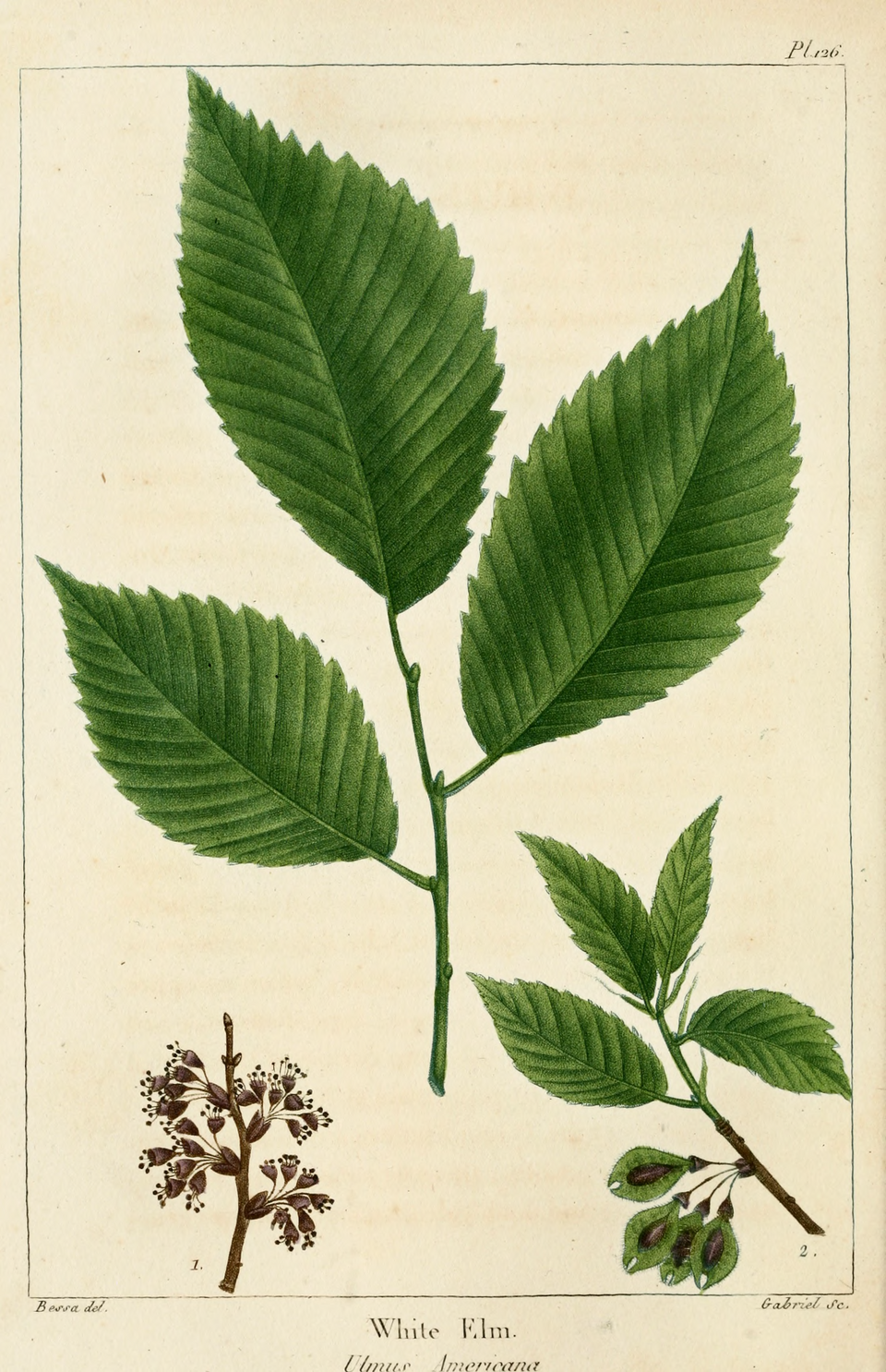
The leaves are simple, alternate, and distinctly asymmetrical at the base — a key identifying feature of elms. Each leaf is 3–6 inches long and 1–3 inches wide, with a doubly serrated (toothed) margin. The upper surface is dark green and slightly rough-textured; the lower surface is paler and may have small tufts of hair in the vein axils. In autumn, the leaves turn bright yellow, providing cheerful fall color. The leaf base is noticeably uneven — one side attaches higher on the leaf stalk than the other.
Flowers & Fruit
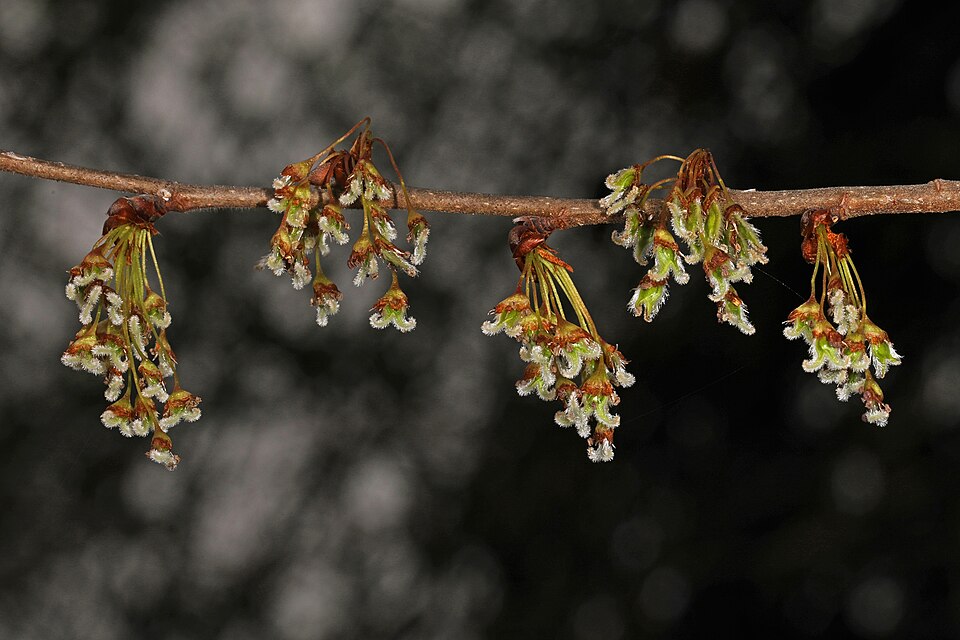
American Elm flowers in early spring — February through April depending on latitude — before the leaves emerge. The flowers are small and inconspicuous, reddish to purple, and borne in pendulous clusters. They are wind-pollinated and produce abundant pollen. The fruit is a small, flat, winged samara (papery disk) about ½ inch across, notched at the tip and surrounding a single seed. The samaras ripen in spring and are dispersed by wind, often carpeting the ground beneath the tree before the leaves are fully open. The seeds are an important early-season food for songbirds and small mammals.
Quick Facts
| Scientific Name | Ulmus americana |
| Family | Ulmaceae (Elm) |
| Plant Type | Deciduous Tree |
| Mature Height | 60–80 ft |
| Sun Exposure | Full Sun |
| Water Needs | Moderate |
| Bloom Time | February – April (before leaf-out) |
| Flower Color | Reddish-purple (inconspicuous) |
| USDA Hardiness Zones | 2–9 |
Native Range
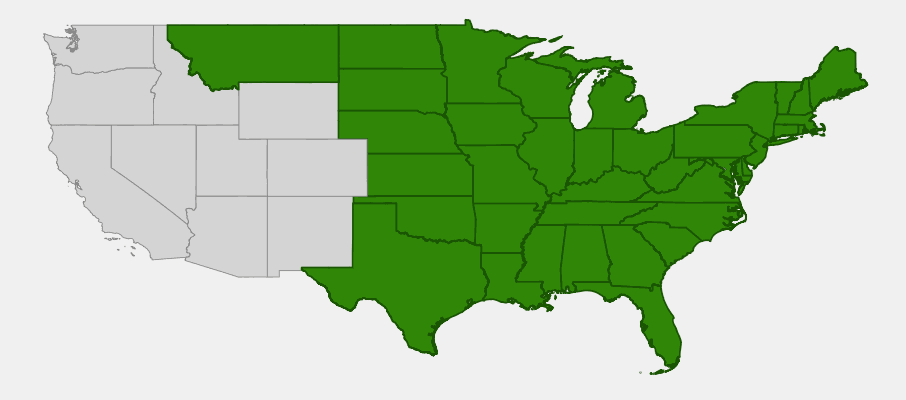
American Elm is native to nearly the entire eastern half of North America, from the Atlantic coast west to the Great Plains and from the Gulf Coast north into southern Canada. It ranges from Maine and Nova Scotia south to Florida, and west to central Nebraska, Kansas, and Texas. The species thrives in moist bottomlands, river floodplains, and rich upland forests throughout this vast range.
In the tri-state region of Delaware, New Jersey, and New York, American Elm was historically abundant along streams, in floodplain forests, and as a beloved street and shade tree. Dutch elm disease, caused by the fungus Ophiostoma ulmi (introduced from Europe in the 1930s), devastated wild and urban populations. However, disease-resistant cultivars have enabled significant replanting efforts, and wild trees that survived the disease continue to grow throughout the region.
American Elm typically grows in association with Silver Maple, Box Elder, Cottonwood, Sycamore, and Red Maple in riparian and floodplain communities. In upland settings, it occurs alongside Red Oak, Sugar Maple, and White Ash. The species tolerates periodic flooding, making it a valuable component of wetland margins and stream corridors.
📋 Regional plant lists featuring American Elm: Delaware, New Jersey & New York
Growing & Care Guide
American Elm is a fast-growing, adaptable tree that thrives in full sun and moist soils. Disease-resistant cultivars have made it a viable choice once again for landscapes across the eastern United States.
Light
American Elm requires full sun for best growth and development. It can tolerate partial shade when young, but produces the fullest, most beautiful vase-shaped crown when grown in open, sunny conditions. Trees grown in shade tend to be more upright and less spreading.
Soil & Water
American Elm thrives in moist, fertile, well-drained soils but tolerates a wide range of conditions including periodic flooding, clay soils, and compacted urban soils. It prefers a pH of 5.5–8.0. Moderate water needs mean it performs best with consistent moisture, though established trees can tolerate brief drought. Mulching helps retain soil moisture and regulate temperature.
Planting Tips
Plant disease-resistant cultivars for best results. ‘Valley Forge,’ ‘Princeton,’ and ‘Jefferson’ are all excellent choices with proven resistance to Dutch elm disease. Plant in fall or early spring. Allow generous spacing — mature trees can spread 60–100 feet wide — making them ideal as specimen trees in parks, large lawns, and along streets with adequate space. Avoid planting near overhead utilities.
Pruning & Maintenance
Prune in late fall or winter when the tree is dormant to minimize the risk of disease transmission (bark beetles that spread Dutch elm disease are active spring through fall). Remove dead, damaged, or crossing branches to maintain good structure. Young trees benefit from training to develop a strong central leader.
Landscape Uses
- Shade tree — one of the largest and most beautiful native shade trees
- Street tree — classic avenue planting with disease-resistant cultivars
- Riparian restoration — excellent for stream buffers and floodplains
- Wildlife habitat — seeds and insects support dozens of bird species
- Urban greening — tolerates compaction and urban stress
Wildlife & Ecological Value
American Elm supports an exceptionally diverse community of wildlife. Studies have documented over 200 species of caterpillars (Lepidoptera larvae) feeding on elm foliage — making it one of the top caterpillar host plants in eastern North America, a crucial resource for breeding birds that depend on caterpillars to feed their nestlings.
For Birds
The early-ripening samaras (winged seeds) provide a critical food source for migrating warblers, finches, and sparrows in spring. American Goldfinches, Purple Finches, and many sparrow species rely heavily on elm seeds during spring migration. Baltimore Orioles frequently nest in the drooping outer branches of elm trees. The insect diversity supported by elm foliage — including hundreds of caterpillar species — makes American Elm an outstanding resource for breeding songbirds.
For Mammals
Squirrels consume elm seeds abundantly when they ripen in spring. Rabbits, deer, and beaver browse elm bark and twigs, especially in winter. Beavers frequently use elm as a building material and food source along stream corridors. The large, hollow trunks of mature elms provide denning and roosting sites for raccoons, opossums, and owls.
For Pollinators
Though wind-pollinated, elm flowers provide early-season pollen for native bees, honeybees, and other insects that emerge before many other plants bloom. The sheer volume of pollen produced by a mature elm makes it a valuable early-season resource.
Ecosystem Role
As a major canopy tree, American Elm plays a fundamental role in eastern riparian and bottomland forests. Its leaf litter is relatively easy to decompose and enriches soil with nutrients. The extensive root system helps stabilize stream banks and reduce erosion. In floodplains, American Elm is a keystone species whose loss — from Dutch elm disease — dramatically altered forest structure and wildlife communities throughout the 20th century.
Cultural & Historical Uses
American Elm holds a special place in American cultural history. For over a century — roughly 1850 to 1950 — it was the dominant street tree of virtually every city and town in the eastern United States. The elm-lined main streets of New England, the Midwest, and the mid-Atlantic were cultural icons, symbols of prosperity and civic pride. When Dutch elm disease spread across the continent beginning in the 1930s, the loss of millions of elms was mourned as a genuine cultural and ecological tragedy.
Indigenous peoples across eastern North America used American Elm extensively. The Ojibwe used the inner bark to make rope and cordage, and prepared medicinal teas from the bark to treat sore throats, coughs, and fever. The Iroquois used elm bark for canoe-building and to construct the large oval longhouses that housed multiple families. Many eastern nations made baskets from strips of elm inner bark, and the wood was used for tool handles, wheel hubs, and boat ribs because of its exceptional resistance to splitting.
The wood of American Elm is tough, interlocking-grained, and highly resistant to splitting — properties that made it ideal for wooden wheel hubs, barrel staves, butcher blocks, and heavy tool handles throughout the colonial and industrial eras. Elm wood was used in cheese boxes, crates, and furniture. The trees themselves were planted as living monuments — the “Washington Elm” in Cambridge, Massachusetts, under which George Washington reportedly took command of the Continental Army in 1775, was an American Elm that stood until 1923 and was mourned by the nation when it finally fell.
Frequently Asked Questions
Is American Elm resistant to Dutch elm disease?
Wild-type American Elms are susceptible to Dutch elm disease. However, several disease-resistant cultivars — including ‘Valley Forge,’ ‘Princeton,’ ‘Jefferson,’ and ‘New Harmony’ — have been developed and are widely available. These cultivars retain the classic vase-shaped form while offering strong resistance to the disease.
How fast does American Elm grow?
American Elm is a fast-growing tree, typically adding 3–6 feet of height per year when young under ideal conditions. It can reach 60–80 feet in 30–50 years. The rate slows with maturity but the tree continues to expand its crown throughout its life.
Where is the best place to plant an American Elm?
Choose a site with full sun, moist fertile soil, and plenty of room — mature trees can spread 60–100 feet wide. They are excellent for large lawns, parks, roadsides, and stream corridors. Avoid planting under overhead power lines or in small spaces.
Does American Elm tolerate flooding?
Yes — American Elm naturally grows in floodplains and bottomlands and tolerates periodic flooding well. It is one of the better large native trees for wet sites and stream restoration projects.
What birds nest in American Elm trees?
Baltimore Orioles are particularly associated with elm trees, often weaving their hanging nests in the drooping outer branches. Many other species including American Robins, Wood Thrushes, Red-tailed Hawks, and Great Horned Owls also nest in or near mature elms.

Looking for a nursery that carries American Elm?
Browse our native plant nursery directory: Delaware · New Jersey