Ocotillo (Fouquiera splendens)
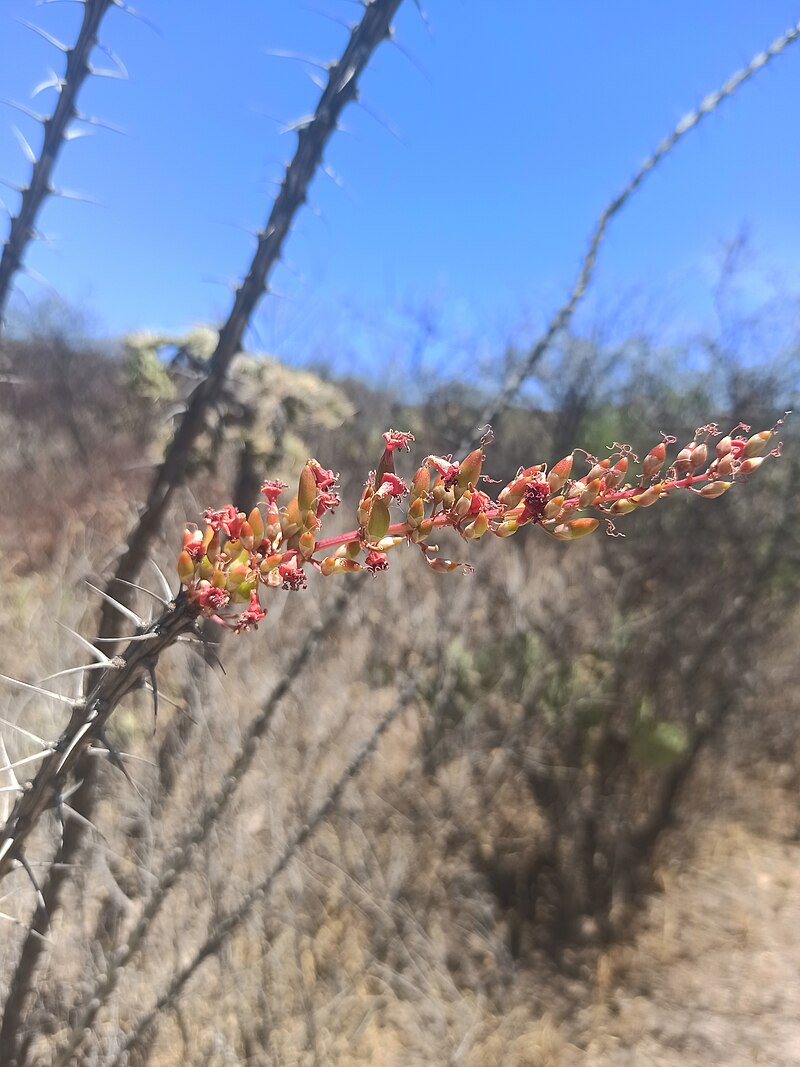
Fouquieria splendens, the Ocotillo, is one of the most architecturally dramatic and ecologically important plants of the Sonoran and Chihuahuan Deserts. Neither a cactus nor a succulent in the traditional sense, Ocotillo is the only widespread species of the Fouquieriaceae family in the United States — a small family of bizarre, drought-adapted shrubs found only in the arid regions of the Southwest and Mexico. Its tall, unbranched, whip-like canes erupt from a central base, reaching up to 12 feet or more, armed with stout spines and tipped in spring with spectacular clusters of brilliant red-orange tubular flowers that pulse with hummingbird activity.
Ocotillo’s remarkable adaptation to drought is unlike almost any other plant. Rather than maintaining persistent succulent water storage like cacti, Ocotillo drops its leaves within days of a drought beginning, then produces entirely new leaves within days of the next rainfall — repeating this cycle multiple times per year as the weather dictates. This metabolic strategy allows the plant to conserve water dramatically during dry periods while photosynthesizing rapidly during wet periods. The result is that an Ocotillo in a dry year may be leafless for months, appearing completely dead, only to flush brilliant green within 72 hours of significant rain.
For desert gardeners and restoration practitioners, Ocotillo is an irreplaceable native — providing structural form, spectacular spring bloom, critical hummingbird habitat, and a uniquely Southwest aesthetic that cannot be replicated with any other plant. Its one non-negotiable demand is excellent drainage: overwatering is the primary cause of Ocotillo decline in garden settings, and standing water is fatal.
Identification
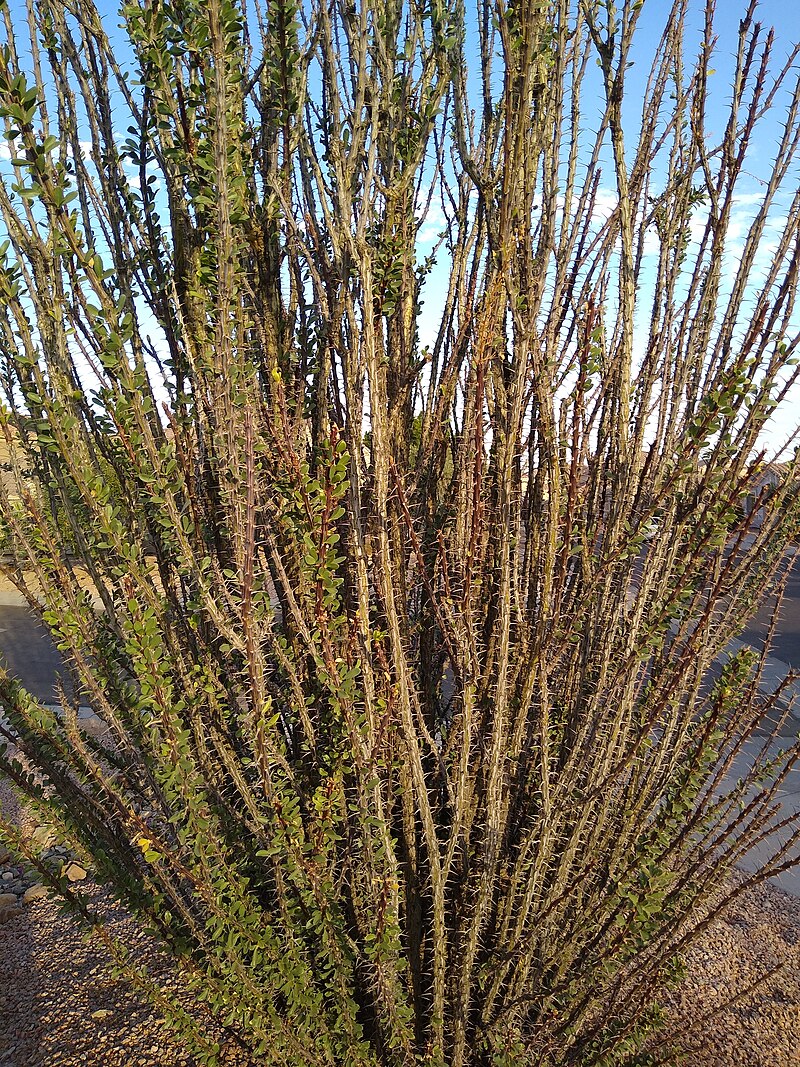
Ocotillo is unmistakable in the desert landscape — no other plant in the Sonoran Desert has its combination of multiple tall, unbranched spiny canes arising from a central point. A mature plant can have 10 to 100 or more canes radiating outward and upward in a dramatic vase-like form that makes it one of the most architecturally striking plants in North America.
Canes & Spines
The canes are round in cross-section, 1 to 2 inches in diameter, and can reach 8 to 12 feet or more in height. They are covered with a grayish bark and armed with stiff, sharp spines up to 2 inches long — modified petioles (leaf stems) of earlier leaves. The canes themselves photosynthesize through their green bark, allowing the plant to produce energy even when leafless. New cane growth at the tips is green and thornless, hardening into spiny gray bark as it matures.
Leaves
Leaves are small, oval to spatula-shaped, 0.5 to 1 inch long, bright green, and smooth. They emerge in clusters from the axils of the spines in response to rainfall. As noted, leaves can appear and disappear multiple times per year depending on moisture availability. The leaf clusters give leafed-out Ocotillo an attractive, billowing green appearance that transforms the entire landscape perception of the plant.
Flowers & Fruit
The flowers are the plant’s greatest glory: brilliant scarlet to orange-red, tubular, about 1 inch long, produced in tight clusters (panicles) at the tips of the canes from March through June. They are rich in nectar and almost perfectly shaped for hummingbird pollination. The fruit is a small, dry capsule containing flat, winged seeds dispersed by wind.
Quick Facts
| Scientific Name | Fouquieria splendens |
| Family | Fouquieriaceae |
| Plant Type | Desert Shrub (unique drought-deciduous strategy) |
| Mature Height | 12 ft |
| Sun Exposure | Full Sun |
| Water Needs | Low (Drought Tolerant) |
| Bloom Time | March – June (heaviest April–May) |
| Flower Color | Brilliant red-orange (scarlet) |
| Notes | Vulnerable to overwatering. Drops and regrows leaves with rainfall cycles. |
| USDA Hardiness Zones | 7–11 |
Native Range
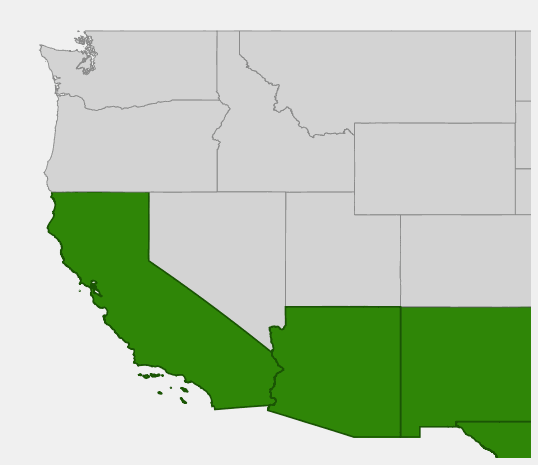
Ocotillo is native to the Chihuahuan and Sonoran Deserts of the southwestern United States and northern Mexico. In the US, it occurs in southern and central Arizona, New Mexico, western Texas (especially the Big Bend region), and a small portion of southeastern California in the Colorado Desert region. Its US range is concentrated at elevations from near sea level to about 5,000 feet, though it is most common between 1,000 and 4,000 feet.
In Arizona, Ocotillo is a defining feature of the landscape across a large swath of the state — from the low Sonoran Desert of the Tucson Basin and the Phoenix area foothills, south to the Mexican border and east into the Chihuahuan Desert grasslands of southeastern Arizona. It typically occurs on rocky hillsides, gravelly bajadas, and dry mountain slopes where drainage is excellent. It is often found growing alongside saguaro cactus, palo verde trees, brittlebush, and teddy bear cholla in the classic Sonoran Desert plant community.
South of the border, Ocotillo ranges extensively through Sonora, Chihuahua, Baja California, and other Mexican states. The genus Fouquieria is entirely endemic to the Sonoran Desert region, with other bizarre tree-like species like Boojum (F. columnaris) occurring only in Baja California.
📋 Regional plant lists featuring Ocotillo: Arizona
Growing & Care Guide
Ocotillo is a gardener’s dream in terms of low maintenance — once established in proper conditions, it requires virtually no care for decades. The challenge is simply giving it exactly what it needs during establishment and never overwatering it thereafter.
Light
Full, unobstructed sun is non-negotiable. Ocotillo evolved on south-facing rocky desert slopes with maximum solar exposure. In the garden, the hottest, most exposed location is ideal. Partial shade causes reduced flowering and weakened canes.
Soil & Water
Perfect drainage is the single most critical requirement. Ocotillo will not tolerate standing water or chronically moist soils — even briefly. Plant on a slight slope or mound to ensure water drains away from the crown. Sandy, gravelly, or rocky soils are ideal. After transplanting, water deeply once a week for the first two months, then taper off to once or twice per month, then rely primarily on rainfall. Once established, Ocotillo should receive minimal to no supplemental water in the Sonoran Desert.
Planting Tips
Ocotillo is most commonly sold as bare-root canes — a bundle of dried canes that appear completely dead. Plant at the same depth as grown in the wild (look for the soil line on the canes). Orient the canes so they lean slightly outward as they grow. Do not amend the soil heavily — Ocotillo prefers lean, well-drained substrate. New leaf growth is the first sign of successful establishment — expect it within weeks of planting if moisture is provided.
Pruning & Maintenance
Ocotillo requires no pruning under normal circumstances. Occasionally remove dead or damaged canes by cutting them at the base. Avoid cutting living canes as this damages the plant’s natural architecture and the wounds are slow to heal in the dry climate. In Arizona, Ocotillo fences are a traditional and effective alternative to wooden or wire fencing — cuttings planted in the ground will root and grow over time.
Landscape Uses
- Focal specimen — unmatched architectural drama in the desert landscape
- Living fence — planted close together, forms an impenetrable spiny barrier
- Hummingbird magnet — essential for Costa’s, Anna’s, and migrating hummingbirds
- Wildlife habitat — provides nesting sites for Cactus Wrens and Curve-billed Thrashers
- Desert restoration — keystone structural element of Sonoran Desert plant community
- Slope and hillside planting — thrives on well-drained rocky slopes
Wildlife & Ecological Value
Ocotillo is a keystone species for the Sonoran Desert ecosystem, providing critical resources for multiple animal groups throughout the year.
For Birds
The spring flowers of Ocotillo are one of the most important nectar sources for hummingbirds in the Sonoran Desert. Costa’s Hummingbirds time their breeding season to coincide with Ocotillo bloom, and Broad-billed, Black-chinned, and Rufous Hummingbirds all nectar heavily at the flowers during migration. Cactus Wrens, Curve-billed Thrashers, and Phainopeplas nest in the spiny canes. Verdin, gnatcatchers, and various warblers forage for insects in and around the plant throughout the year.
For Mammals
The nectar-rich flowers are accessible to long-nosed bats, which are important pollinators of Ocotillo at night. Mule deer and javelina browse the new leaf growth when it appears after rains. The spiny cane structure provides protected refuges for small rodents, lizards, and other animals that benefit from the thorny barrier against predators.
For Pollinators
Beyond hummingbirds and bats, Ocotillo flowers are visited by large native bees including carpenter bees and various digger bees. The flowers produce abundant nectar, and their tubular shape shows adaptation to long-tongued pollinators. Specialist insects associated with Ocotillo include several moth species whose larvae feed on the seeds and foliage.
Ecosystem Role
As one of the tallest and most structurally complex native plants in the Sonoran Desert understory layer, Ocotillo creates important three-dimensional habitat structure at heights (6–12 ft) where few other native plants operate. This vertical complexity supports biodiversity at scales beyond what ground-level species alone can provide. Its deep root system helps stabilize rocky slopes against erosion during intense monsoon rain events.
Cultural & Historical Uses
Ocotillo holds a special place in the cultural landscape of the Sonoran Desert borderlands. Indigenous peoples including the Tohono O’odham, Seri, Pima, Tarahumara, and various Apache groups used the plant extensively. The stiff, dry canes were ideal for construction — laid horizontally across wooden frames to form ramada roofs and walls, creating shaded outdoor structures that are still used in traditional desert architecture today. The canes were also used for fence posts, carrying poles, and as fuel.
Medicinally, Ocotillo had significant uses across multiple Indigenous cultures. The flowers were eaten fresh or dried as food, providing both sugar (from nectar) and nutrition. Root bark was prepared as a tea or applied as a poultice for leg fatigue and to treat lymphatic congestion. Contemporary herbalists still use Ocotillo root preparations, and some evidence supports its traditional use as a lymphagogue (promoting lymphatic flow) and for improving absorption of fats and fat-soluble nutrients.
The name “Ocotillo” derives from the Nahuatl word for torch or pine torch — a reference to the resinous, flammable quality of the dry canes, which were traditionally bundled and burned as torches. Spanish colonizers adopted and perpetuated the name, which has remained in use ever since. The plant’s distinctive silhouette — multiple tall, thorny canes against a desert sky — has become one of the most iconic symbols of the Sonoran Desert Southwest, appearing in art, photography, and regional cultural identity across Arizona and beyond.
Frequently Asked Questions
Is Ocotillo a cactus?
No. Despite its desert habitat and thorny appearance, Ocotillo is not a cactus. It belongs to its own family, Fouquieriaceae, which is entirely unrelated to cacti. Unlike true cacti, Ocotillo has true leaves (which it drops during drought), wood in its stems, and produces small, winged seeds rather than fleshy fruits.
Why does my Ocotillo look dead?
Ocotillo goes fully leafless during drought — this is completely normal and the plant is not dead. Simply scratch the bark of a cane with your fingernail: if the inner tissue is green and moist, the plant is alive. Provide a deep watering and watch for new leaf and flower bud development within days to a week after watering.
How do I establish a bare-root Ocotillo?
Plant bare-root canes in spring or fall. Set them into the ground at the same depth as their natural soil line. Water deeply once installed, then continue weekly watering for 6–8 weeks. New leaf buds typically appear within 2–4 weeks. Once you see consistent new growth, begin tapering irrigation.
Can I grow Ocotillo from cuttings?
Yes — Ocotillo propagates readily from cane cuttings. Cut a mature cane to the desired length and plant 6–12 inches deep in well-drained soil. Water lightly and consistently until new growth appears (several months). Traditional Ocotillo fences are made this way, using closely spaced cane cuttings that root in place over time.
Does Ocotillo need supplemental water in Tucson?
Established Ocotillo in Tucson can survive entirely on natural rainfall (roughly 12 inches annually), but benefits from a monthly deep soaking during the dry spring months to promote better bloom. In Phoenix (less than 8 inches annual rainfall), additional irrigation every 2–4 weeks during the driest periods improves plant health and flowering without overwatering.

Looking for a nursery that carries Ocotillo?
Browse our native plant nursery directory: Arizona