Nuttall Oak (Quercus nuttallii)
Quercus nuttallii, commonly known as Nuttall Oak, is a magnificent deciduous tree native to the bottomland forests of the south-central United States. Named in honor of the 19th-century botanist Thomas Nuttall, this large red-oak-group member is one of the defining trees of the Mississippi River alluvial valley and adjacent Gulf Coastal Plain, growing in the seasonally flooded bottomland hardwood forests that are among the most ecologically complex and productive ecosystems in North America. Reaching 70 to 85 feet tall at maturity — occasionally to 100 feet — Nuttall Oak is not only a landscape giant but one of the most ecologically valuable oaks in its native region.
What sets Nuttall Oak apart among the oaks of the South is its combination of rapid growth, excellent flood tolerance, and exceptional acorn production. It is one of the fastest-growing oaks native to the region, capable of adding 2–3 feet per year in favorable conditions. The acorns — produced in mast years every 4–7 years in extraordinary abundance — are a critical food source for white-tailed deer, wild turkey, wood ducks, and a host of other wildlife species. Even in non-mast years, Nuttall Oak produces a reliable crop that sustains wildlife through winter.
In landscape applications, Nuttall Oak is increasingly used as a large shade tree in urban and suburban settings, particularly in areas with heavy clay soils or periodic flooding where other oaks struggle. Its tolerance of wet conditions, fast growth, and brilliant red fall color make it an outstanding choice where a large, long-lived shade tree is needed. For wildlife gardeners, restoration ecologists, and anyone planting a legacy tree for future generations, Nuttall Oak is among the most rewarding choices in the southeastern native flora.
Identification
Nuttall Oak is a large deciduous tree reaching 70 to 85 feet tall, with a trunk 2 to 3 feet in diameter at maturity. The crown is broadly oval to rounded, with large ascending branches and a strong central leader in youth that becomes more spreading with age. The overall impression is of a tall, stately tree with a somewhat open crown that allows light to penetrate — a characteristic of bottomland oaks adapted to growing in areas with seasonal flooding and high soil moisture.
Bark & Stems
The bark on mature trees is gray to dark gray, with flat-topped ridges and relatively shallow fissures. It is less deeply furrowed than some other red-group oaks. Young branches are grayish-brown to reddish-brown, smooth, and marked with pale lenticels. Twigs are moderately stout, ending in clusters of brown, pointed, multiple terminal buds characteristic of the red oak group. The inner bark is slightly reddish.
Leaves
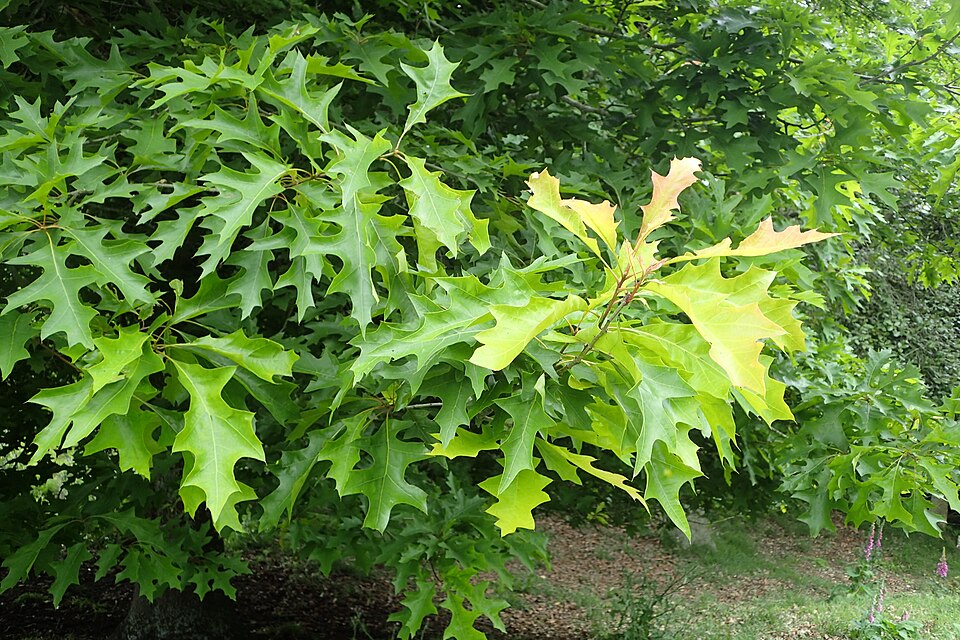
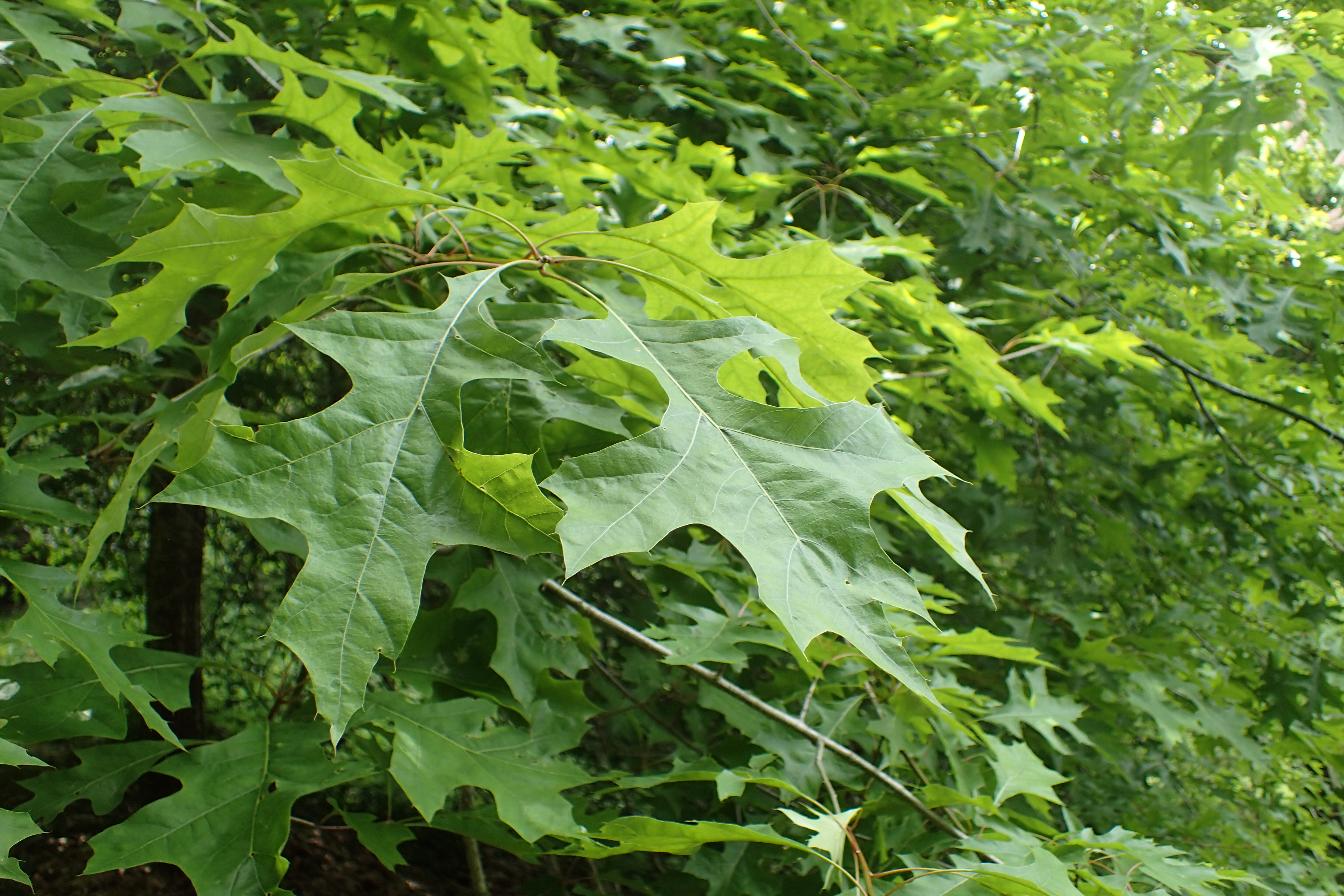
The leaves are large — 4 to 9 inches long and 3 to 6 inches wide — with 7 to 11 deep lobes separated by broad sinuses that extend nearly to the midrib. Each lobe ends in several bristle-tipped teeth, characteristic of the red oak group. The upper surface is shiny dark green in summer, paler and sometimes slightly hairy beneath. Nuttall Oak’s leaves can be difficult to distinguish from Pin Oak (Quercus palustris) and other similar red oaks, but the combination of leaf size, lobe shape, and acorn characteristics provides reliable identification. Fall color is typically red to red-orange, often spectacular in good years.
Flowers & Acorns
Like all oaks, Nuttall Oak is monoecious — bearing separate male and female flowers on the same tree. Male flowers are drooping catkins that appear in spring as the leaves emerge; female flowers are small, barely visible structures in leaf axils. The acorns are relatively large for a red-oak-group species, ½ to 1 inch long and ½ to ¾ inch wide, with a shallow, saucer-like cap covering about ¼ of the nut. Acorns require two years to mature — a characteristic of all red-group oaks. In mast years, production can be prodigious, literally carpeting the ground beneath the trees.
Quick Facts
| Scientific Name | Quercus nuttallii |
| Family | Fagaceae (Beech) |
| Plant Type | Deciduous Tree |
| Mature Height | 70–85 ft |
| Sun Exposure | Full Sun to Part Shade |
| Water Needs | Moderate to High |
| Bloom Time | March – April (catkins) |
| Flower Color | Yellow-green (catkins) |
| USDA Hardiness Zones | 5–9 |
Native Range
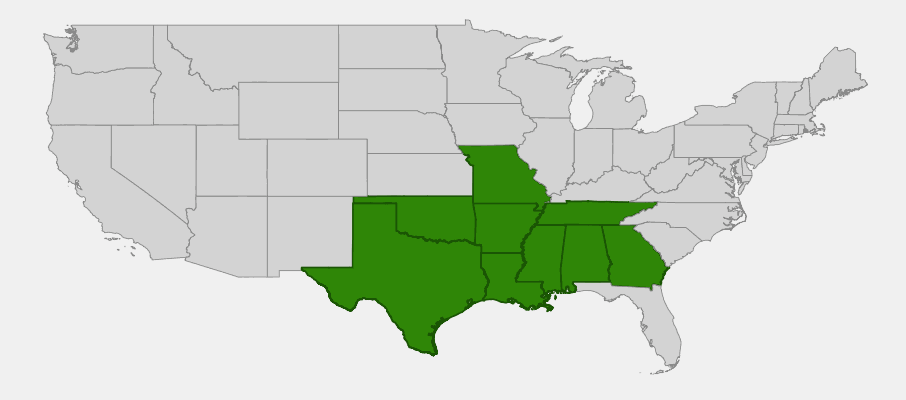
Nuttall Oak is native to the south-central United States, with its core range centered on the Lower Mississippi River Valley and Gulf Coastal Plain. It occurs in Alabama, Mississippi, Louisiana, Arkansas, Tennessee, Missouri, Texas, Oklahoma, and Georgia — with its greatest abundance in the alluvial bottomland forests of the Mississippi River and its major tributaries. It is the characteristic oak of the bottomland hardwood forests that once dominated the river valleys of the South, and its decline as bottomland forests were cleared for agriculture has significantly reduced its historical abundance.
In its natural habitat, Nuttall Oak grows in the wetter portions of bottomland hardwood forests — areas subject to seasonal flooding lasting from weeks to several months. It tolerates longer flooding than most other oaks, making it a reliable choice for floodplain planting. Associated species in these forests include water hickory (Carya aquatica), green ash (Fraxinus pennsylvanica), sugarberry (Celtis laevigata), swamp white oak, overcup oak (Quercus lyrata), and various willows and cottonwoods. In slightly better-drained portions of the bottomlands, Nuttall Oak grows alongside cherrybark oak (Quercus pagoda), swamp chestnut oak (Quercus michauxii), and willow oak (Quercus phellos).
The species is recognized as one of the most important oaks for bottomland reforestation in the South, and it is widely planted by conservation agencies, hunting clubs, and wildlife managers seeking to restore bottomland oak forest habitat and maximize food resources for wildlife. The periodic mast years, when Nuttall Oak produces acorns in overwhelming quantities, are events of considerable ecological significance — creating food surpluses that sustain wildlife populations and support reproduction across multiple species.
📋 Regional plant lists featuring Nuttall Oak: Alabama, Georgia & Mississippi
Growing & Care Guide
Nuttall Oak is a vigorous, adaptable tree that grows well in cultivation beyond its native bottomlands, provided it has adequate moisture and full sun. Its fast growth rate makes it one of the most rewarding large oaks to plant for those seeking significant shade tree establishment in their lifetime.
Light
Nuttall Oak is a full-sun to light-shade tree. In full sun, it grows fastest and develops the densest, most attractive crown. It tolerates some shade, particularly when young, but mature trees do best with open sky. It is not a shade-tolerant species in the sense of tolerating deep shade — for full development, plant it where it will have full sun for most of the day.
Soil & Water
This oak’s most notable soil adaptation is its tolerance of heavy, poorly drained clay soils and seasonal flooding. It is one of the best large oaks for wet sites, stormwater management areas, and flood-prone locations. It grows naturally in clay loam bottomland soils that are seasonally saturated or flooded for extended periods. In cultivation, it also adapts to better-drained soils as long as moisture is adequate. It is less drought-tolerant than upland oaks and should be watered regularly during the first 2–3 growing seasons and in extended dry spells.
Planting Tips
Plant in fall or early spring. Nuttall Oak establishes well from container stock or bare-root nursery plants. Dig a wide, shallow planting hole and backfill with native soil rather than amended planting mix — oaks establish better when encouraged to develop roots into the surrounding native soil. Stake lightly for the first growing season if needed, but remove stakes after one year. Give the tree a permanent site: at maturity, it requires substantial space — at least 40 feet from structures and other large trees.
Pruning & Maintenance
Minimal pruning is needed — remove dead, crossing, or structural problem branches in late winter. Avoid heavy summer pruning, which can stress the tree. Nuttall Oak is generally resistant to most common oak diseases and pests. Oak wilt is a concern in some parts of its range; avoid pruning during the growing season if oak wilt is present in your area. Annual mulching of the root zone out to the drip line benefits establishment and long-term health.
Landscape Uses
- Large shade tree for parks, large residential lots, and institutional properties
- Wet sites and stormwater management — one of the best large trees for these applications
- Wildlife habitat planting — maximum acorn production for deer, turkey, waterfowl
- Bottomland reforestation and ecological restoration
- Street tree in appropriate settings with adequate soil volume
- Legacy tree — plant one for future generations
Wildlife & Ecological Value
Nuttall Oak is among the top wildlife-value trees in the American South. Few plants deliver the ecological punch of a mature mast-producing oak, and Nuttall Oak’s periodic abundance of large acorns makes it particularly significant.
For Birds
Acorns are consumed by Wood Duck, Wild Turkey, Red-headed Woodpecker, Blue Jay, and many other species. Nuttall Oak’s large acorns are especially valuable for Wood Duck, which cannot crack the smaller acorns of some other oaks. The tree’s canopy hosts caterpillars of hundreds of moth and butterfly species — these larvae are the critical food source that songbirds need during nesting season to raise their young. A single large Nuttall Oak supports more biological diversity than almost any other tree in the southeastern landscape.
For Mammals
White-tailed deer are major consumers of Nuttall Oak acorns, particularly during mast years when the crop is so abundant that deer gather from miles around. Squirrels — fox, gray, and flying squirrels — cache and consume acorns year-round. Wild boar, raccoons, opossums, and bears also feed on the mast. The tree is a keystone species for wildlife food webs in the bottomland forests where it dominates.
For Pollinators
The catkins produce pollen that is taken by native bees, while the canopy supports an extraordinary diversity of invertebrates — including dozens of specialist bee species that use oak pollen. More than 530 species of Lepidoptera (butterflies and moths) are associated with oaks in the eastern United States — a number exceeded only by willows and cherries.
Ecosystem Role
Nuttall Oak is a foundational species of bottomland hardwood forests — ecosystems that rank among the most threatened and most productive in North America. These forests filter agricultural runoff, reduce flood peaks, sequester carbon, and support extraordinary biodiversity. Nuttall Oak plays a central structural and functional role in these ecosystems, providing food, habitat structure, and the organic matter inputs that sustain the food web from fungi and invertebrates all the way up to bears and deer.
Cultural & Historical Uses
Like most oaks, Nuttall Oak was utilized by Indigenous peoples of the south-central United States for food, medicine, and material. The acorns, while bitter due to tannins (characteristic of red-group oaks), were processed to remove tannins through leaching and used as a food source. Ground acorn meal was made into bread, porridge, and other preparations. The tannin-rich bark and acorn shells were used for tanning leather and for medicinal preparations as astringents.
Nuttall Oak’s timber is commercially valuable as part of the Southern Red Oak complex, often sold as “red oak” lumber. The wood is hard, heavy, and coarse-grained, valued for flooring, furniture, cabinetry, and veneer. However, the species grows most abundantly in bottomland sites where harvesting has historically been difficult; as a result, it has been less heavily exploited than some upland oaks. The importance of Nuttall Oak as a wildlife food source was long recognized by hunters and trappers of the Mississippi Valley, who knew to search bottomlands beneath Nuttall Oak groves for concentrations of deer and turkeys.
In modern conservation, Nuttall Oak is recognized as a keystone species for bottomland reforestation and wildlife habitat restoration. Conservation organizations including Ducks Unlimited, the National Wild Turkey Federation, and state wildlife agencies actively promote the planting of Nuttall Oak in reforestation projects targeting wildlife habitat across the lower Mississippi Valley. Its combination of fast growth, flood tolerance, and exceptional mast production make it the top choice for bottomland wildlife plantings throughout its native range.
Frequently Asked Questions
How often does Nuttall Oak produce acorns?
Like most oaks, Nuttall Oak exhibits mast-year behavior — producing enormous acorn crops every 4–7 years, with smaller crops in intervening years. Even in off-years, mature trees produce some acorns. The heavy mast years are events of major ecological significance, concentrating wildlife from large areas and enabling significant population growth in acorn-dependent species.
Is Nuttall Oak the same as Pin Oak?
No, though the two are often confused. Pin Oak (Quercus palustris) is a separate species with a more northern range. Nuttall Oak tends to be larger, with bigger acorns, and is better adapted to the deeper South and more prolonged flooding. Pin Oak is more common in the upper South and Midwest. Both are in the red oak group with similar leaf shapes.
Can Nuttall Oak be planted in upland (non-bottomland) areas?
Yes. While native to bottomlands, Nuttall Oak adapts well to upland conditions in cultivation, provided it has adequate water during establishment. It grows well in urban and suburban landscapes on a wide range of soils. Many municipalities and landscapers have planted it successfully in ordinary residential and commercial settings far from bottomlands.
How fast does Nuttall Oak grow?
Nuttall Oak is one of the fastest-growing native oaks — typically 2–3 feet per year in favorable conditions. This makes it much faster-growing than white oak or bur oak, though not as fast as some poplars or willows. A tree planted at 2–3 feet can reach 25–30 feet within a decade under optimal conditions.
When should I plant Nuttall Oak?
Fall planting is ideal — it allows root establishment over winter before summer heat stress. Spring planting before bud break is also good. Avoid planting in summer heat. Bare-root seedlings, if available, are typically planted in late winter while dormant.

Looking for a nursery that carries Nuttall Oak?
Browse our native plant nursery directory: Alabama · Georgia · Mississippi