
Partridge Pea (Chamaecrista fasciculata)
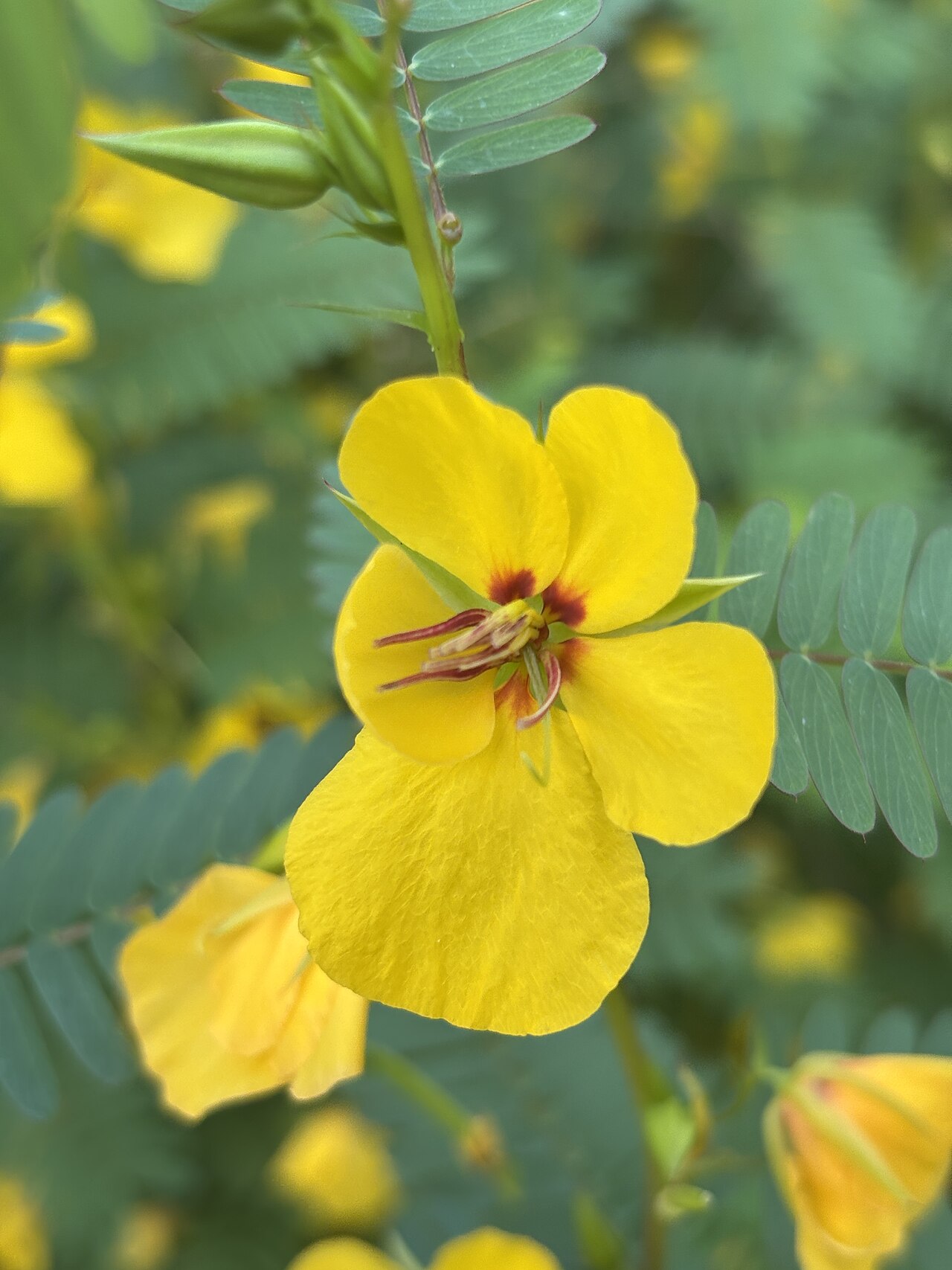
Partridge pea (Chamaecrista fasciculata) is a yellow-flowered native annual that can bring a young meadow to life while slower perennials establish. Fine, paired leaflets create a fernlike texture, and the flowers stand out clearly against that foliage. It is a legume, but it is not a vegetable pea: its role in this guide is as a native wildflower for appropriately managed gardens and habitat plantings.
The entire visible plant completes its life cycle in one growing season. A patch returns through seed, not through an overwintering perennial crown. That distinction is central to both success and control. Gardeners who remove every pod may lose the next generation; gardeners who never monitor seedlings may get more plants than they intended. Think of it as a responsive annual population rather than a fixed clump.
For a sunny Nebraska or Kansas site, partridge pea can be a useful part of a diverse planting. It is not automatically native in every state represented by a combined regional list, and a planting does not need to cover every available space with it. Give it enough sun, identify its seedlings, and decide how much seed production fits the surrounding garden. The aim is a varied community, not a uniform stand that excludes slower neighbors.
Identification
Stems and habit
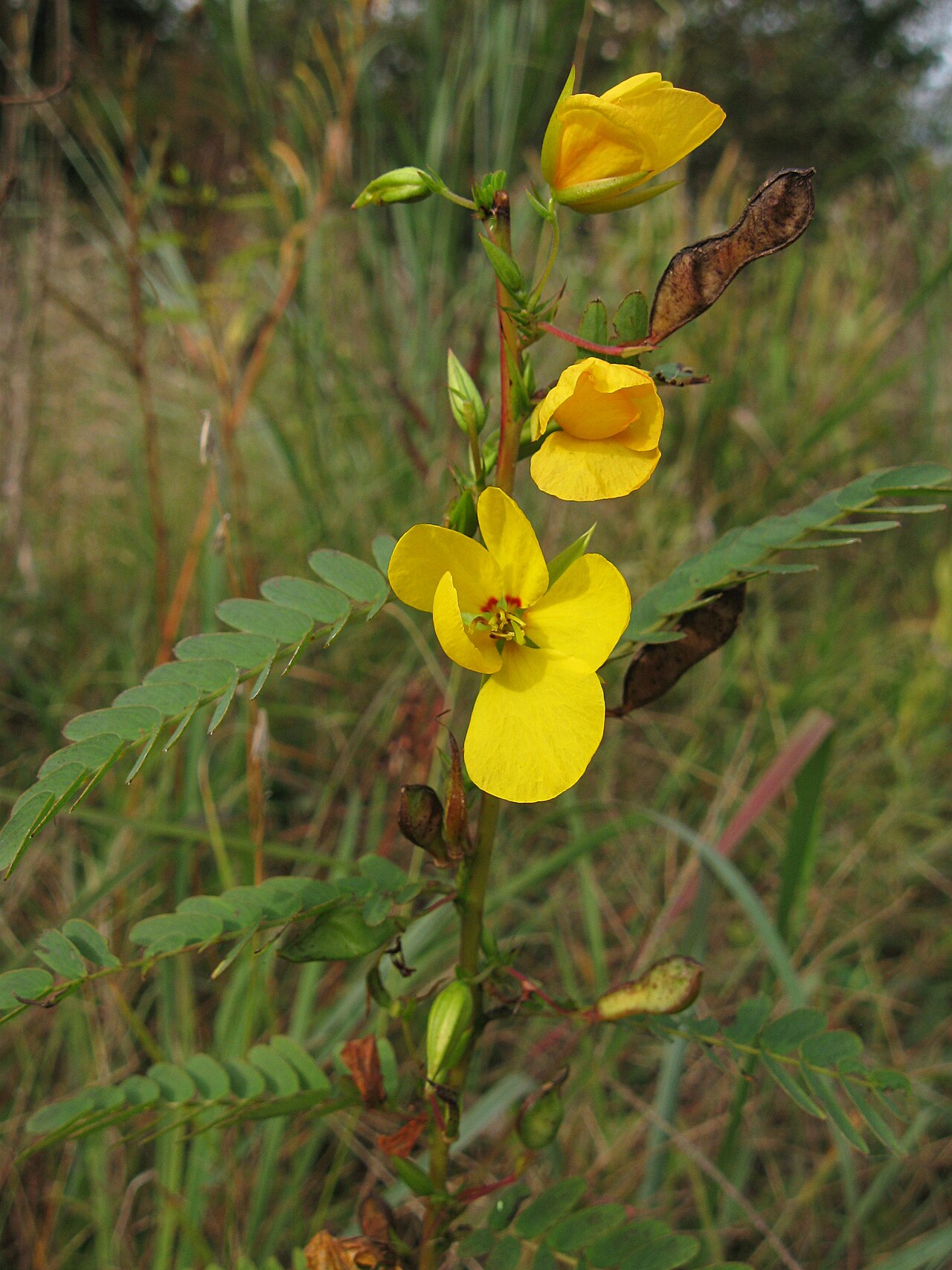
Plants commonly stand about 1–3 feet tall, branching as they develop. Stems can lean or sprawl, particularly in crowded or lush conditions. Because it is an annual, early growth looks very different from a mature flowering plant. Keep a few labeled seedlings for comparison during the first season so volunteer plants can be distinguished from weeds without waiting for every one to bloom.
Leaves
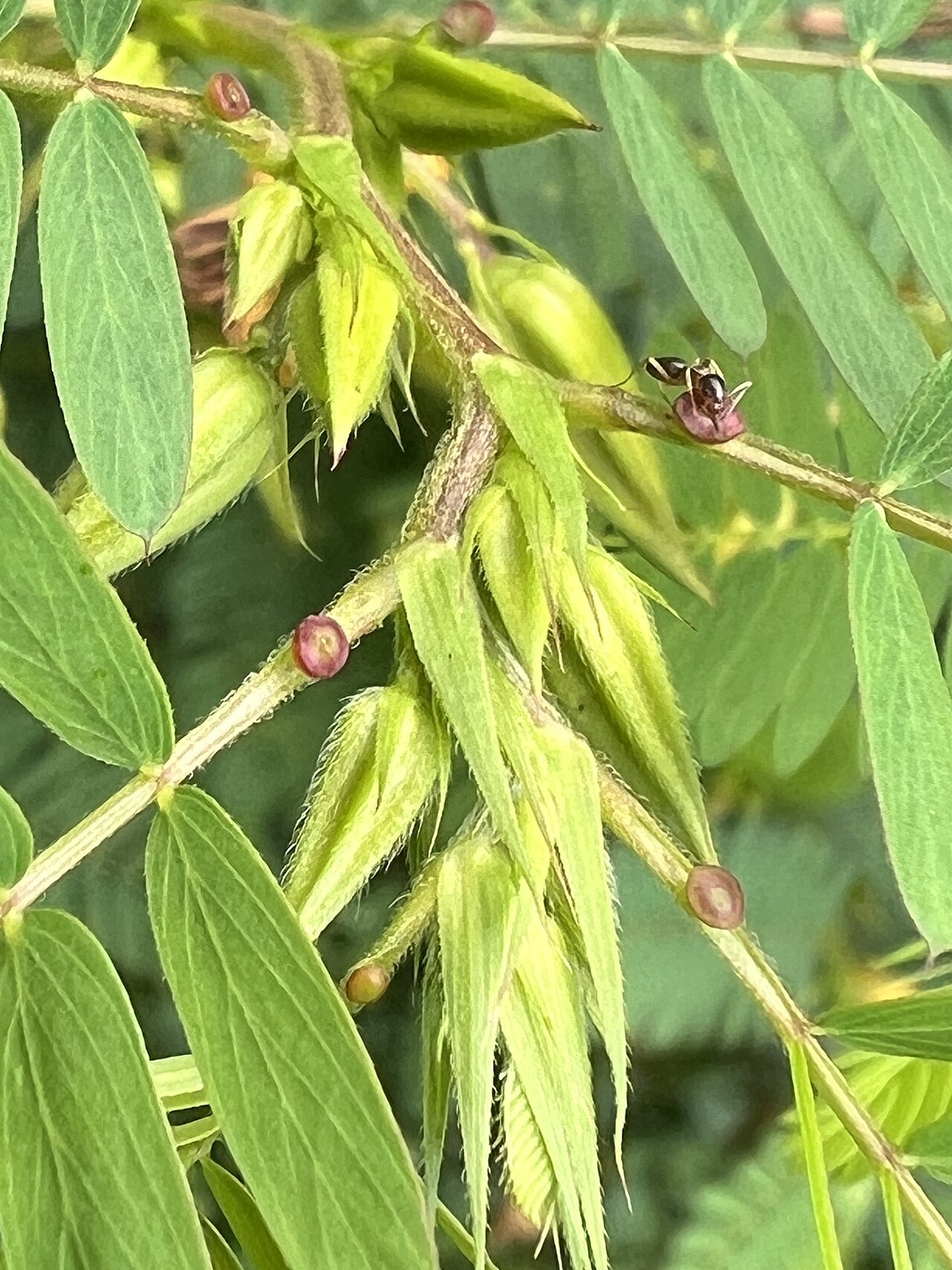
The leaves are compound, divided into many small paired leaflets along a central axis. They fold in response to darkness and can react to disturbance. A small gland near the base of the leaf supplies nectar outside the flower; this is visible in the close-up photograph below. Leaf movement alone does not establish identity, because other sensitive-leaved legumes exist. Check the flower and pod characters too.
Flowers
The bright yellow flowers have five unequal petals and conspicuous darker reproductive parts; reddish markings can be visible near the petal bases. Blossoms are roughly an inch across and appear in the leaf axils rather than as a typical garden-pea flower. Flowering extends through part of summer into early fall depending on location and growing conditions. A close view makes clear why the plant is valued for more than a distant wash of yellow.
Pods and seeds
Narrow pods mature from green to brown. Dry pods split and can twist, scattering seed away from the parent. When collecting garden seed, inspect frequently as pods approach maturity rather than waiting until every pod has opened. Store labeled seed from authorized nursery-grown plants; do not harvest wild populations casually. Pods and seeds are not recommended here as human food.
Quick Facts
| Scientific Name | Chamaecrista fasciculata; older name Cassia fasciculata |
| Family | Fabaceae (legume family) |
| Plant Type | Herbaceous annual wildflower |
| Mature Height | Usually 1–3 feet |
| Mature Spread | Variable with branching and crowding; manage seedlings |
| Growth Rate | Rapid seasonal annual growth |
| Sun Exposure | Full sun preferred; some shade tolerated |
| Water Needs | Average to dry once established; well-drained soil |
| Soil Type | Often sandy or sandy loam; tolerates other drained soils |
| Soil pH | Acid to neutral; USDA guide gives lower pH limit about 5 |
| Bloom Time | Summer into early fall; commonly July–September |
| Flower Color | Bright yellow with darker central markings |
| Fall Color | Annual foliage declines as pods mature and frost arrives |
| Fruit | Dry, narrow legume pods that split to release seeds |
| Deer Resistant | No; foliage can be browsed |
| USDA Hardiness Zones | Approximately 3–9 as an annual; persistence is by seed |
Native Range
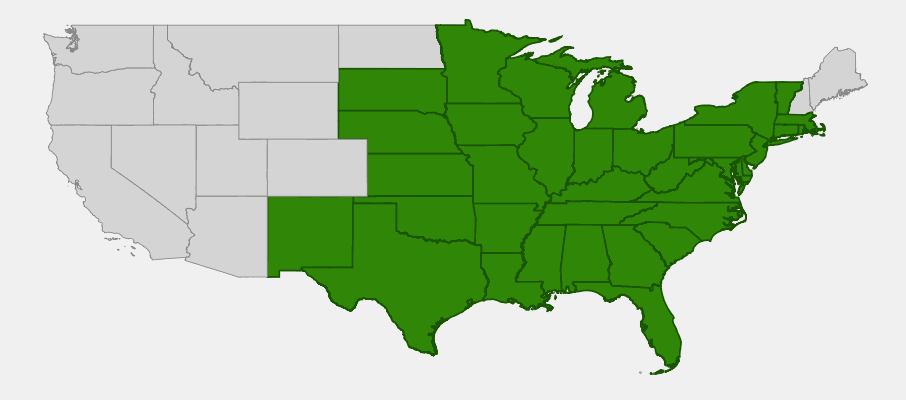
Partridge pea is native across much of the central and eastern United States and into southeastern Canada. Kew’s treatment separates that native range from introductions, including Maine and New Hampshire. Those introduced states are deliberately not shaded on this map. A broad occurrence list can otherwise make a widely seeded wildflower appear native everywhere it has been recorded.
Nebraska and Kansas are included in the native distribution used here, while Colorado is not included. The combined regional table covers Nebraska, Kansas and eastern Colorado; the presence of an entry there must not be read as an all-state nativity claim. For restoration work, check county-level records and use seed adapted to the project area rather than choosing only by the general species name.
Natural settings include prairies and other open ground, sandy savannas, and disturbed openings. Its annual strategy works well where seed can reach soil and competition leaves space for seedlings. An established, closed canopy of perennial vegetation may support fewer plants over time. That decline can be a normal shift in the planting, not necessarily a problem to reverse by disturbing the entire site.
📋 Regional plant list: Nebraska, Kansas and Eastern Colorado
Growing & Care Guide
Light
Full sun gives the most reliable display. The old regional table listed only partial sun, but USDA guidance identifies full sunlight as best while noting shade survival. Choose a genuinely open site, not a small bright opening that taller neighbors close over by midsummer. If plants stretch toward light or remain sparse beneath shrubs, adjust placement rather than compensating with extra fertilizer.
Soil and water
A drained sandy or loamy site is a useful starting point. Water newly germinating or transplanted plants according to actual moisture conditions; do not confuse established stress tolerance with immunity to seedling drought. Avoid chronic saturation. In a mixed planting, group plants with compatible water needs so partridge pea is not subjected to the irrigation required by a nearby wetland species.
Planting tips
Seed is a practical way to establish this annual. Begin with a manageable area so seedlings can be identified and competition controlled. Seed-to-soil contact matters; throwing seed over a thick, intact mulch blanket may not establish a stand. Use a seed supplier’s instructions appropriate to the lot and region instead of copying an agricultural seeding rate into a small garden without conversion.
Pruning and maintenance
Decide where volunteers are welcome before pods ripen. Remove unwanted young plants while they are easy to handle, and leave selected plants to supply next year’s seed. Avoid mowing the entire planting during flowering if pollinator use is a goal. Where long-lived perennials are establishing, monitor whether the annual canopy is becoming too dense around them and thin locally rather than treating the whole bed as a failure.
Propagation
Hard-seeded legumes can respond to scarification, and the USDA guide discusses seed treatment and cold-moist stratification. Treatment needs vary with storage and source, so ask whether the purchased seed is already prepared. Label experiments and compare a small test lot before treating all available seed. If inoculation is needed for a project, use the correct compatible rhizobial product rather than an unspecified general garden inoculant.
Troubleshooting
A stand that does not return may have failed to set seed, lost seed to cleanup, or had no suitable germination space. A stand that is too dense requires selective thinning and seed management, not an assumption that native plants always regulate themselves in a small garden. Leaf spot or mildew can occur; assess crowding and growing conditions before choosing a treatment, and avoid unnecessary sprays on a plant supporting insects.
Landscape Uses
- A monitored annual component in a new native meadow.
- Summer color in a sunny pollinator planting.
- Wildlife-oriented patches where seed production is welcome.
- A mixed revegetation planting designed with local conservation guidance.
- An educational bed for observing compound leaves, pods and extrafloral nectaries.
Wildlife & Ecological Value
For pollinators
Bees collect pollen at the flowers. The USDA plant guide makes an important distinction: nectar is produced at glands on the leaves rather than being available in the flowers. Ants commonly visit those extrafloral nectaries, as the photograph shows. Do not remove ants simply because they are present. A diverse planting should also supply other flowering species with nectar resources throughout the season.
Birds
The seeds are documented food for quail and other birds, and standing vegetation can provide cover. Where a wildlife planting is the goal, retain an appropriate portion of the seed crop and avoid clearing every stem immediately after flowering. The value of a small garden patch depends on the surrounding landscape; it is one habitat element, not a replacement for larger grassland and edge habitats.
Mammals
Small mammals may use seed and cover, while deer can browse foliage. Guard especially vulnerable establishing plants if local browsing is heavy. This species should not be promoted as livestock forage or a human edible pea merely because wildlife consumes it. Different animals respond differently to plant chemistry, and food value for birds is not evidence of safety for people or domestic animals.
Ecosystem role
As a legume with suitable microbial partners, partridge pea can contribute biologically fixed nitrogen. It is also a short-lived colonizer, so its abundance may fall as a more persistent plant community develops. Do not interpret that ecological role as a promise to correct every poor soil or eliminate fertilizer needs in neighboring crops. Evaluate the whole planting and local soil conditions.
Cultural & Historical Uses
Older accounts often place the species in Cassia, especially under Cassia fasciculata. The accepted name used here is Chamaecrista fasciculata. Matching those names prevents the same species being mistaken for two different entries when consulting older conservation guides or seed records.
The USDA plant guide documents conservation uses including wildlife plantings, revegetation and erosion-control mixtures. It also describes named conservation materials selected for particular purposes and regions. A named selection is not automatically the best material for every location; source, adaptation and the project’s conservation objectives still matter.
Historical ethnobotanical records are not prescriptions. Although the USDA guide cites traditional uses, this gardening page does not recommend preparing or consuming the plant. Its well-supported modern garden role is as a nursery-propagated or responsibly sourced native annual in a diverse, deliberately managed planting.
Frequently Asked Questions
Is partridge pea a perennial?
No. It is an annual. A patch can return through seed, but the flowering stems and root system do not behave like a permanent perennial clump.
Why are ants visiting the leaves?
Small extrafloral glands produce nectar. Ant visits can be a normal part of the plant’s insect interactions and are not by themselves evidence of aphids or a reason to spray.
Should it be planted in shade?
Full sun is preferred. It can survive some shade, but survival and a strong flowering display are not the same thing. The table’s light code has been corrected to reflect that distinction.
Will it take over the garden?
It can seed freely where conditions favor it. Decide where volunteers are wanted, thin seedlings around slower plants and limit seed production if the patch becomes too large.
Can I eat the peas?
This is not a vegetable-pea recommendation. Do not use the common name or the fact that birds eat its seeds as evidence that it is safe for human consumption.
Sources & Further Reading
- USDA NRCS: Partridge Pea Plant Guide
- Kew: taxonomy and native versus introduced range
- NC State Extension: partridge pea
- US Forest Service: Fire Effects Information System
- Ohio State University: Chamaecrista fasciculata
Find Native Plants
Ask growers about nursery propagation and regional provenance. Browse our Nebraska native plant nurseries, Kansas native plant nurseries, Colorado native plant nurseries directory for suppliers.