Inland Sea Oats (Chasmanthium latifolium)
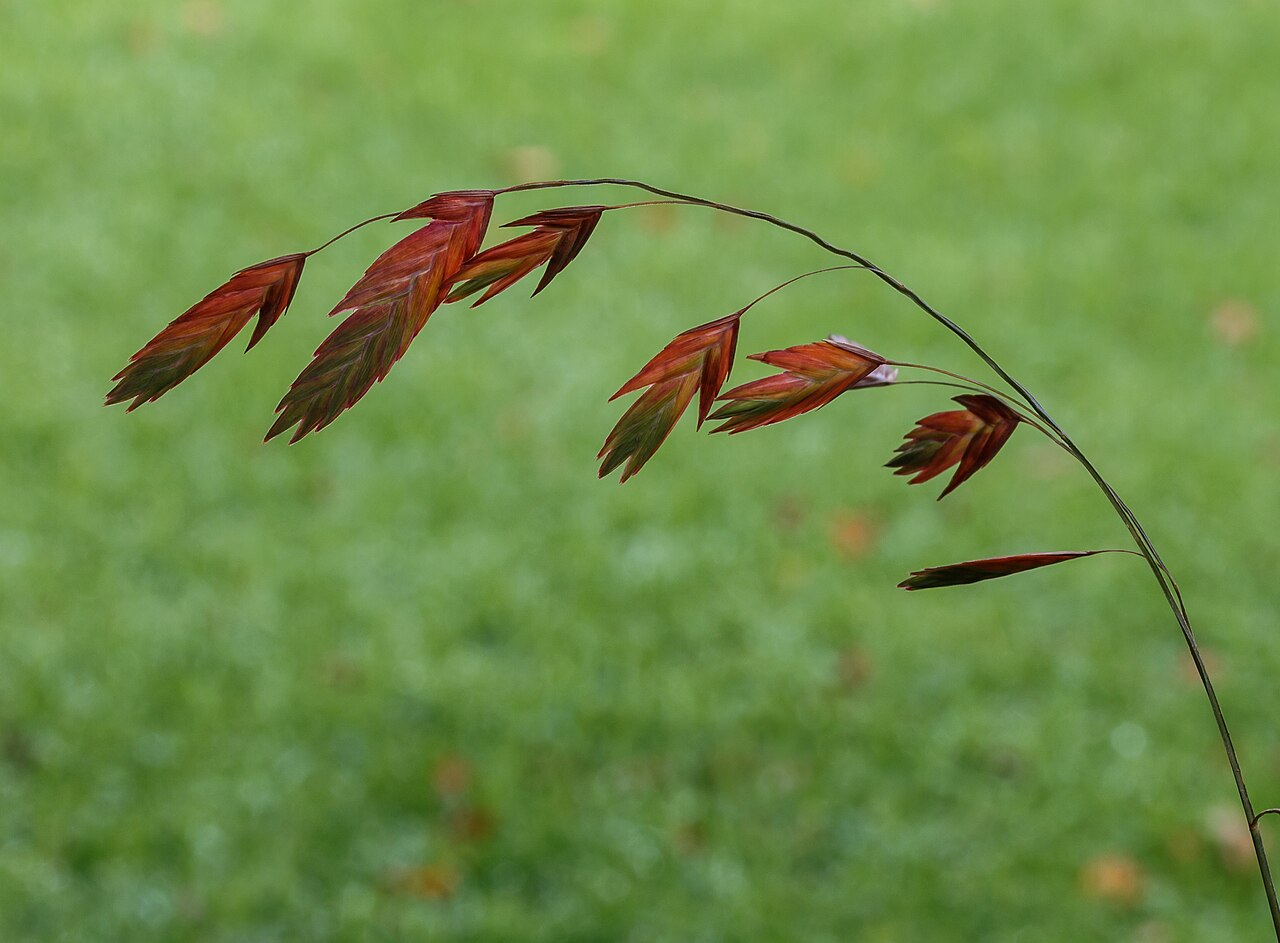
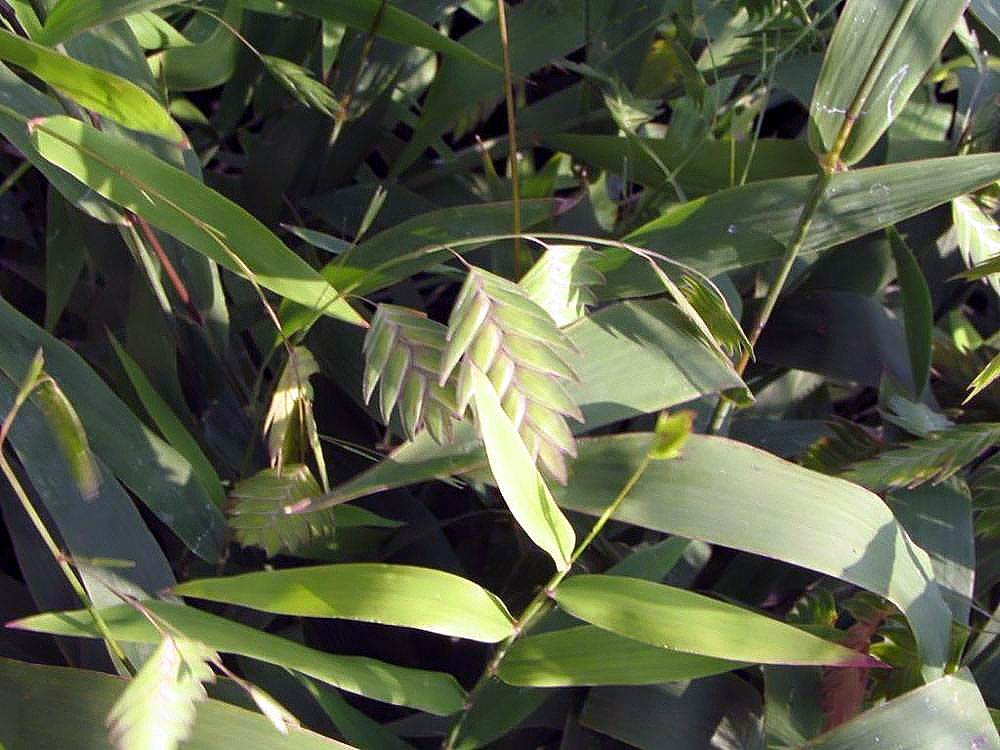
Inland sea oats (Chasmanthium latifolium), also called river oats and northern sea oats, brings motion to the shady garden. Its broad green blades and flattened dangling spikelets give it a character quite unlike a typical lawn grass. A breeze turns the seed heads on their slender stalks, revealing green, bronze, and eventually tawny surfaces as the season advances.
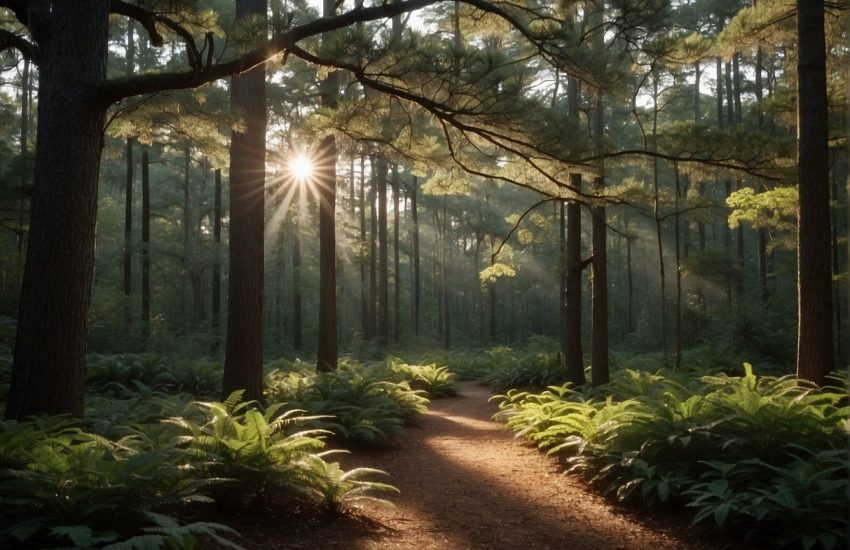
This is a grass for woodland edges, streamside gardens, and generous naturalistic beds. It can provide a useful middle layer between low woodland herbs and shrubs. The foliage has a bamboo-like appearance without the woody stems of bamboo, while the seed heads remain conspicuous after many summer flowers have faded. A position where light passes through the stems makes the display especially easy to appreciate.
The practical qualification is spread. Inland sea oats is not a permanently isolated ornamental tuft: rhizomes enlarge its patch, and seedlings can appear nearby. In a spacious native planting that ability may be welcome; among small, slow-growing treasures it can create work. Choose the location with both the attractive seed heads and the next generation of seedlings in mind.
Identification
Stems and Habit
An established plant produces a group of upright leafy stems, commonly two to five feet high. The stems are herbaceous rather than woody and emerge from a perennial underground system. Individual plants begin as clumps, but short rhizomes and recruitment from seed can turn a few clumps into a colony. A four-foot entry in a regional table is a useful typical flowering height, not a strict upper limit.
Leaves
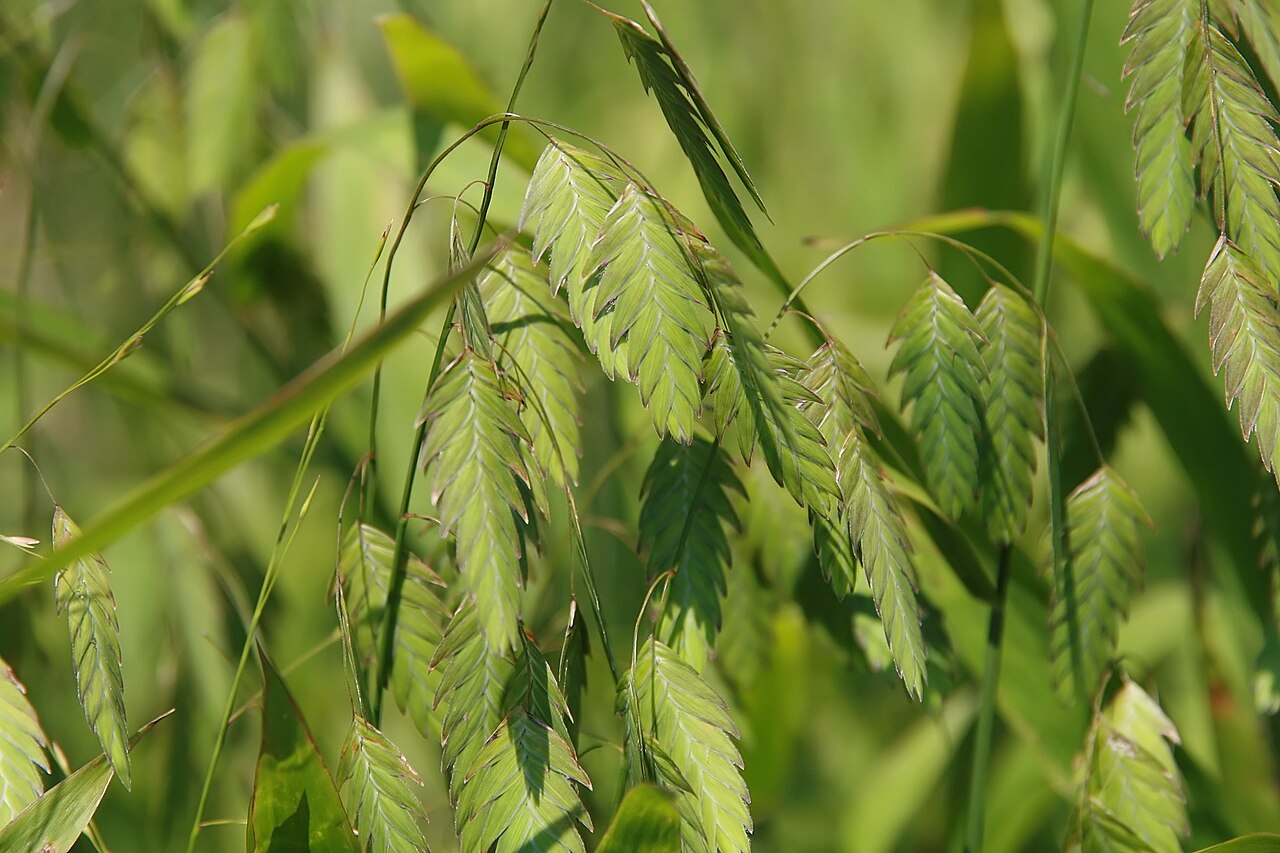
The flat blades are broad for an ornamental grass and arranged alternately along the stems. Their pointed tips and relatively wide surfaces create the familiar bamboo-like effect. Examine the junction with the sheath as well as the blade: the NC State wetland guide notes loose hairs where the leaves clasp the stem. Autumn foliage may become yellow or copper, especially where the plant receives some light.
Flowers and Spikelets
The open flower cluster carries broad, strongly flattened spikelets on slender drooping branches. These hanging structures are the most useful field character. They contain multiple small grass florets, not one large flower with colored petals. The flattened outline remains visible when the florets mature, so a seed head can be more informative than an out-of-focus picture of green foliage.
Seeds and Winter Appearance
The spikelets pass through green and bronze or purplish tones before drying. Tiny grass fruits develop within them. Mature seed can produce volunteers, which explains why collecting stems for indoor arrangements before seed dispersal also reduces recruitment. Some dry stems remain attractive into winter, although wind, rain, and snow eventually bend them down.
Not Coastal Sea Oats
Do not substitute this plant for the dune-building sea oats of ocean beaches, Uniola paniculata. The shared common name is misleading: inland sea oats belongs principally to inland woodland and freshwater settings. It also differs from native canes, which have genuinely woody stems. An old label reading Uniola latifolia can refer to this same inland species; the epithet matters.
Quick Facts
| Scientific Name | Chasmanthium latifolium; synonym Uniola latifolia |
| Family | Poaceae — grass family |
| Plant Type | Rhizomatous perennial grass |
| Mature Height | Usually 2–5 ft; regional tables use 4 ft |
| Mature Spread | Individual clump about 1–2.5 ft; colonies expand farther |
| Growth Rate | Moderate; seedlings can establish readily |
| Sun Exposure | Partial shade or dappled light; more sun with adequate moisture |
| Water Needs | Average to moist; tolerates occasional wetness |
| Soil Type | Loam, clay or sandy soil with suitable moisture |
| Soil pH | Adaptable; use local soil and provenance rather than a rigid target |
| Bloom Time | Summer into fall, varying with climate |
| Flower Color | Green spikelets, maturing tan to bronze-purple |
| Fall Color | Yellow to copper foliage; brown winter stems |
| Fruit | Small grass grains within flattened spikelets |
| Deer Resistant | Often resistant; no planting is browse-proof |
| USDA Hardiness Zones | Typically 5–9 |
Native Range
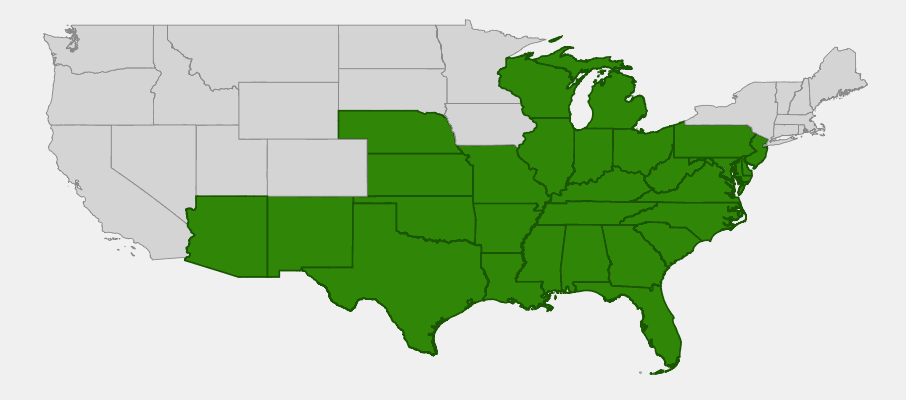
Inland sea oats is native to a broad central and eastern North American region, extending into northeastern Mexico. Its natural occurrence is tied to local habitat rather than a continuous blanket of grass across the continent. River banks, wooded floodplains, shaded slopes, and openings with adequate moisture are useful ecological models for a garden planting.
Arkansas, Louisiana, eastern Oklahoma, and eastern Texas are within its well-established native region. Farther northeast the range becomes localized: Pennsylvania has documented native populations, including conservation-sensitive occurrences. Its appearance in a combined New York–Pennsylvania–New Jersey garden list must not be read as proof of native status throughout all three states; check local flora before restoration work.
The map follows Kew’s native-state list and is a broad orientation tool, not a county planting prescription. Massachusetts, listed as introduced by Kew, is excluded. Some secondary distribution lists differ at the margins, so use the USDA county link and regional botanical records when local native provenance is the deciding criterion.
📋 Regional plant list: Arkansas, Louisiana, Eastern Oklahoma and Eastern Texas
Growing & Care Guide
Light
Start with partial shade or dappled woodland light. The broad leaves work well beneath an open deciduous canopy or beside shrubs. Full sun can be workable where moisture is reliable, but a hot exposed bed is not equivalent to a shaded stream bank. Observe afternoon wilting and dry leaf margins before concluding that more fertilizer is needed. In very deep shade the display may be less substantial.
Soil and Water
Ordinary garden soil can be suitable if it holds some moisture without keeping the crown continuously submerged. A loamy streamside edge is an obvious fit, but the plant also occurs away from water. Match watering to the actual root zone, not the word “oats.” Average moisture in a regional table is water demand; it is not a rating of drought endurance.
Planting
Set a nursery-grown plant with its crown at the existing soil level, loosen constricted outer roots, and water the root ball and surrounding soil thoroughly. Give each plant room to become a leafy clump rather than packing it between delicate seedlings. A modest surface layer of leaf mulch is useful in a woodland design, but keep a heavy mound of mulch off the crown.
Establishment
Check the root ball during the first growing season, particularly beneath trees where rainfall may be intercepted and established roots compete strongly. Water when the planting zone is drying rather than on a fixed calendar. Once roots have extended outward, reduce unnecessary irrigation. Maintaining continually lush growth through excess water or feed can increase the maintenance burden rather than improve the design.
Managing Seedlings
If volunteers would be unwelcome, cut the hanging seed heads before they shed ripe seed. This sacrifices some winter display, so decide which goal matters more in each bed. Pull young volunteers while their roots are small and the soil is workable. In a naturalized patch, leave selected stems to mature and remove only seedlings that crowd paths or less vigorous neighbors.
Rhizomes and Division
Enlarging clumps can be divided when conditions are mild and plants can be kept watered afterward. Lift only cultivated stock, separate viable portions with roots and buds, and replant promptly. Division is also an opportunity to reduce a patch that has become too wide. It is not necessary to disturb healthy plants every year merely to satisfy a calendar rule.
Pruning and Winter
Leave attractive dry stems if their seed is acceptable and the planting is not creating a hazard along a path. Remove old top growth before new shoots make cleanup difficult, keeping the cutting tools above the living crown. Selective removal of collapsed stems can be enough. The species does not need repeated shearing into the shape of a formal hedge.
Seed Propagation
Use seed from known, correctly identified cultivated plants or a reputable regional supplier. A seed lot should have a species name and an origin, not just “sea oats.” Follow the supplier’s dormancy and sowing instructions; conditions differ among stored and freshly harvested lots. Keep germinating trays distinguishable from volunteer lawn grasses and pot seedlings on before roots become badly crowded.
Garden Placement
The best place is often a broad woodland margin where its eventual patch size is welcome and the seed heads can be seen against a calm background. Keep the plant out of a tiny crevice garden or a bed reserved for slow-growing woodland rarities. Along a stream, avoid soil disturbance or planting into protected natural populations; a garden design should not damage the habitat it imitates.
Landscape Uses
- A moving middle layer in a moist woodland-edge planting.
- A streamside or rain-garden margin that is not permanently submerged.
- Seed heads for fresh or dried arrangements from cultivated plants.
- A substantial ground layer beneath open-canopied deciduous trees.
Wildlife & Ecological Value
Pollinators and Caterpillars
Like other grasses, inland sea oats is wind-pollinated rather than a nectar-rich flower. Its wildlife value includes foliage used by grass-feeding caterpillars; NC State specifically records northern pearly-eye and skipper associations. Add locally native flowering plants nearby if a continuous nectar supply is also a goal. Host foliage and nectar flowers provide different resources.
Birds and Small Mammals
Mature seeds can be used by birds and small mammals, while the leafy patch adds cover close to the ground. Leaving every seed head is not necessary in a small garden, but retaining some in an appropriate location preserves that part of the plant’s seasonal role. Avoid assuming that a tidy clump with all heads removed provides the same seed resource.
Soil and Habitat Structure
Rhizomes and fibrous roots contribute to a persistent ground layer in suitable soil. That does not make the species a substitute for engineering advice on an unstable bank. In ecological plantings, retain a varied community rather than allowing one vigorous grass to become the entire understory. Watch how seedlings affect neighboring herbs over several seasons.
Cultural & Historical Uses
The old botanical name Uniola latifolia still appears on labels and in literature. Matching it to Chasmanthium latifolium helps gardeners recognize that two names may describe one species rather than two different purchases. The common names river oats and inland sea oats reflect the conspicuous oat-like spikelets, not membership in a cultivated cereal crop.
Inland sea oats has been promoted in native horticulture partly because it offers an ornamental grass for shade, a setting where many sun-loving prairie grasses perform poorly. Its selection as North Carolina Wildflower of the Year in 1994 is one example of that regional garden interest. The same qualities that make it easy to establish also explain its reputation for enthusiastic self-sowing.
This guide focuses on cultivated landscape use and documented ecology. It does not prescribe medicinal or food uses or encourage harvest from wild populations. Buy propagated stock, keep the botanical name with it, and use local conservation guidance where the species is scarce. A common garden plant in one region can still deserve protection in another.
Frequently Asked Questions
Will inland sea oats take over my garden?
It can spread by rhizomes and seedlings, especially in a favorable moist site. Give it room and remove seed heads before ripening where volunteers would be a problem.
Can I plant it in full shade?
Dappled or partial shade is a good starting point. Very dark shade can reduce vigor and seed-head display; judge the actual light and competition.
Is this the grass used on beach dunes?
No. Coastal sea oats is Uniola paniculata. Chasmanthium latifolium is an inland woodland and freshwater-associated species.
Why does a table say four feet when my plant is taller?
Four feet is a typical value. Flowering stems commonly fall within a two-to-five-foot range, affected by site and growing conditions.
Does its presence in a regional list prove it is native to my county?
No. Regional lists combine multiple states and garden contexts. Use county records and locally sourced nursery material for habitat restoration.
📋 Also listed: New York, Pennsylvania and Northern New Jersey
Sources & Further Reading
- NC State Plant Toolbox
- NC State wetland identification guide
- USDA NRCS inland sea oats fact sheet
- Pennsylvania Natural Heritage wild-oats account
- Texas A&M AgriLife inland sea oats
- Kew Plants of the World Online native distribution
Find Native Plants
Ask growers about nursery propagation and regional provenance. Browse our AR native plant nurseries, LA native plant nurseries, OK native plant nurseries, TX native plant nurseries, PA native plant nurseries, NJ native plant nurseries directory for suppliers. Explore the native nursery finder.