Purple Lovegrass (Eragrostis spectabilis)
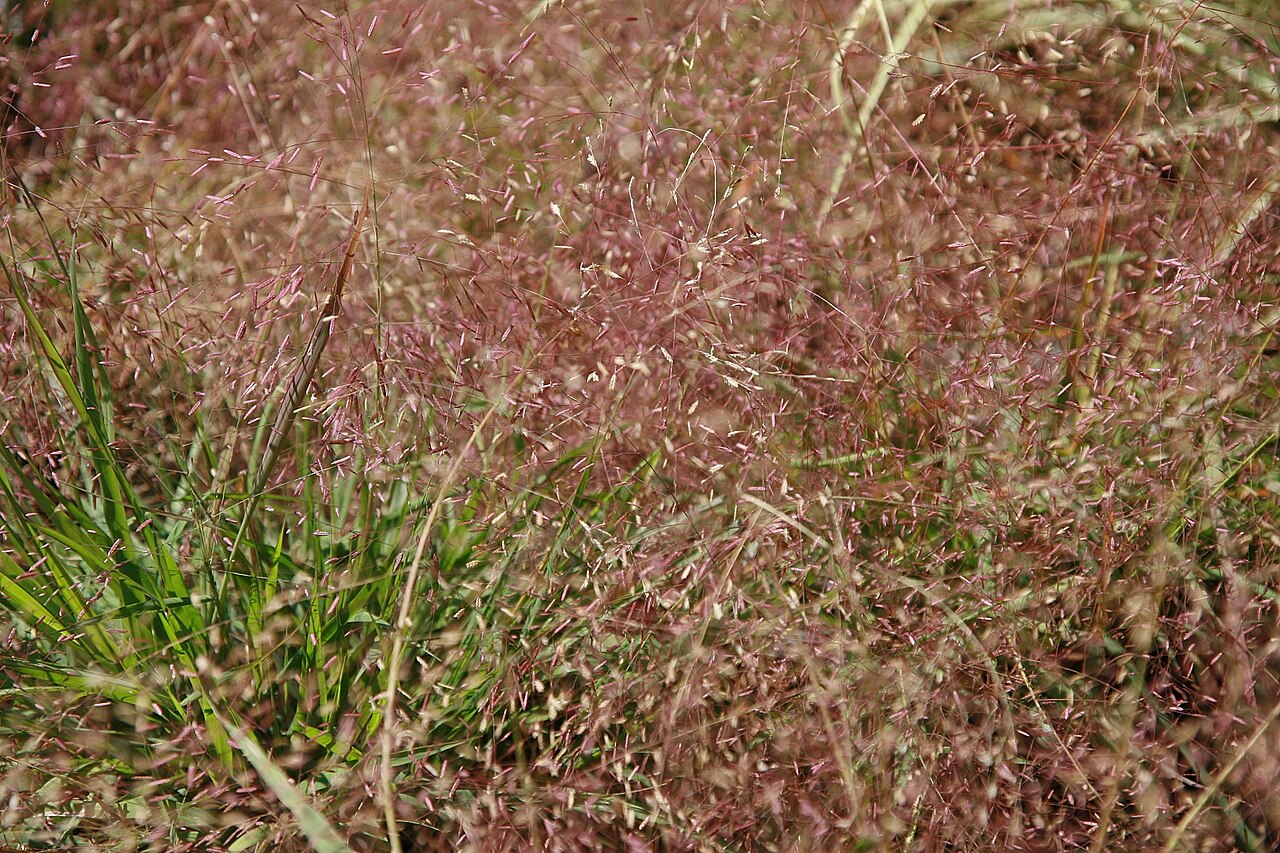
Purple lovegrass (Eragrostis spectabilis) spends much of the growing season as a modest tuft of green blades. Late in summer it changes character: finely branched flower clusters expand above the foliage, producing a low haze of reddish purple. The effect is strongest where several plants grow together and the light catches their airy heads from the side.
This small warm-season grass is useful where a tall ornamental grass would overwhelm the planting. Its scale suits a sunny border edge, a sandy meadow opening, or a low matrix between compatible wildflowers. The foliage is a real clump, not a transparent mist all year, so a good design makes room for both its ordinary green phase and its brief colorful display.
Purple lovegrass is a mainland North American native, not a Hawaiian native. A legacy occurrence in a Hawaii garden table does not change its origin. For a native Hawaiian landscape, choose a locally native grass appropriate to the island and site instead. On the mainland, check local range and seed provenance rather than assuming every plant sold under this name belongs in every state.
Identification
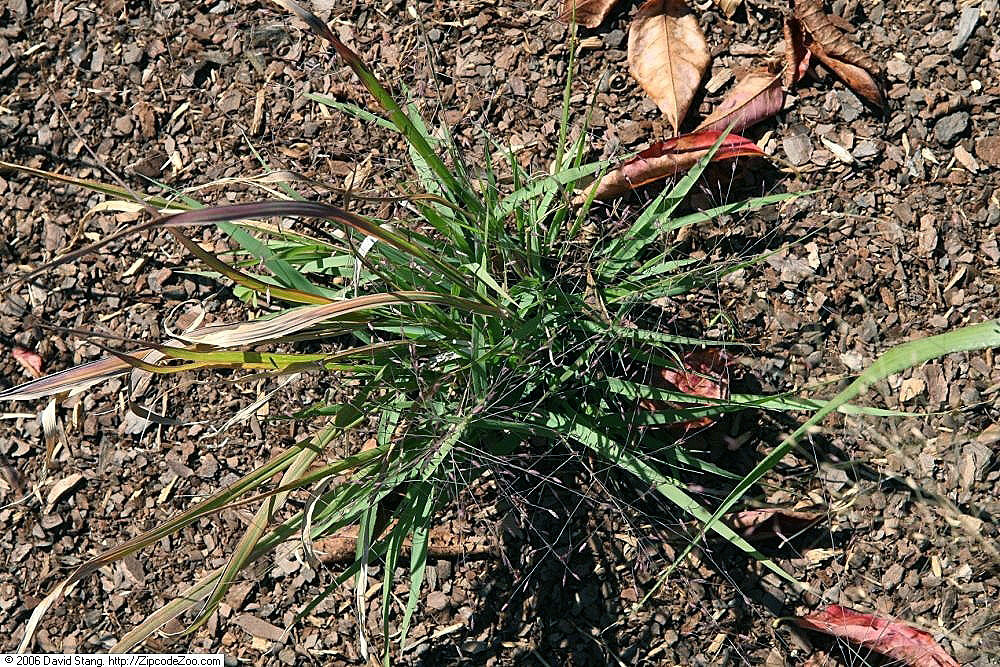
The Basal Clump
Look for a small perennial tuft with most leaves near the ground. Short rhizomes can slowly enlarge a patch, but it is not a tall, woody-stemmed bamboo or a running lawn grass. The foliage often stands lower than the flowering stems. Descriptions that give a height close to one foot and regional lists that give eighteen to twenty-four inches may be measuring different parts of the same plant.
Leaves
The blades are narrow and flat, with a texture coarser than their slender outline suggests. Hairs on the blades or around the sheaths are useful when a specimen is examined closely. The green foliage can acquire reddish or copper tones as the season ends. Leaf color alone is unreliable for identification because drought, frost, and sun exposure change it.
Airy Flowering Heads
The branching panicles open into a loose purple or reddish cloud in late summer and fall. Individual grass flowers are tiny and lack showy petals; the combined branching structure supplies the ornamental effect. Avoid naming a grass solely from a distant pink cloud. Several grasses produce a similar garden impression while differing substantially in size, leaves, and spikelets.
Spikelets and Seeds
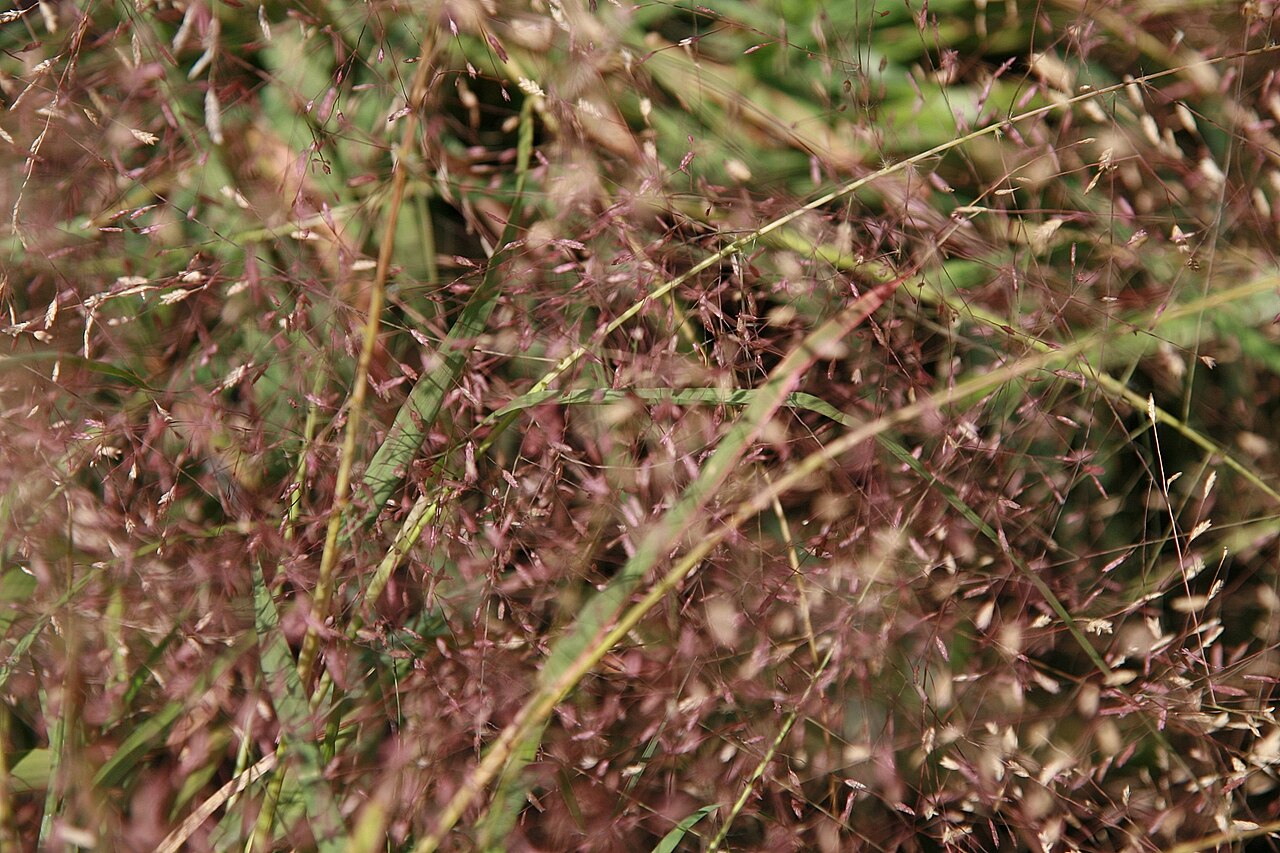
A closer view reveals small multi-flowered spikelets distributed along the fine branches. This helps separate purple lovegrass from pink muhly, whose tiny spikelets have a different structure. As the heads dry, color fades toward tan and the small grains become available for dispersal. Detached dry panicles may move with the wind, explaining the common name tumble grass.
Similar Grasses
Pink muhly usually makes a larger, wirier mound and a higher pink display. Other Eragrostis species require a grass key for reliable separation, particularly before flowering. Use the full botanical name when buying plugs or seed; “love grass” can refer to unrelated horticultural choices within a large genus, including species not native to your region.
Quick Facts
| Scientific Name | Eragrostis spectabilis |
| Family | Poaceae — grass family |
| Plant Type | Warm-season perennial bunchgrass with short rhizomes |
| Mature Height | Foliage often 8–14 in; flowering display commonly 18–24 in |
| Mature Spread | About 1–2 ft; gradual spread and seedlings possible |
| Growth Rate | Slow to moderate clump enlargement |
| Sun Exposure | Full sun |
| Water Needs | Dry to average after establishment; avoid persistent saturation |
| Soil Type | Well-drained sandy, gravelly or ordinary garden soil |
| Soil pH | Broad tolerance in suitable drained soil |
| Bloom Time | Late summer to fall |
| Flower Color | Pink-purple to reddish, fading tan |
| Fall Color | Copper or reddish foliage followed by winter dormancy |
| Fruit | Tiny grass grains in airy panicles |
| Deer Resistant | Not guaranteed; assess local browsing pressure |
| USDA Hardiness Zones | Often listed for zones 5–9; select regional stock |
Native Range
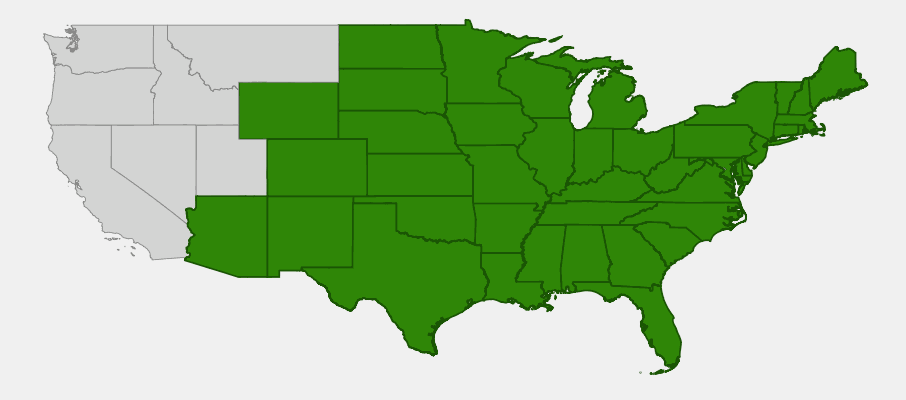
Purple lovegrass is native across a broad central and eastern portion of mainland North America, reaching into northeastern Mexico. Botanical treatments differ at some northern margins, so Canadian and northern-edge status should be checked with a regional flora. It is associated with open, often sandy ground rather than deep forest shade or permanently flooded marsh.
The Arkansas–Louisiana–eastern Oklahoma–eastern Texas region and the Delaware–southern New Jersey–Long Island region include appropriate mainland habitat. Within those broad areas, local soils and provenance remain important. A sandy sunny opening and a shaded wet hollow may occur a few yards apart while offering very different conditions for this grass.
The state map combines Kew’s native-state distribution with Native Plant Trust’s U.S. list, which includes Delaware. It is not a map of every county or an endorsement of transplantation into wild habitat. Hawaii is intentionally absent. Where native status is uncertain at an edge of the range, obtain a local botanical determination before restoration.
📋 Regional plant list: Arkansas, Louisiana, Eastern Oklahoma and Eastern Texas
Growing & Care Guide
Full Sun
Give purple lovegrass an open position where it receives direct sun for much of the day. The low cloud is most visible with room around it rather than buried inside tall foliage. Deep shade is not a good way to restrain its size: it compromises the display and favors other plants. Consider the summer canopy of nearby shrubs, not just the light available when planting in spring.
Drainage Before Fertility
This grass is useful on lean, sandy or gravelly ground, provided roots can establish. It can also grow in ordinary garden soil that drains adequately. A persistently wet depression is a different habitat and calls for a different species. Do not add a pocket of highly amended soil inside compacted clay and assume the resulting planting hole will drain.
Planting Plugs
Small nursery plugs are easy to overlook, so mark their positions during the first season. Plant at the depth at which the crown was growing and firm the surrounding soil without burying the basal leaves. Water after planting to settle the roots. Leave enough space for the mature flower heads to overlap lightly rather than crowding every crown into a dense mat.
Water During Establishment
Drought tolerance belongs to an established root system, not a newly installed plug. Check the soil beside the root ball and water while it is becoming established. Once growth is secure, reduce routine irrigation according to rainfall and soil texture. Constantly wet conditions undermine the reason for choosing a dry-site grass in the first place.
Feeding
Avoid trying to produce a lush lawn-like green mound through regular high-nitrogen feeding. A small native bunchgrass in a lean community does not need to mimic a heavily fertilized border perennial. If a plant is weak, first inspect light, drainage, root competition, and weed pressure. Addressing the wrong problem with fertilizer can simply help its neighbors outgrow it.
Seasonal Cleanup
Expect the plant to become dormant in winter. Remove old foliage before new growth makes cutting awkward, or tidy selectively where the dry heads remain attractive. Do not repeatedly shear off the developing late-season panicles if the purple display is the reason you planted it. In a small garden, hand removal of dead material is often sufficient.
Division and Seed
Division of established cultivated clumps and propagation from seed are both options. Divide when plants can recover in mild conditions with water available, retaining sound roots on each piece. For seed, use a named regional source and follow its sowing guidance. The fine seed and seedlings can disappear among weeds, so clean propagation conditions and careful labeling matter.
Using It Near Paths
Purple lovegrass can be used as a low ground-layer element, but it should not be treated as a sports lawn. A planted edge may tolerate occasional light passage; repeated heavy traffic compacts soil and damages the crowns. Put stepping stones or a clear path where people actually walk. This protects both the planting and its late-summer display.
Keeping a Mixed Planting
Slow rhizome spread and seedlings can gradually change the outline of a patch. Thin only where needed to protect smaller neighbors or retain a path edge. Pair it with plants that prefer similarly open, drained conditions and do not overwhelm the low foliage. A mixed meadow with varied heights is a better ecological goal than an uninterrupted blanket of one ornamental grass.
Landscape Uses
- Low drifts in a sunny, dry-to-average native border.
- A fine-textured layer among compatible meadow wildflowers.
- Sandy garden margins where tall grasses would be out of scale.
- A light-catching autumn accent beside a path, outside the walking line.
Wildlife & Ecological Value
Flowers and Pollination
Purple lovegrass is wind-pollinated. Its purple panicles are not equivalent to a nectar-rich aster or milkweed, so include flowering companions when building a pollinator planting. The grass adds structure and other resources while the flowering herbs supply much of the nectar. A diverse planting can provide both without assigning the wrong function to either.
Seed Users
The tiny grains can contribute food for seed-eating wildlife, including small birds and mammals. Retaining some mature heads in a suitable location preserves that seasonal resource. In a small bed, a compromise between seed retention and volunteer control is reasonable. Avoid applying broad insecticide treatments merely because insects are present in the foliage.
Ground-Layer Function
Tufts create cover and a persistent root system in open soil. In a meadow, the spaces around the tufts also matter: they support other plants and ground-level activity. Heavy mulch covering every gap can suppress the mixed community a gardener intended to encourage. Manage invasive weeds while allowing the desired native community to establish.
Cultural & Historical Uses
The ornamental appeal of purple lovegrass rests on a plant that is easy to miss outside its flowering season. The name spectabilis points to its showy phase, while the common name tumble grass reflects the movement of dry heads. Neither name by itself identifies a safe substitute for another lovegrass species.
Native horticulture has made this low grass more visible in designed landscapes, particularly where gardeners want autumn color without the height of a large prairie grass. The most successful use follows its open-site ecology rather than treating it as a miniature version of any pink ornamental grass. Its modest spring appearance is part of its seasonal rhythm.
No medicinal or edible use is recommended here. Obtain propagated plants or properly identified seed and keep provenance records for habitat projects. The erroneous placement of a mainland species in a Hawaiian native list is a reminder that garden availability and geographic nativity are different facts; the local flora should guide ecological planting.
Frequently Asked Questions
Is purple lovegrass the same as pink muhly?
No. Eragrostis spectabilis is generally lower and has different spikelets and foliage. Muhlenbergia capillaris is a separate species.
Why is my plant still green without purple clouds?
The show is seasonal, usually late summer into fall. Check maturity and sunlight before assuming the plant has failed.
Can it replace a heavily used lawn?
Not reliably. It can serve as a low planting with light traffic, but repeated heavy use damages bunchgrass crowns.
Does it need wet soil?
No. Choose a drained, dry-to-average site and provide establishment water. Persistent saturation is a poor fit.
Is it native to Hawaii because it appeared in a Hawaii table?
No. Its native region is on the North American mainland. Use a locally native Hawaiian species for an island-native planting.
📋 Also listed: Delaware, Southern New Jersey and Long Island
Sources & Further Reading
- NC State Plant Toolbox
- Native Plant Trust plant finder
- Kew Plants of the World Online
- USGS Plants of Louisiana
- USDA PLANTS
Find Native Plants
Ask growers about nursery propagation and regional provenance. Browse our AR native plant nurseries, LA native plant nurseries, OK native plant nurseries, TX native plant nurseries, DE native plant nurseries, NJ native plant nurseries, NY native plant nurseries directory for suppliers. Explore the native nursery finder.