
Gray Goldenrod (Solidago nemoralis)
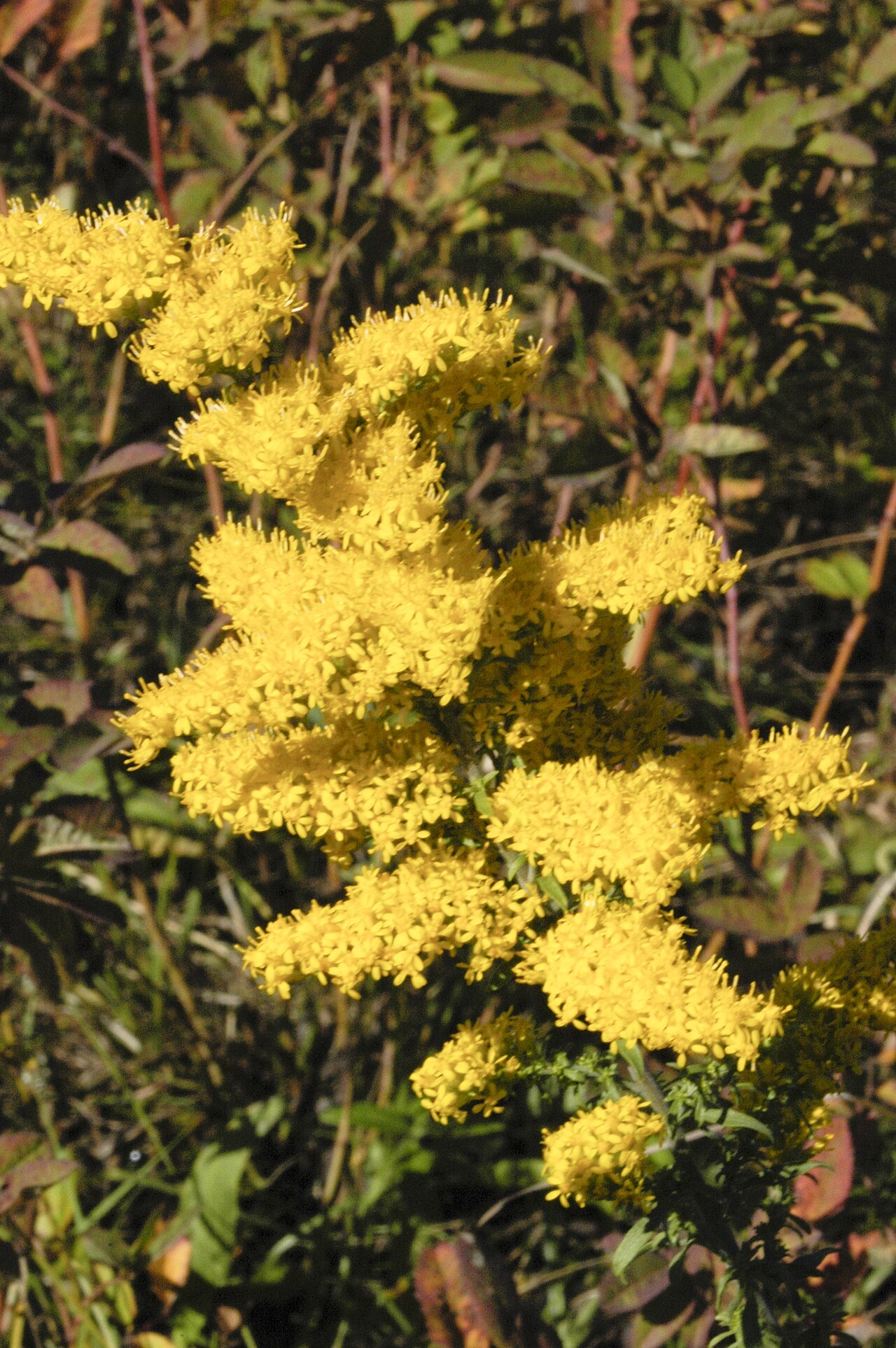
Gray goldenrod is a good reminder that a native meadow does not need to be head-high to feed autumn insects. Solidago nemoralis usually makes a relatively low mound of foliage beneath slender flowering stems. The yellow display leans or arches to one side rather than forming a broad, flat-topped umbrella. Seen among shorter grasses, that curve is one of its most appealing garden features.
This is primarily a plant for open, well-drained ground. A sandy slope, sunny gravelly border or dry meadow edge is a more promising starting point than a watered flower bed with deep, rich soil. Its grayish hairs, narrow upper leaves and modest stature fit this setting, but the plant is still a living perennial that needs moisture while its roots establish.
Use the scientific name when buying seed or plants. “Goldenrod” includes many species with very different heights, soils and growth habits. The guide below concerns gray goldenrod specifically, and the state map uses a conservative current botanical range rather than assuming that every western record assigned to a similar goldenrod represents the same taxon.
Identification
Overall form
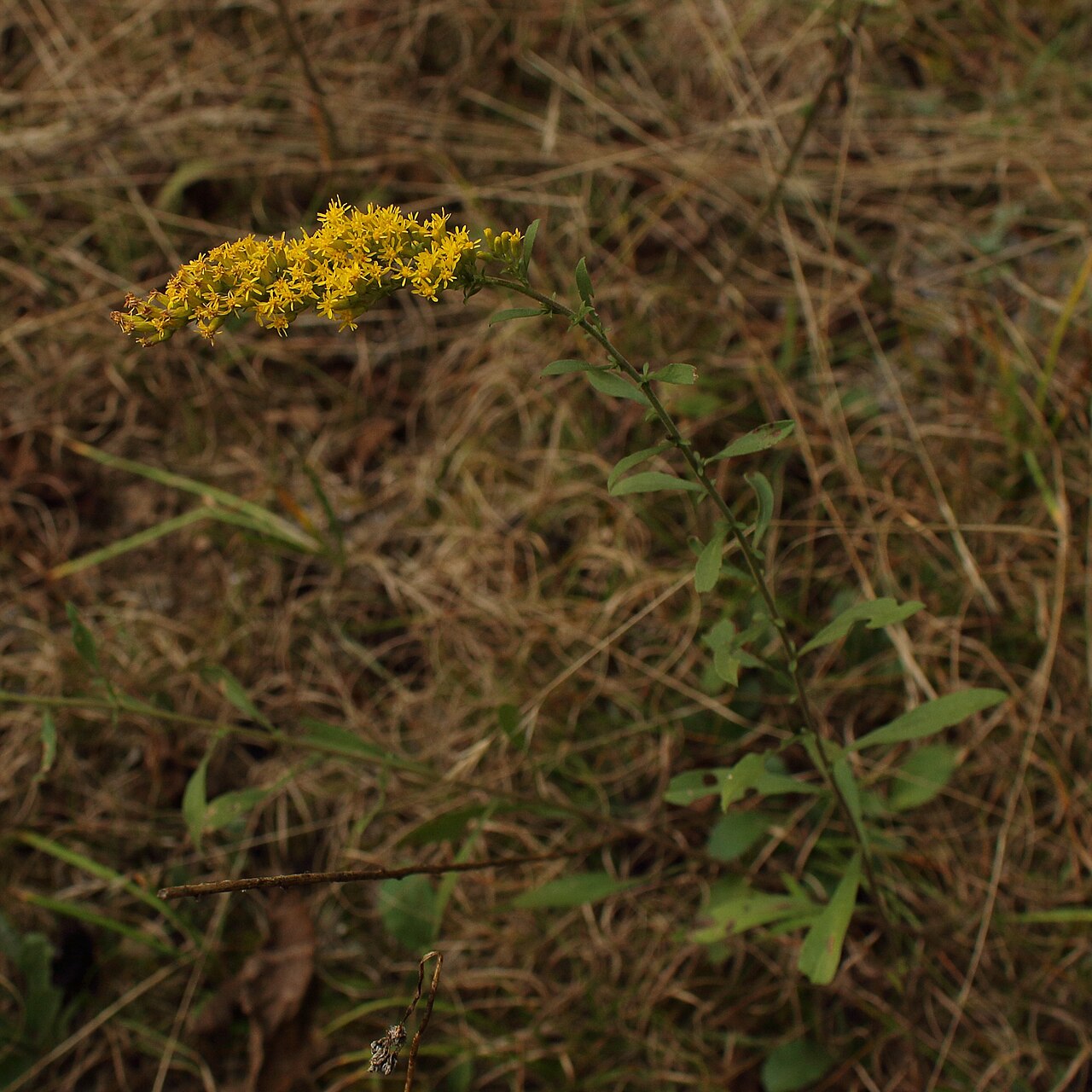
Look for one or a few upright flowering stems rising from a low perennial base. Plants may be only several inches high on exposed ground or approach two feet in more favorable conditions. A small nursery plug is not representative of mature flowering height, and a vigorous garden specimen is not a reliable guide to the size of a plant in thin prairie soil. Gray goldenrod can gradually form patches, but an individual flowering stem remains comparatively slender.
Leaves and gray hairs
Lower leaves are larger and commonly have stalks and toothed margins. Leaves farther up the stem become smaller, narrower and less conspicuously toothed. Fine hairs on stems and leaves give the plant its dull gray-green appearance. Compare several leaves from different stem positions; identifying a goldenrod from one upper leaf discards much of the useful evidence.
Flowering branches
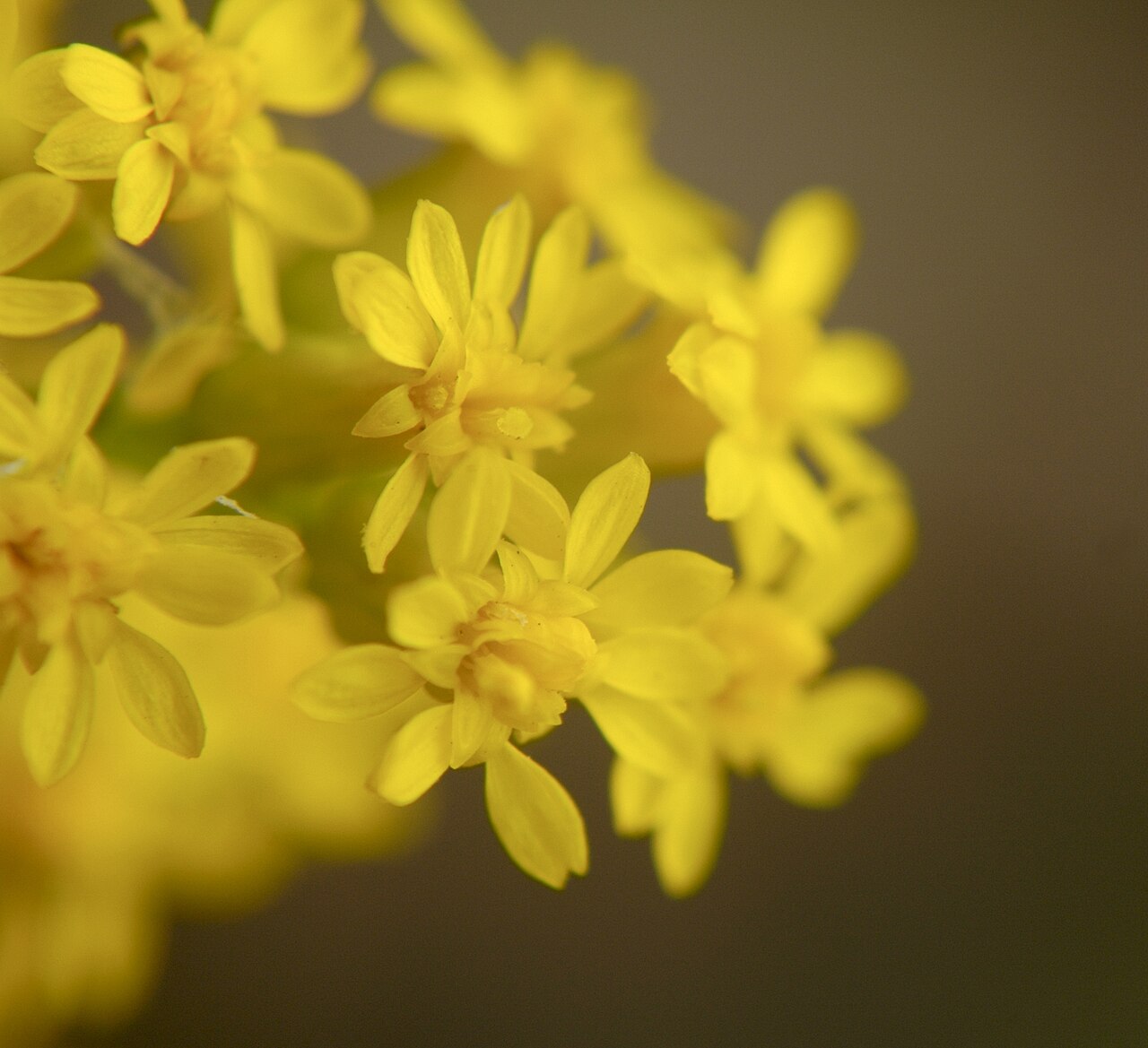
The yellow heads are carried on short branches arranged into an often one-sided, nodding or arching plume. Each small head contains several ray florets around central disc florets. From a distance the display looks continuous, but a close photograph reveals many separate heads. The exact size of the flowering cluster varies with growing conditions and the number of stems.
Seeds and seasonal appearance
After flowering, the heads become pale and fuzzy as the dry fruits mature with their dispersal hairs. This change is normal, not mildew. Basal foliage and old stems can remain useful identification clues after the bright color has faded. For a confident identification, photograph the whole plant, lower and upper leaves, stem hairiness and an open flower head.
Similar goldenrods
Do not distinguish gray goldenrod merely by choosing the shortest goldenrod in a field. Young plants of tall species can be small, and mowing can suppress height. The combination of gray hairs, lower versus upper leaf shape and the one-sided inflorescence is much more useful. Where closely related taxa occur, use a regional botanical key rather than guessing from a landscape photograph.
Quick Facts
| Scientific Name | Solidago nemoralis |
| Family | Asteraceae |
| Plant Type | Rhizomatous herbaceous perennial |
| Mature Height | Usually 6–24 inches; exceptionally taller in favorable conditions |
| Mature Spread | About 6–24 inches per clump; colonies can expand |
| Growth Rate | Clump-forming; spreads by rhizomes and seed |
| Sun Exposure | Full sun preferred; tolerates light shade |
| Water Needs | Dry to moderately moist; good drainage essential |
| Soil Type | Sandy, gravelly or rocky soils; tolerates poor ground |
| Soil pH | Tolerates somewhat acidic soils; avoid using pH alone to choose a site |
| Bloom Time | Late summer into autumn; timing varies with latitude |
| Flower Color | Yellow |
| Fall Color | Flowers and pale seed plumes provide seasonal interest |
| Fruit | Small dry achenes with wind-dispersed hairs |
| Deer Resistant | Often less preferred; not guaranteed deer-proof |
| USDA Hardiness Zones | 3–9, as listed by Missouri Botanical Garden |
Native Range
Current Plants of the World Online records place Solidago nemoralis across much of central and eastern North America. Its U.S. range includes the Great Plains eastward to Atlantic states and the Southeast, with state-level detail shown below. Canadian records include Manitoba, Ontario, Quebec and several Maritime provinces. A native designation applies to the botanical range, not to every county or every habitat in a colored state.
Older horticultural sources sometimes describe a broader western distribution. Different taxonomic treatments and the way related goldenrods have been included can produce apparently conflicting maps. This page follows the current Kew state treatment for its overview and does not silently extend the map into additional western states. For restoration, confirm the local taxon with a state flora or herbarium before buying a large seed lot.
Our Nebraska–Kansas–eastern Colorado and Dakotas–western Minnesota lists are multi-state regional lists. Presence in such a table does not establish that this species is native in every component state. In particular, the current map should not be read as a Colorado recommendation. Within its documented range, choose seed of known regional origin and match the particular soil and moisture regime.
Native Range at a Glance
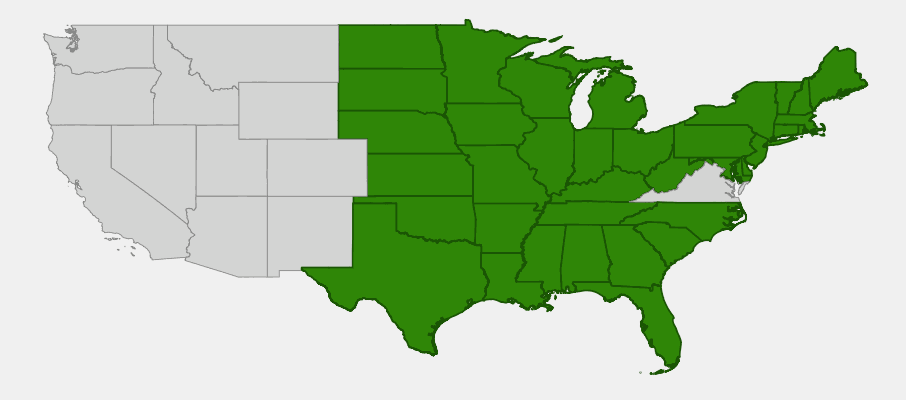
| U.S. States | Alabama, Arkansas, Connecticut, Delaware, Florida, Georgia, Illinois, Indiana, Iowa, Kansas, Kentucky, Louisiana, Maine, Maryland, Massachusetts, Michigan, Minnesota, Mississippi, Missouri, Nebraska, New Hampshire, New Jersey, New York, North Carolina, North Dakota, Ohio, Oklahoma, Pennsylvania, Rhode Island, South Carolina, South Dakota, Tennessee, Texas, Vermont, West Virginia, Wisconsin |
| Mexico / Canada / Other Range | Native in parts of central and eastern Canada; see range discussion |
| Ecoregion | Prairies, dry openings and rocky uplands within the documented range |
| Elevation Range | Variable; check local occurrence records rather than a universal elevation band |
| Habitat | Dry fields, open woods, banks, rocky ground and prairie remnants |
| Common Associates | Locally appropriate native bunchgrasses and dry-site asters; composition varies by site |
Explore our regional native-plant lists: NEKS regional list · DAKOTA regional list. These lists cover several states; each species has its own native range.
Growing & Care Guide
Choose the sunny, lean part of the garden
Start with a site that receives direct sun for much of the day and drains after rain. Light shade can be tolerated, but an increasingly shaded border may give a weaker display. A dry meadow edge or a bank with open soil between grasses suits the plant better than the low point below a downspout. Before planting, watch the site after a substantial rain rather than judging drainage from its dry surface alone.
Plant and establish roots
Set a nursery-grown plant at its existing soil level and water the root ball thoroughly. During establishment, check the root zone rather than watering on a fixed daily schedule. Dry-site plants can fail when a small root ball dries completely before roots reach surrounding soil. Once established, reduce supplemental water according to weather and the soil; “drought tolerant” is not a requirement to keep a new plant dry.
Avoid unnecessary fertilizer
Fertile soil is not needed to produce a useful flowering plant. Repeated feeding and heavy irrigation can push a dry-site perennial toward softer, taller growth and create an unnecessary maintenance problem. If growth is poor, check shade, drainage, root damage and competition before adding fertilizer. Do not treat a naturally compact specimen on lean soil as a nutrient-deficient version of a tall garden goldenrod.
Manage colonies deliberately
Allow space for both short-distance clump expansion and seedlings. In a naturalistic planting, this can help fill small gaps. In a tight border, remove unwanted seedlings while their roots are small and divide an expanding clump when appropriate. Cutting seed heads before they disperse can reduce new seedlings, but retaining some heads preserves seasonal structure and seed resources. Choose that balance according to the site.
Propagation and seasonal cleanup
Seed and division are practical routes to more plants. Use reliably identified seed and follow the supplier’s germination guidance; treatment needs can vary with seed age and storage. For division, move a piece that includes sound roots and growing buds, not just an old flowering stalk. Leave some standing stems where they are safe, and time cleanup with local conditions rather than automatically clearing everything as soon as flowers fade.
Troubleshoot the site before treating symptoms
A plant that disappears in a wet winter may have been placed in unsuitable soil rather than attacked by an unusual disease. Sparse bloom can reflect shade or an immature plant. If leaves are damaged, identify the cause before applying a pesticide: insects are one of the reasons to include native plants. A few chewed leaves and successful establishment are compatible outcomes in a wildlife garden.
Landscape Uses
- A shorter late-season component in a sunny native meadow, with enough space for seedlings.
- A well-drained bank or rocky border where taller goldenrods would dominate neighboring plants.
- A dry pollinator planting paired with locally native grasses and flowers that bloom earlier.
- An educational planting showing that goldenrod species differ in form and should be identified individually.
Wildlife & Ecological Value
For Pollinators
The many small flowers provide a late-season feeding surface for visiting bees and other insects. Goldenrods as a group support numerous specialist and generalist insects, but a record for the genus should not automatically be treated as proof for every individual species. Keeping some flowers open through the season is more useful than repeatedly cutting a patch merely to preserve a tidy outline.
For Birds
Mature seed heads can contribute food and cover in an autumn or winter planting. Bird use depends on the wider habitat, not just one flower species. Retain adjoining cover, reduce unnecessary pesticide use and allow a mixture of seed-bearing plants if supporting birds is a goal. A single goldenrod should not be advertised as a complete bird-habitat solution.
For Mammals
Gray goldenrod is often listed among plants that deer browse less readily, but hunger, season and local animal pressure matter. Protect young transplants if browsing prevents establishment. A low-maintenance native planting can still need temporary protection; the phrase deer resistant is a relative observation rather than a guarantee.
Ecosystem Role
In open habitats the plant occupies a different layer from tall grasses and shrubs. Its usefulness in a garden comes from matching that layer rather than forcing it into every location. Preserve a range of flowering times and plant heights, and avoid collecting wild plants from a remnant simply because the species is widespread elsewhere.
Cultural & Historical Uses
The common name refers to the grayish surface created by fine hairs, while the arching flower plume makes the plant recognizable even before a close inspection. A labeled demonstration planting can help visitors move beyond the generic word goldenrod and notice useful differences among native species.
Goldenrods are often blamed for late-summer hay fever because their bright flowers are conspicuous when less showy wind-pollinated plants are also active. Their flowers are principally adapted to insect pollination. That distinction does not mean that no person can react to a plant, but it does mean that removing a goldenrod is not a sound diagnosis of a seasonal allergy problem.
Historical uses of other Solidago species should not be transferred into home-remedy instructions for this one. This guide treats gray goldenrod as a landscape and habitat plant, not an edible or medicinal recommendation. Accurate labeling and nursery propagation are more useful to a garden project than an unsupported claim of a traditional cure.
Frequently Asked Questions
Will gray goldenrod take over my garden?
It can spread by seed and rhizomes. In a meadow that may be welcome; in a small border, monitor seedlings and divide an expanding clump. It is not a promise of a stationary, maintenance-free plant.
Why is mine taller than the table height?
Height changes with site and growing conditions. Regional tables summarize typical observations rather than setting a biological limit. Lean, exposed sites often produce shorter plants than richer garden soil.
Can it grow in a rain garden?
Not in a basin that remains wet. If a rain garden has a genuinely dry, well-drained upper edge, evaluate that separate planting zone rather than treating the entire installation as one moisture condition.
Does it belong in Colorado?
Do not infer Colorado nativity from the title of a multi-state list. The conservative state treatment used on this page does not include Colorado; use a local botanical source for any proposed Colorado restoration.
Should I cut it back after flowering?
You can remove heads where seedlings are unwanted, but retaining some seed heads and stems adds seasonal habitat. There is no need to remove a healthy stem simply because its yellow flowers have faded.
Sources & Further Reading
- Kew Plants of the World Online: identity, synonyms and native distribution
- USDA PLANTS profile
- NC State Extension: Gray Goldenrod
- Missouri Botanical Garden: Solidago nemoralis
- Native Plant Trust: identification and New England occurrence
- Native Plant Trust Garden Plant Finder
Find Native Plants Near You
Ask a native-plant nursery for correctly identified, nursery-propagated stock and information about regional provenance. Match the plant to your site rather than collecting it from a wild population.
Nebraska native plant nurseries · Kansas native plant nurseries · North Dakota native plant nurseries · South Dakota native plant nurseries · Minnesota native plant nurseries