
Eastern Blazing Star (Liatris scariosa)
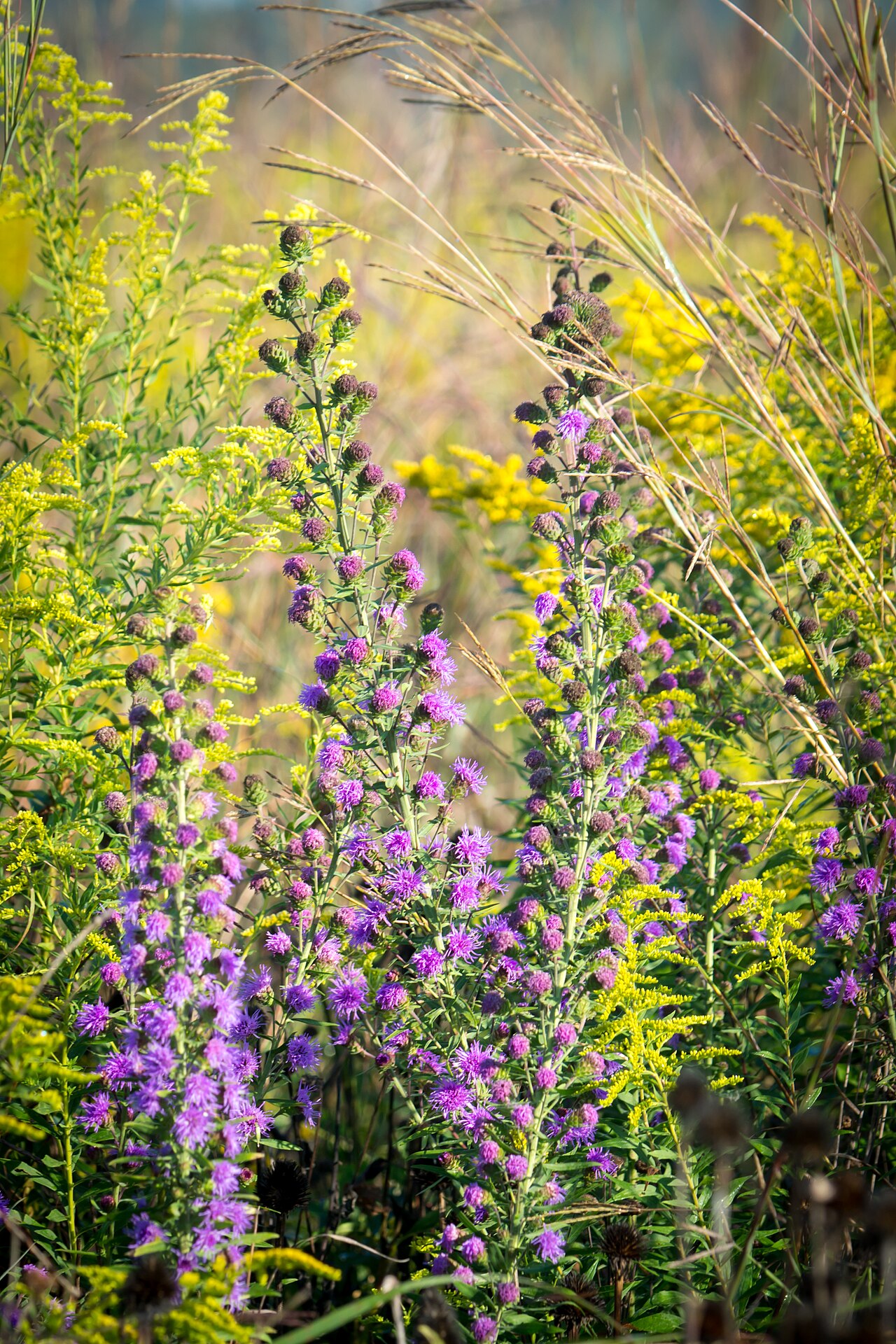
Eastern blazing star brings a different texture to a late-summer planting: rounded, shaggy purple heads spaced along an upright stem rather than a continuous dense plume. The heads are individually conspicuous, and the flowers attract butterflies and other visitors. In a sunny border or savanna-style garden, it provides vertical structure without the broad branching top of a large ironweed.
This page uses Liatris scariosa in the broad sense followed by Flora of North America and Kew, including the Midwestern plant often called var. nieuwlandii or Liatris nieuwlandii. Some regional floras separate members of this complex as species. That distinction matters when purchasing local native stock: a New England blazing star and a Midwestern savanna blazing star should not be treated as interchangeable restoration material.
Our Illinois, Iowa, and Missouri regional table contains the historical name Eastern Blazing Star. The broad species is documented as native in Illinois and Missouri by the sources used here, but Kew does not list Iowa. The table’s combined regional heading is therefore not a claim of nativity in all three states. Check local records and provenance before selecting this plant for an Iowa native restoration.
Identification
Upright stems and corm
The perennial grows from a rounded underground corm, producing an upright leafy flowering stem and additional growth as the clump matures. Plants commonly reach 2–4 feet in gardens, with a broader published range of about 1–5 feet. The corm is a storage structure, not an edible garden bulb. Keep the crown free of persistent wetness and avoid unnecessary digging once it is established.
Leaves
Lower leaves are relatively long and narrow, becoming smaller farther up the stem. They are arranged alternately rather than in opposite pairs. The basal foliage may be much less conspicuous once the flower stem is fully developed. When comparing species, examine lower leaves as well as the flowering top, because a photograph of purple heads alone often omits important identifying information.
Large stalked flower heads
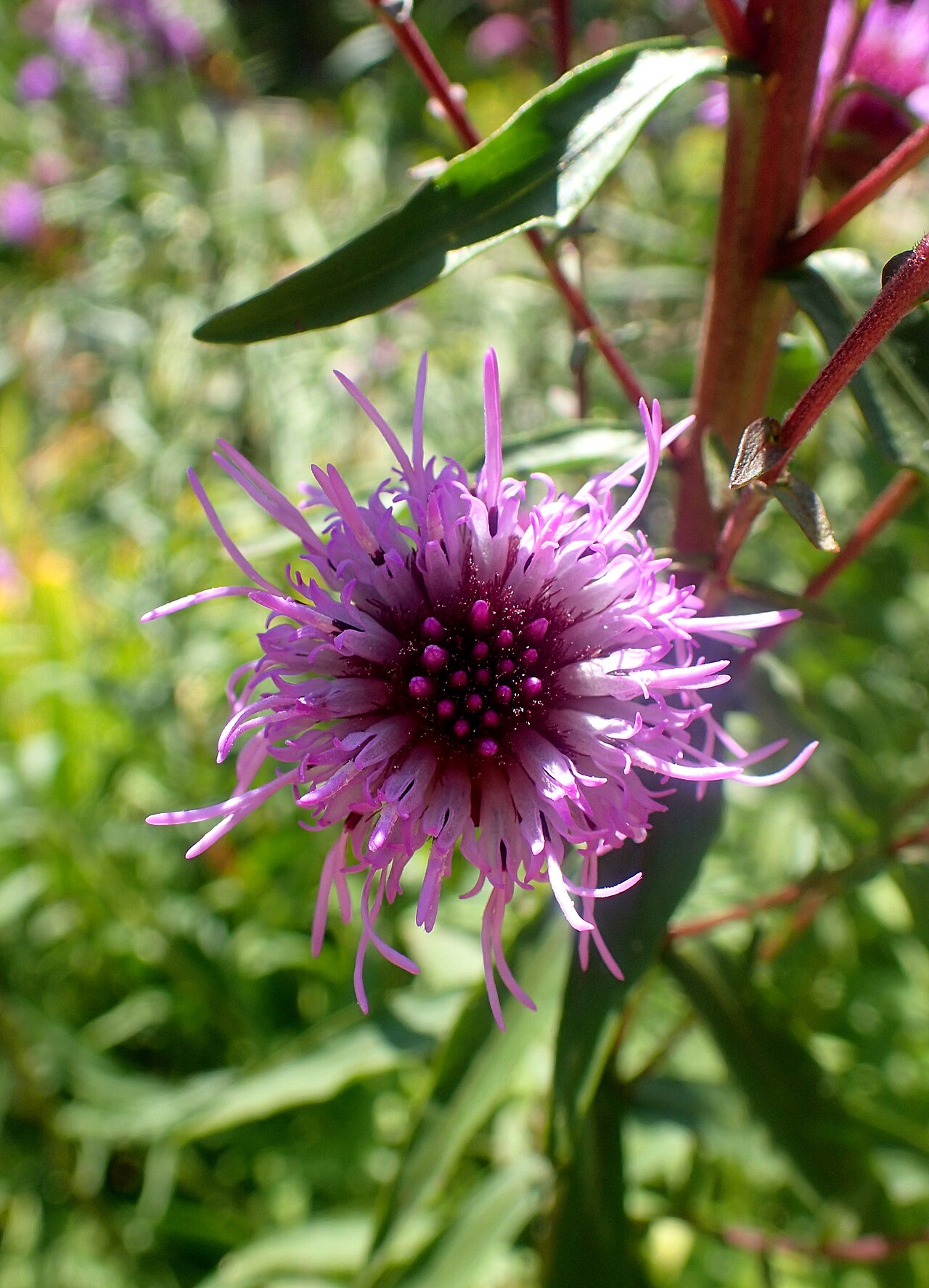
The heads are held on noticeable short stalks along a raceme and contain many tubular florets, with no broad ray petals. Their projecting styles contribute to the shaggy appearance. Flowering generally progresses downward from the upper heads. The spaces between heads and their stalks distinguish this form from the dense, nearly continuous spikes commonly sold as florist’s liatris.
Bracts and lookalikes
Overlapping bracts surround each head. In the scariosa complex they are relatively broad and rounded rather than the strongly narrow, spreading scales characteristic of some other blazing stars. Liatris aspera can be similar, but its heads are much less distinctly stalked. Use a full regional key for wild identification, especially where closely related taxa occur together.
Seed heads and seasonal changes
After flowering, the heads become fluffy with the hairs attached to their small dry fruits. Some seed disperses on the wind, while standing heads can remain into winter. Foliage and stems eventually brown as the perennial enters dormancy. The plant’s disappearance above ground in winter is normal and should not prompt excavation of a healthy corm.
Quick Facts
| Scientific Name | Liatris scariosa, broad FNA/Kew concept |
| Family | Asteraceae (aster family) |
| Plant Type | Corm-forming herbaceous perennial |
| Mature Height | Usually 2–4 feet; approximately 1–5 feet across the complex |
| Mature Spread | Clump-forming; allow roughly 1–2 feet of space |
| Growth Rate | Moderate; seed-grown plants may need several seasons to flower |
| Sun Exposure | Full sun to partial sun |
| Water Needs | Dry to average, well-drained soil; regional forms vary |
| Soil Type | Loamy, sandy or rocky soil with good drainage |
| Soil pH | Use locally appropriate stock; avoid assuming one narrow requirement |
| Bloom Time | Late summer to early fall |
| Flower Color | Rosy purple to lavender-purple |
| Fall Color | Tan seed heads and dormant brown stems |
| Fruit | Small dry fruits with a tuft of hairs |
| Deer Resistant | No guarantee; foliage and corms may be browsed |
| USDA Hardiness Zones | Commonly 3–8; choose regional provenance |
Native Range
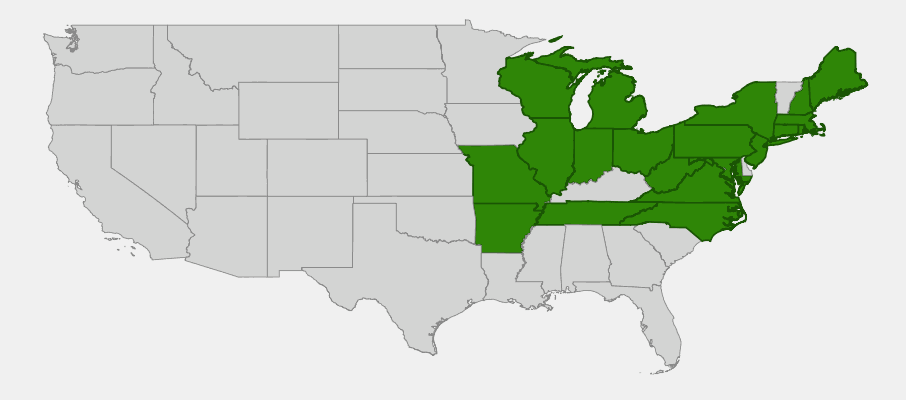
The map follows Kew’s broad Liatris scariosa distribution, which includes central and eastern states from Arkansas and Missouri through the Great Lakes and into the Northeast and Mid-Atlantic. It includes Illinois and Missouri, but not Iowa. This is a species-complex map, not a map of each separate variety or of every county where a plant can be grown.
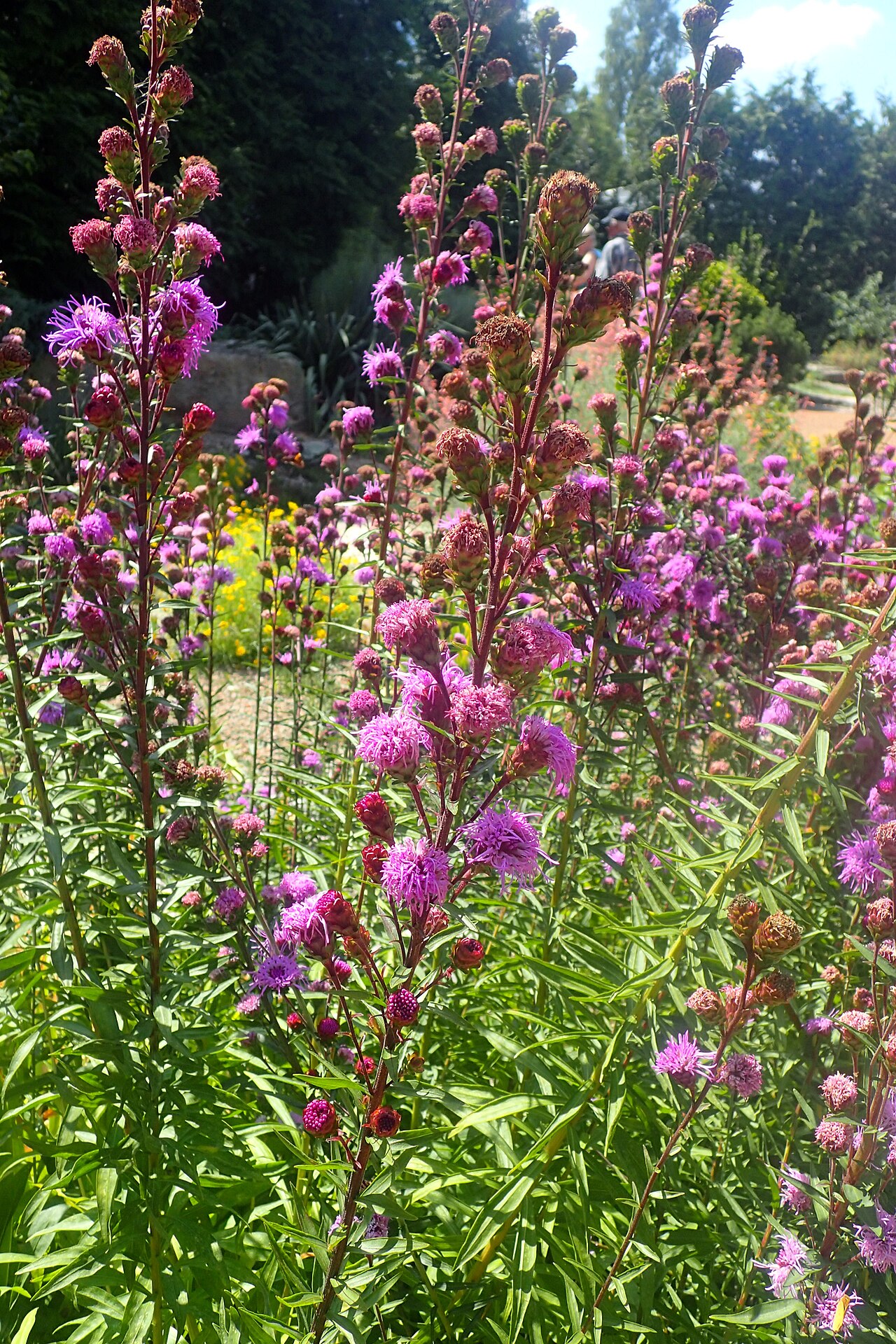
Flora of North America recognizes regional varieties, and the USDA guide discusses the Midwestern nieuwlandii, the more eastern typical variety, and the New England member. Other floras elevate some of these to species. The photographs here include an Ohio prairie plant and cultivated Missouri Botanical Garden specimens labeled L. scariosa; they illustrate the broad concept rather than certifying a particular variety for every image.
Natural settings include open savannas, upland prairies, glades, and woodland openings. A garden site should provide adequate light and drainage without excessive competition. For conservation work, the exact regional taxon and seed source are essential. A broadly labeled ornamental plant is not automatically appropriate for a rare local population or a restoration planting.
📋 Regional plant list: Illinois, Iowa & Missouri
Growing & Care Guide
Choose the right regional stock
Ask a native nursery whether the plant is the Midwestern savanna form and where its seed originated. Keep that information with the plant label. The word native on a pot is not enough for a restoration project involving a complex with several regional names. For an ornamental garden, accurate labeling still helps you understand expected size, bloom time, and local ecological fit.
Light and placement
An open sunny position generally supports a strong flowering stem. Some partial sun is tolerated, especially by savanna forms, but deep shade encourages a weaker display and more competition. Position the plant where the full vertical raceme is visible. A narrow strip directly beneath a spreading shrub may look bright in spring but become unsuitable as the shrub leafs out.
Soil and winter drainage
Use a well-drained site rather than a low pocket that remains wet through winter. Dry-to-average conditions suit the broad garden guidance, while individual regional forms can differ. Avoid burying the corm under a mound of moisture-retaining mulch. If the bed repeatedly loses corm-forming plants after wet winters, improve the wider drainage pattern or choose a different location.
Planting a container-grown specimen
Set the plant at its original depth and water the surrounding soil thoroughly. Keep competing weeds away during establishment, but do not cultivate deeply beside the corm. A small label or marker is useful because dormant plants are easy to overlook during spring garden work. Allow room for a mature clump rather than crowding several pots into a tight temporary display.
Watering
Water new plants when their root zone dries, then reduce supplemental irrigation once they are established. Avoid treating drought tolerance as permission to neglect a fresh transplant. Conversely, repeated watering on a lawn schedule can be excessive for a well-established plant in a suitable soil. Observe drainage and plant condition rather than following a fixed daily routine.
Nutrition and stem support
Very rich soil and excessive feeding can produce stems that are less self-supporting. Start with ordinary garden soil and make amendments only for a demonstrated need. Nearby compatible grasses can provide gentle support. In a formal border, a discreet support placed early is less disruptive than tying heavy flowering stems after they have already fallen across a path.
Growing from seed
The USDA guide describes a cool, moist treatment of about 60 days and shallow sowing. Fall sowing can provide seasonal chilling where conditions permit. Germination and flowering are separate milestones: seed-grown plants may need more than one season before producing a substantial bloom. Keep trays labeled by source and do not assume a lack of first-year flowers means the seedlings are unsuitable.
Division
An established garden clump can be divided carefully in early spring, retaining viable growing points and roots on each piece. Do not divide tiny or stressed plants merely to increase numbers quickly. Replant promptly and monitor moisture. Never obtain divisions by digging wild populations, particularly where the regional taxon is uncommon or protected.
After flowering
Leave some seed heads for seasonal interest and wildlife, or collect a modest amount from your own correctly identified plants when mature. Remove unwanted seedlings while small if the design requires a fixed clump. A mix of retained and removed heads lets you balance a tidy edge with seed production. Avoid stripping every flowering stem before seed has a chance to develop.
Problems and long-term care
Check wet soil, shading, browsing, and competition before reaching for a treatment. Deer or rabbits may eat foliage, and voles can damage corms. A missing stem is not always a disease symptom. In a garden, manage encroaching vegetation by selective removal; prescribed fire belongs to properly planned professional land management, not an improvised small-yard maintenance routine.
Landscape Uses
- Add upright purple accents to a sunny native border among compatible grasses.
- Use regionally appropriate stock in a savanna-style planting with open light and controlled competition.
- Place where late-season butterflies can be observed, leaving enough distance from paths for mature stems.
Wildlife & Ecological Value
Butterfly and bee visits
The large purple heads provide late-season floral resources for butterflies, skippers, and bees. Monarch visits are documented for savanna blazing star, but no single plant guarantees a particular visitor. Include earlier and later local flowers and avoid spraying open blooms. A sequence of resources is more useful than relying on one short flowering period.
Insects beyond nectar visitors
Several moths use blazing stars as host plants. This means some feeding on leaves, stems, or flower heads can be part of the plant’s ecological role rather than a failure of the garden. Identify the cause and severity of damage before acting. A thriving habitat planting need not have flawless leaves on every stem.
Seeds and browsing
Seeds can be used by birds, while mammals may browse foliage or underground parts. Retaining a portion of the mature heads and protecting young plants where needed are compatible goals. The plant is not reliably deer-proof. Local browsing pressure, nearby food sources, and the size of the planting all affect how much protection is necessary.
Cultural & Historical Uses
The scariosa complex demonstrates why botanical names change between regional floras and nursery catalogs. A name such as Liatris nieuwlandii may describe the Midwestern member treated elsewhere as a variety of L. scariosa. This guide states its broad concept explicitly so that older table labels are connected to useful information without pretending that all regional taxonomic treatments are identical.
Blazing stars have become familiar garden plants for their vertical form and butterfly appeal, but a garden cultivar does not represent every wild population. Some members of this complex have limited or vulnerable local populations. Buying propagated material and preserving provenance information separates responsible horticulture from collecting plants out of the wild.
Historical medicinal accounts exist for plants placed in this complex, but they are not used here as treatment advice. The practical focus is a correctly identified perennial for an appropriate native planting. Its flower architecture, seasonal seed heads, and relationship to open savanna habitats are sufficient reasons to grow it without attaching unsupported health claims.
Frequently Asked Questions
Is Liatris nieuwlandii the same as this plant?
It is the Midwestern member often treated as L. scariosa var. nieuwlandii. This page uses the broad FNA/Kew concept and notes that some floras recognize separate species.
Is it native to Iowa?
Kew’s broad range used here does not list Iowa. Our combined Illinois/Iowa/Missouri table should not be read as proof of nativity in every state; verify local records before restoration planting.
Why are the flower heads separated?
Distinct stalked heads along the upright stem are characteristic of this group. It does not form the same dense continuous plume as some other commonly sold liatris species.
Will seed-grown plants flower immediately?
Not necessarily. Establishment can take several seasons, and a healthy first-year plant may consist mainly of foliage. Keep the site open and monitor the plant rather than forcing it with fertilizer.
Can I put it in a wet rain-garden bottom?
Choose a better-drained position. Persistent saturation, especially in winter, is unsuitable for the general corm-forming garden guidance given here.
Sources & Further Reading
- Kew: broad Liatris scariosa range
- Flora of North America: Liatris scariosa
- USDA NRCS 2026 plant guide
- Illinois Wildflowers: savanna blazing star
- NC State Extension: Liatris scariosa
- Missouri Botanical Garden: eastern blazing star
Find Native Plants
Ask growers about nursery propagation and regional provenance. Browse our IL native plant nurseries, MO native plant nurseries directory for suppliers. Explore the native nursery finder.