
Geiger Tree (Cordia sebestena)
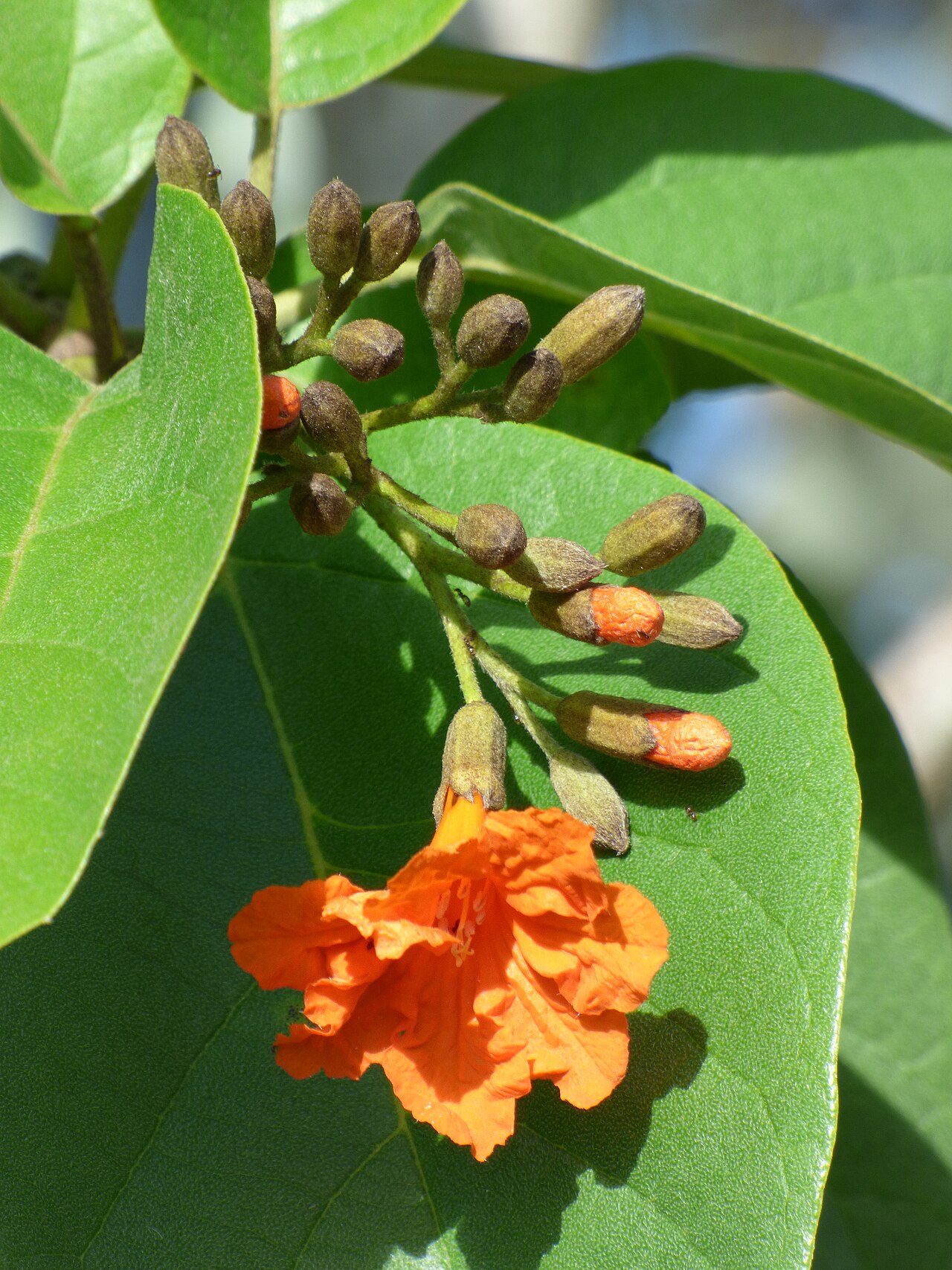
Cordia sebestena, commonly called the Geiger Tree (also Geigertree or Orange Geiger), is a small evergreen tree prized in South Florida and the Florida Keys for its clusters of brilliant orange-red, crepe-textured flowers that bloom nearly year-round. A member of the borage family (Boraginaceae), it is a tough, salt-tolerant tree of coastal and tropical hammocks, long associated with Key West, where weathered old specimens still grow around the Ernest Hemingway Home and the Audubon House and Tropical Gardens.
The tree’s common name comes from John Geiger, a Key West harbor pilot and “wrecker” whose house stood beside a large, striking specimen of this tree. Naturalist John James Audubon stayed at the Geiger house in 1832 and painted a pair of White-crowned Pigeons perched in its orange-flowered branches for his Birds of America, giving the species an early place in American natural history illustration and, eventually, its common name.
This is a genuinely honest page about the Geiger Tree’s native status: USDA PLANTS currently treats Cordia sebestena as introduced, not native, in Florida, Puerto Rico, and the U.S. Virgin Islands — its core native range is the Caribbean islands and the adjacent coasts of Venezuela and Colombia. Some regional Florida sources and older floras have argued for a native (or at least pre-Columbian, long-naturalized) presence in the Florida Keys, citing its deep cultural history there and occurrence on undeveloped Keys hammocks, but that view is not the current USDA position. We follow USDA PLANTS here and describe the tree as introduced and naturalized in the Keys and South Florida, while still covering it because it is so widely grown, locally iconic, and relevant to Florida gardeners researching the tree they see on Keys streets and in coastal yards.
Identification
The Geiger Tree is a small, often multi-trunked evergreen tree or large shrub, typically 15 to 25 feet tall with an equal or wider spread, occasionally reaching 30 feet in ideal conditions. It develops a rounded, spreading crown and can be trained to a single trunk or allowed to branch low and wide, which is how most mature specimens in the Keys are shaped by decades of salt wind.
Bark & Stems
Young stems are stout, gray-brown, and finely hairy, thickening into gray, somewhat furrowed bark on older trunks. Branches tend to be stiff and angular, giving older trees a gnarled, picturesque silhouette that is part of the tree’s appeal in historic Key West gardens.
Leaves
Leaves are simple, alternate, broadly ovate to elliptic, 3 to 8 inches long, dark green above and noticeably rough and sandpapery to the touch on both surfaces — a reliable field mark for the species and for the genus Cordia generally. Margins are entire or slightly wavy, and the leaves are evergreen, persisting year-round in frost-free sites.
Flowers
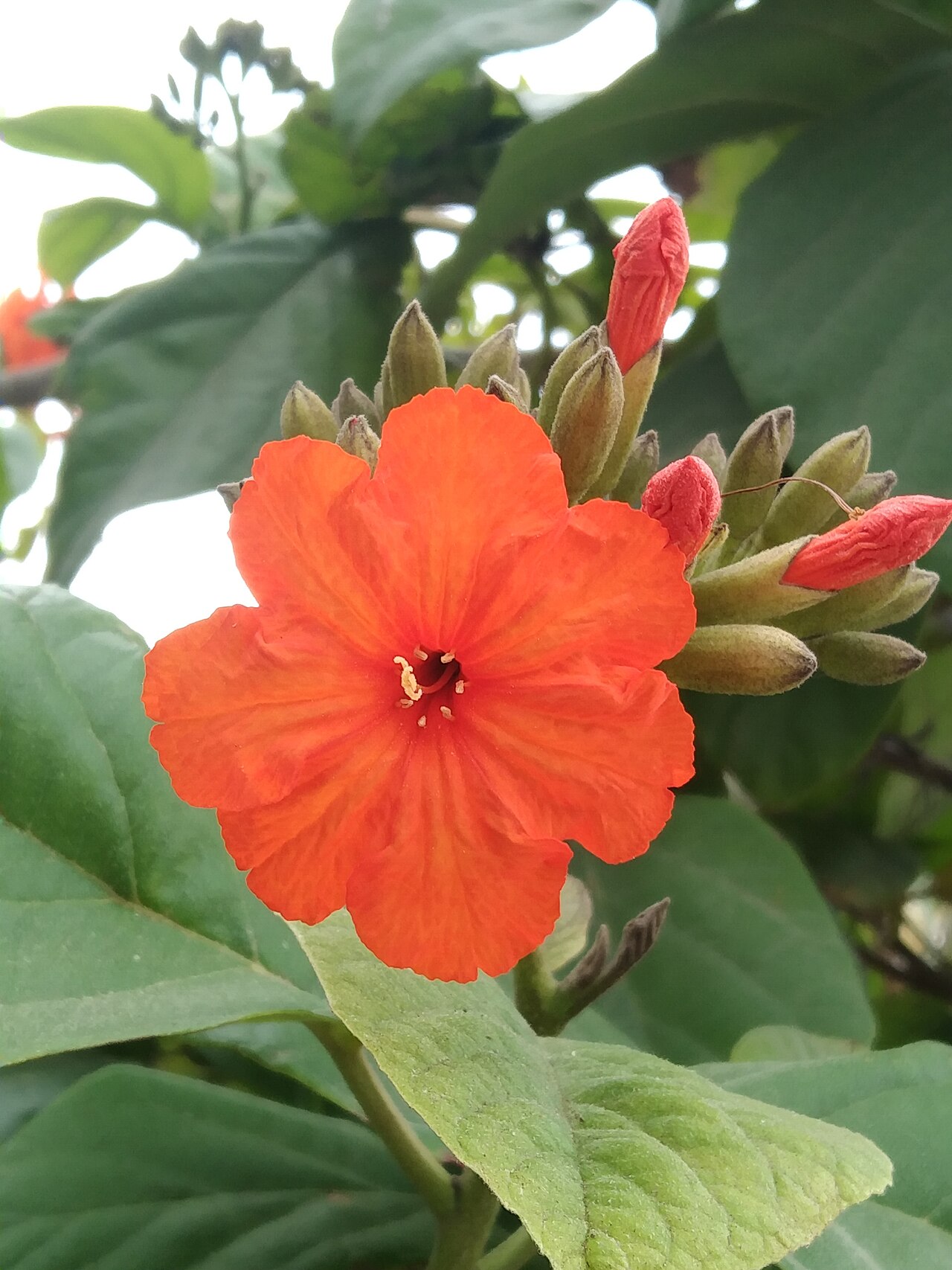
The flowers are the tree’s signature feature: funnel-shaped, 1.5 to 2 inches across, with crinkled, crepe-paper-textured petal lobes in vivid orange to orange-red, occasionally shading toward scarlet. They open in dense, rounded clusters (cymes) at the branch tips and are produced in flushes through most of the year in South Florida’s warm climate, peaking in spring and again after summer rains. A white-flowered form and a less common orange-and-white bicolor form (sometimes called “Aruba Geiger”) are also grown in cultivation, though the straight orange-flowered form is what is treated here.
Fruit & Seeds
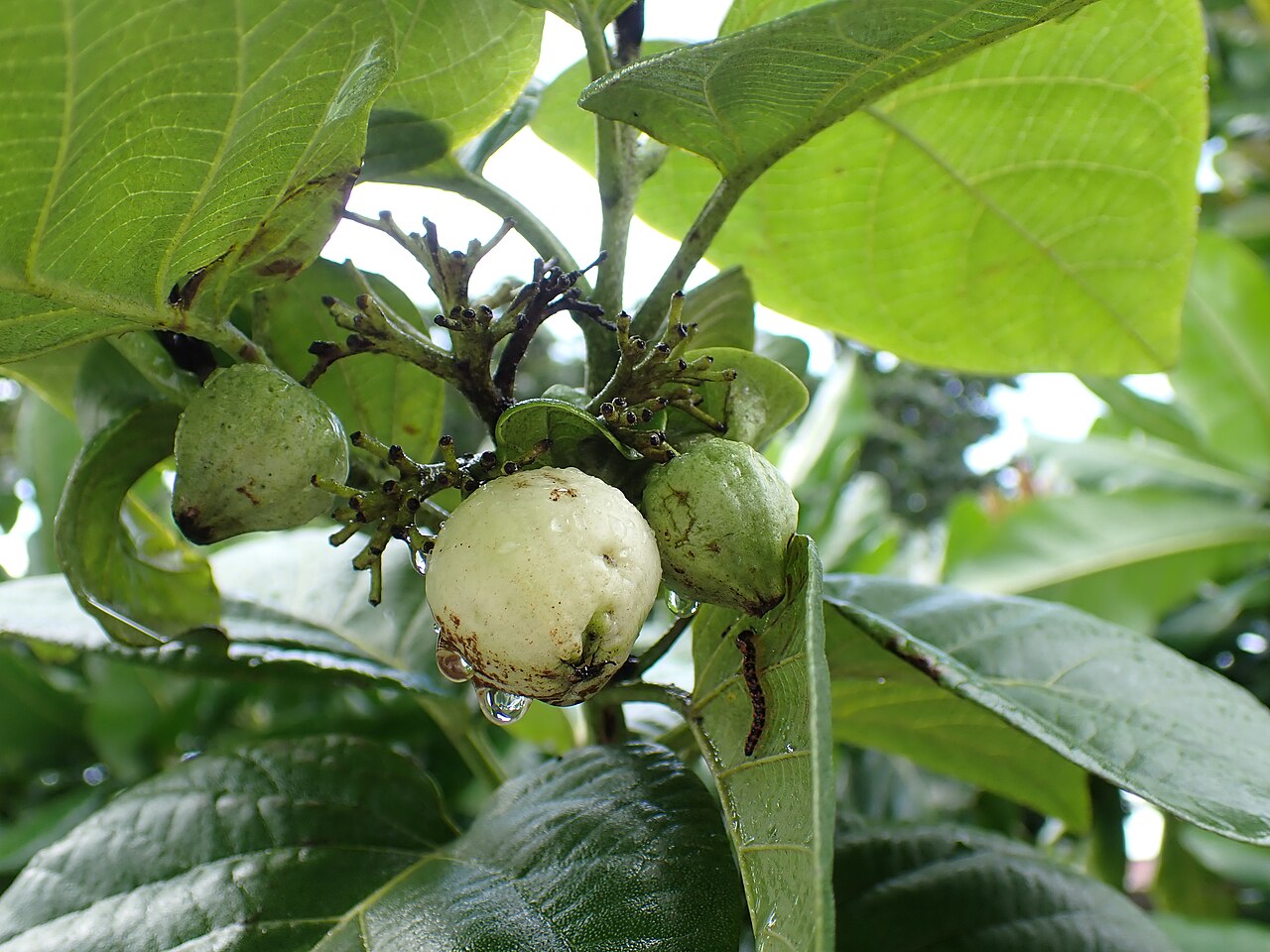
Fruit is a white, ovoid to pear-shaped drupe about 1 to 1.5 inches long, borne in small clusters and ripening through the warm months. The thin, mucilaginous white pulp surrounds a hard central stone. The fruit is technically edible and has historically been made into preserves in parts of the Caribbean, but it is mild, mucilaginous, and not widely eaten — most fruit is left for wildlife.
Quick Facts
| Scientific Name | Cordia sebestena |
| Family | Boraginaceae (Borage) |
| Plant Type | Evergreen Tree / Large Shrub |
| Mature Height | 15–25 ft (occasionally to 30 ft) |
| Mature Spread | 15–25 ft |
| Growth Rate | Moderate |
| Sun Exposure | Full Sun |
| Water Needs | Low to Moderate |
| Soil Type | Sandy, limestone or well-drained soils; tolerates poor soil |
| Soil pH | 6.0–8.0 (tolerates alkaline) |
| Bloom Time | Nearly year-round in South Florida, peak spring and late summer |
| Flower Color | Orange to orange-red |
| Fall Color | None (evergreen) |
| Fruit | White, pear-shaped drupe |
| Deer Resistant | Yes |
| USDA Hardiness Zones | 10–11 |
Native Range
The Geiger Tree’s true native range is the Caribbean basin: it is native to the West Indies (including Cuba, the Bahamas, and the Lesser and Greater Antilles) and the adjacent mainland coasts of Venezuela and Colombia, where it grows in dry coastal scrub, rocky shorelines, and tropical deciduous woodlands. It is a long-cultivated and widely planted tree far beyond that range because of its showy flowers, salt tolerance, and drought hardiness.
In the continental United States, the Geiger Tree is found only in South Florida and the Florida Keys, where it has been planted since at least the early 1800s and has naturalized in places — spreading from cultivation into coastal hammocks and disturbed ground on the Keys and the southeastern Florida mainland. USDA PLANTS classifies this Florida population, along with Puerto Rico and the U.S. Virgin Islands, as introduced rather than native. The tree’s deep roots in Key West history (it is the tree in Audubon’s 1832 White-crowned Pigeon painting, and the source of the “Geiger” name used for the historic Geiger/Audubon House) mean it is sometimes informally described as a Keys native, but that is a claim about cultural history, not botanical origin.
Because of this, the Geiger Tree should be understood in Florida gardens as a well-adapted, long-naturalized ornamental rather than a true native — useful where tough, salt- and drought-tolerant flowering trees are wanted, but not a substitute for true Florida natives in a restoration planting. It is not cold-hardy outside Zones 10–11 and will not survive freezes north of South Florida.
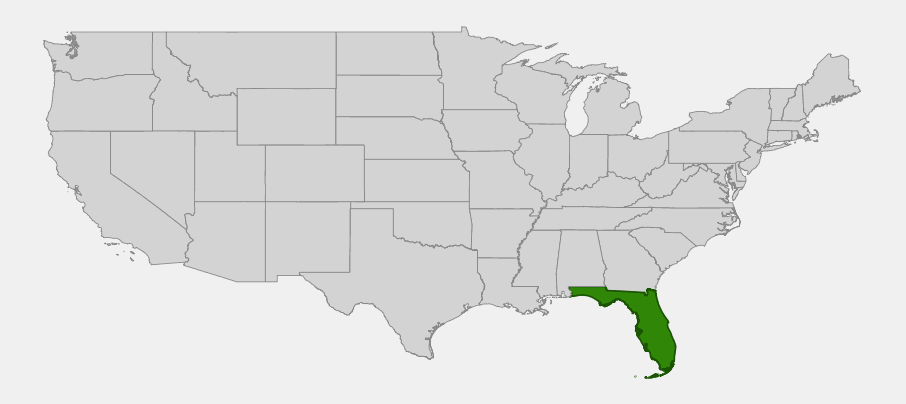
📋 Regional plant lists featuring Geiger Tree: No Florida regional plant list currently covers this introduced species; browse all Native Plant Profiles.
Growing & Care Guide
The Geiger Tree is one of the easiest, toughest small flowering trees for a South Florida or Keys landscape, thriving on heat, salt spray, and drought once established — qualities that have made it a fixture of old Key West gardens for two centuries.
Light
Plant in full sun for the best flower production. Trees tolerate light shade but bloom more sparsely and grow leggier reaching for light. A full-sun, open position also keeps the crown dense and well-shaped.
Soil & Water
Geiger Tree is highly adaptable to poor, rocky, and alkaline soils, including the oolitic limestone common on the Keys, and it handles salt spray and brief salt-water flooding better than most flowering trees. Water regularly for the first year to establish a deep root system; after that, it is quite drought tolerant and needs supplemental water only in extended dry spells. Good drainage is more important than soil fertility — it does not want wet feet.
Planting Tips
Set out container-grown trees in spring or early summer so roots establish before the cooler, drier winter. Give it room to spread — 15 to 20 feet from structures or other trees — and avoid frost pockets or low spots, since the species has no cold tolerance below the high 20s°F. It is an excellent choice for coastal, beachfront, or street-side plantings where wind and salt rule out less tolerant trees.
Pruning & Maintenance
Prune lightly after a bloom flush to shape the crown and remove dead or crossing wood; the tree responds well to pruning and can be kept compact or trained to a single trunk. It is generally untroubled by serious pests, though leaf-feeding caterpillars of the Geiger beetle (a tortoise beetle largely specific to Cordia) can skeletonize leaves in some years without lasting harm to an established tree.
Propagation
Propagate from fresh seed (the stone from ripe fruit) or from semi-hardwood cuttings taken in warm weather. Seed germination is improved by removing the pulp and soaking the stone before sowing; cuttings root readily under mist with rooting hormone.
Landscape Uses
Good choices for the Geiger Tree include:
- Coastal and beachfront plantings where salt tolerance is essential
- Specimen or accent tree for its long bloom season and bright color
- Street tree or parking-lot planting in frost-free South Florida
- Pollinator and hummingbird gardens
- Xeriscape and low-water landscaping once established
- Historic or heritage plantings referencing Key West garden tradition
Wildlife & Ecological Value
Though not a Florida native, the Geiger Tree pulls real weight as a nectar and fruit source in the South Florida landscapes where it has long been established.
For Pollinators
The nectar-rich orange flowers are visited heavily by butterflies, including swallowtails and sulphurs, as well as by bees and other nectar-seeking insects. Its long, nearly continuous bloom season makes it a dependable nectar source through much of the year in a region where many native bloomers are more seasonal.
For Birds
Hummingbirds, particularly wintering Ruby-throated Hummingbirds, visit the tubular flowers for nectar. The white fruit is eaten by a variety of birds, including White-crowned Pigeons — the species famously painted feeding in a Geiger Tree by John James Audubon at the historic Geiger House in Key West.
For Mammals
Fruit is occasionally taken by small mammals where the tree grows near natural hammock edges, though this is a minor part of its wildlife value compared with its role for pollinators and birds.
Ecosystem Role
In the naturalized coastal hammocks where it has established, the Geiger Tree contributes nectar and fruit resources and some structural diversity to a shrub-and-small-tree canopy layer, though because it is not native it is best regarded as a long-present ornamental and wildlife-supporting tree rather than a foundational hammock species.
Cultural & Historical Uses
The Geiger Tree’s American history is inseparable from Key West. John Geiger, a prominent harbor pilot and wrecker, lived in a house built around 1839 that still stands today as the Audubon House and Tropical Gardens, named for naturalist John James Audubon, who stayed there in 1832 while studying and painting Florida Keys birds. Audubon is said to have painted his famous plate of White-crowned Pigeons in the branches of a large Geiger Tree on the property, and the tree’s common name in English traces to this association with the Geiger family and house.
In its native Caribbean range, the wood of Cordia sebestena has been used locally for small carpentry and turnery, and the mucilaginous white fruit pulp has historically been used to make preserves or candied sweets in some islands, though this is a minor, localized folk use rather than a significant food crop. The tree has long been planted ornamentally throughout the tropics and subtropics for its striking, long-lasting flower color.
In Florida, the Geiger Tree became an emblematic plant of old Key West gardens during the 19th and 20th centuries, grown alongside other tough, salt-tolerant ornamentals in the gardens of wreckers, sea captains, and early settlers. It remains a signature tree of historic Key West landscaping today, including at the Hemingway Home and the Audubon House, and is widely sold at South Florida nurseries as a reliable flowering tree for coastal gardens.
Frequently Asked Questions
Is the Geiger Tree native to Florida?
No. USDA PLANTS classifies Cordia sebestena as introduced and naturalized in Florida; its native range is the Caribbean islands and the nearby coasts of Venezuela and Colombia. It has been cultivated and has naturalized in South Florida and the Keys since at least the early 1800s, which gives it deep local history even though it is not a Florida native.
Why is it called the Geiger Tree?
It is named for John Geiger, a 19th-century Key West harbor pilot whose house (now the Audubon House and Tropical Gardens) had a notable specimen of this tree. Naturalist John James Audubon painted White-crowned Pigeons in its branches while staying there in 1832, cementing the tree’s association with the Geiger name.
Can you eat Geiger Tree fruit?
The white fruit is technically edible and has occasionally been used for preserves in parts of the Caribbean, but it is mild, mucilaginous, and not a significant food source. It is best left for birds and other wildlife rather than eaten.
How cold-hardy is the Geiger Tree?
It is reliably hardy only in USDA Zones 10–11 and has essentially no frost tolerance; temperatures in the high 20s°F will cause significant dieback or kill young trees. It should be planted only in frost-free parts of South Florida and the Keys.
Is the Geiger Tree salt tolerant?
Yes, it is one of the more salt-tolerant small flowering trees available for Florida landscaping, handling salt spray and occasional saltwater flooding well, which is part of why it has thrived in Key West gardens for two centuries.

Looking for a nursery that carries Geiger Tree?
Browse our native plant nursery directory: Florida