
Osage-orange (Maclura pomifera)
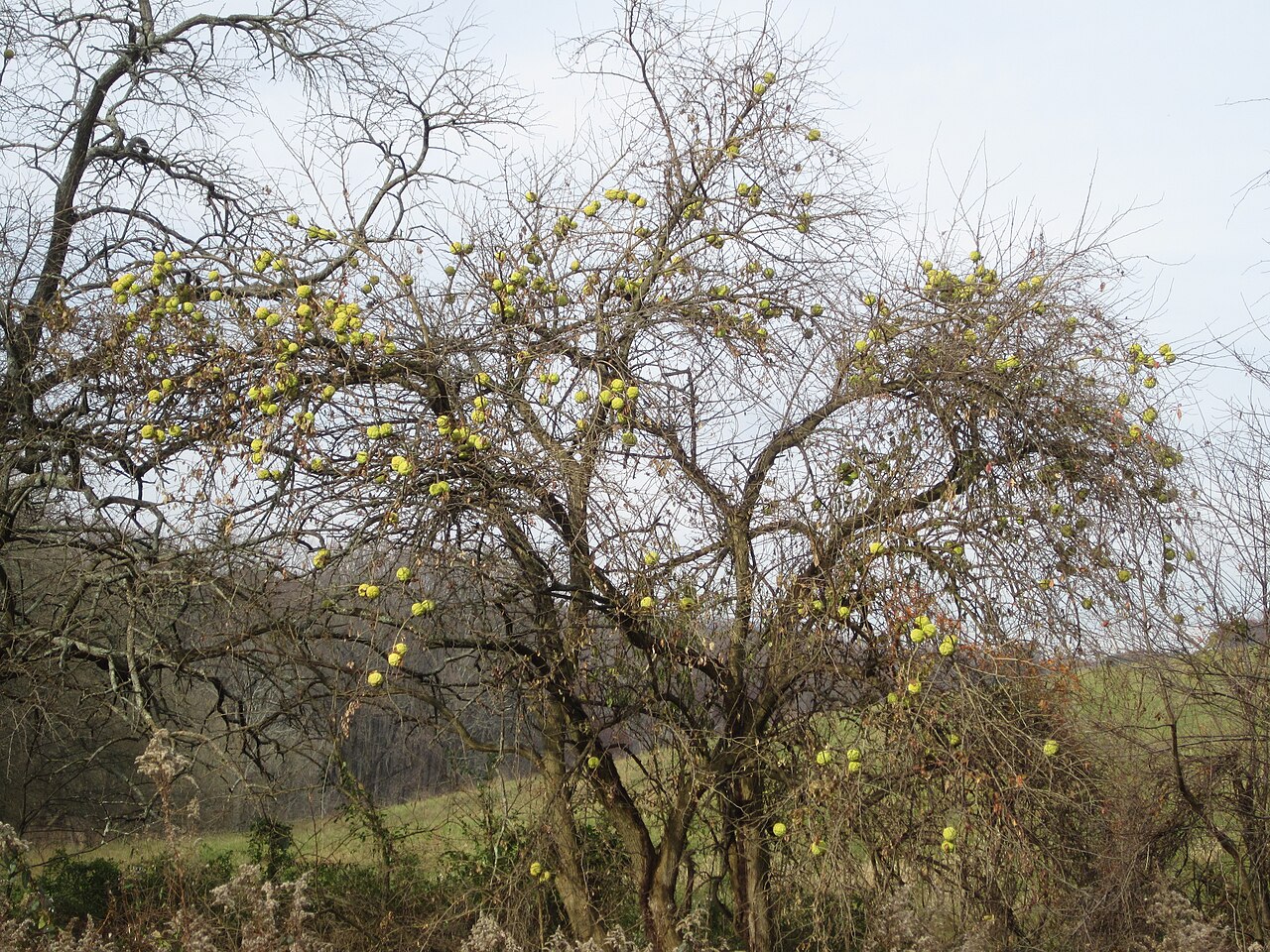
Maclura pomifera, the Osage-orange, is a tough, thorny tree best known for two things: the huge, wrinkled, chartreuse fruit it drops every fall, and the dense, nearly impenetrable hedges it once formed across the American prairie. Also called Bois d’Arc, Bodark, Hedge Apple and Horse Apple, this member of the mulberry family (Moraceae) is native to a surprisingly small corner of the south-central United States, but thanks to more than a century and a half of deliberate planting it is now a familiar sight in farm country and old home sites far beyond that original range.
The tree’s story is tied to American agricultural history. Before the invention of barbed wire in the 1870s, farmers across the Midwest and Great Plains planted dense rows of Osage-orange, pruned and woven into “horse-high, bull-strong, and hog-tight” living fences. Millions of these trees were planted from the 1850s through the 1870s, and many of the gnarled, multi-trunked Osage-oranges found today along old fence lines and field edges, far outside the species’ native range, are the descendants or survivors of that era.
In the home landscape, Osage-orange is valued less for subtlety than for sheer toughness: it shrugs off drought, poor soil, wind and urban pollution, and its wood is exceptionally dense, rot-resistant and prized by bowyers and fence-post makers alike. Because of its stout thorns and the heavy, messy fruit drop, it’s best sited away from walkways and mowed lawns, and gardeners wanting fruit-free trees should look for a male cultivar, since only female trees bear the familiar hedge apples.
Identification
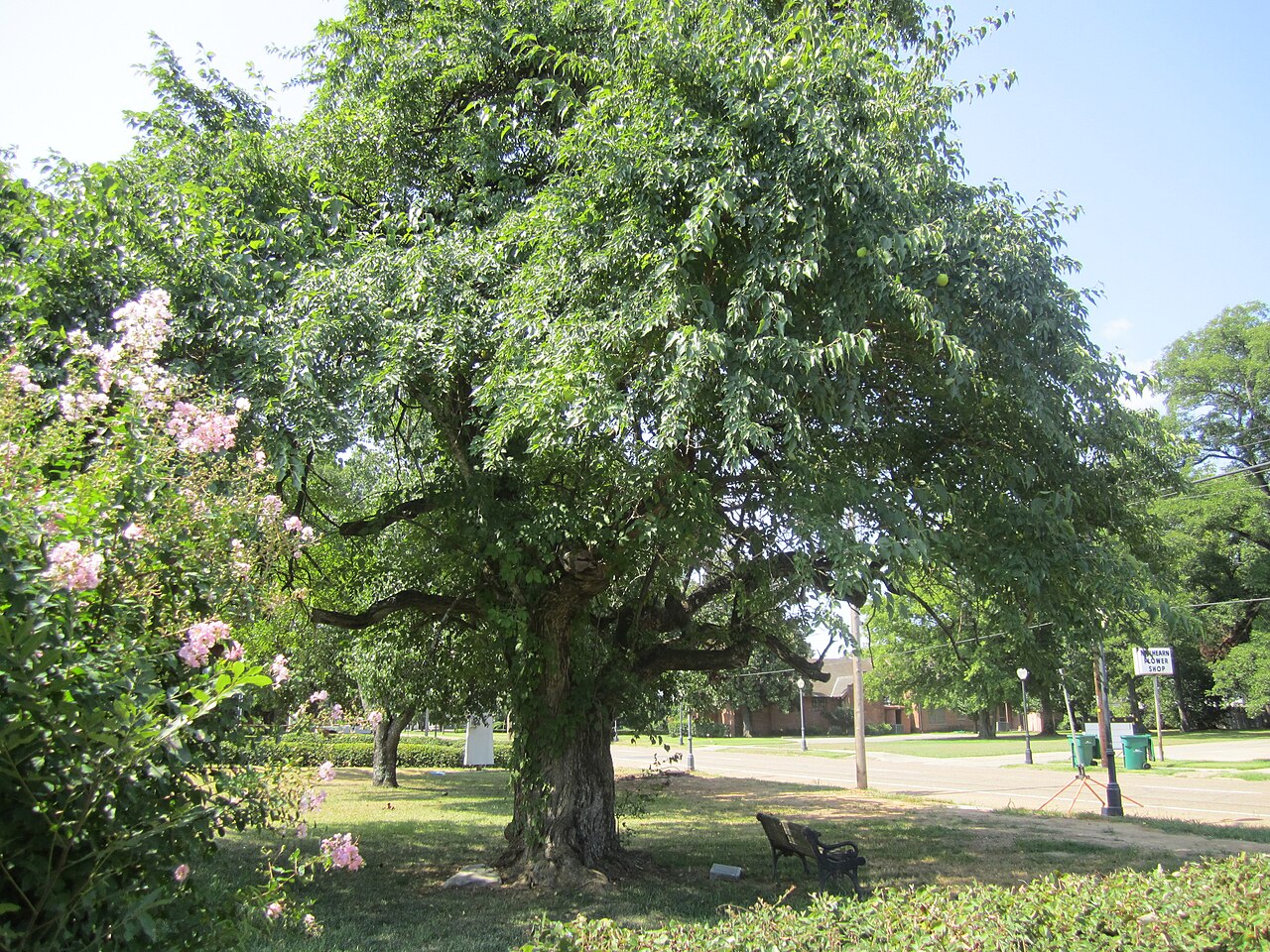
Osage-orange grows as a medium-sized deciduous tree, typically 30 to 50 feet tall with an irregular, rounded crown and a short, often leaning or crooked trunk. Wild and hedgerow trees frequently branch low and multi-trunk, especially where they have been repeatedly cut back.
Bark & Stems
Mature bark is orange-brown to gray, deeply furrowed into narrow, braided-looking ridges. Young twigs are stout, zigzagging, and armed with stiff, straight thorns up to an inch long that sit just above each leaf scar; these spines make Osage-orange genuinely unpleasant to work around or walk through, which is exactly why it worked so well as a hedge.
Leaves
Leaves are simple, alternate, ovate to lance-shaped, 2 to 5 inches long, with smooth margins and a glossy, dark yellow-green upper surface that turns clear yellow in fall. All parts of the tree exude a milky, latex-like sap when cut or bruised, a quick field mark for the species.
Flowers & Fruit
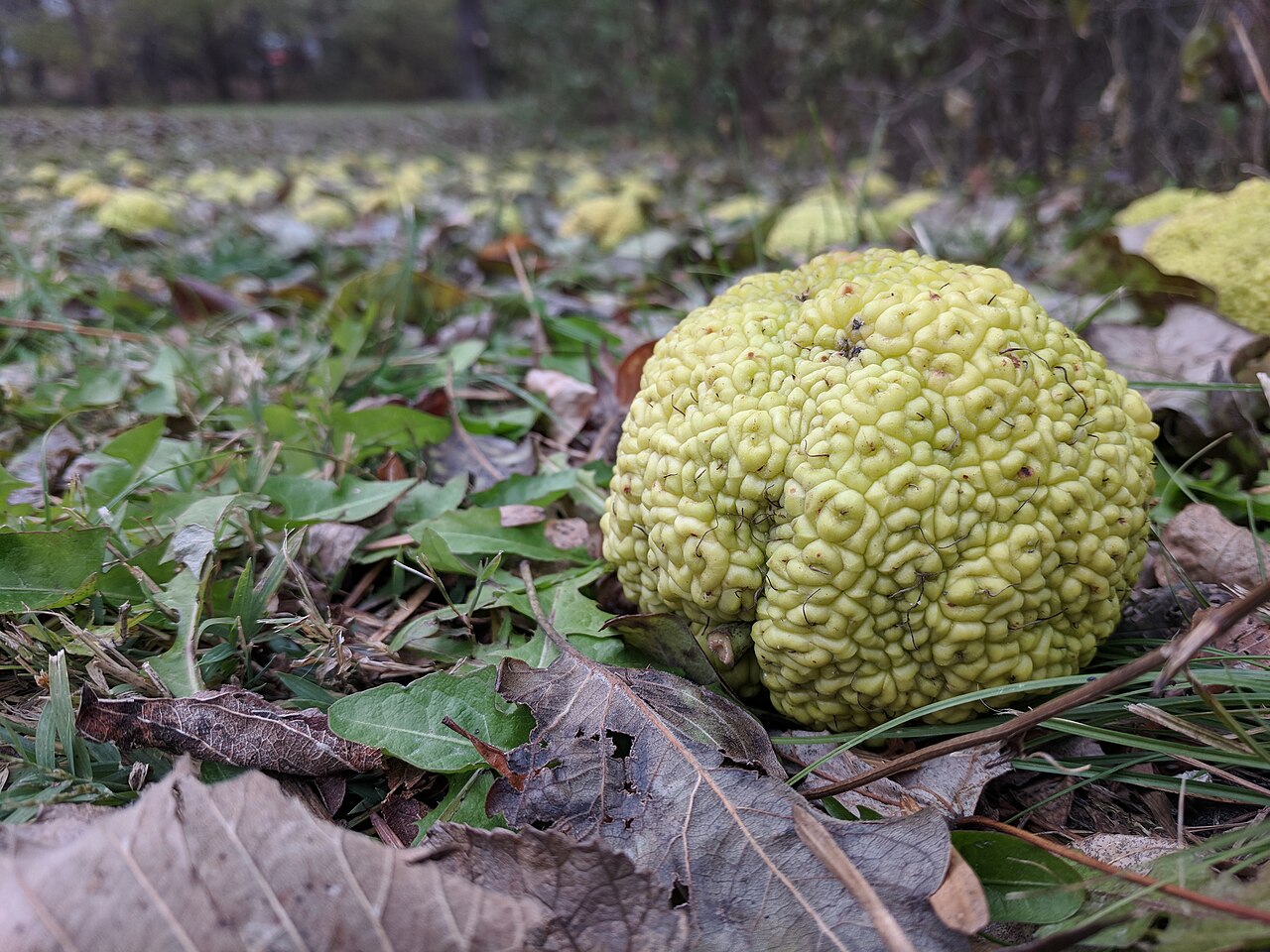
Osage-orange is dioecious, meaning individual trees are either male or female. Flowers are small, green and inconspicuous, male flowers in open clusters and female flowers in dense, rounded heads, both appearing in late spring as the leaves emerge. Only female trees produce fruit: a knobby, spherical, yellow-green syncarp 4 to 6 inches across, resembling a brain-textured orange. The fruit is not a food crop for people — it has almost no edible pulp and is generally considered inedible by humans, though squirrels will dig into it for the seeds. The fruit ripens and falls heavily in autumn, bruising readily and releasing the same milky sap found elsewhere in the tree.
Quick Facts
| Scientific Name | Maclura pomifera |
| Family | Moraceae (Mulberry) |
| Plant Type | Deciduous tree |
| Mature Height | 30–50 ft |
| Mature Spread | 30–40 ft |
| Growth Rate | Moderate to fast |
| Sun Exposure | Full Sun |
| Water Needs | Low; very drought tolerant once established |
| Soil Type | Adaptable; clay, loam or sand, including poor or compacted soil |
| Soil pH | Wide tolerance, acidic to alkaline |
| Bloom Time | April – May |
| Flower Color | Green, inconspicuous |
| Fall Color | Clear yellow |
| Fruit | Large yellow-green syncarp, 4–6 in, on female trees only; not edible for people |
| Deer Resistant | Yes (thorny, bitter foliage and sap) |
| USDA Hardiness Zones | 4–9 |
Native Range
Osage-orange’s original native range is one of the smallest of any widely known American tree: botanists generally place it in the Red River drainage of southwestern Arkansas, southeastern Oklahoma and northeastern Texas, possibly extending south along the Blackland Prairie into central Texas. Within that core area it grew along rivers and streams, on rocky wooded slopes, and at the edge of prairies, often on the limestone-influenced soils typical of the region.
Before European settlement, the Osage and other Plains nations prized the wood of trees growing in this limited native range for bow-making, and early 19th-century botanical explorers found the species growing wild almost exclusively within a few hundred miles of the Red River. Everything beyond that core area — the huge sweep of Osage-orange seen today from the Great Plains to the East Coast — reflects 19th- and 20th-century hedgerow planting and later naturalization, not an original range.
Osage-orange is not native to most of the places it now grows. It has naturalized widely across the eastern and central United States, including states such as Missouri, Kansas, Illinois, Kentucky and much of the Northeast and Pacific Northwest, where old hedge trees and their wild-sprouted offspring are common along fence lines, field edges and roadsides. Gardeners in those areas should treat it as a naturalized, non-native tree rather than a straightforward native planting choice, and should be mindful of its potential to spread from root sprouts and seed in disturbed ground.
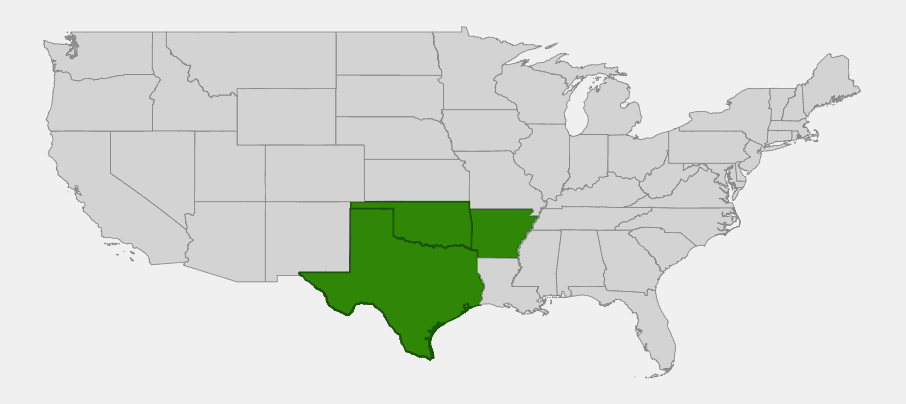
📋 Regional plant lists featuring Osage-orange: Arkansas, Louisiana, Eastern Oklahoma & Eastern Texas
Growing & Care Guide
Within its native Red River corner of Arkansas, Oklahoma and Texas, Osage-orange is about as low-maintenance as a native tree gets — it was chosen for hedging precisely because it thrives where little else will.
Light
Osage-orange needs full sun to develop a strong, well-branched form. In shade it grows thin, leans toward available light, and produces far less fruit.
Soil & Water
This tree tolerates an exceptional range of soils, from heavy clay to dry rocky ground, and a wide pH range. It is deeply drought tolerant once its root system is established, needing supplemental water only in its first year or two. Good drainage matters more than fertility; avoid planting in permanently soggy ground.
Planting Tips
Plant container or balled-and-burlapped trees in fall or early spring. Give Osage-orange plenty of room away from walkways, patios and mowed lawns, since both the thorns and the heavy fall fruit drop are hazards underfoot. Gardeners who want the tree’s toughness without the mess should seek out a thornless, fruitless male cultivar from a nursery rather than planting an unselected seedling.
Pruning & Maintenance
Young trees benefit from early structural pruning to establish a strong central leader, since unpruned trees tend toward a low, spreading, multi-trunked habit. Osage-orange tolerates hard pruning and even coppicing extremely well, a legacy of its hedge-row history, and can be cut back hard to control size or renew an overgrown hedge. Wear heavy gloves and eye protection when pruning because of the thorns.
Landscape Uses
Within its native range, Osage-orange suits a narrow but useful set of landscape roles:
- Windbreaks and screens on exposed, dry sites where few other trees establish
- Wildlife hedgerows providing dense cover and thorny protection for nesting birds
- Historic or farmstead restoration plantings echoing the 19th-century hedge tradition
- Difficult, compacted or urban sites where drought and pollution tolerance matter most
- Fruitless male cultivars as shade trees where the thorns and fruit are a concern
Wildlife & Ecological Value
Osage-orange supports wildlife mainly through structure and seed, rather than through its odd, little-eaten fruit.
For Birds
The dense, thorny growth of hedge-grown Osage-orange provides excellent nesting cover and protection from predators for songbirds, and old hedgerows remain important shelterbelt habitat across the farm country where the species was historically planted.
For Mammals
Squirrels are the primary consumers of Osage-orange fruit, tearing the knobby syncarp apart to reach the seeds inside and scattering pulp in the process; this is the main way the tree’s seeds are dispersed today. Deer and livestock generally avoid browsing the thorny, bitter foliage.
Ecosystem Role
Some ecologists consider Osage-orange a likely example of “evolutionary anachronism” — a plant whose large fruit may have been adapted for dispersal by now-extinct Pleistocene megafauna such as ground sloths or mammoths, which could have swallowed the fruit whole and passed the seeds intact. Without such a disperser, the tree today relies mainly on rodents, gravity and, historically, deliberate human planting to spread.
Cultural & Historical Uses
The Osage and other Indigenous peoples of the southern plains valued Osage-orange wood above all others for bow-making, prizing its combination of strength, flexibility and density; early French traders in the region called the tree bois d’arc, “bow-wood,” a name that survives today as “Bodark” or “Bodock” in parts of the South.
The tree’s second great historical role came after 1850, when agricultural promoters, including Illinois nurseryman Jonathan Baldwin Turner, began marketing Osage-orange as a living fence for the treeless prairie. Settlers planted it by the millions of miles across the Midwest before cheap barbed wire made thorny hedges obsolete in the 1870s and 1880s; many of the gnarled Osage-orange trees still found along old field lines today are survivors of that hedge-planting boom.
Beyond bows and hedges, the dense, rot-resistant, insect-resistant wood has long been prized for fence posts, tool handles and, in a Depression-era program, for windbreak plantings across the Great Plains under the Great Plains Shelterbelt project. The bright yellow-orange heartwood was also used historically to produce a natural dye.
Frequently Asked Questions
Can you eat Osage-orange fruit?
No. The fruit is not considered edible for people — it has little usable pulp, a bitter milky latex, and no history as a human food crop. Squirrels will tear into it for the seeds, but it should not be treated as a foraged food.
Is Osage-orange native to my state?
Probably not, unless you garden in the Red River region of southwestern Arkansas, southeastern Oklahoma or northeastern Texas. The tree has naturalized across much of the central and eastern United States from 19th-century hedge planting, but that widespread presence is not the same as being native.
Why are Osage-orange trees full of thorns?
The stout thorns likely evolved as a defense against browsing by Pleistocene megaherbivores, and they proved equally effective at stopping cattle, which is exactly why 19th-century farmers planted the species as a living fence.
Is Osage-orange wood really that durable?
Yes. It is one of the hardest, heaviest and most rot-resistant woods native to North America, which is why it remains a favorite for fence posts, tool handles and traditional bow-making to this day.
Do all Osage-orange trees produce fruit?
No. The species is dioecious, so only female trees bear the large green fruit; male trees flower but never fruit. Nurseries selling fruitless, often thornless cultivars are propagating male trees specifically to avoid the mess and hazard of fallen fruit.
