
Desert Lavender (Hyptis emoryi)
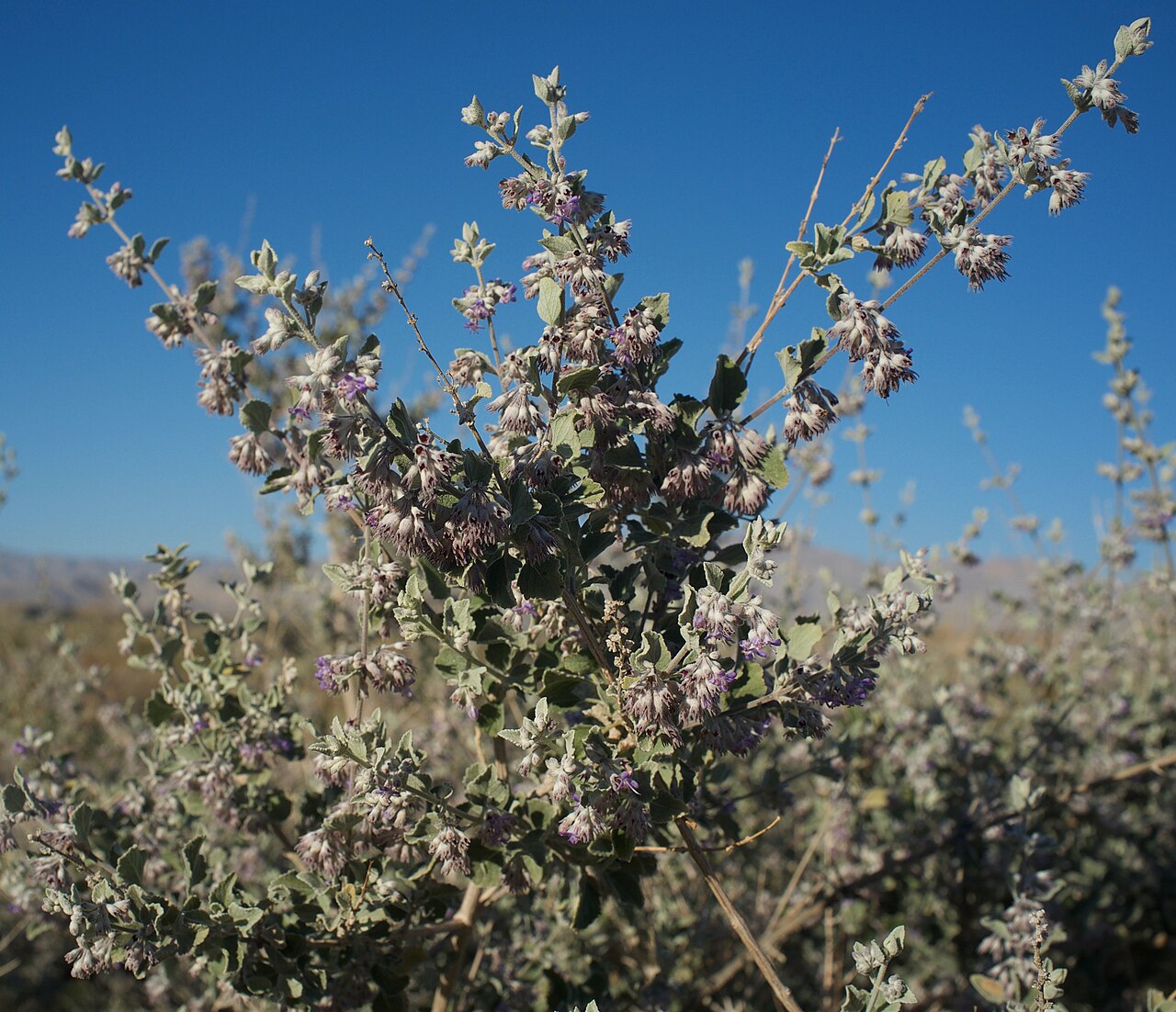
Hyptis emoryi (also classified as Condea emoryi), commonly known as Desert Lavender, is a large, many-stemmed shrub of the mint family found throughout the hottest, driest washes of the Sonoran and Mojave deserts. It is not a true lavender — that name comes only from its pale, powdery gray-green foliage and its small violet-blue flowers, which share lavender’s color and, when crushed, a similarly sharp, resinous fragrance. The genus question is still unsettled among botanists: USDA PLANTS and many older references keep it in Hyptis, while the Jepson eFlora and Plants of the World Online have moved it into Condea after DNA studies showed Hyptis as traditionally defined was not a single natural group. Both names refer to the same plant, and you will see either on plant tags and in older field guides.
Desert lavender is one of the toughest shrubs in the low desert, surviving summer heat well over 110°F and months without rain by shedding leaves and going dormant rather than dying back. It typically grows as a rounded, airy mound of slender, whitish-gray stems 4 to 8 feet tall, occasionally taller in a favored wash, with small, softly fuzzy leaves that feel almost like flannel. From late winter into spring — and again after summer monsoon rains — the plant covers itself in dense whorls of tiny lavender-blue flowers that are intensely attractive to honeybees, native bees and hummingbirds, making it one of the most important nectar sources in the Sonoran Desert during the lean late-winter months.
For desert gardeners, Desert Lavender is prized precisely because it asks for almost nothing: no supplemental water once established, no fertilizer, no pruning beyond an occasional shaping, and it still rewards you with months of fragrant bloom and a steady traffic of pollinators. It is an excellent anchor shrub for a low-water wash garden, a wildlife planting, or simply a fragrant screen along a hot, sun-baked wall where few other plants would survive.
Identification
Desert Lavender is a multi-stemmed, rounded to upright shrub, usually 4 to 8 feet tall and nearly as wide, though in the best wash microclimates with reliable underground moisture it can reach 10 to 12 feet. The overall look is open and airy rather than dense, with many slender branches radiating from the base.
Bark & Stems
Young stems are square in cross-section, as in most mints, and covered in a dense coat of fine white-gray hairs that give the whole plant a pale, almost silvery cast visible from a distance. Older stems lose some of this hair and turn a dull tan-brown, but the newer growth at the branch tips stays conspicuously whitish year-round, which is often the quickest way to pick the plant out among other desert shrubs even when it isn’t in bloom.
Leaves
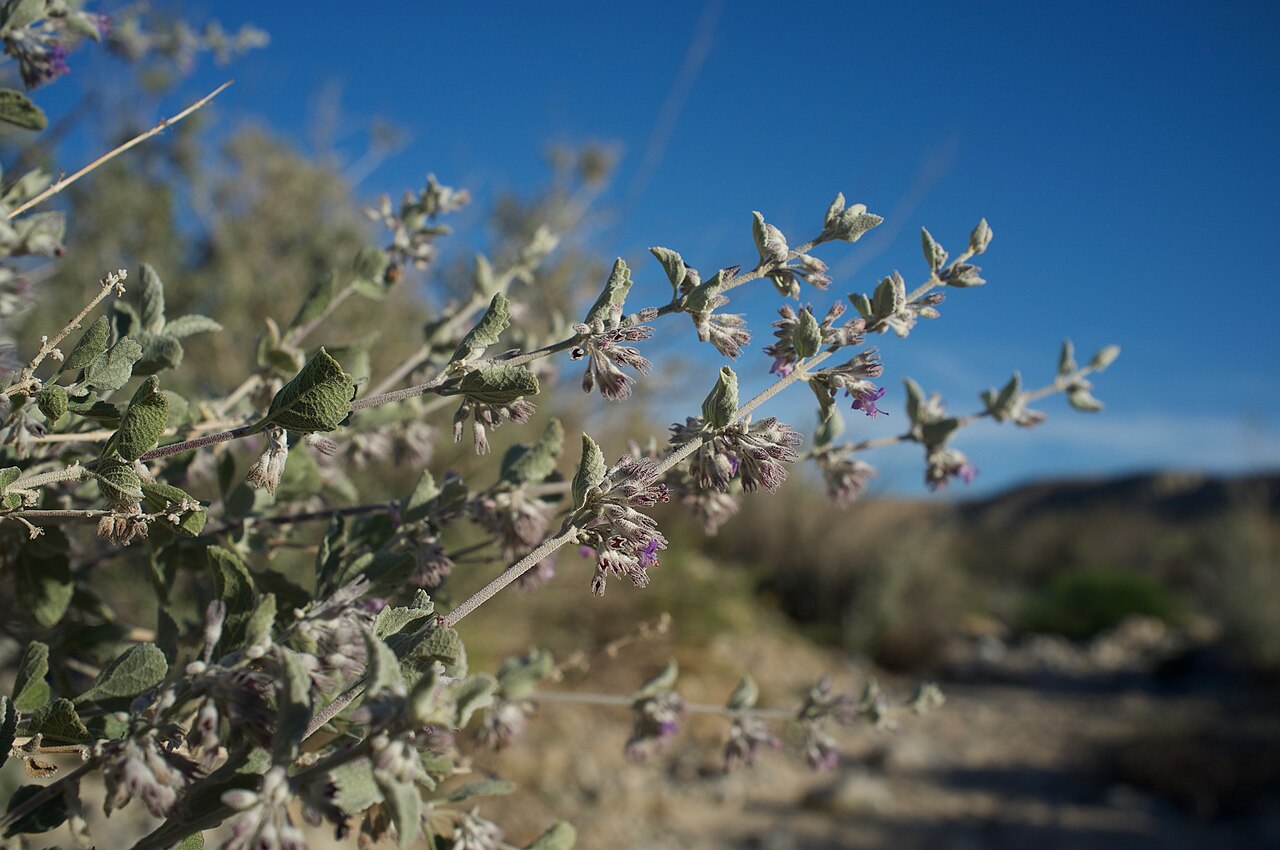
The leaves are opposite, oval to egg-shaped, about 1 to 3 inches long, with shallowly scalloped or toothed margins. Both surfaces are covered in soft, dense hairs, giving the foliage a felted, gray-green to whitish-green color that helps reflect intense desert sun and reduce water loss. The leaves are drought-deciduous: in extended dry spells, especially in summer, the plant drops most of its leaves to conserve water, then refoliates quickly once rain returns. Crushed leaves release a strong, pleasant, lavender-like herbal scent.
Flowers
Flowers are small, tubular, two-lipped, and pale violet to lavender-blue, carried in dense, rounded clusters (verticillasters, typical of the mint family) along the upper stems. Bloom is heaviest from December through April, with a secondary flush often following summer monsoon rains. Each individual flower is tiny, under half an inch, but the plant produces so many in such dense clusters that a blooming shrub hums audibly with foraging honeybees on a warm afternoon — it is considered one of the best honey-producing native plants in the low desert.
Fruit & Seeds
After flowering, each tiny flower produces a small, dry fruit that splits into four single-seeded nutlets, typical of the mint family. The fruit is inconspicuous, dry, and brown, with no ornamental value, and ripens through spring and into early summer.
Quick Facts
| Scientific Name | Hyptis emoryi (syn. Condea emoryi) |
| Family | Lamiaceae (Mint) |
| Plant Type | Drought-deciduous shrub |
| Mature Height | 4–8 ft (to 12 ft in favored washes) |
| Mature Spread | 4–8 ft |
| Growth Rate | Moderate |
| Sun Exposure | Full Sun |
| Water Needs | Very low once established; excellent drought tolerance |
| Soil Type | Sandy, rocky or gravelly, fast-draining desert soils |
| Soil pH | Neutral to alkaline (about 7.0–8.5) |
| Bloom Time | December – April, with a lighter rebloom after summer rain |
| Flower Color | Violet-blue to lavender |
| Fall Color | None; foliage stays gray-green year-round or drops in extreme drought |
| Fruit | Small dry nutlets, not ornamental |
| Deer Resistant | Yes (aromatic, bitter foliage) |
| USDA Hardiness Zones | 9–11 |
Native Range
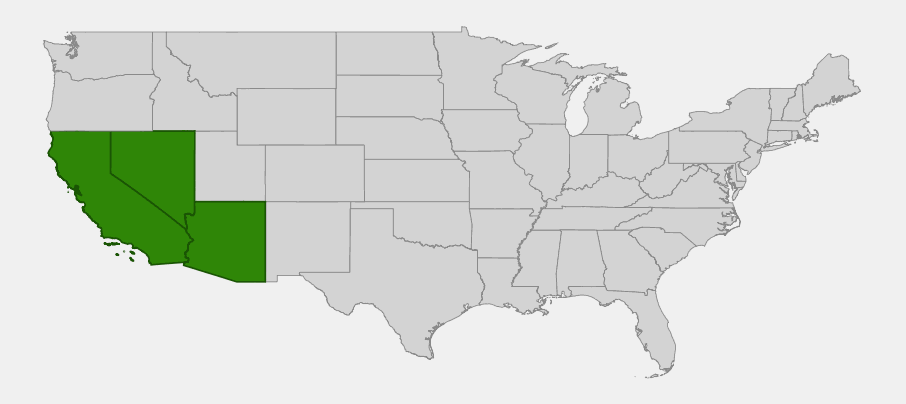
Desert Lavender is native to the hot low deserts of the southwestern United States, found in Arizona, California and Nevada, and extending south into northwestern Mexico in Sonora and Baja California. In Arizona it ranges from the central part of the state through the southwestern Sonoran Desert, with scattered populations reaching into the Mojave Desert in the northwest. In southern California and Nevada it occupies the southern Mojave Desert and the Colorado Desert region of the Sonoran Desert.
The species is closely tied to desert washes and areas with some subsurface moisture; it is rarely found on open, exposed flats far from drainage. It grows alongside classic Sonoran Desert wash species such as blue palo verde, desert ironwood, catclaw acacia, brittlebush and wolfberry, usually below about 3,300 feet elevation. This affinity for washes means the plant benefits from occasional flash flooding and the extra moisture that collects in sandy arroyo soil, even though the surrounding uplands may receive only a few inches of rain a year.
Desert Lavender is common and secure throughout its range (NatureServe ranks it G5, Secure) and is not considered rare or of conservation concern. It is widely available in desert-adapted nurseries, so there is no reason to collect it from the wild.
📋 Regional plant lists featuring Desert Lavender: Arizona & New Mexico
Growing & Care Guide
Desert Lavender is about as low-maintenance as a flowering shrub gets, provided it has full sun and sharp drainage. It is a staple of low-water desert landscaping precisely because it thrives on neglect once its roots are established.
Light
Give Desert Lavender full sun. In its native range it grows in open desert washes with no overhead shade, and it needs that intense light to flower well and keep a compact, floriferous form. In light shade it becomes leggy and blooms sparsely.
Soil & Water
Plant in fast-draining sandy, decomposed granite or rocky soil; it does poorly in heavy clay or any soil that stays wet. Water deeply but infrequently during the first one to two growing seasons to establish a deep root system, then taper off. Established plants need little to no supplemental water in most low-desert gardens and are best treated like other wash-adapted shrubs: occasional deep soaks during long dry stretches, especially before the main winter-spring bloom, will produce heavier flowering, but the plant will survive extended drought without any irrigation at all. Avoid regular shallow watering, which encourages root rot and a shorter lifespan.
Planting Tips
Plant in fall or early spring so roots can establish before the heat of summer. Choose a site with reflected heat and excellent drainage, such as a south-facing slope or the base of a rock-mulched berm. Space plants 5 to 6 feet apart to allow for their mature spread and airy, informal form. A layer of gravel or decomposed granite mulch keeps the base cool and mimics the washes where the plant grows naturally; avoid organic mulch piled against the stems, which can hold too much moisture.
Pruning & Maintenance
Desert Lavender needs very little pruning. A light shaping after the main winter-spring bloom will keep the shrub denser and encourage fresh new growth; avoid heavy shearing, which removes the wandy branch tips where most flowers form. Older plants that have become leggy can be cut back by up to a third in late winter to rejuvenate them. No regular fertilizer is needed; a desert-adapted shrub like this one is adapted to naturally lean soils.
Propagation
Desert Lavender is usually propagated from semi-hardwood cuttings taken in late spring or summer, which root readily with bottom heat and a well-draining mix. Seed propagation is also possible: collect the dry nutlets after flowering, sow shallowly in a sandy mix, and keep lightly moist until germination, which can be slow and uneven. Nursery-grown plants from local native plant sales are the most reliable source for desert gardeners.
Landscape Uses
- Wash gardens and dry streambeds, recreating its natural desert habitat
- Pollinator gardens, where its long winter-to-spring bloom feeds bees when little else is flowering
- Informal hedges or screens along hot walls and fences
- Xeriscape and water-wise landscaping as a low-water anchor shrub
- Fragrance gardens, where crushed foliage releases a strong lavender-like scent
- Habitat restoration plantings along desert washes and disturbed arroyo edges
Wildlife & Ecological Value
Few native desert shrubs match Desert Lavender’s value to pollinators, and its dense, airy growth also offers real cover for desert wildlife.
For Pollinators
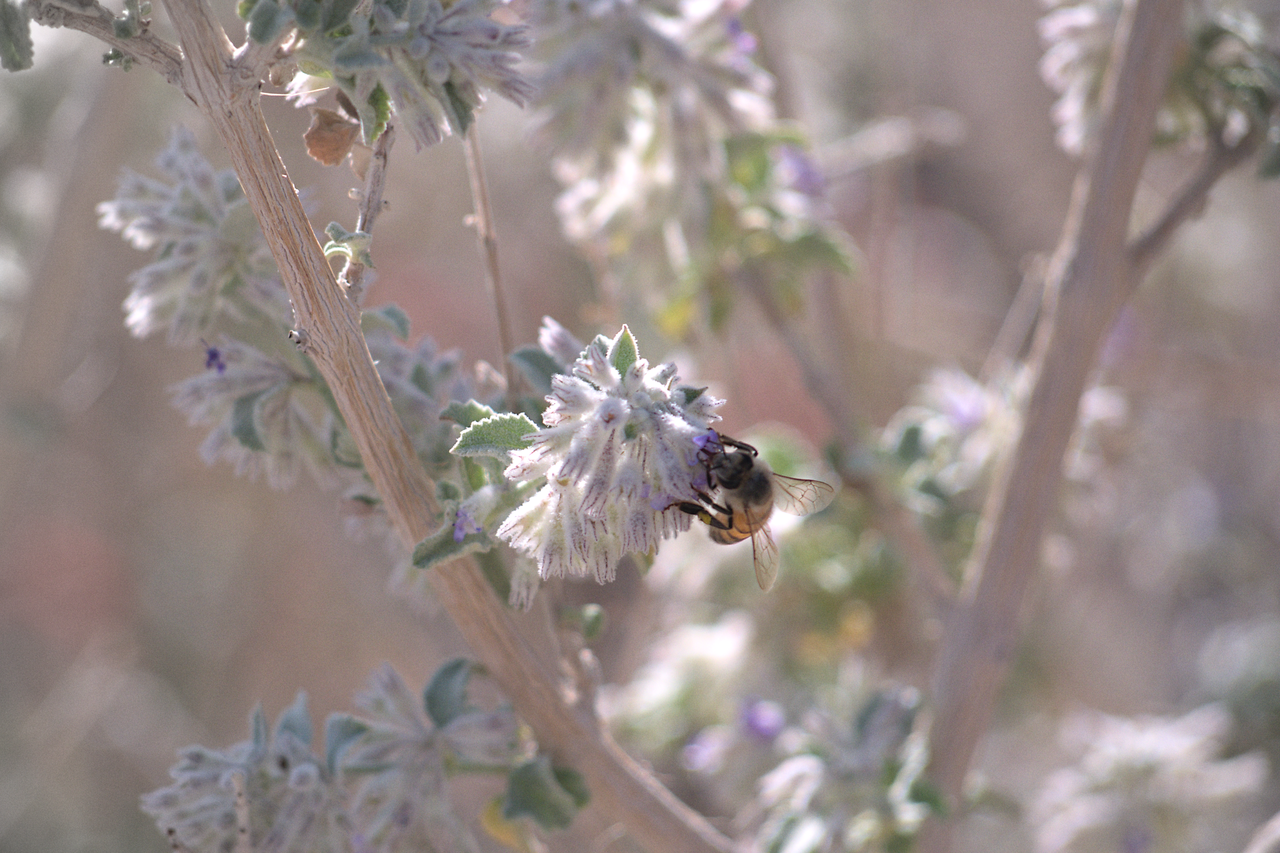
Desert Lavender is considered one of the most important nectar sources for honeybees in the Sonoran Desert, with beekeepers in Arizona and California prizing areas where it grows abundantly. Native bees, including carpenter bees and small solitary bees, along with butterflies and other nectar-feeding insects, also visit the flowers heavily during the long winter-to-spring bloom period, when few other desert plants are flowering.
For Birds
Hummingbirds, including Costa’s and Anna’s hummingbirds, regularly feed on the tubular flowers. The dense, tangled branching provides nesting sites and cover for small desert birds such as verdins and gnatcatchers, which use the shrub’s airy structure to hide from predators while remaining close to open foraging ground.
For Mammals
The foliage is aromatic and bitter, which keeps browsing by deer and rabbits low, though desert bighorn sheep and other wildlife will use the plant for cover. Small mammals such as desert woodrats and ground squirrels often shelter beneath and among the branches.
Ecosystem Role
As a common, long-lived wash shrub, Desert Lavender helps stabilize sandy arroyo soils and adds structural diversity to desert wash communities that are otherwise dominated by low, open scrub. Its long bloom season bridges a critical nectar gap for pollinators between the fall and the main spring wildflower bloom.
Cultural & Historical Uses
Desert peoples of the Sonoran Desert region, including the Tohono O’odham and other Indigenous communities, historically used the aromatic leaves of Desert Lavender in various ways, including as a seasoning and as a fragrant addition to other preparations, drawing on the plant’s strong, pleasant lavender-like scent. The dried foliage was also sometimes used as a natural air freshener or strewn in dwellings for its fragrance.
Because the plant blooms so reliably through the cooler months and produces abundant nectar, it has long been valued by desert beekeepers, and “desert lavender honey” has a regional reputation among apiarists in Arizona and the Colorado Desert for its light color and mild, pleasant flavor.
In modern desert landscaping, Desert Lavender has become a staple low-water shrub, promoted by botanical gardens such as the Desert Botanical Garden in Phoenix and widely available at desert-adapted nurseries as water-conscious landscaping has grown in popularity across the Southwest.
Frequently Asked Questions
Is Desert Lavender a true lavender?
No. Despite the common name and a similar fragrance, Desert Lavender is not in the genus Lavandula. It belongs to Hyptis (or Condea, depending on the classification used), a different genus in the mint family, and is native to North American deserts rather than the Mediterranean.
Is it Hyptis emoryi or Condea emoryi?
Both names refer to the same plant. USDA PLANTS lists it under Hyptis emoryi, while the Jepson eFlora and Plants of the World Online now place it in Condea following DNA studies that split the traditional genus Hyptis. You may see either name used, especially on older references or nursery tags.
How much water does Desert Lavender need?
Very little once established. Water regularly for the first one to two years to establish roots, then it can largely survive on rainfall alone in most low-desert gardens, though occasional deep watering during long dry spells will improve flowering.
Does Desert Lavender lose its leaves?
It can. The species is drought-deciduous, meaning it may drop a significant portion of its leaves during extended heat and drought to conserve water, then quickly releaf after rain. This is a normal survival strategy, not a sign of a dying plant.
Is Desert Lavender good for bees?
Yes, exceptionally so. It is considered one of the best native nectar plants for honeybees and native bees in the Sonoran Desert, flowering heavily from December through April when few other plants are in bloom.

Looking for a nursery that carries Desert Lavender?
Browse our native plant nursery directory: Arizona · California · Nevada