
Licorice Fern (Polypodium glycyrrhiza)
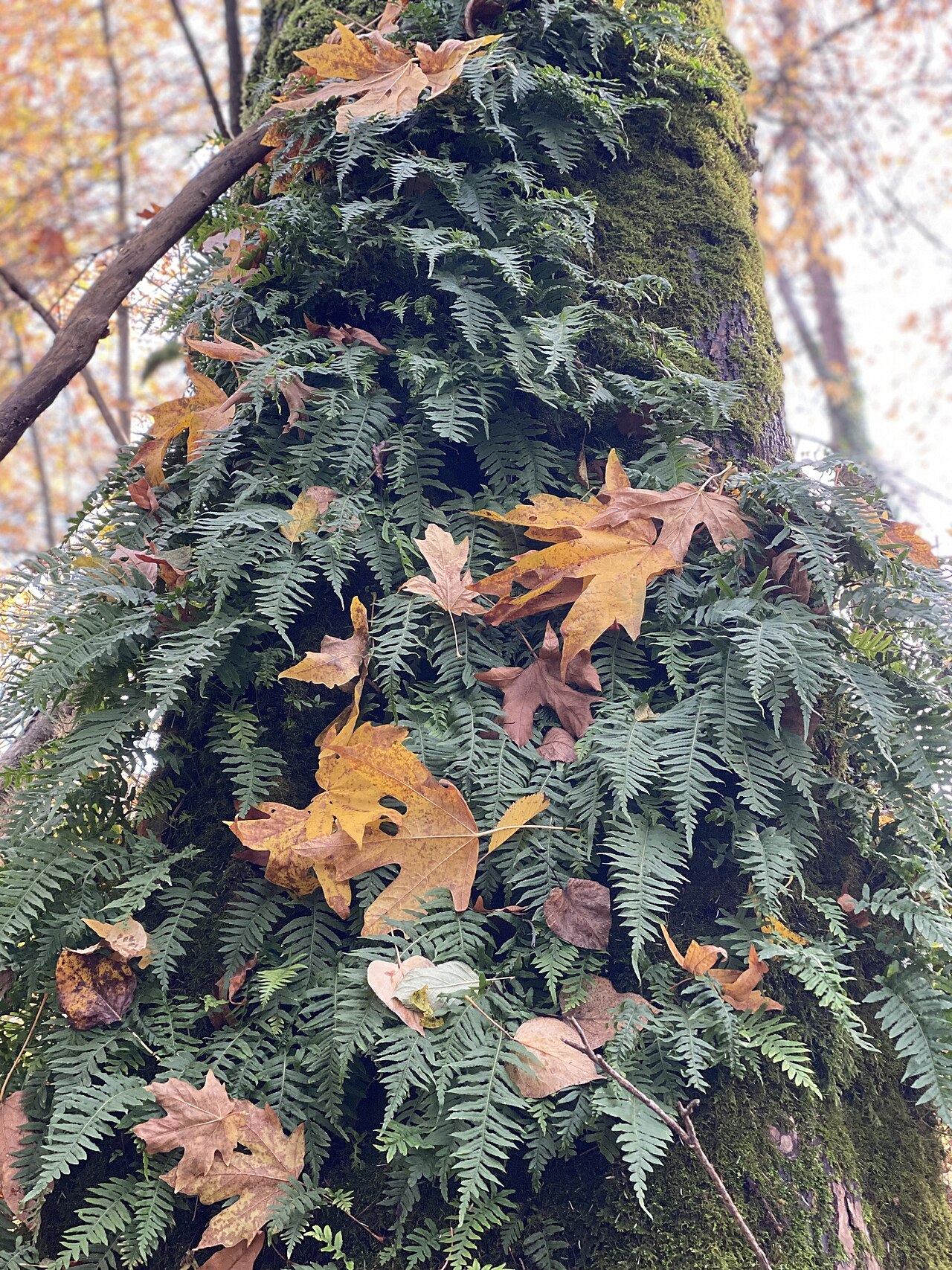
Polypodium glycyrrhiza, commonly known as Licorice Fern, is a small, deciduous fern native to the cool, wet forests of the Pacific Northwest coast. It belongs to the Polypodiaceae, the polypody family, and takes both its scientific and common names from the sweet, licorice-like flavor of its creeping rhizome — glycyrrhiza comes from the Greek glykys (sweet) and rhiza (root). Unlike most ferns, which flush out in spring and go dormant in winter, Licorice Fern does the opposite: it is “summer deciduous,” dying back during the dry summer months and sending up fresh green fronds with the return of cool, wet fall and winter weather.
Licorice Fern is best known for its intimate partnership with bigleaf maple (Acer macrophyllum), whose moss-blanketed limbs and trunks it colonizes as an epiphyte — a plant that grows on another plant without parasitizing it. It also grows readily on rocks, nurse logs, and shaded humus-rich soil, wherever moisture and shade are reliable. The single fronds arise scattered along a thick, creeping rhizome (the “many feet” that give the genus Polypodium its name), giving established colonies a loose, irregular, almost random-looking spread rather than a tidy clump.
In the garden, Licorice Fern is a charming, low-maintenance choice for shaded, moist niches — tucked into the mossy crotch of a tree, draped over a shaded rock wall, or massed as a woodland-floor groundcover. It is not a plant for hot, dry, or sunny sites, and gardeners outside its native coastal range should not expect it to thrive without the cool, humid conditions it evolved for.
Identification
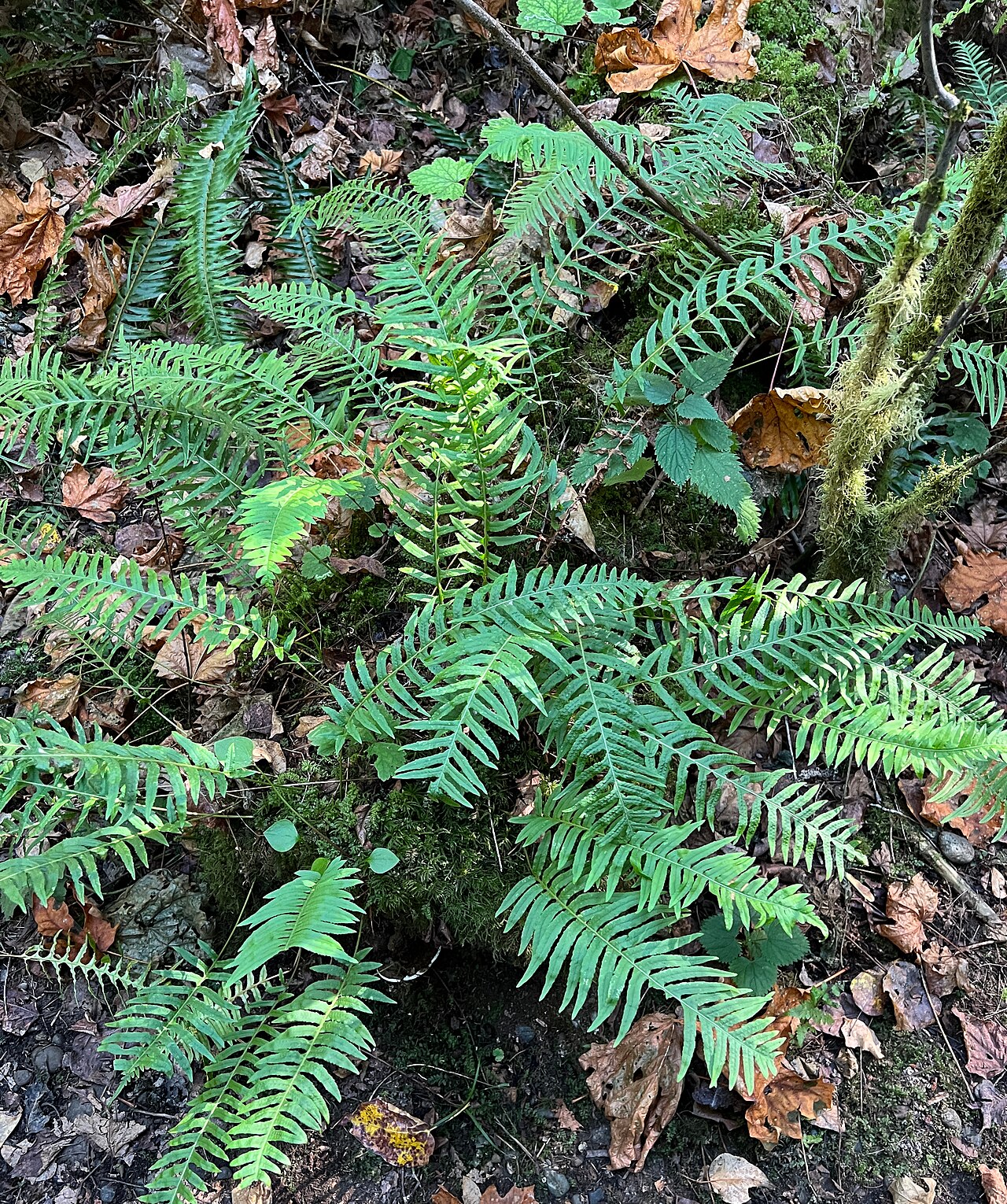
Licorice Fern produces single fronds that emerge individually along a creeping rhizome rather than in a clustered crown, so established patches often look like a loose scatter of fronds rather than a single plant. Fronds are usually at least 1 foot (30 cm) long, sometimes over 2 feet (60 cm) under good conditions, but can be much smaller on thin soil or in deep shade.
Rhizome
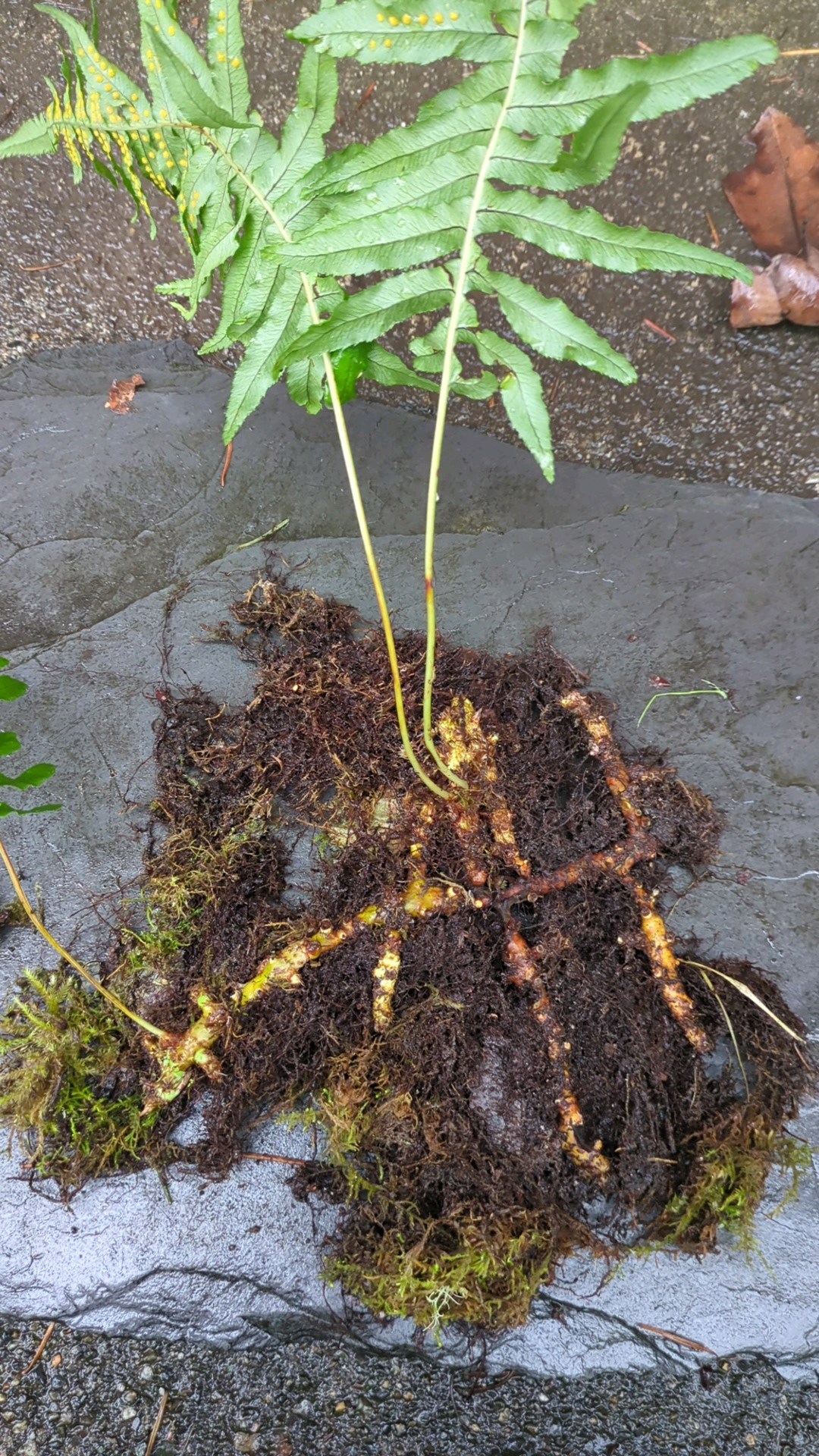
The creeping, branching rhizome is reddish-brown, usually about pencil-thickness, and roots into moss, bark crevices, or soil as it spreads. When chewed, the fresh rhizome has a distinct, pleasant licorice-like sweetness, a flavor long noted and used by Pacific Northwest Indigenous peoples and still enjoyed by curious hikers today.
Fronds
Fronds are once-divided (pinnatifid) and triangular to lance-shaped in outline, with finely toothed margins and pointed leaflets (pinnae) that narrow gradually toward the frond tip. Veins run roughly parallel within each leaflet. Fronds are bright to deep green when fresh, becoming more leathery with age, and sit on a short stalk connecting back to the rhizome.
Spores & Sori
Spores form in two rows of rounded sori on the underside of the fronds, appearing as raised bumps on the corresponding upper leaf surface. Sori range from yellow to orange to brown as they mature and release spores during cool, humid weather, typically in late fall and winter. Fronds on stressed or poorly established plants may show patchy, irregular sori or none at all.
Quick Facts
| Scientific Name | Polypodium glycyrrhiza |
| Family | Polypodiaceae (Polypody) |
| Plant Type | Epiphytic/terrestrial fern, rhizomatous, summer deciduous |
| Mature Height | Fronds 1–2 ft (30–60 cm) |
| Mature Spread | Spreading, indefinite via creeping rhizome |
| Growth Rate | Moderate |
| Sun Exposure | Part shade to full shade |
| Water Needs | Consistent moisture while active; summer dormancy is normal |
| Soil Type | Moss, bark, humus-rich soil, or rock crevices |
| Soil pH | Slightly acidic |
| Spore Release | Late fall through winter |
| Frond Color | Bright to deep green; dormant in summer |
| Fall/Winter Interest | Fresh green fronds emerge as other plants go dormant |
| Reproduction | Spores (no flowers or seed; this is a fern) |
| Deer Resistant | Yes |
| USDA Hardiness Zones | 7–9 |
Native Range
Licorice Fern is native to a narrow, near-coastal strip of northwestern North America, from southern Alaska and southwestern Yukon Territory south through coastal British Columbia, Washington, Oregon, and down into California, including pockets of the Sierra Nevada. Within the Lower 48, it is most common and most visible west of the Cascade Range, where mild, wet winters and cool, humid summers along the coast suit its growth cycle.
The species occurs at low elevations, generally below about 2,000 feet (600 m), in shaded, consistently damp settings: mossy tree trunks and limbs (especially bigleaf maple), rock outcrops, nurse logs, and the forest floor in mixed coniferous-deciduous woods. It takes particular advantage of the Pacific Northwest’s mild, wet winters, photosynthesizing and growing through the cool season when most other temperate plants are dormant, then retreating into dormancy during the region’s relatively dry summers.
Licorice Fern is tied closely to the coastal, maritime-influenced climate of its native range and is not naturally found inland across most of the continent. Gardeners east of the Cascades, in the continental interior, or in regions with hot, dry summers and cold winters should not expect it to perform like it does on the coast, where consistent moisture and moderate temperatures are part of its basic biology.
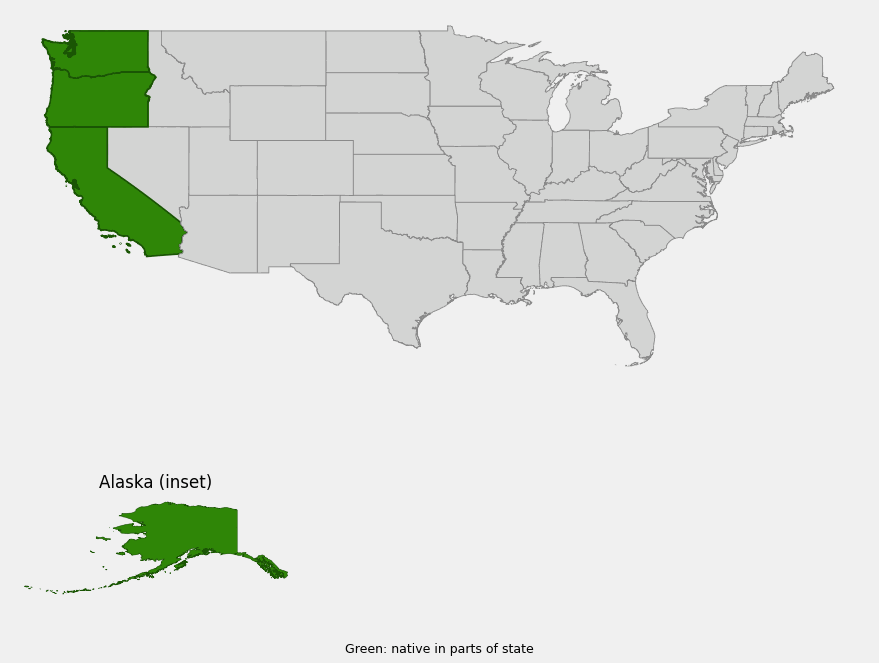
📋 Regional plant lists featuring Licorice Fern: Alaska · Western Oregon & Western Washington
Growing & Care Guide
Licorice Fern is an easy, low-care plant once sited correctly: the key is matching its need for shade and steady moisture during the cool season, and accepting that it will die back naturally each summer.
Light
Give Licorice Fern part to full shade. It is a true forest-floor and epiphytic species and will scorch or struggle in direct sun, especially inland or away from the moderating influence of the coast.
Soil & Water
This fern prefers constantly moist, humus-rich conditions during its active growing season (fall through spring) — mossy bark, rotting wood, or organic-rich soil over rock all work well. It does not need, and should not receive, heavy watering through its natural summer dormancy; letting it dry out and go quiet in summer is normal, not a sign of failure. A slightly acidic soil or substrate suits it best.
Planting Tips
Licorice Fern establishes well tucked into mossy crevices on rocks, logs, or the lower trunks and limbs of established trees, as well as directly into shaded, organic garden soil. Plant divisions in fall or winter, during its active growth period, so roots can establish before the summer dormancy. It pairs naturally with other shade-loving Pacific Northwest natives and looks most at home massed informally rather than in neat rows.
Pruning & Maintenance
Little pruning is needed. Old, tattered fronds can be tidied away as new growth emerges in fall, and the plant’s own summer die-back handles seasonal cleanup naturally. Avoid disturbing the rhizome network once established, since it spreads slowly and resents transplanting.
Propagation
Propagate by dividing sections of rhizome with attached roots during the cool growing season, and transplanting them onto a suitably mossy or organic surface, keeping them consistently moist until new fronds appear. Spore propagation is possible but slow and best left to fern specialists.
Landscape Uses
- Epiphytic accents on mossy tree trunks and limbs, especially bigleaf maple
- Shaded rock gardens and mossy stone walls
- Woodland-floor groundcover in shaded native plant gardens
- Nurse-log and stump plantings in naturalistic Pacific Northwest designs
- Winter-interest plantings, since it is green when many other plants are dormant
Wildlife & Ecological Value
Licorice Fern’s ecological contribution is tied closely to its role in the forest canopy and understory rather than as a food source for larger wildlife.
For Pollinators
As a fern, Licorice Fern does not flower and offers no nectar or pollen; it plays no direct role in supporting pollinators.
For Birds & Mammals
Dense epiphytic mats of Licorice Fern and moss on maple limbs provide shelter and foraging habitat for small invertebrates that in turn support insectivorous birds, and the humid microhabitat it helps create on tree bark supports a broader community of mosses, lichens, and small invertebrates typical of Pacific Northwest old-growth and mature second-growth forests.
Ecosystem Role
Licorice Fern is part of the distinctive epiphyte community that blankets bigleaf maple branches in wetter parts of the Pacific Northwest, contributing to the canopy’s capacity to intercept moisture and recycle nutrients. Its unusual winter-growing, summer-dormant cycle lets it exploit a niche — cool-season photosynthesis — that few co-occurring plants use, reducing direct competition with the surrounding summer-active vegetation.
Cultural & Historical Uses
Licorice Fern has a long history of use among Pacific Northwest Coast Indigenous peoples, including the Squamish, Shishalh, Comox, Nuxalk, Haida, and Kwakwaka’wakw, among others, who chewed the fresh or dried rhizome for its sweet, licorice-like flavor. It was valued both as a pleasant-tasting treat and, historically, as a traditional remedy used for colds and sore throats.
The sweetness of the rhizome was long attributed to a compound called glycyrrhizin, the same substance associated with true licorice root (Glycyrrhiza glabra, an unrelated flowering plant), but later research identified the actual source as a different compound, polypodoside, reported to be hundreds of times sweeter than a dilute sugar solution. Despite the shared flavor and name, Licorice Fern is botanically unrelated to commercial licorice.
Beyond its traditional use as a chewed root flavoring, Licorice Fern has become a popular ornamental fern in cultivation, including selected garden cultivars, and continues to be appreciated today as a distinctive, easy-care native fern for shaded Pacific Northwest gardens.
Frequently Asked Questions
Why does Licorice Fern disappear in summer?
It is naturally “summer deciduous,” meaning it goes dormant during the region’s dry summer months and sends up fresh fronds again with the cooler, wetter weather of fall. This is normal behavior, not a sign of a dying plant.
Can Licorice Fern really grow on a tree without harming it?
Yes. It is epiphytic, meaning it grows on the surface of trees like bigleaf maple using moss and bark debris for rooting material, without tapping into the tree’s tissues or stealing its nutrients the way a parasite would.
Does the root really taste like licorice?
Yes — the fresh rhizome has a distinct, pleasant sweetness reminiscent of licorice, which is where both the common and scientific names come from. This flavor was traditionally enjoyed by Pacific Northwest Coast peoples, though gardeners today grow it mainly as an ornamental rather than for eating.
Will Licorice Fern grow outside the Pacific Northwest?
It is adapted to a cool, humid, maritime climate and performs best within or close to its native coastal range. In hotter, drier, or more continental climates, it is likely to struggle without the consistent moisture and moderate temperatures it needs.
Does Licorice Fern need full shade?
It prefers part to full shade and is best suited to shaded trunks, rocks, and woodland floors; avoid full, direct sun, which will stress or scorch the fronds.

Looking for a nursery that carries Licorice Fern?
Browse our native plant nursery directory: Alaska · Washington · Oregon · California