Yerba Santa (Eriodictyon californicum)
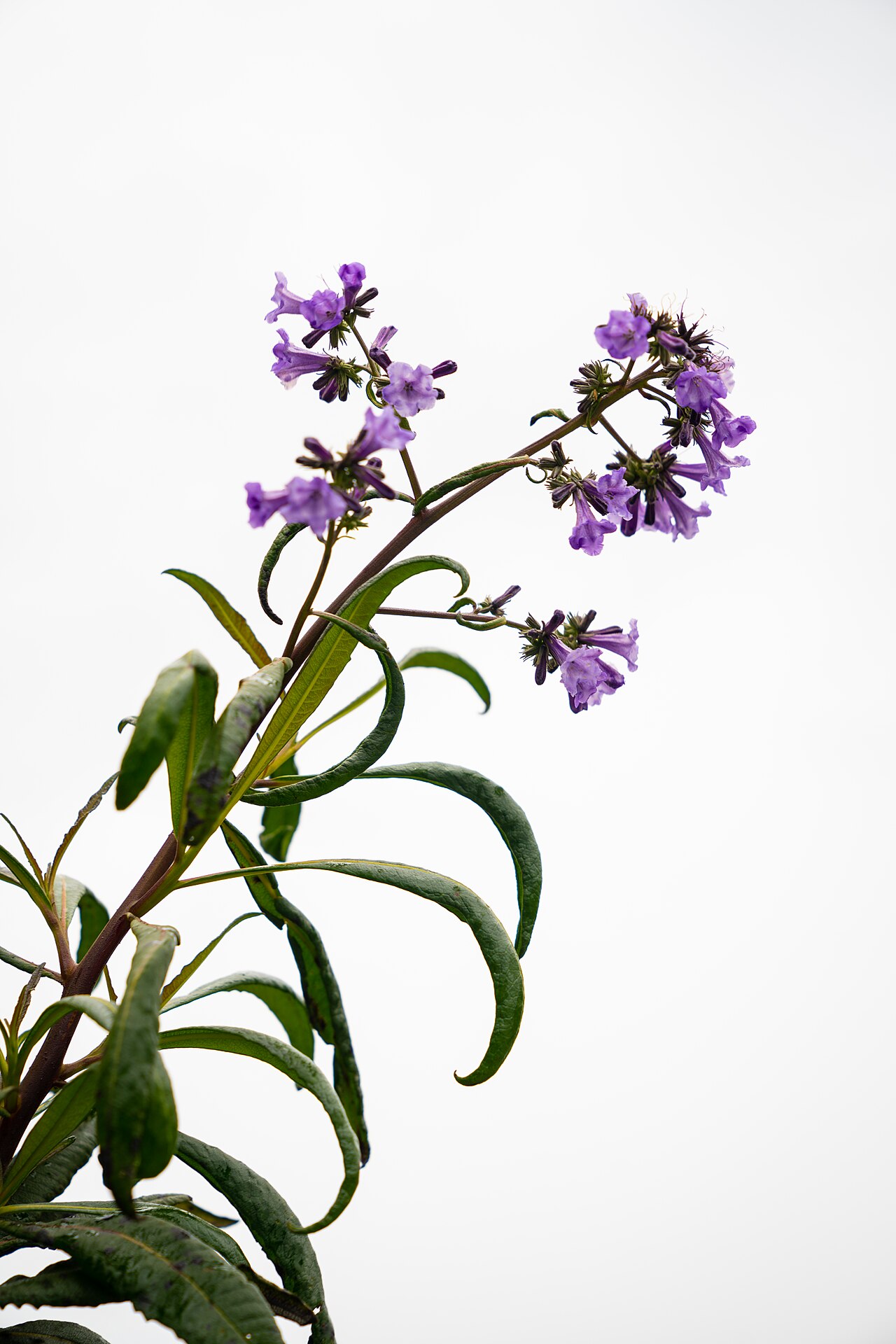
Eriodictyon californicum, commonly called Yerba Santa (“holy herb” in Spanish), is an aromatic, sprawling evergreen shrub found across the dry foothills and chaparral of California and southern Oregon. It is instantly recognizable by its narrow, dark green leaves, which are coated with a sticky, fragrant resin that makes the whole plant smell faintly of balsam or turpentine on a warm day. In late spring, clusters of lavender to pale violet, funnel-shaped flowers crowd the branch tips, drawing bees and other pollinators to otherwise dry, open slopes.
Yerba Santa is a member of the borage family (Boraginaceae, formerly placed in its own family Hydrophyllaceae) and is the type species of its genus, which includes about a dozen related shrubs across California and the Southwest. It spreads by rhizomes as well as seed, and because it resprouts vigorously from underground roots after fire, it is often one of the first shrubs to green up a burned chaparral slope — a trait that has earned it the secondary common name “mountain balm.”
For native-plant gardeners, Yerba Santa offers something unusual: a genuinely drought-proof shrub with showy spring flowers, strong pollinator value, and an aromatic presence that makes it a pleasure to brush past on a garden path. It spreads with enthusiasm once settled in, so it works best in naturalistic plantings, slope stabilization, and informal borders rather than tight, manicured beds.
Identification
Yerba Santa is an upright to sprawling evergreen shrub typically 3 to 8 feet tall, though it can reach taller in favorable sites, often forming loose colonies from spreading rhizomes rather than a single discrete bush.
Stems
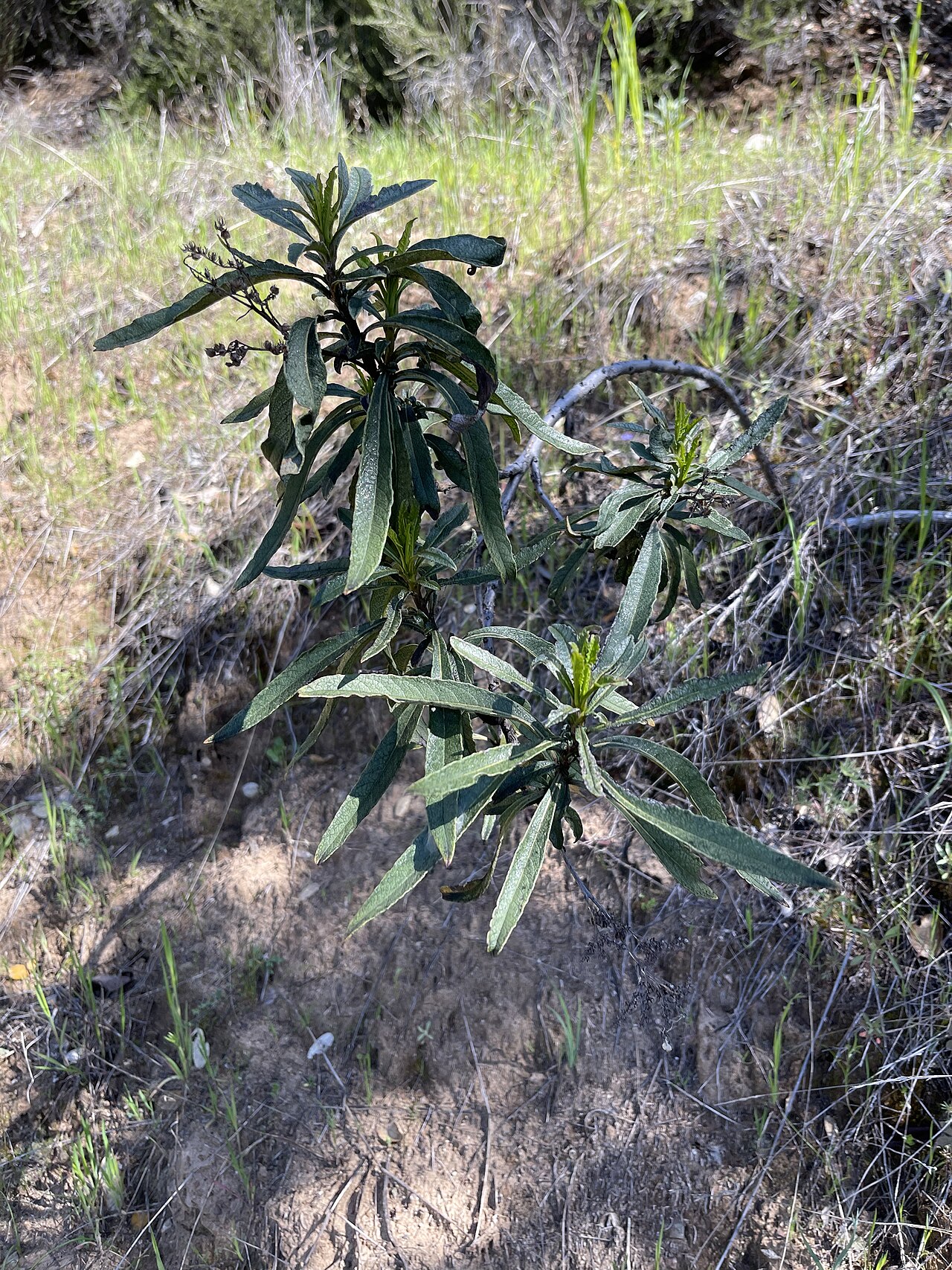
Young stems are reddish-brown and finely hairy to sticky-resinous, becoming woody and gray-brown with age. Plants often appear somewhat scraggly and open in form, with branches radiating from the base and resprouting readily after fire or cutting.
Leaves
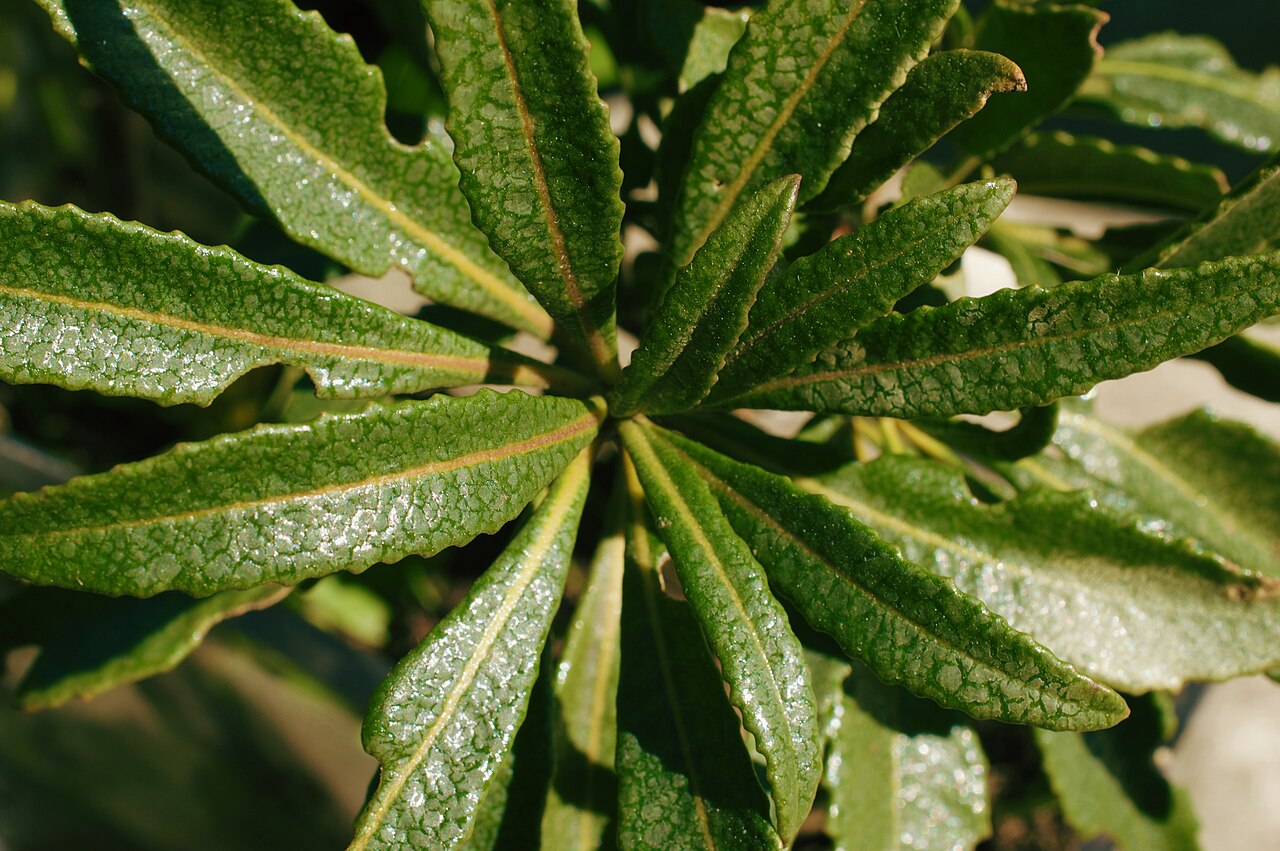
The leaves are narrow, lance-shaped, 2 to 6 inches long, with finely toothed or wavy margins and a prominent network of veins. The upper surface is dark green, glossy, and coated with a sticky resin that gives the leaves a varnished look and a strong, balsamic fragrance when crushed; the lower surface is paler and often felted with fine hairs. This resinous coating is the plant’s most distinctive identification feature and the reason the foliage feels tacky to the touch.
Flowers & Fruit
Flowers appear in dense, coiled clusters (cymes) at the branch tips from late spring into summer. Each flower is tubular to funnel-shaped, about ½ to ¾ inch long, in shades of lavender, violet, or occasionally white, with five shallow lobes at the mouth. The fruit is a small, dry capsule containing numerous tiny seeds, which are released as the capsule splits open later in summer.
Quick Facts
| Scientific Name | Eriodictyon californicum |
| Family | Boraginaceae (Borage) |
| Plant Type | Evergreen shrub |
| Mature Height | 3–8 ft |
| Mature Spread | 4–8 ft (spreads by rhizomes) |
| Growth Rate | Moderate to fast |
| Sun Exposure | Full Sun to Part Shade |
| Water Needs | Very low once established |
| Soil Type | Dry, rocky or sandy, well-drained |
| Soil pH | 6.0–7.5 |
| Bloom Time | May – July |
| Flower Color | Lavender to violet, sometimes white |
| Fall Color | None (evergreen) |
| Fruit | Small dry capsule |
| Deer Resistant | Yes |
| USDA Hardiness Zones | 7–10 |
Native Range
Yerba Santa is native to California and southern Oregon, where it grows across the Coast Ranges, the Sierra Nevada foothills, the Transverse and Peninsular Ranges, and into the Klamath-Siskiyou region of southern Oregon. It is common throughout much of California below about 5,000 feet, from the Bay Area and Central Valley foothills south into the mountains surrounding Los Angeles and San Diego.
Typical habitat is dry, open chaparral, foothill woodland, and disturbed sites such as roadcuts and recently burned slopes, usually on well-drained, rocky or sandy soils. It is especially conspicuous in the first few years after a chaparral fire, when it resprouts rapidly from its spreading rhizome system and often forms dense colonies well ahead of slower-recovering neighbors.
Within its range, Yerba Santa is abundant and not a species of conservation concern, though like much of California’s chaparral flora it depends on the periodic fire cycles and intact wildland habitat that are increasingly fragmented by development.
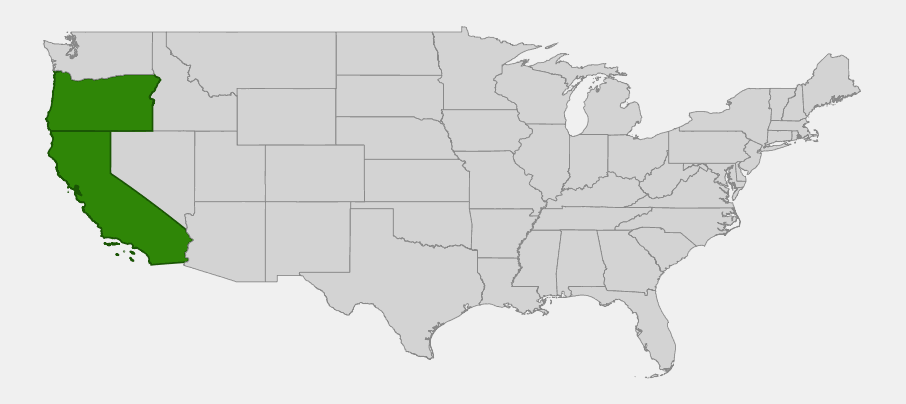
📋 Regional plant lists featuring Yerba Santa: California and Nevada · Western Oregon and Western Washington
Growing & Care Guide
Yerba Santa is a rewarding, nearly carefree shrub for a dry, sunny spot, but it is not a plant for tidy, confined beds — give it room, and in return it will fill a difficult slope with fragrant evergreen foliage and bees-loud spring flowers.
Light
Full sun produces the most compact, floriferous plants, matching the open chaparral slopes where it naturally grows. It tolerates light shade, especially in hot inland gardens, but becomes looser and bloom declines in deeper shade.
Soil & Water
Fast-draining, lean soils are ideal — rocky, sandy, or decomposed-granite sites mimic its native chaparral habitat. Established plants need no summer irrigation in coastal and inland California gardens and can suffer root rot with regular watering. Water young plants modestly through their first one or two summers to help roots establish, then taper off.
Planting Tips
Plant from containers in fall to take advantage of winter rains for establishment. Because Yerba Santa spreads by rhizomes, site it where it has room to naturalize — a slope, a wild border, or a restoration planting rather than a tight foundation bed. Where spread is unwanted, plant in an area bounded by pavement, mowed grass, or other barriers to rhizome travel.
Pruning & Maintenance
Little pruning is required. Cut back leggy or frost-damaged stems in late winter to encourage fuller growth; plants also respond well to being cut nearly to the ground occasionally, resprouting vigorously much as they do after wildfire. Removing spent flower clusters is optional and mainly a matter of tidiness.
Landscape Uses
- Dry slopes and erosion control, where the spreading rhizomes help hold soil
- Pollinator and bee gardens, thanks to heavy spring bloom
- Fire-recovery and restoration plantings in chaparral settings
- Naturalistic and wildland-edge gardens rather than formal beds
- Fragrant gardens, since the resinous leaves scent the air on warm days
- Low-water, fire-wise landscaping once established
Wildlife & Ecological Value
Yerba Santa is a valuable early-recovery and pollinator plant across California’s chaparral and foothill woodlands.
For Pollinators
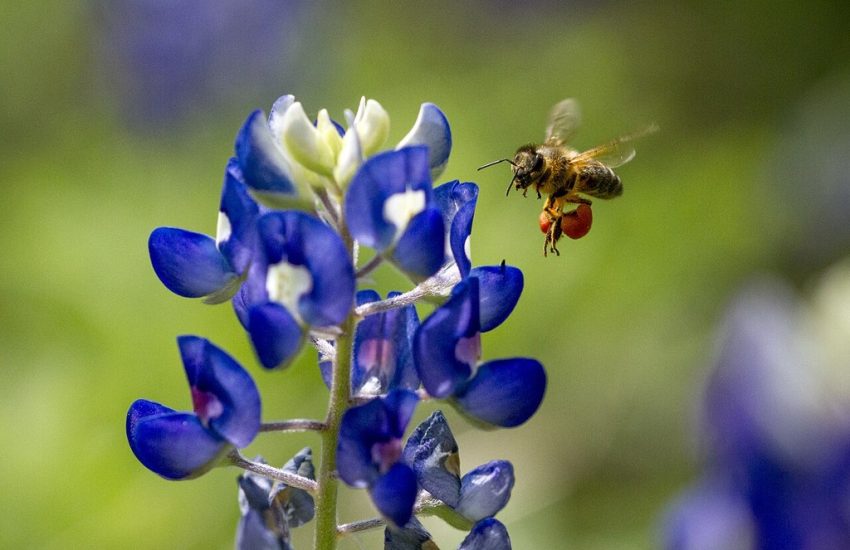
The lavender flowers are heavily visited by native bees, bumblebees, and honeybees, which rely on the nectar during the late spring to early summer period when they bloom. Several specialist bee species are closely associated with Eriodictyon flowers, and the shrub is considered a strong source of bee forage across its range.
For Birds
Small songbirds use the dense, resprouting thickets for cover, particularly in the years after fire when Yerba Santa may be one of the few shrubs offering structure on an otherwise open slope. Seed-eating birds forage the dry capsules once they split open.
For Mammals
Deer generally avoid browsing the sticky, resinous foliage, which is part of why the plant is considered deer resistant; this also makes it a dependable shrub in gardens near wildland edges. Small mammals use the colonies for cover.
Ecosystem Role
As one of the fastest shrubs to resprout from its rhizomes after chaparral fires, Yerba Santa plays an important early-succession role, stabilizing burned slopes and providing structure and nectar while slower-growing shrubs like manzanita and chamise reestablish around it.
Cultural & Historical Uses
Yerba Santa takes its Spanish name — “holy herb” — from its long history of use among California’s Indigenous peoples and later Spanish missionaries, who learned of the plant’s reputation from local tribes including the Costanoan, Miwok, and Cahuilla. The leaves were traditionally chewed, smoked, or brewed as a tea, and the plant held a respected place in regional ethnobotanical practice, passed down through generations of use.
Following Spanish contact, Yerba Santa became well known among 19th-century settlers and was eventually adopted into mainstream American herbal commerce, appearing in pharmacies and botanical supply catalogs by the late 1800s; it was listed in the U.S. National Formulary for several decades. A compound derived from the leaves is still used today as a bittering and flavor-masking agent in the pharmaceutical and food industries, prized for its ability to disguise unpleasant tastes in other preparations.
Beyond these historical uses, Yerba Santa has long been valued simply for its fragrance — crushed leaves release a resinous, balsamic scent that travelers and hikers in California’s foothills have remarked on for well over a century.
Frequently Asked Questions
Why does yerba santa smell so strong?
The leaves are coated in an aromatic resin that gives off a balsamic, almost turpentine-like scent, especially when crushed or on a warm day. This resin is the plant’s most distinctive identification trait and the source of its long history of use among Indigenous Californians.
Does yerba santa spread aggressively?
It spreads by underground rhizomes and can form expanding colonies over time, especially in loose, well-drained soil. This makes it excellent for erosion control and naturalistic plantings but a poor choice for small, tightly bordered beds unless its spread is contained.
Is yerba santa the same plant used in herbal teas today?
Historically, yes — Indigenous Californians and later settlers used the leaves in teas and preparations, and a leaf extract is still used commercially, mainly as a flavor-masking agent. This article describes that history for context; it is not a recommendation to forage or self-treat with the plant.
How quickly does yerba santa recover after fire?
Very quickly. Its rhizome system typically survives fire even when the above-ground stems are killed, and the shrub often resprouts within the first growing season, making it one of the earliest shrubs to green up a burned chaparral slope.
Will deer eat yerba santa?
Rarely. The sticky, resin-coated leaves are unappealing to deer, which makes Yerba Santa a reliable choice for gardens in areas with heavy deer pressure.

Looking for a nursery that carries Yerba Santa?
Browse our native plant nursery directory: California · Oregon