Bush Poppy (Dendromecon rigida)
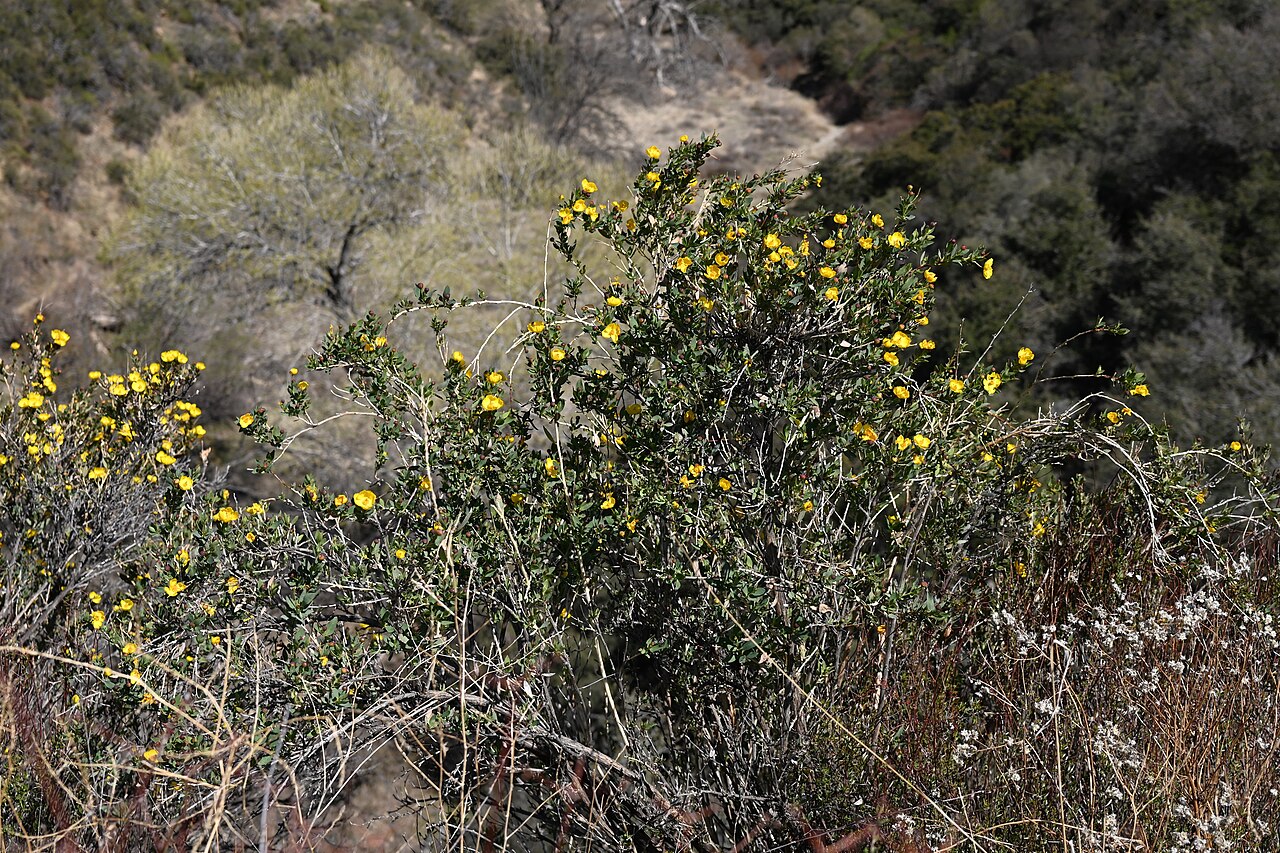
Dendromecon rigida, commonly called Bush Poppy or Tree Poppy, is an evergreen chaparral shrub in the poppy family (Papaveraceae) found only in California and northern Baja California. It is the woody cousin of the familiar California poppy, and its satiny, bright yellow, four-petaled flowers have the same cupped, crepe-paper look — but held on a stiff, branching shrub instead of a low herbaceous stem. In late winter and spring, a hillside of blooming Bush Poppy can look like it is covered in scattered gold coins against gray-green foliage.
Bush Poppy grows from the foothills of the California Coast Ranges, the Klamath Mountains, and the southwestern Cascade Range, south through the western Sierra Nevada foothills and the chaparral belt of Southern California to Baja California. It is a classic “fire follower” shrub: seeds can lie dormant in the soil for years, then germinate in large numbers after a chaparral fire, when smoke chemicals and heat break their hard seed coats. Established plants are also killed by fire but quickly recolonize a burned slope from the seed bank, making Bush Poppy one of the first shrubs to green up a post-fire hillside.
For gardeners in California, Bush Poppy is an excellent low-water, fast-growing shrub for a sunny slope or bank, especially where good drainage is non-negotiable. It asks for almost nothing once established — no summer water, no fertilizer, no pampering — and rewards that neglect with months of cheerful yellow flowers that draw native bees and beneficial insects.
Identification
Bush Poppy is a rounded to somewhat open, evergreen shrub typically reaching 3 to 12 feet (1–3.7 m) tall and nearly as wide, though old plants on favorable sites can grow taller and rangier. Stems are slender, woody, and pale gray to tan, often with a slightly brittle, upright-arching habit. The whole plant has a clean, almost blue-green cast that stands out against the duller olive tones of surrounding chaparral shrubs like chamise and ceanothus.
Stems
Young stems are smooth and gray-green, aging to pale gray-tan bark with fine longitudinal ridging. The wood is relatively brittle and can snap in strong wind or under heavy snow load, which is one reason Bush Poppy is best sited away from foot traffic and not planted as a thick hedge.
Leaves
Leaves are simple, alternate, narrowly lance-shaped to elliptic, 1 to 4 inches (2.5–10 cm) long, with smooth or very finely toothed margins. They are a distinctive gray-green to blue-green on both surfaces (not whitish-hairy underneath, which helps separate Bush Poppy from the similar Island Bush Poppy, Dendromecon harfordii, found mainly on the Channel Islands). The foliage is evergreen, though plants may drop some older leaves during severe summer drought.
Flowers
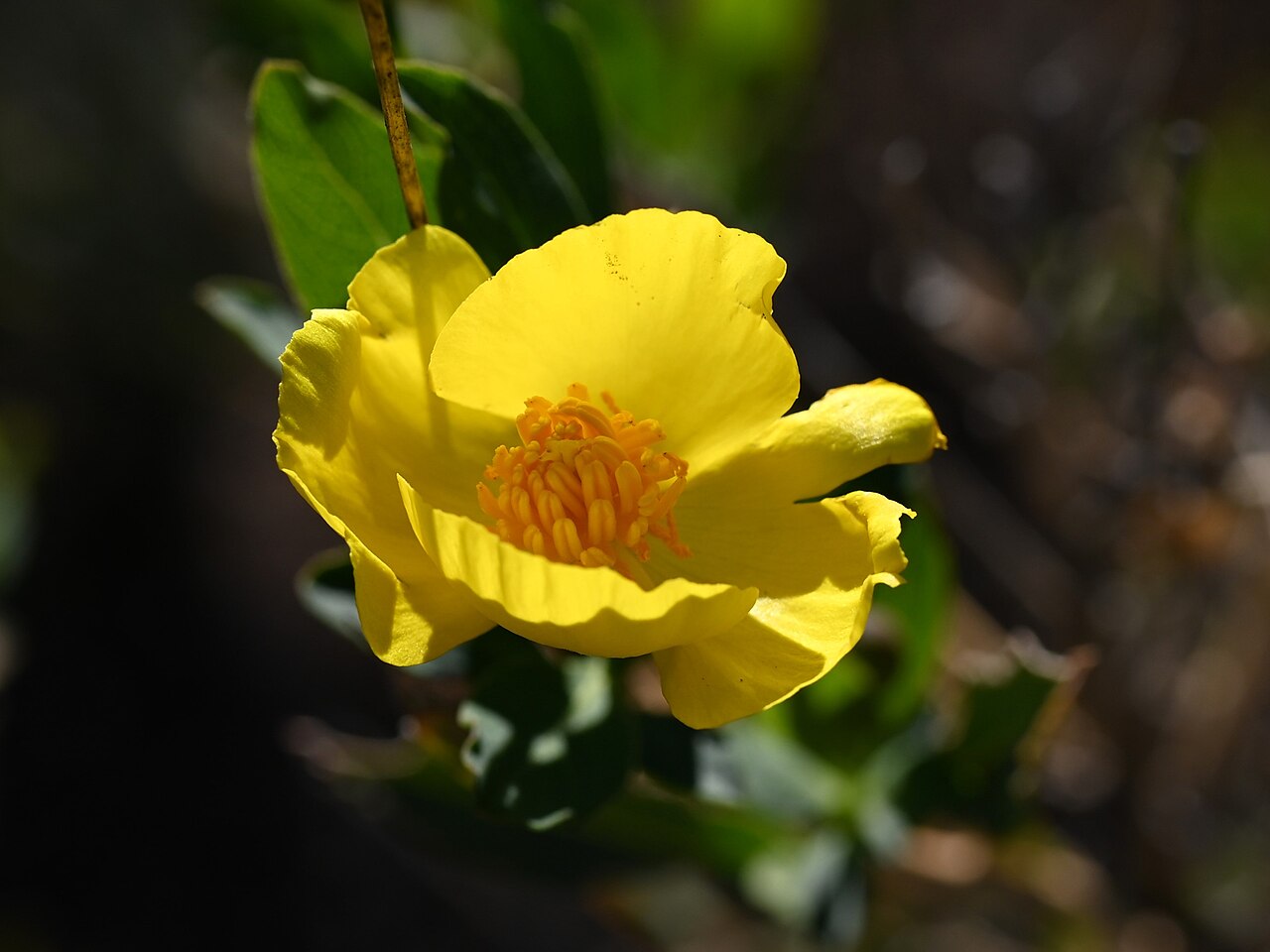
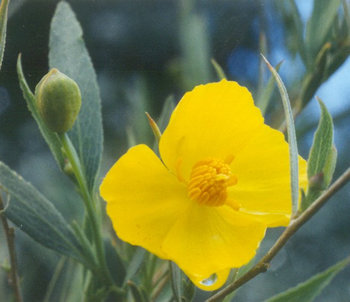
Flowers are solitary, borne at branch tips, with four broad, overlapping, silky yellow petals forming a shallow cup 1.5 to 3 inches (4–8 cm) across. A dense central boss of bright orange-yellow stamens surrounds a short green pistil. The flowers have a light, fresh fragrance and open fully in sun, closing somewhat on overcast days. Peak bloom runs from February through June, with scattered flowers appearing after good rain years almost any time of year.
Fruit & Seeds
After flowering, Bush Poppy produces a narrow, curved, cylindrical seed capsule 2 to 4 inches (5–10 cm) long that splits open along two seams when ripe, releasing numerous small, shiny black or dark brown seeds. The capsules are an easy identification feature even when the plant is not in bloom — no other common California chaparral shrub has quite this long, slender, banana-like pod.
Quick Facts
| Scientific Name | Dendromecon rigida |
| Family | Papaveraceae (Poppy) |
| Plant Type | Evergreen Shrub |
| Mature Height | 3–12 ft (1–3.7 m) |
| Mature Spread | 3–8 ft (1–2.4 m) |
| Growth Rate | Fast |
| Sun Exposure | Full Sun |
| Water Needs | Low; none once established |
| Soil Type | Dry, rocky, fast-draining; sandy or gravelly loam |
| Soil pH | 6.0–7.5 (slightly acidic to neutral) |
| Bloom Time | February – June |
| Flower Color | Bright yellow |
| Fall Color | None (evergreen) |
| Fruit | Narrow curved seed capsule, 2–4 in |
| Deer Resistant | Yes, generally |
| USDA Hardiness Zones | 8–10 |
Native Range
Bush Poppy is a California endemic shrub, with its range extending only a short distance south into northern Baja California, Mexico. In the north, it grows in the foothills of the California Coast Ranges, the Klamath Mountains, and the southwest Cascade Range, then continues south through the western Sierra Nevada foothills. In Southern California it is a common chaparral component from the Transverse and Peninsular Ranges down to San Diego County.
Across this range, Bush Poppy favors dry, rocky slopes, canyon walls, and disturbed or recently burned ground in chaparral and foothill woodland plant communities, typically from near sea level up to about 5,000 feet (1,500 m) elevation. It associates with chamise, California buckwheat, ceanothus, manzanita, scrub oak, and toyon, and is frequently one of the showiest early colonizers of a burn scar.
Bush Poppy is not considered rare or protected, and its fire-adapted biology means wild populations are generally resilient to the periodic burns that shape California’s chaparral ecosystems. It is widely available from California native plant nurseries and is an appropriate, locally native choice almost anywhere within its home range that offers full sun and sharp drainage.
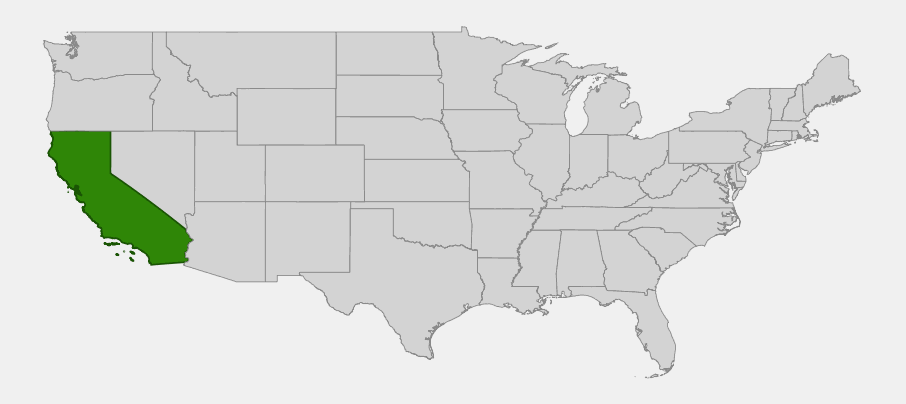
📋 Regional plant lists featuring Bush Poppy: California & Nevada
Growing & Care Guide
Bush Poppy is one of the easiest California native shrubs to grow, provided you give it the one thing it truly demands: excellent drainage. It is a plant for a dry, sunny bank rather than a rich garden bed, and it will struggle or rot if treated like a typical ornamental shrub with regular irrigation.
Light
Plant Bush Poppy in full sun. It flowers most heavily and holds its compact, rounded form best with at least six to eight hours of direct sun daily. In partial shade it grows leggier and blooms more sparsely.
Soil & Water
Fast-draining, lean, rocky or sandy soil is essential — Bush Poppy is adapted to thin chaparral soils and does not tolerate heavy clay or poor drainage, especially in summer. Once established (after the first one to two years), it needs no supplemental irrigation in most of its range and is highly drought tolerant. Occasional deep watering during an unusually dry winter can help, but overwatering in summer is the most common cause of failure, often leading to root rot.
Planting Tips
Set out container plants in fall, giving roots the cool, wet season to establish before summer heat arrives. Choose an open, sunny slope or raised, well-drained bed; avoid low spots where water collects. Space plants 4 to 6 feet apart for a naturalistic chaparral planting. Water deeply but infrequently the first year, then taper off sharply.
Pruning & Maintenance
Bush Poppy benefits from light pruning after the main spring bloom to keep it compact and encourage denser branching, since unpruned plants can become sparse and woody-looking with age. Remove dead or frost-damaged wood in late winter. The shrub is relatively short-lived for a woody plant, often declining after 10 to 15 years, so many gardeners let a few seedlings come up nearby to naturally replace aging plants.
Propagation
Seeds benefit from the same fire cues they receive in the wild: a brief soak in smoke-infused water or a light scarification before sowing improves germination. Cuttings of semi-hardwood taken in late summer also root reasonably well with rooting hormone and bottom heat.
Landscape Uses
Bush Poppy earns its keep in several garden roles:
- Dry slope and bank stabilization on sunny, well-drained sites
- Chaparral and fire-wise restoration plantings
- Low-water, no-irrigation gardens once established
- Pollinator gardens for an extended bloom season
- Accent shrub for its bright, long-lasting yellow flowers against gray-green foliage
- Mixed chaparral hedgerows with ceanothus, manzanita, and buckwheat
Fire Ecology
Bush Poppy is a textbook fire-follower. Mature plants are killed outright by fire, but the soil seed bank survives, and heat and smoke compounds trigger mass germination within the first one to two growing seasons after a burn. Stands of young Bush Poppy seedlings are often among the first conspicuous green growth on a recently burned chaparral hillside, and the resulting flush of bloom the following spring can be spectacular. Because of this biology, Bush Poppy is a useful indicator species for post-fire recovery and erosion control on burned slopes.
Wildlife & Ecological Value
Bush Poppy plays a modest but genuine role in chaparral ecology, particularly as an early food source in a landscape where few other shrubs are flowering.
For Pollinators
The open, pollen-rich flowers are especially attractive to native bees, which forage directly on the dense cluster of stamens since Bush Poppy flowers produce no nectar. Bumble bees, carpenter bees, and various solitary bees are frequent visitors, along with beetles and other pollen-feeding insects, especially during the plant’s extended late-winter and spring bloom.
For Birds
Small seed-eating birds, including native sparrows and finches, will take seeds from the ripe, split capsules, though Bush Poppy is not a major food source compared to berry-producing chaparral shrubs. The dense branching structure offers some cover and perching habitat for small birds moving through open chaparral.
Ecosystem Role
As a fast-colonizing, nitrogen-poor-soil-tolerant shrub, Bush Poppy helps stabilize soil and shade out erosion on steep burned slopes during the vulnerable years immediately after a fire, before slower-growing chaparral shrubs reestablish. Its persistent, fire-triggered seed bank is a long-term ecological reserve that keeps the species present in a landscape through repeated fire cycles.
Cultural & Historical Uses
Bush Poppy does not carry the extensive ethnobotanical record of some California native plants, but it has long been recognized and admired by botanists and naturalists for its striking flowers and its close relationship to the California poppy. Early California botanical collectors, including those working in the Sierra Nevada foothills and southern Coast Ranges, documented it among the showier spring-blooming chaparral shrubs.
In the twentieth century, Bush Poppy became a staple of California native plant horticulture, prized by pioneering native-plant gardeners and nurseries for its reliability on difficult, dry, sunny sites where few other showy-flowered shrubs would thrive. It remains a favorite today in low-water and fire-wise landscaping throughout its native range.
The plant has no documented food or medicinal use among California Indigenous peoples comparable to that of many chaparral shrubs, and like other members of the poppy family it is not used as a food plant; its main historical and cultural value has been horticultural and aesthetic rather than practical.
Frequently Asked Questions
Is Bush Poppy the same as California Poppy?
No. California Poppy (Eschscholzia californica) is a low, herbaceous annual or perennial wildflower, while Bush Poppy (Dendromecon rigida) is a woody evergreen shrub. Both belong to the poppy family and share a similar four-petaled yellow flower shape, but they are different genera with very different growth habits.
How much water does Bush Poppy need?
Very little once established. Give young plants regular water through their first one to two years, then reduce to occasional deep watering or none at all. Bush Poppy is adapted to California’s dry summers and is one of the more drought-tolerant native flowering shrubs available.
Why did my Bush Poppy die suddenly after a few years?
Bush Poppy is relatively short-lived (often 10–15 years) and is also prone to root rot from summer irrigation or poor drainage. Sudden decline is most often caused by overwatering or heavy, slow-draining soil rather than disease; planting on a slope or raised bed with sharp drainage greatly improves longevity.
Will Bush Poppy come back after a wildfire?
Yes, usually abundantly. Fire kills the above-ground plant, but heat and smoke trigger germination of seeds stored in the soil, so burned chaparral slopes often fill with young Bush Poppy seedlings the following growing season.
Is Bush Poppy toxic?
Like many members of the poppy family, Bush Poppy contains alkaloids and is not considered edible. It is not a documented serious hazard to pets or livestock, but it should not be eaten and is best treated as an ornamental and wildlife plant rather than a food or medicinal one.

Looking for a nursery that carries Bush Poppy?
Browse our native plant nursery directory: California