Hollyleaf Redberry (Frangula ilicifolia)
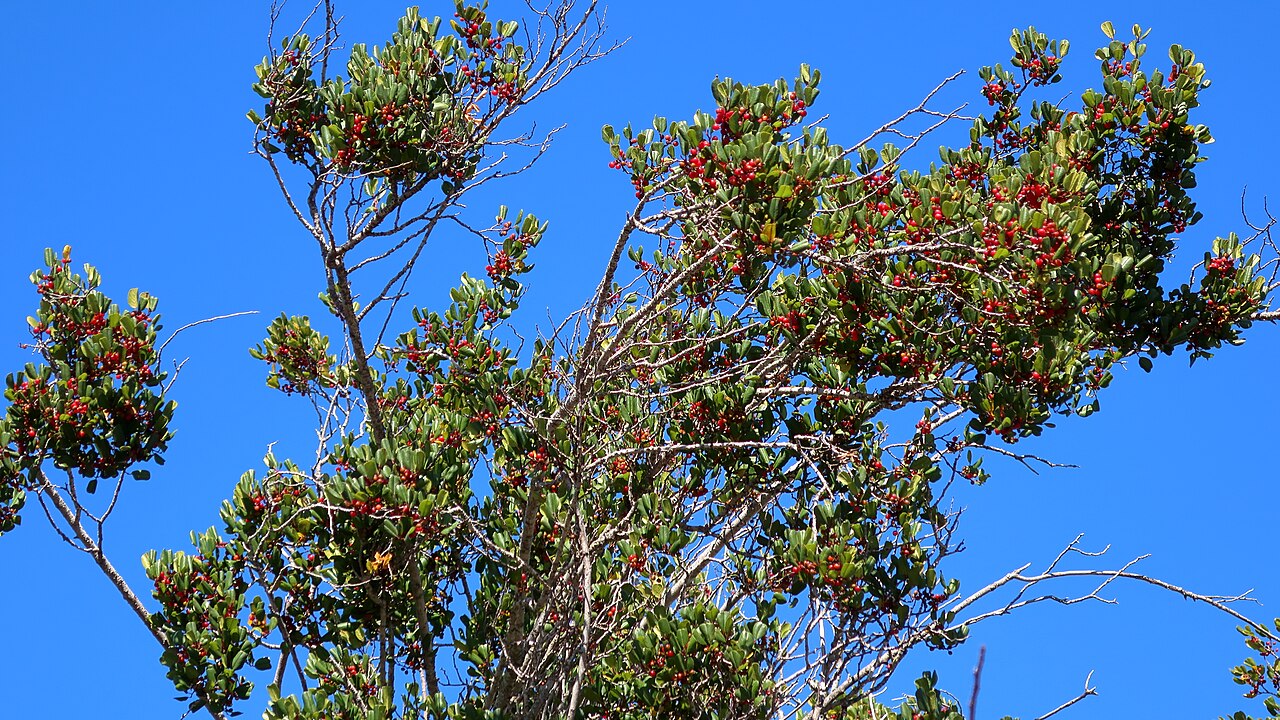
Frangula ilicifolia (also widely sold and described in older references as Rhamnus ilicifolia), commonly called hollyleaf redberry or hollyleaf buckthorn, is a tough evergreen shrub of California’s chaparral and foothill woodlands. Its common name comes from its leaves, which genuinely resemble miniature holly leaves — stiff, glossy, and edged with small spiny teeth — even though the plant is completely unrelated to true holly (Ilex).
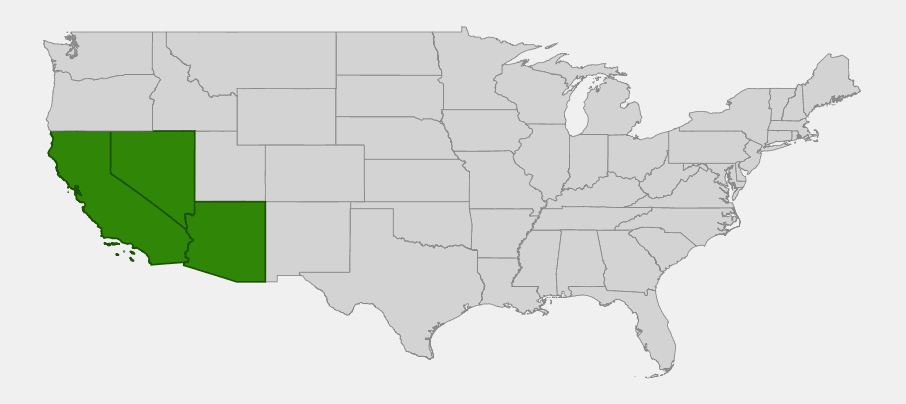
Hollyleaf redberry typically grows 3 to 12 feet tall as a dense, rounded shrub, occasionally taller in favorable sites. It is one of the more drought-adapted members of the buckthorn family, thriving on dry, rocky slopes with no supplemental water once established. Clusters of small, bright red (sometimes nearly black when fully ripe) berries follow inconspicuous greenish flowers, and the shrub is a dependable, low-fuss presence in the chaparral and oak woodland communities of California, southern Nevada, and Arizona.
For native gardeners, hollyleaf redberry offers structure, year-round green foliage, and genuine wildlife value in a plant that asks for almost nothing in return. It is less showy than many chaparral natives but earns its place as a backbone shrub — the kind of plant that quietly holds a dry slope together while feeding birds through the hottest part of the year.
Identification
Hollyleaf redberry grows as a dense, rounded to spreading evergreen shrub, typically 3 to 12 feet tall and similarly wide, with rigid, somewhat stiff branching. Young twigs are often reddish and finely hairy, aging to gray-brown bark.
Leaves
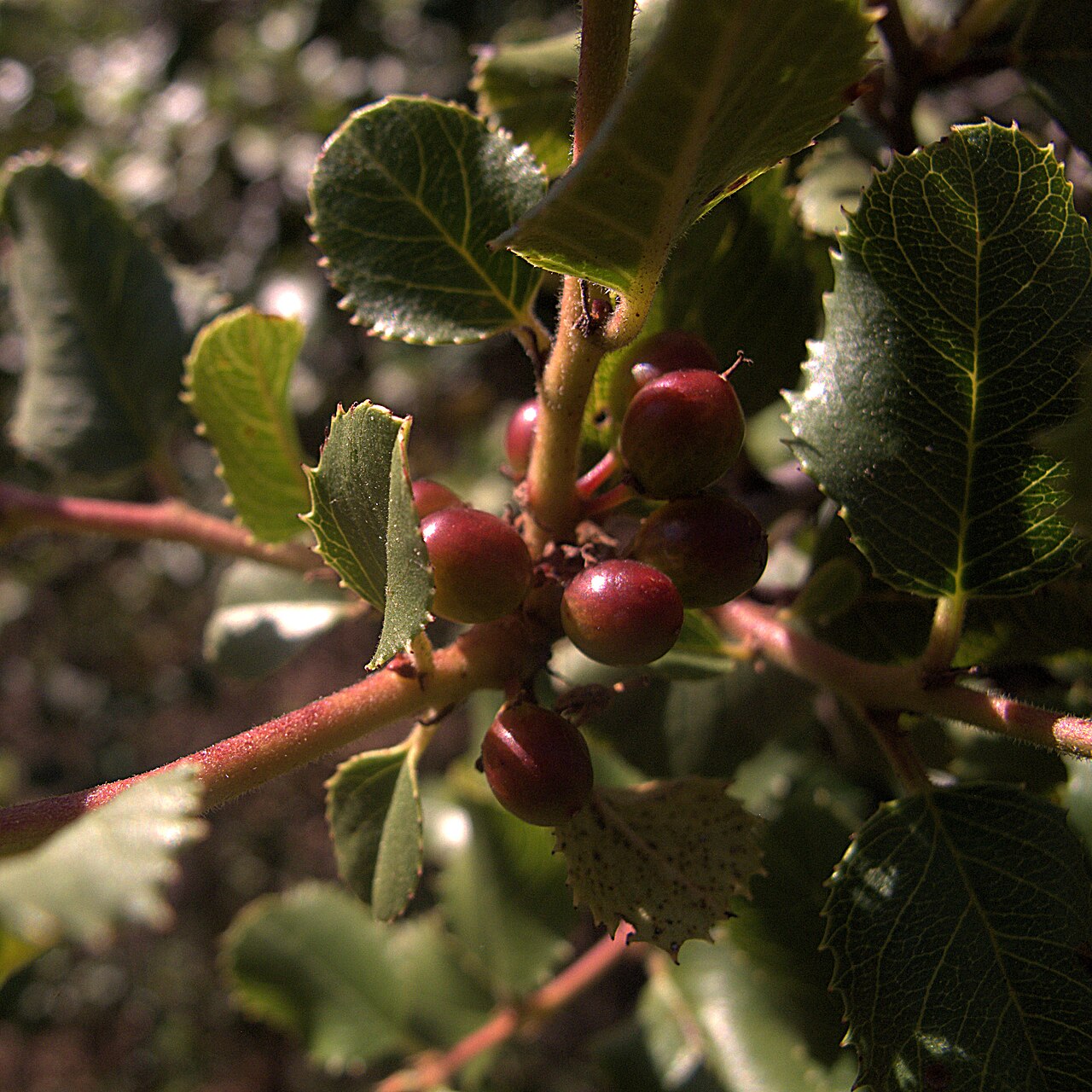
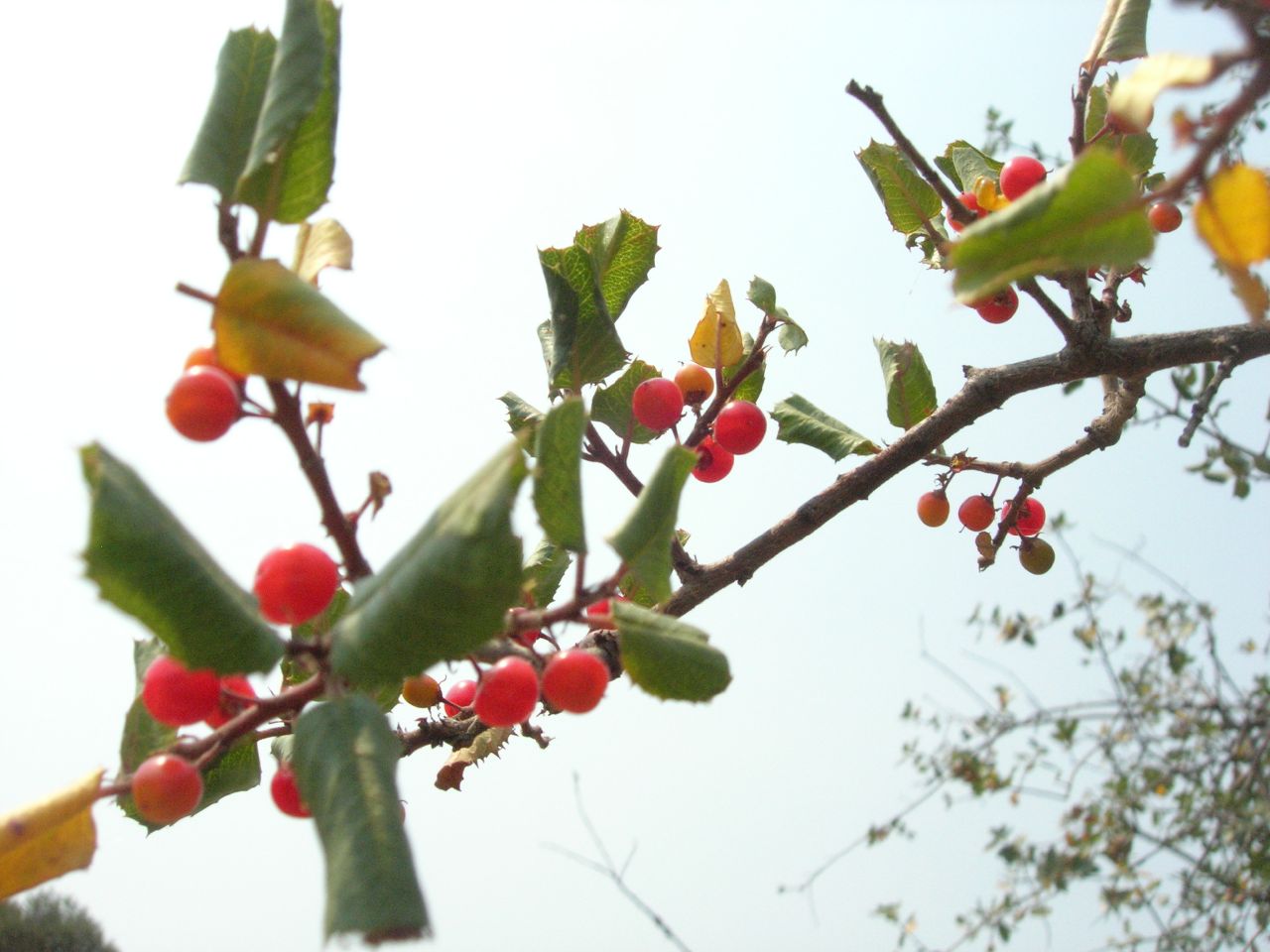
Leaves are the plant’s signature feature: evergreen, alternate, oval to elliptic, about ¾ to 2 inches long, with a thick, leathery texture and spiny-toothed margins that closely mimic true holly. The upper surface is glossy dark green; leaves are typically smaller and more tightly packed than those of its close relative, spiny redberry (Rhamnus crocea), with which it is sometimes confused and occasionally hybridizes where ranges overlap.
Flowers
Flowers are small, greenish-yellow, and inconspicuous, borne in small axillary clusters in spring. They lack showy petals and are easy to miss, but they are an important early-to-mid-season nectar source for small native bees and flies.
Fruit & Seeds
The fruit is a round berry-like drupe, about ¼ to ⅓ inch across, ripening from green to bright red and finally to purplish-black as it fully matures, usually from summer into fall. Each fruit contains two hard seeds. Fruit is produced in loose clusters along the branches and is a key late-summer food source for birds and small mammals when much of the surrounding chaparral has gone dry and dormant.
Quick Facts
| Scientific Name | Frangula ilicifolia (syn. Rhamnus ilicifolia) |
| Family | Rhamnaceae (Buckthorn) |
| Plant Type | Evergreen Shrub |
| Mature Height | 3–12 ft |
| Mature Spread | 3–10 ft |
| Growth Rate | Slow to Moderate |
| Sun Exposure | Full Sun to Part Shade |
| Water Needs | Low |
| Soil Type | Well-drained; rocky, sandy or clay-loam |
| Soil pH | 6.0–8.0 (neutral to alkaline) |
| Bloom Time | March – May |
| Flower Color | Greenish-yellow |
| Fall Color | None (evergreen) |
| Fruit | Red ripening to purplish-black berries |
| Deer Resistant | Yes (spiny leaves discourage browsing) |
| USDA Hardiness Zones | 8–10 |
Native Range
Hollyleaf redberry is native throughout much of California, from the Coast Ranges and Transverse Ranges through the Sierra Nevada foothills and south into the Peninsular Ranges, as well as into southern Nevada and Arizona, where it occupies similar dry, rocky slopes at low to middle elevations. It generally avoids the Central Valley floor and the coldest, highest mountain elevations, favoring the broad band of chaparral and foothill woodland in between.
Within this range it grows in chaparral, coastal sage scrub, and the understory or edges of oak woodland and mixed foothill forest, almost always on well-drained slopes rather than valley bottoms. It tolerates rocky, nutrient-poor soils that would challenge less drought-adapted shrubs, and it resprouts readily from its root crown after fire, making it a persistent, long-lived component of fire-adapted plant communities.
Because hollyleaf redberry and spiny redberry (Rhamnus crocea) overlap in range and habit and were long treated as a single variable species, some older references and nursery labels use the names inconsistently; gardeners planting for restoration should confirm which species a nursery is actually selling, since the two differ in leaf size, overall habit, and finer range details.
📋 Regional plant lists featuring Hollyleaf redberry: California & Nevada · Arizona & New Mexico
Growing & Care Guide
Hollyleaf redberry rewards a hands-off approach. It is built for dry, rocky slopes and resents the frequent watering and rich soil often lavished on garden shrubs.
Light
Full sun is ideal for the densest growth and best fruit set, though the species tolerates part shade, particularly under an open oak canopy similar to its natural woodland-edge habitat.
Soil & Water
Excellent drainage is essential — this is a shrub adapted to thin, rocky chaparral soils, and it struggles in heavy, poorly drained ground or with regular irrigation. Once established (typically after one to two seasons), hollyleaf redberry needs no supplemental summer water in most California gardens. Overwatering is the most common cause of decline.
Planting Tips
Plant young container stock in fall to take advantage of winter and spring rains for root establishment. Space plants 4 to 8 feet apart for a naturalistic chaparral planting or hedgerow. The spiny leaf margins make it a useful, if prickly, barrier plant along property edges.
Pruning & Maintenance
Minimal pruning is needed. Remove dead wood as needed and shape lightly if a tidier form is wanted, but avoid heavy cutting, since the shrub’s natural dense, irregular form is part of its appeal and its slow regrowth rewards a light touch. It is naturally resistant to most pests and diseases.
Landscape Uses
Hollyleaf redberry fills several practical garden roles:
- Dry-garden backbone shrub for slopes and fire-wise landscaping
- Wildlife hedgerow — spiny foliage offers safe cover for nesting birds
- Erosion control on dry, rocky banks
- Barrier or boundary planting thanks to its prickly leaves
- Chaparral restoration and habitat gardens
- Evergreen structure in mixed native plantings that go summer-dormant
Wildlife & Ecological Value
Hollyleaf redberry is a quiet but steady contributor to chaparral wildlife communities, offering food and shelter precisely when the surrounding landscape is driest.
For Birds
The berries are eaten by a variety of resident and migratory birds, including California thrashers, towhees, mockingbirds and various thrushes, especially valuable in late summer and fall when many other chaparral plants have finished fruiting. The dense, spiny branching also offers secure nesting habitat that deters some predators.
For Mammals
Small mammals, including foxes and rodents, consume the fruit and disperse the seeds. The prickly foliage discourages heavy browsing by deer, making the species comparatively resilient in landscapes with significant deer pressure.
For Pollinators
Though small and unshowy, the spring flowers attract native bees and other small pollinating insects, providing a nectar source during a period when chaparral flowering can otherwise be patchy.
Ecosystem Role
As a fire-adapted, root-crown-resprouting shrub, hollyleaf redberry helps chaparral communities recover structure after burns, and its persistence on steep, rocky slopes contributes to soil stabilization in erosion-prone terrain. Its summer and fall fruiting fills a seasonal food gap for wildlife in an ecosystem defined by long, dry summers.
Cultural & Historical Uses
Documented ethnobotanical use of hollyleaf redberry specifically is limited compared to some of its more widely used chaparral neighbors, though other members of the buckthorn genus, including cascara (Rhamnus purshiana), were historically important for their laxative bark. This history belongs to related species, not hollyleaf redberry, and the fruit and bark of Frangula ilicifolia are not established as a safe food or home remedy.
The plant’s main historical role has been ecological and structural — as a durable, long-lived component of California’s chaparral that provided wildlife forage and helped define fire-return cycles across the landscape long before European settlement. Its resemblance to holly has also made it a point of interest for landscapers seeking a drought-tolerant substitute for ornamental hollies in dry Western gardens.
Today, hollyleaf redberry is primarily valued in habitat restoration, fire-wise landscaping, and native plant gardens that aim to recreate authentic chaparral plant communities rather than for any documented traditional use.
Frequently Asked Questions
Is hollyleaf redberry related to holly?
No. The spiny, glossy leaves closely resemble those of true holly (Ilex), but hollyleaf redberry belongs to the buckthorn family (Rhamnaceae) and is only distantly related to holly. The resemblance is a case of leaves evolving similar defenses against browsing, not shared ancestry.
Can you eat the berries?
No — the berries are not established as a safe food source and should not be eaten. Leave them for the birds and other wildlife that rely on them.
How is hollyleaf redberry different from spiny redberry?
The two species overlap in range and habit and were historically treated as varieties of one species. Hollyleaf redberry (Frangula ilicifolia) generally has larger, more sharply spine-toothed leaves than spiny redberry (Rhamnus crocea), though intermediate forms exist where their ranges meet, and some nurseries use the names inconsistently.
Does hollyleaf redberry need regular watering?
No, and it generally shouldn’t get it. Once established, this is a genuinely low-water chaparral shrub; frequent irrigation, especially in heavy soil, is more likely to cause root problems than to help the plant.
Is hollyleaf redberry deer resistant?
Yes. The stiff, spiny leaf margins discourage browsing, making it a reliable choice in gardens where deer pressure limits other shrub options.

Looking for a nursery that carries Hollyleaf Redberry?
Browse our native plant nursery directory: California · Nevada · Arizona