Sierra Gooseberry (Ribes roezlii)
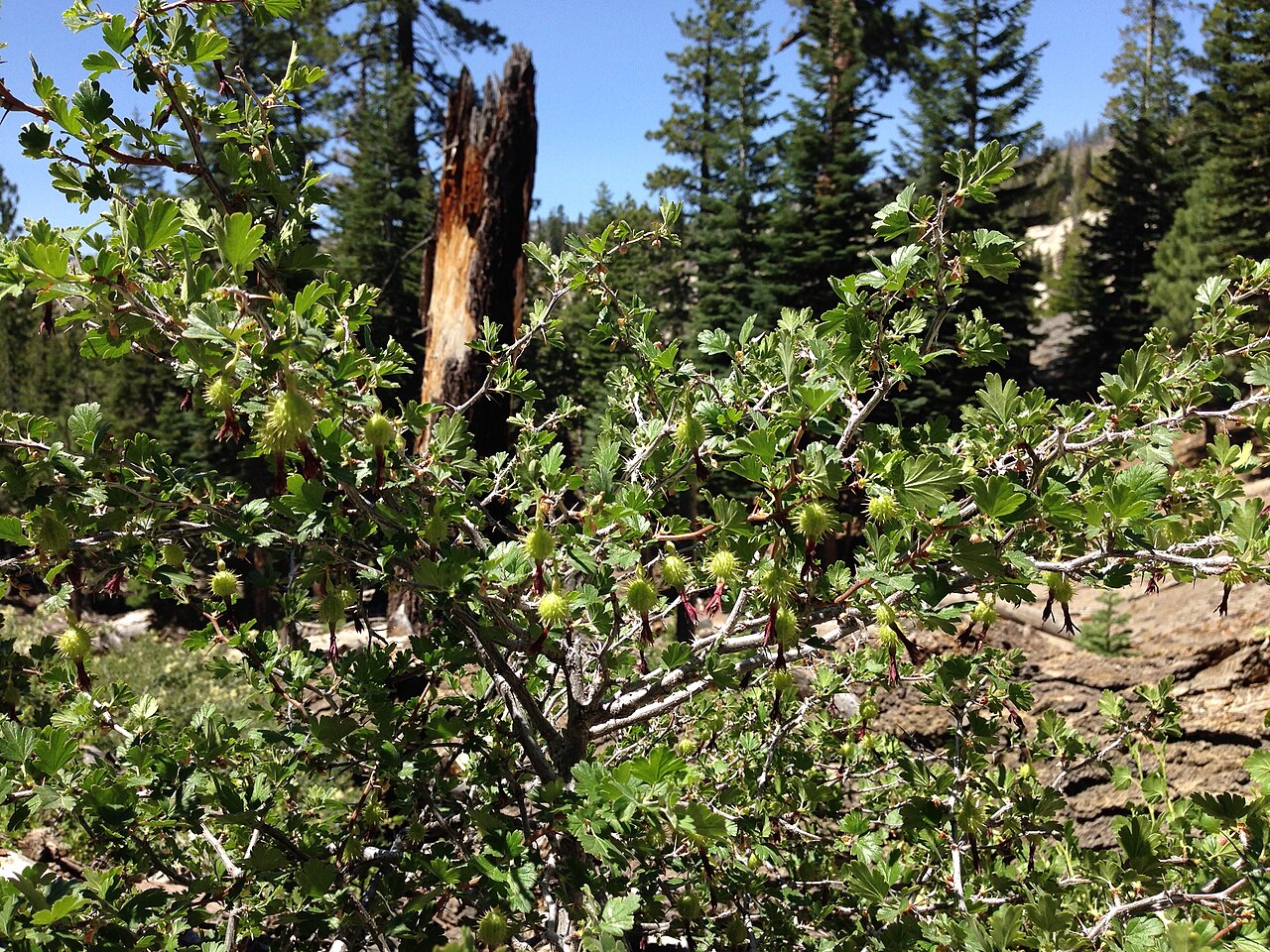
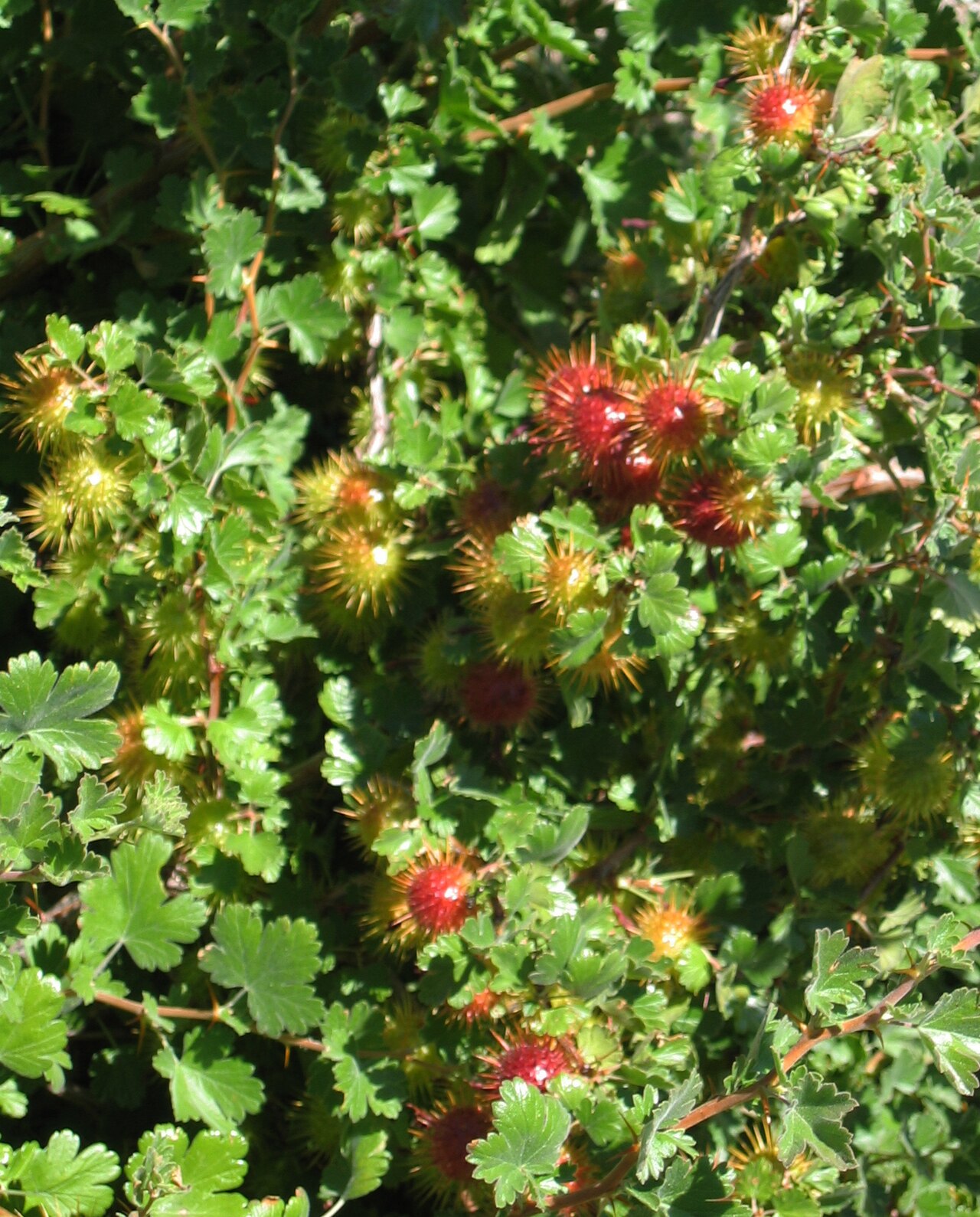
Ribes roezlii, commonly known as Sierra gooseberry or mountain gooseberry, is a compact, spiny, deciduous shrub found in dry mixed-conifer and yellow pine forests across much of California, with smaller populations extending into western Nevada and southwestern Oregon. A member of the Grossulariaceae (currant and gooseberry family), Sierra gooseberry is unmistakable once it fruits: its round, golf-ball-sized berries are covered in a dense coat of long, stiff spines, among the spiniest fruit of any North American native plant.
Growing 2 to 6 feet tall with an arching, somewhat tangled branching habit, Sierra gooseberry is armed at each node with one to three sharp spines, a defense that discourages browsing by deer and livestock alike. In spring, it produces small, drooping, red-and-white fuchsia-like flowers that attract hummingbirds, followed by the shrub’s signature spiny fruit, which ripens to deep red or purple by summer.
Well suited to dry, part-shaded sites beneath pines and firs, Sierra gooseberry is a good choice for native woodland gardens, understory restoration, and wildlife plantings throughout its mountain range, needing little water once established and tolerating the lean, rocky soils typical of montane forest floors.
Identification
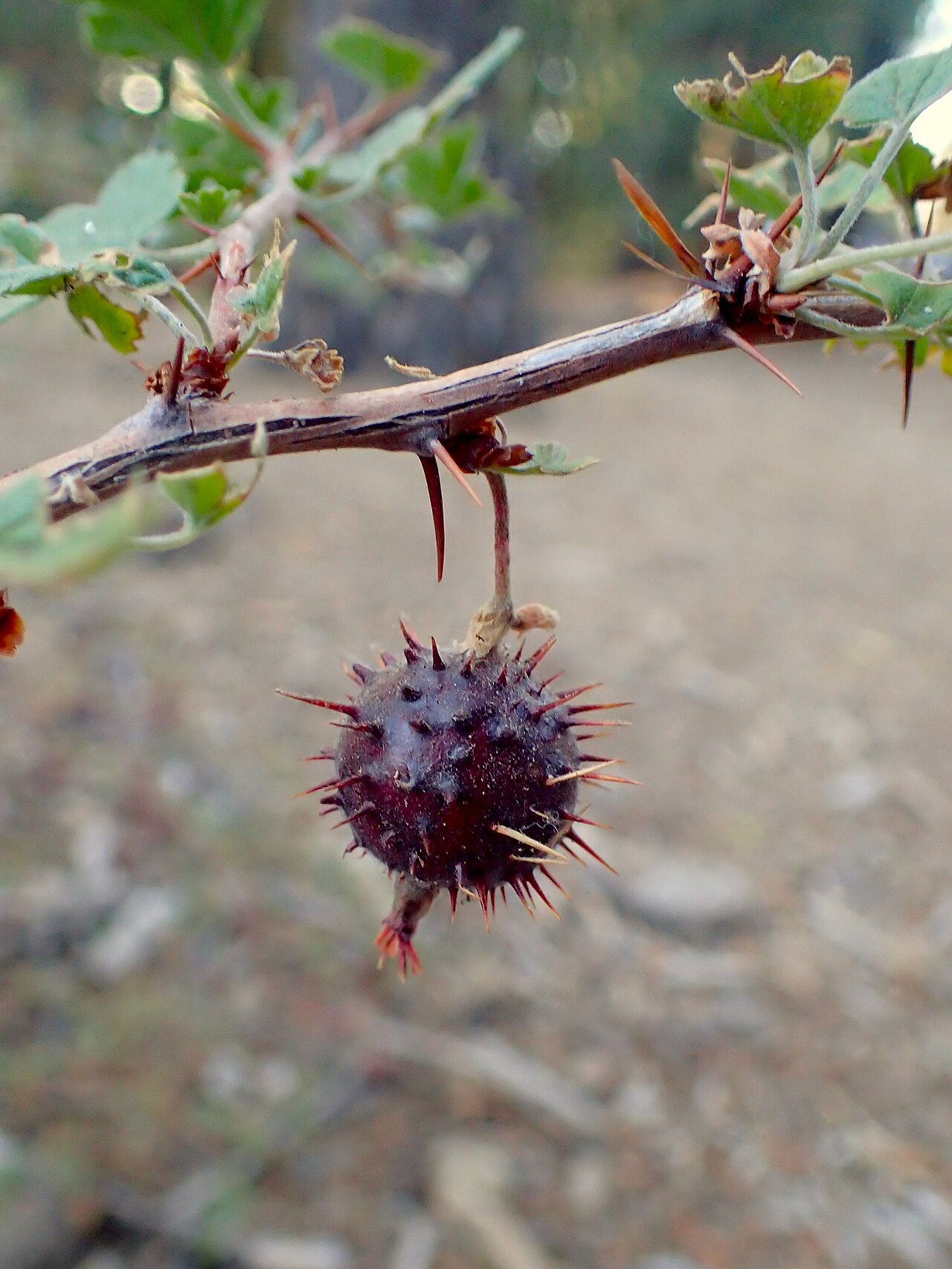
Sierra gooseberry is a low, densely branched, deciduous shrub typically 2 to 6 feet tall and somewhat wider, with an arching, sprawling growth habit. Each stem node bears one to three stout, sharp spines, and the fruit itself is also densely covered in slender prickles — a double layer of defense characteristic of this species among native Ribes.
Bark & Stems
Young stems are reddish-brown and bear the characteristic node spines; older wood becomes gray and woody. The spiny architecture makes mature shrubs effective, if prickly, cover for small wildlife.
Leaves
Leaves are simple, alternate, and small, generally ½ to 1½ inches across, deeply three- to five-lobed with rounded, toothed segments, resembling a miniature maple leaf. The foliage is bright to dull green, sometimes with fine hairs, and typically drops by late summer as the plant goes dormant through the dry season.
Flowers
Flowers appear in spring (April to June, depending on elevation), hanging singly or in small clusters of two to three from the leaf axils. Each flower has a tubular, fuchsia-like shape with reddish to maroon sepals that flare backward and whitish to pale pink petals, giving the bloom a pendant, two-toned appearance that attracts hummingbirds in search of early-season nectar.
Fruit & Seeds
The fruit is the species’ most distinctive feature: a round berry, roughly ½ to ¾ inch across, densely covered in long, stiff, golden to reddish spines. It ripens from green to deep red, wine-purple, or nearly black by mid- to late summer. Beneath the spiny skin, the pulp is tart and seedy; while technically edible, the fruit’s formidable spines make harvesting by hand a genuinely prickly undertaking, and the spines must be removed or cooked down before eating.
Quick Facts
| Scientific Name | Ribes roezlii |
| Family | Grossulariaceae (Currant) |
| Plant Type | Deciduous Shrub |
| Mature Height | 2–6 ft |
| Mature Spread | 3–6 ft |
| Growth Rate | Slow to Moderate |
| Sun Exposure | Part Shade to Full Sun |
| Water Needs | Low; drought tolerant once established |
| Soil Type | Rocky, gravelly, or sandy forest soils |
| Soil pH | 5.5–7.0 |
| Bloom Time | April – June |
| Flower Color | Maroon-red sepals with pale pink to white petals |
| Fall Color | Leaves drop in late-summer dormancy, not noted for fall color |
| Fruit | Round, densely spiny berries, red to purple-black |
| Deer Resistant | Yes (spiny stems and fruit deter browsing) |
| USDA Hardiness Zones | 6–9 |
Native Range
Sierra gooseberry is native throughout much of California’s mountain ranges, from the Sierra Nevada and Klamath Mountains to the Coast Ranges and Transverse and Peninsular Ranges of Southern California. Its range also extends into far western Nevada, where it is documented in Washoe County near the California border, and into a small area of southwestern Oregon, where it occurs in Curry, Josephine, and Jackson counties near the Klamath border region.
Across this range, Sierra gooseberry typically grows between about 2,000 and 9,000 feet elevation in dry yellow pine and mixed-conifer forest, chaparral-forest transition zones, and rocky montane slopes, often in the filtered shade of ponderosa pine, Jeffrey pine, white fir, or black oak. It is a common component of the forest understory on the drier, west-facing slopes of the Sierra Nevada.
Because its range in Nevada and Oregon is limited to just a few border counties, gardeners in those states should confirm local native status before planting, while Californians throughout the state’s mountain regions can plant Sierra gooseberry with confidence as a true regional native.
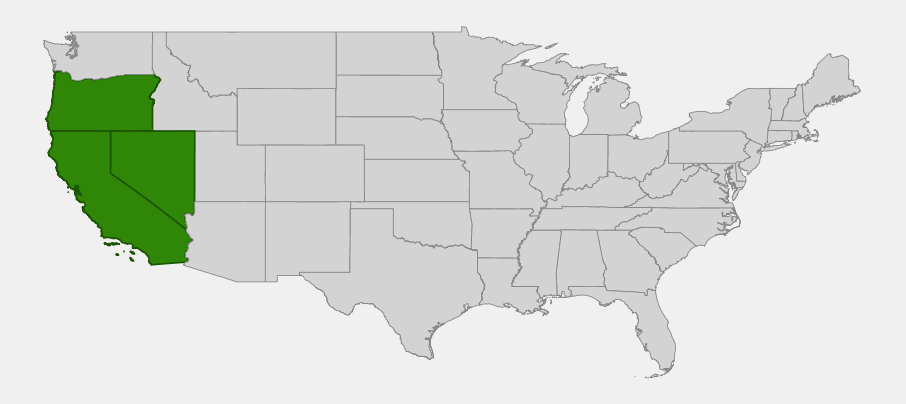
📋 Regional plant lists featuring Sierra gooseberry: California & Nevada · Western Oregon & Western Washington
Growing & Care Guide
Sierra gooseberry is a rugged, low-maintenance shrub well suited to dry, shaded or lightly sunny spots beneath established trees — exactly the conditions many gardeners struggle to plant successfully.
Light
Give it part shade to filtered sun, mimicking its native spot in open conifer forest. It also tolerates more open sun at higher, cooler elevations, but in hot, low-elevation gardens, some afternoon shade helps keep the plant looking its best through summer.
Soil & Water
Sierra gooseberry prefers lean, rocky, or gravelly, well-drained soils typical of forest floors, and does not want rich, constantly moist garden beds. Water regularly during the first one to two seasons after planting, then reduce to occasional deep watering during extended summer drought. Overly wet soils can lead to root problems, particularly in heavier clay.
Planting Tips
Plant container stock in fall or early spring beneath the dappled shade of oaks, pines, or other established trees. Because of its spiny stems and fruit, site it away from paths, play areas, or anywhere people brush past regularly — a woodland bed edge or naturalized slope is ideal. Space plants 3 to 5 feet apart for a loose understory grouping.
Pruning & Maintenance
Little pruning is required beyond removing dead wood. Because the spines make close-up maintenance uncomfortable, use thick gloves when working near the plant, and avoid pruning paths that put the shrub close to walkways. The species is generally pest-free and rarely needs intervention once established.
Propagation
Propagate from seed collected from ripe fruit (handle with gloves), cleaned of pulp, and cold-stratified over winter for spring germination, or from hardwood cuttings taken during winter dormancy. Germination can be slow and uneven, as with many native Ribes species.
Landscape Uses
- Dry woodland understory plantings beneath pines and oaks
- Wildlife hedgerows and barrier plantings, thanks to its spiny structure
- Montane forest restoration projects
- Deer-resistant landscaping in mountain and foothill gardens
- Low-water native gardens at mid to upper elevations
Wildlife & Ecological Value
Despite — or perhaps because of — its formidable spines, Sierra gooseberry is a valuable contributor to montane forest wildlife communities.
For Pollinators
The pendant spring flowers attract native bees and other pollinators active in the cooler mountain spring, providing an early nectar source in forest understory habitat where flowering shrubs can be scarce.
For Birds
Hummingbirds are drawn to the tubular, two-toned spring flowers for nectar. Later in the season, various songbirds eat the ripe fruit, apparently undeterred by the spines that make hand-harvesting so impractical for people.
For Mammals
Black bears and other mammals consume the ripe berries, spines and all, helping disperse seeds through the forest. The dense, spiny branching also offers protected cover for small mammals and ground-nesting birds, while the spines themselves help deter browsing deer from damaging the plant.
Ecosystem Role
As a common understory shrub in dry conifer forest, Sierra gooseberry adds structural diversity to the forest floor and contributes a summer fruit resource in habitat that otherwise offers relatively little soft mast at higher elevations. Its deep, fibrous root system also helps stabilize rocky montane soils on slopes.
Cultural & Historical Uses
Indigenous peoples of the Sierra Nevada and surrounding mountain ranges, including Sierra Miwok and other Central California groups, gathered the fruit of Sierra gooseberry and related native gooseberries, carefully removing or singeing off the spines before eating the berries fresh or drying them for later use. The labor involved in processing the spiny fruit meant it was typically a secondary, supplementary food source rather than a primary staple.
Early Euro-American settlers and foothill residents in gold-rush-era California sometimes gathered wild gooseberries, including this species, for pies and preserves, following practices adapted from Indigenous use. The plant’s formidable spines have long made it memorable to hikers and foragers alike, and it remains a recognizable feature of Sierra Nevada forest understory today.
Modern use of Sierra gooseberry is largely horticultural and ecological rather than culinary; the fruit is edible once the spines are removed, but is rarely harvested today given the effort involved, and the species’ main value now lies in forest understory restoration and deer-resistant native landscaping.
Frequently Asked Questions
Is Sierra gooseberry fruit safe to eat?
Yes, the ripe fruit pulp is edible once the dense spines are removed or cooked away, but it should never be eaten straight off the branch due to the spines. Historically it was a minor, labor-intensive food source rather than a primary one.
Is Sierra gooseberry native to Nevada and Oregon?
Its range extends slightly beyond California into a few border counties — Washoe County in western Nevada and Curry, Josephine, and Jackson counties in southwestern Oregon — but it is overwhelmingly a California species, most common throughout the state’s mountain ranges.
Is Sierra gooseberry deer resistant?
Yes. Its stiff node spines and spiny fruit make it one of the more reliably deer-resistant native shrubs for mountain and foothill gardens.
What’s the difference between Sierra gooseberry and other native currants?
Unlike unarmed currants such as chaparral currant, Sierra gooseberry has spiny stems and, distinctively, spiny fruit as well — a trait shared by few other native California Ribes species and a reliable identification feature.
How much sun does Sierra gooseberry need?
It grows best in part shade to filtered sun, similar to its native spot in open conifer forest understory, though it can tolerate more sun at higher, cooler elevations.

Looking for a nursery that carries Sierra gooseberry?
Browse our native plant nursery directory: California · Nevada · Oregon