Pacific Stonecrop (Sedum spathulifolium)
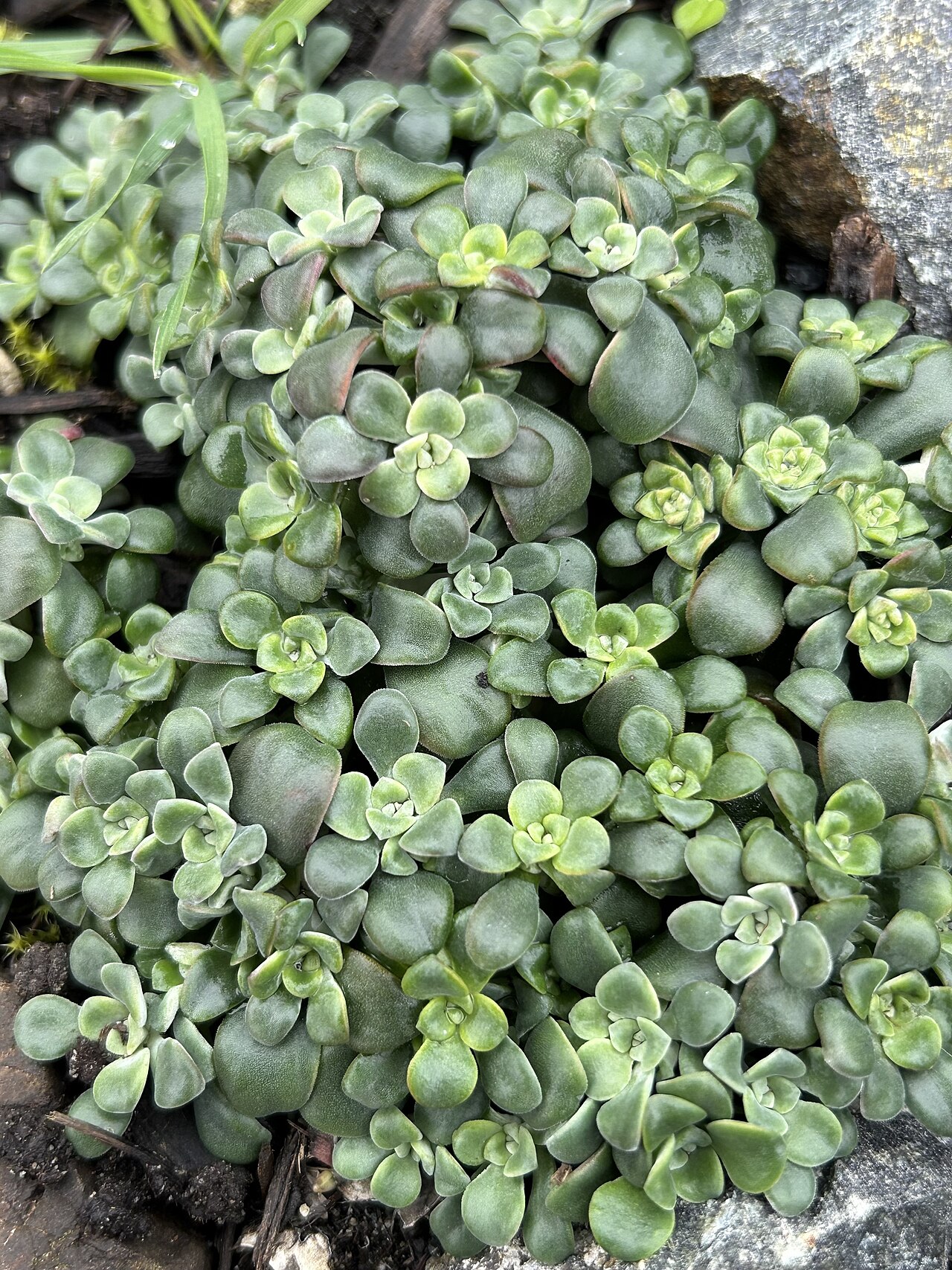
Sedum spathulifolium, commonly called Pacific stonecrop or broadleaf stonecrop, is a low, mat-forming succulent native to rocky outcrops, cliffs, and thin soils along the Pacific coast and coastal mountains of California, Oregon, and Washington. A member of the Crassulaceae (stonecrop family), it survives in places almost nothing else can root — bare rock ledges, mossy boulders, and gravelly road cuts — by storing water in its thick, spoon-shaped leaves and going dormant through the driest months.
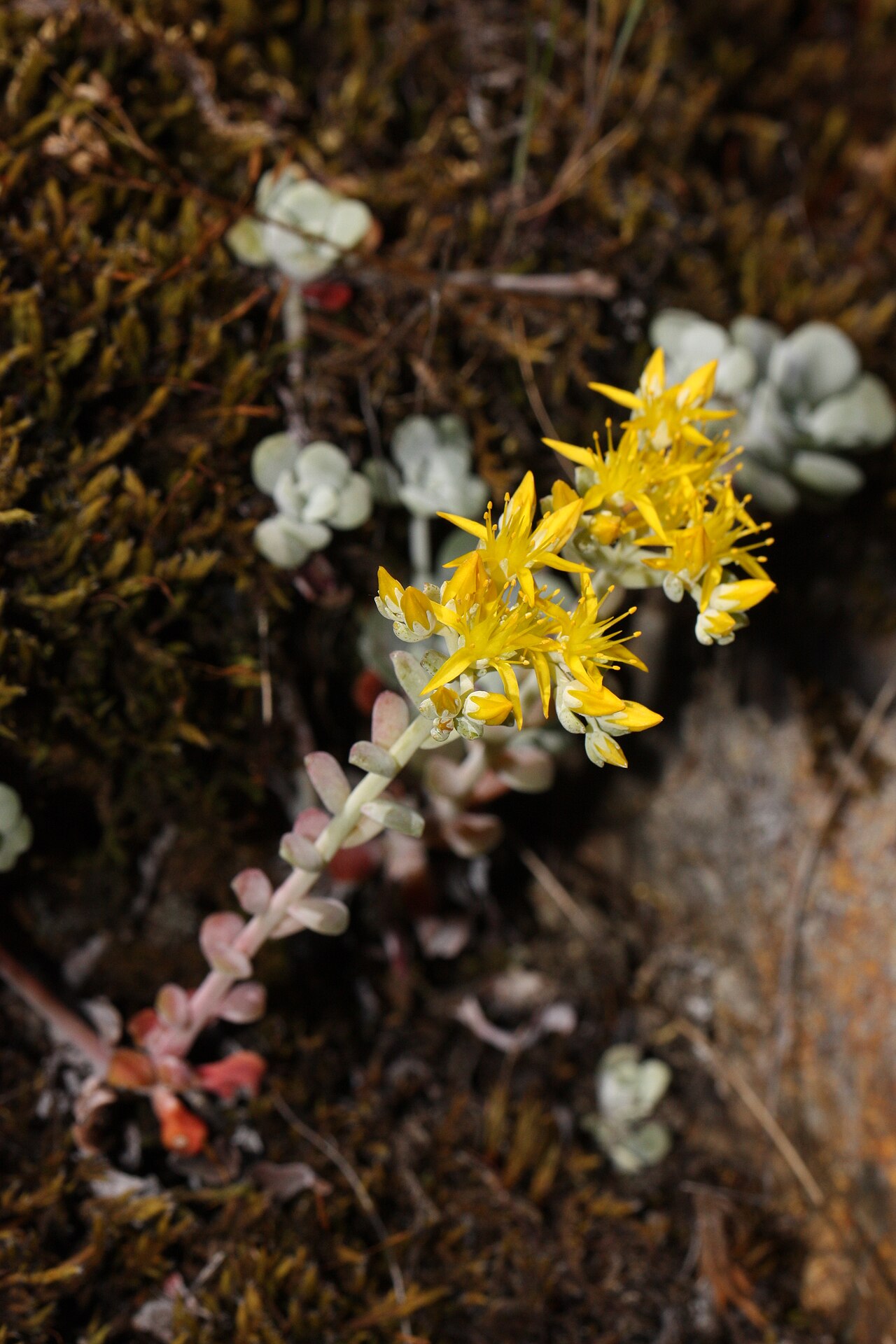
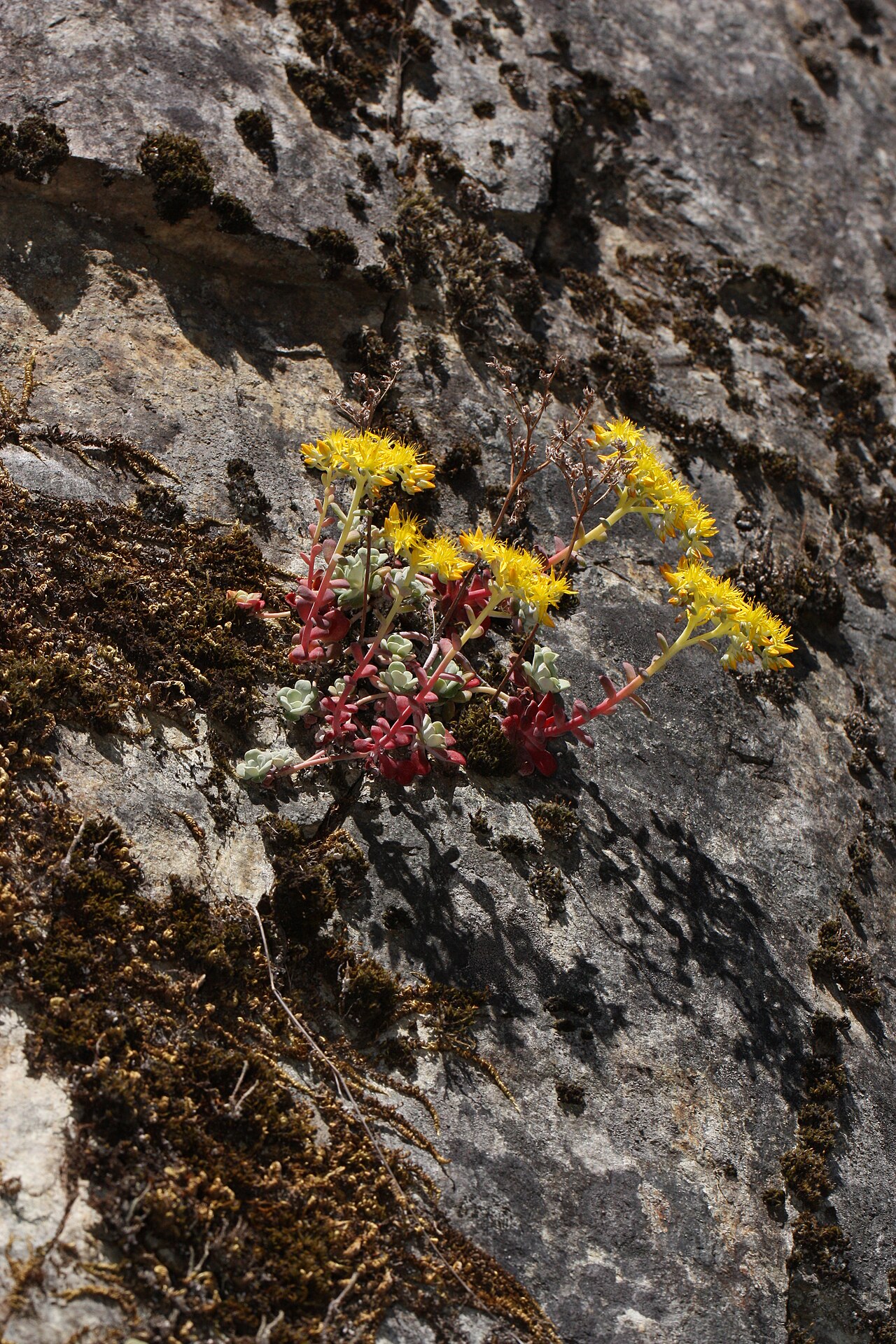
The plant forms spreading colonies of tight rosettes, each one a cluster of fleshy, powdery blue-green leaves that often blush deep purple-red in full sun or cold weather. In late spring and early summer, branched clusters of bright yellow, star-shaped flowers rise a few inches above the foliage on reddish stems, drawing in bees and other small pollinators at a time when little else is blooming on open rock. The combination of silvery foliage, winter color, and cheerful flowers has made it one of the most widely grown native succulents for West Coast rock gardens and green roofs.
Pacific stonecrop is exceptionally drought-tolerant and asks for almost nothing once established: sharp drainage, a sunny or lightly shaded spot, and room to spread slowly across rock or gravel. It is an easy, low-maintenance choice for gardeners in its native range who want authentic coastal rock-garden character without supplemental water.
Identification
Pacific stonecrop is a low, mat-forming succulent perennial, typically only 2 to 6 inches (5–15 cm) tall, spreading slowly by short rhizomes and offsets to form patches a foot or more across. Non-flowering rosettes hug the rock surface; flowering stems stand a bit taller and more upright.
Leaves
The leaves are the plant’s signature feature: thick, fleshy, and spoon- or wedge-shaped (spatulate), ½ to 1 inch (1–2.5 cm) long, arranged in tight, overlapping rosettes at the stem tips. Their color ranges from a frosty, powdery blue-green to silvery white, often flushed with purple, rose, or coppery red where sun and cold are most intense — the plant is noticeably more colorful in winter and on exposed, unshaded rock. A light waxy bloom on the leaf surface helps reduce water loss.
Flowers
Flowering stems rise 3 to 6 inches above the rosettes in late spring to midsummer, each topped with a flattened, branching cluster (cyme) of small star-shaped flowers. The five narrow, pointed petals are bright golden yellow, and the open flower clusters give rock outcrops a brief haze of yellow color. Individual flowers are only about ¼ to ⅓ inch (6–8 mm) across, but a well-established patch produces enough of them to be conspicuous from a distance.
Fruit & Seeds
After flowering, each blossom develops into a cluster of small, star-shaped, dry seed pods (follicles) that split open to release fine dust-like seeds. The flowering rosette typically dies after seed is set, while the surrounding offsets continue the colony — a common pattern in mat-forming stonecrops.
Quick Facts
| Scientific Name | Sedum spathulifolium |
| Family | Crassulaceae (Stonecrop) |
| Plant Type | Mat-Forming Succulent Perennial |
| Mature Height | 2–6 in (5–15 cm) |
| Mature Spread | 12–24 in (30–60 cm), slowly spreading |
| Growth Rate | Slow |
| Sun Exposure | Full Sun to Part Shade |
| Water Needs | Low |
| Soil Type | Rocky, gravelly or sandy; very sharply drained |
| Soil pH | 6.0–7.5 (slightly acidic to neutral) |
| Bloom Time | May – July |
| Flower Color | Bright yellow |
| Fall Color | Foliage often deepens to purple-red in cold weather |
| Fruit | Small dry star-shaped seed pods (follicles) |
| Deer Resistant | Yes |
| USDA Hardiness Zones | 5–9 |
Native Range
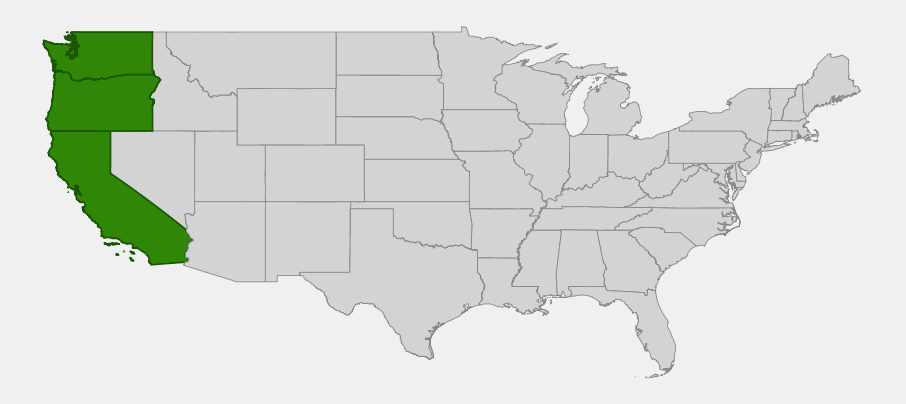
Pacific stonecrop is native to the Pacific coast and nearby mountains of western North America, from southwestern British Columbia south through Washington and Oregon to central and southern California. Within this range it is closely tied to exposed rock: coastal bluffs, sea cliffs, rocky balds, canyon walls, and road cuts from near sea level up into the lower mountains.
It is most common west of the Cascade and Sierra Nevada crests, where coastal fog and winter rain keep it alive through the dry summer, but it also reaches inland to rocky canyons along rivers such as the Rogue in southern Oregon. It typically grows in thin, mineral soils or directly in rock crevices with almost no organic duff, often alongside mosses and lichens that colonize the same bare outcrops.
Because it needs so little soil, Pacific stonecrop is frequently among the first vascular plants to colonize fresh rock faces and talus, and it persists on sites too dry and exposed for most other perennials. Populations are generally secure within this range, though individual colonies on popular coastal bluffs can be damaged by foot traffic and should be left undisturbed when encountered in the wild.
📋 Regional plant lists featuring Pacific stonecrop: California & Nevada · Western Oregon & Western Washington
Growing & Care Guide
Pacific stonecrop is one of the easiest native succulents to grow in coastal and foothill gardens, as long as drainage is sharp. It is built for lean, dry, rocky conditions and resents rich soil or standing moisture far more than it minds neglect.
Light
Full sun produces the tightest rosettes and the most intense winter color — deep purples, reds, and coppery tones layered over the blue-green leaves. In hot interior gardens, light afternoon shade keeps the foliage from scorching, though plants still perform well with some shelter from the most intense sun.
Soil & Water
Sharp drainage is essential. Plant in rocky, gravelly, or sandy soil, in a raised bed, rock garden, crevice planting, or shallow container — anywhere water will not pool around the roots. Established plants need no supplemental irrigation in their native coastal range and will rot if kept consistently wet, especially in winter. An occasional deep soak during an unusually dry, hot summer is more helpful than frequent light watering.
Planting Tips
Set out small divisions or rooted offsets in fall or early spring so roots can establish before summer dryness sets in. Tuck plants into crevices between rocks, along the edges of a dry wall, or into a gravel mulch bed; firm, well-drained contact with mineral soil matters more than soil depth. Space divisions 8 to 12 inches apart to allow the mat to fill in over a season or two.
Pruning & Maintenance
Little maintenance is needed. Trim out spent flowering stems after bloom if a tidier look is wanted; the rosette that flowered will naturally decline while its offsets carry on. Divide congested mats every few years in fall by lifting rooted sections and replanting them elsewhere, which also keeps the colony vigorous.
Propagation
Pacific stonecrop propagates readily from stem or leaf cuttings. Let a broken-off rosette or leaf callus over for a day or two in a dry spot, then set it on the surface of gritty, well-drained soil; it will root within a few weeks without rotting if kept on the dry side. Division of established offsets is just as easy and gives a flowering-size plant more quickly than seed.
Landscape Uses
Pacific stonecrop fits naturally into dry, rocky garden settings:
- Rock gardens and crevice plantings where it can root directly in stone
- Green roofs and shallow container plantings that need drought-proof groundcover
- Dry rock walls, tucked between stones for color and texture
- Coastal and foothill gardens replicating native bluff and outcrop habitat
- Succulent and xeriscape beds paired with other low-water natives
- Erosion-resistant groundcover on steep, rocky, unirrigated slopes
Wildlife & Ecological Value
Despite its small size and demanding habitat, Pacific stonecrop plays a real role in supporting pollinators and stabilizing fragile rock surfaces along the coast.
For Pollinators
The summer flowers are an important nectar source on bare rock, where few other blooming plants compete for pollinator attention. Native bees, small butterflies, and syrphid (hover) flies regularly visit the bright yellow blossoms, especially on coastal bluffs where blooming plants are otherwise scarce in the dry season.
Birds
The dense, low mats offer limited direct forage for birds, but the insects drawn to the flowers provide a food source for insectivorous songbirds foraging over rocky, open ground.
Mammals
Pacific stonecrop is not a significant browse species; its thick, fleshy leaves are unappealing to deer and other grazers, which is part of why it remains reliably deer resistant in the garden.
Ecosystem Role
As one of the first vascular plants able to establish on bare rock, Pacific stonecrop helps begin the slow process of soil formation on cliffs and outcrops, trapping windblown dust and organic debris among its roots and rosettes. Its mats also help stabilize thin soils on steep rock faces, reducing erosion in a habitat where almost nothing else can get a foothold.
Cultural & Historical Uses
Pacific stonecrop has no significant documented history of use as food or medicine among Indigenous peoples of the Pacific coast, likely owing to its small size, bitter sap, and the sparse, exposed rock habitats where it grows. Unlike many other native succulents, it was not a notable ethnobotanical resource.
Its modern significance is almost entirely horticultural. Since the mid-20th century, Pacific stonecrop has been a mainstay of West Coast rock gardens, prized by alpine and succulent plant collectors for its colorful winter foliage and ease of cultivation. It was among the native Sedums that helped popularize drought-tolerant rock gardening in California and the Pacific Northwest.
More recently, Pacific stonecrop and related native Sedum species have become popular choices for green-roof plantings in the Pacific Northwest, valued for their shallow root systems, drought tolerance, and ability to survive the thin growing medium typical of extensive green roofs.
Frequently Asked Questions
Is Pacific stonecrop the same plant as Oregon stonecrop?
No. Pacific stonecrop (Sedum spathulifolium) has broader, spoon-shaped leaves and is native mainly to California, Oregon, and Washington, while Oregon stonecrop (Sedum oreganum) has narrower leaves and a somewhat more northerly, often higher-elevation range. Both are low, mat-forming native succulents in the same family.
How much water does Pacific stonecrop need?
Very little once established. In its native coastal range it survives entirely on winter rain and summer fog, needing no irrigation. In hotter, drier inland gardens an occasional deep soak during peak summer helps, but overwatering — especially in winter — is a far greater risk than underwatering.
Will Pacific stonecrop spread aggressively in a garden?
No. It spreads slowly by short rhizomes and offsets, gradually filling in rocky gaps rather than running or seeding in weedily. It is easy to keep within bounds and simple to divide if you want to share or relocate it.
Can Pacific stonecrop grow in a container or on a green roof?
Yes. Its shallow roots and tolerance of thin, well-drained mineral soil make it well suited to shallow containers, troughs, and extensive green-roof plantings, provided drainage is sharp and it gets several hours of sun.
Why do the leaves turn purple or red?
Cold temperatures and strong sun trigger anthocyanin pigments in the leaves, turning the normally blue-green foliage shades of purple, rose, or copper, especially in winter. The color fades back toward blue-green as the weather warms and new growth emerges in spring.

Looking for a nursery that carries Pacific stonecrop?
Browse our native plant nursery directory: California · Oregon · Washington