Yellow Sand Verbena (Abronia latifolia)
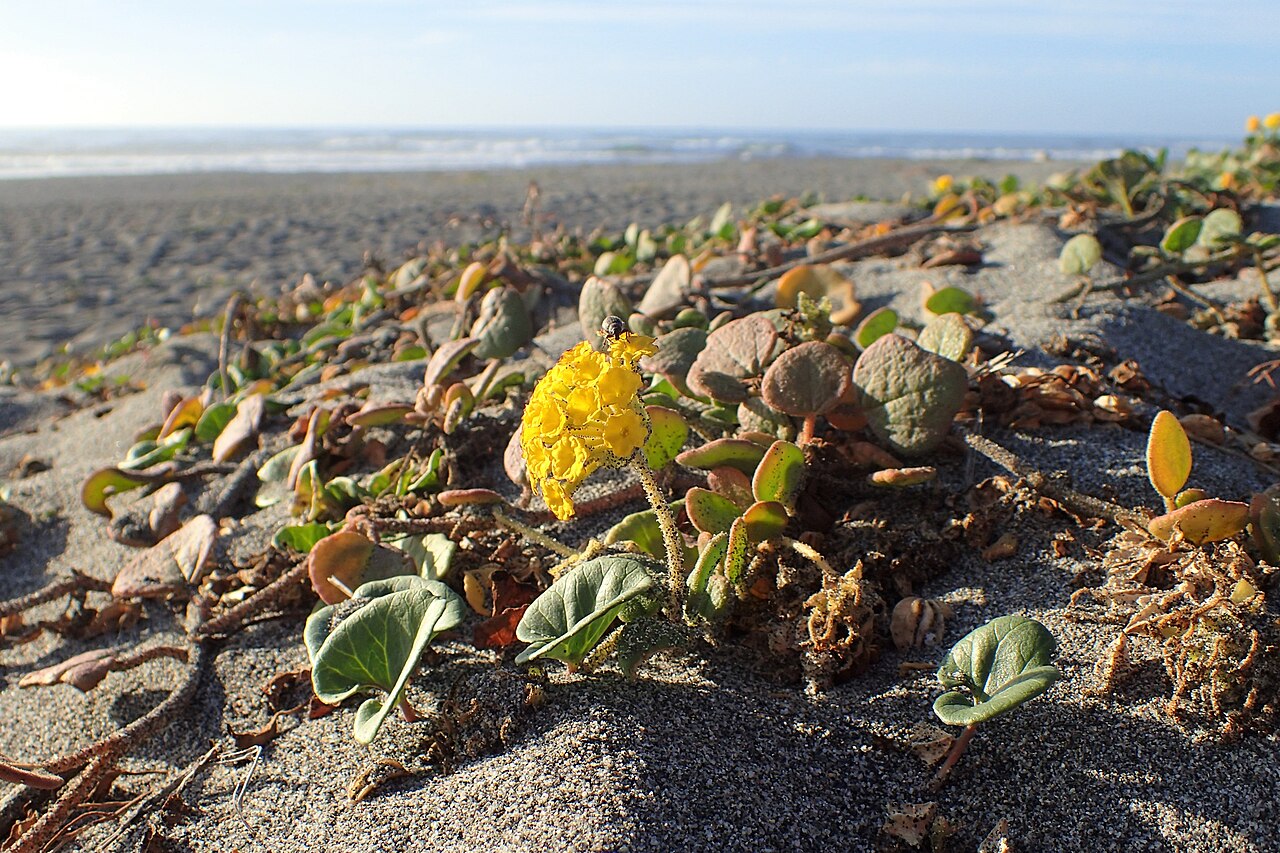
Abronia latifolia, commonly called yellow sand verbena or coastal sand-verbena, is a low, sprawling succulent perennial that holds down the shifting sand of open coastal dunes from central California north to Washington and British Columbia. It belongs to the four-o’clock family (Nyctaginaceae), the same group that gives us the garden four-o’clock and the showy pink sand verbenas of the desert Southwest. Unlike those relatives, yellow sand verbena is a true beach specialist, found nowhere but the active foredunes and upper beach of the Pacific coast.
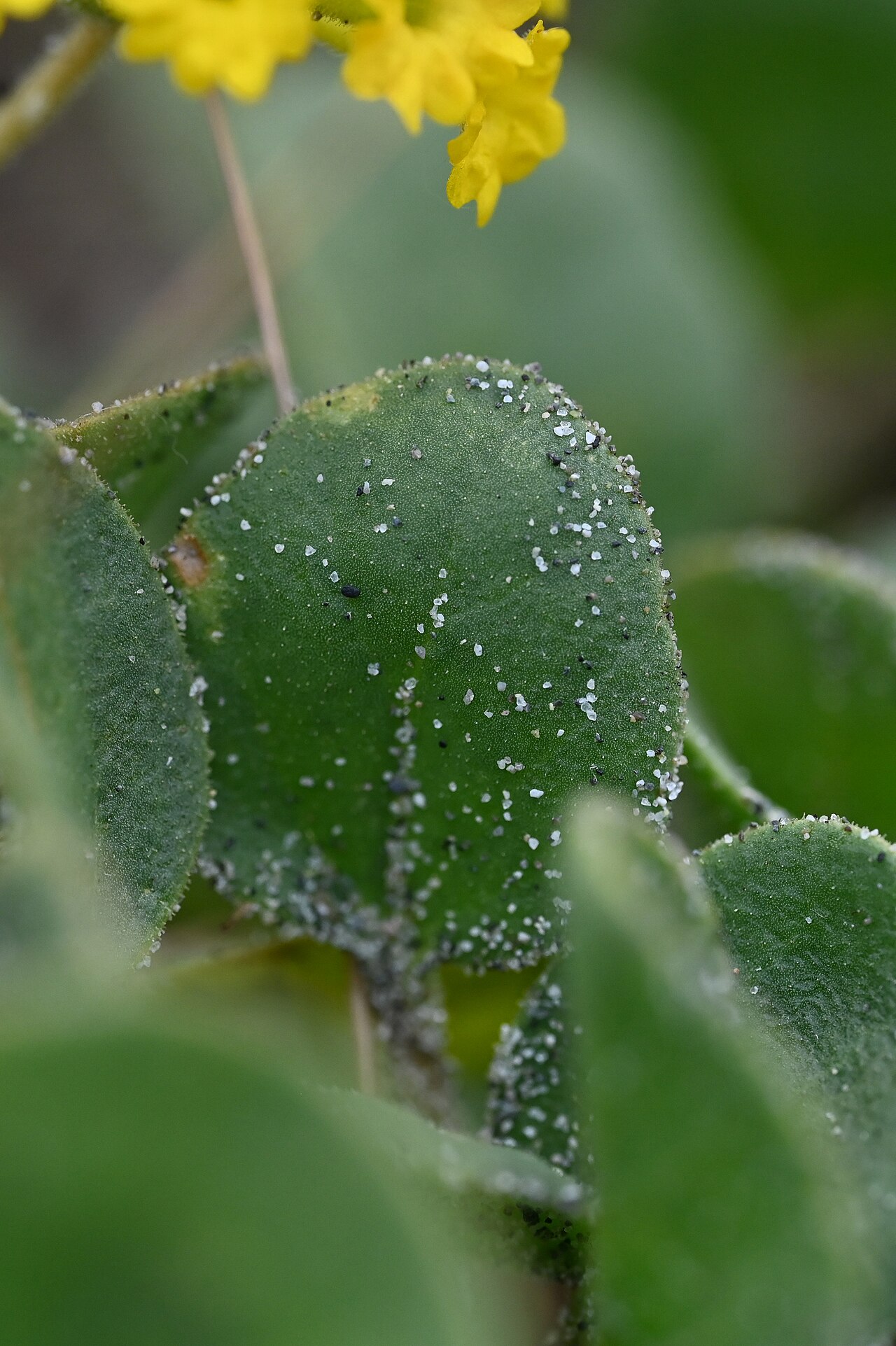
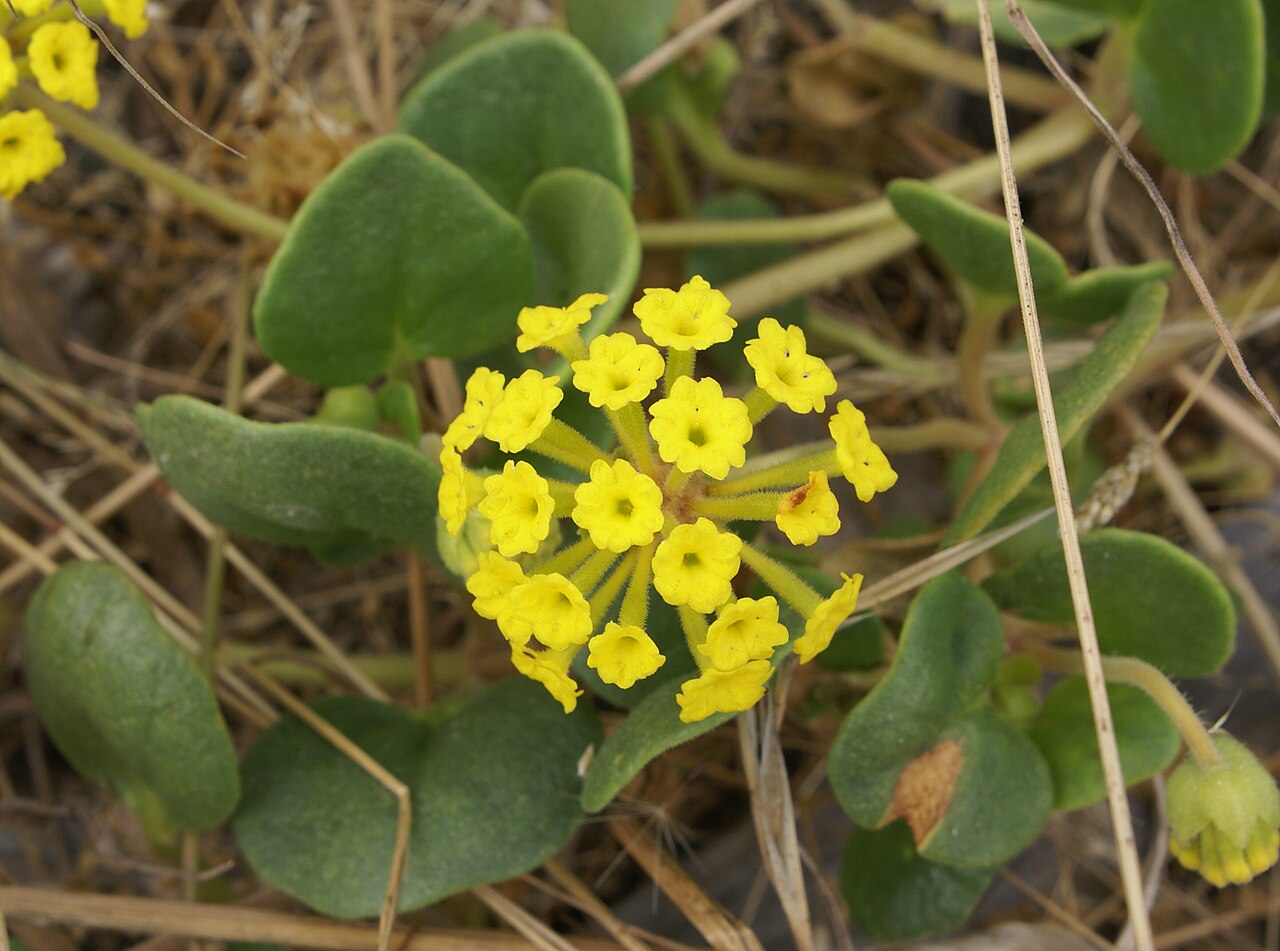
The plant forms sprawling mats of thick, rounded, blue-green leaves on fleshy trailing stems that can stretch many feet across open sand. Rounded clusters of small, bright yellow, trumpet-shaped flowers open through the warmer months and release a sweet, honey-like fragrance at dusk that draws night-flying moths. Both the stems and leaves are coated with a sticky, glandular hairiness that traps loose sand grains — a visible adaptation called psammophory that helps the plant stay anchored and may deter browsing insects.
Because it grows in one of the harshest, most dynamic habitats on the continent — open sand exposed to salt spray, wind, and shifting dunes — yellow sand verbena is an important dune stabilizer and a magnet for coastal-restoration plantings. It thrives where almost nothing else will, making it a distinctive, low-care choice for beachfront or sandy coastal gardens within its native range.
Identification
Yellow sand verbena is a low, mat-forming perennial that rarely rises more than 4 to 6 inches above the sand, though its trailing stems can run 3 feet or more along the surface, rooting as they spread. The whole plant has a fleshy, succulent character suited to its sandy, salt-sprayed habitat.
Stems
Stems are thick, prostrate, and often reddish, radiating outward from a stout taproot. They are covered in short, sticky, glandular hairs that catch windblown sand — a trait so characteristic of the species that a grain-covered stem or leaf is often the easiest field mark.
Leaves
Leaves are opposite, thick, and fleshy, broadly oval to kidney-shaped, 1 to 3 inches long, with smooth or slightly wavy margins. They are usually blue-green to gray-green and, like the stems, sticky to the touch with embedded sand grains in windy, dry conditions.
Flowers
Flowers are small, tubular, and bright lemon-yellow, 5 to 8 lobed and about ¼ to ½ inch across individually, but packed into rounded umbels of 15 to 30 flowers on short stalks above the foliage. The flowers are sweetly fragrant, especially in the evening, and bloom from roughly April through October along most of the range.
Fruit & Seeds
Each flower produces a small, dry, winged or ribbed fruit called an anthocarp, typically under ¼ inch, that is dispersed short distances by wind rolling across open sand and sometimes by water or birds. The papery wings help the fruit catch the wind on exposed, open dunes.
Quick Facts
| Scientific Name | Abronia latifolia |
| Family | Nyctaginaceae (Four O’Clock) |
| Plant Type | Mat-forming Perennial Succulent |
| Mature Height | 4–6 in |
| Mature Spread | 3–6 ft trailing stems |
| Growth Rate | Fast |
| Sun Exposure | Full Sun |
| Water Needs | Low |
| Soil Type | Loose, well-drained sand |
| Soil pH | 6.0–7.5 (neutral to slightly acidic) |
| Bloom Time | April – October |
| Flower Color | Bright yellow |
| Fall Color | None notable |
| Fruit | Small dry winged anthocarp |
| Deer Resistant | Yes |
| USDA Hardiness Zones | 7–10 |
Native Range
Yellow sand verbena is native to the immediate Pacific coast of North America, from central California north through Oregon and Washington into coastal British Columbia. Within the United States it is confirmed by county-level herbarium and distribution records along nearly the entire California, Oregon, and Washington coastlines, with scattered inland disjunctions essentially absent — this is a true strand plant, restricted to a narrow band within a few hundred feet of the ocean.
It grows almost exclusively on active and semi-stabilized foredunes, open sandy beaches, and the upper beach berm above the high-tide line, usually at or very near sea level. These are among the most physically stressful habitats on the continent: constant salt spray, shifting sand, strong onshore winds, and periodic burial are normal conditions for this species.
Because yellow sand verbena is tied so tightly to open, undisturbed dune habitat, it has declined in many developed stretches of coastline due to beach grooming, foot traffic, and competition from introduced dune grasses such as European beachgrass. It remains common, however, on protected dunes, state parks, and national seashores throughout its range, and is a priority species in many Pacific coast dune-restoration projects.
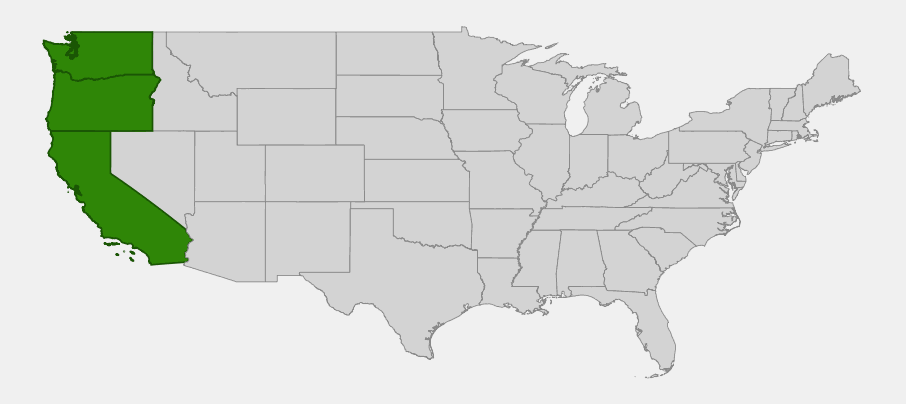
📋 Regional plant lists featuring Yellow Sand Verbena: California & Nevada, Western Oregon & Western Washington
Growing & Care Guide
Yellow sand verbena is not a plant for ordinary garden soil — it is built for pure sand, full sun, and salt air. In the right coastal setting it is one of the toughest, lowest-maintenance groundcovers available, but it generally struggles or fails outright away from truly sandy, open sites.
Light
Full sun is essential. This species evolved on completely open, unshaded dunes and does not tolerate shade from buildings, fences, or taller plants. Give it the sunniest, most exposed spot available.
Soil & Water
Loose, fast-draining sand is non-negotiable; the plant rots quickly in heavier soils that hold moisture. Once established, it needs very little supplemental water and is remarkably drought-tolerant, relying on fog drip and occasional rain along the coast. Avoid rich or amended soil, which encourages rot and weak growth.
Planting Tips
Plant from containers in fall or early spring so roots can establish before the dry season. Space plants 2 to 3 feet apart to allow for their sprawling habit; they fill in quickly once rooted. Yellow sand verbena is best suited to beachfront or immediate coastal properties with genuinely sandy soil — it is not a good candidate for inland or heavy-soil gardens.
Pruning & Maintenance
Essentially no pruning is needed. Plants can be lightly trimmed to control spread, but otherwise thrive on neglect. Avoid foot traffic over the mats, and keep the area free of thick mulch, which this sand specialist does not need and may resent.
Propagation
Propagate from fresh seed sown directly in sand, or from stem cuttings taken from actively growing shoots and rooted in sandy mix. Seed germination can be irregular; nursery-grown starts are the more reliable route for home gardeners.
Landscape Uses
Yellow sand verbena fills a very specific but valuable niche:
- Dune stabilization and coastal restoration plantings
- Beachfront groundcover where little else will grow
- Fragrance gardens near patios and walkways on sandy coastal lots
- Pollinator and moth gardens along the immediate coast
- Erosion control on exposed, sandy slopes near the shore
Wildlife & Ecological Value
As one of the few flowering plants able to persist on active dunes, yellow sand verbena plays an outsized ecological role for a small plant, both stabilizing sand and feeding specialized coastal wildlife.
For Pollinators
The evening fragrance and tubular flower shape are tuned to night-flying hawkmoths and other moths, which are the primary pollinators. Bees and other daytime insects also visit the blooms, making the plant a valuable nectar source on dunes that otherwise offer little floral diversity.
For Birds
Shorebirds and small songbirds forage among the mats for insects drawn to the flowers and foliage, and the dense low growth offers some cover from wind and predators on otherwise open beach terrain.
For Mammals
Small mammals occasionally browse the foliage, though the sticky, sand-coated leaves likely discourage heavy grazing. The extensive root system helps support the broader dune community that many coastal mammals depend on for cover.
Ecosystem Role
Yellow sand verbena is a keystone dune stabilizer: its spreading stems and roots trap blowing sand and slow erosion, helping build and maintain the foredune ridge that protects habitat further inland. It is also host to the endangered Behren’s silverspot butterfly in parts of its range and supports other dune-specialist insects found nowhere else.
Cultural & Historical Uses
Coastal Indigenous peoples of the Pacific Northwest and California, including Salishan- and Chinookan-speaking groups, were familiar with yellow sand verbena as a conspicuous and fragrant part of the beach landscape, though it was not a significant food or material plant compared with dune neighbors like American dunegrass, whose stems were used for cordage and basketry.
In the 20th century, yellow sand verbena populations declined across much of its range as European beachgrass (Ammophila arenaria) was intentionally planted to stabilize dunes for development, outcompeting native strand species and altering dune shape. Recognition of this damage has since made yellow sand verbena a flagship species in Pacific coast dune-restoration efforts, where removing invasive beachgrass has allowed native strand communities to recover.
Today the plant is valued chiefly for its ecological role and its fragrant, cheerful flowers, which make it a popular subject for coastal wildflower photography and a staple of dune-walk interpretive signage from California to British Columbia.
Frequently Asked Questions
Can I grow yellow sand verbena away from the coast?
It is difficult. This species is adapted to pure sand, salt air, and constant sun, and it generally performs poorly in ordinary garden soil or inland climates. It is best reserved for beachfront or immediate coastal properties with genuinely sandy ground.
Is yellow sand verbena the same as the pink sand verbenas sold at nurseries?
No. Many nursery “sand verbenas” are desert species like Abronia villosa or South American Glandularia hybrids with pink or purple flowers. Yellow sand verbena is a distinct Pacific coast dune species with bright yellow blooms and a very different native habitat.
Does yellow sand verbena spread aggressively?
It spreads readily by trailing stems within open sand, but it does not compete well in vegetated or shaded ground, so it rarely becomes a problem outside of true dune habitat.
Why do the leaves feel gritty?
The leaves and stems are covered in sticky glandular hairs that trap windblown sand grains, a trait called psammophory. This sand coating may help protect the plant from insect damage and intense sun on exposed dunes.
Is yellow sand verbena endangered?
It is not federally listed, but it has declined in many developed coastal areas due to beach grooming and competition from invasive beachgrass. It remains a conservation priority in dune-restoration programs along the Pacific coast.

Looking for a nursery that carries Yellow Sand Verbena?
Browse our native plant nursery directory: California · Oregon · Washington