Foothill Needlegrass (Nassella lepida)
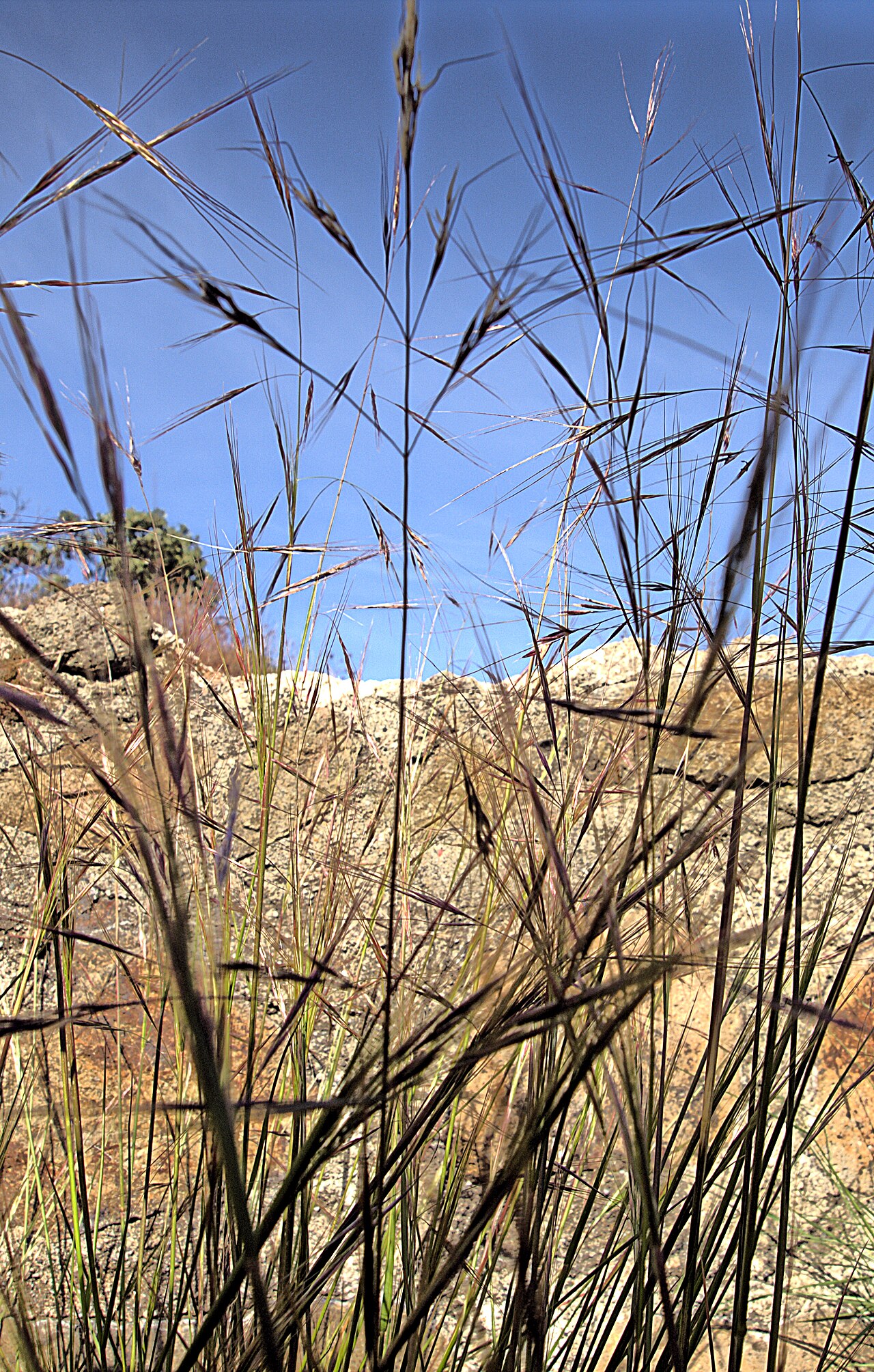
Nassella lepida (syn. Stipa lepida), commonly known as Foothill Needlegrass, is a small, wiry perennial bunchgrass found throughout the coastal ranges and foothills of California. It belongs to the needlegrass tribe of the grass family (Poaceae), named for the sharp, needle-like seeds that each carry a long, twisting awn. Though it rarely draws attention the way a wildflower does, foothill needlegrass is one of the quiet, durable bunchgrasses that hold together California’s chaparral, coastal sage scrub, and oak woodland understories.
Foothill needlegrass forms dense, low tufts of fine, rolled leaf blades that stay mostly evergreen in mild winters, sending up slender flowering culms from late winter into early summer. Its drought tolerance and modest size make it an excellent choice for naturalistic plantings that mimic the open, sun-baked slopes where it grows wild. Unlike many California native grasses that struggle under heavy competition, foothill needlegrass tolerates the dry shade at the edge of oaks and shrubs as readily as it tolerates full sun.
As a fire-adapted bunchgrass, foothill needlegrass is also valued in restoration work: it resprouts and reseeds readily after chaparral burns, helping stabilize bare slopes before shrubs recover their cover. For home gardeners, it offers a fine-textured, low-water groundcover grass that pairs naturally with California sagebrush, buckwheats, and other classic chaparral and coastal sage scrub companions.
Identification
Foothill needlegrass is a small bunchgrass, typically forming tufts 8 to 20 inches (20–50 cm) tall at the foliage, with flowering culms reaching 1 to 2.5 feet (30–75 cm). It is easy to overlook until the seedheads mature and catch the light, or until the sharp, barbed seeds catch on a sock or a passing animal.
Growth Habit
Plants grow as dense, rounded clumps (bunchgrass habit, not spreading by rhizomes), with numerous slender stems rising from a fibrous crown. The foliage is fine and wiry, giving mature clumps a soft, tousled appearance that can look green in winter and spring and fades to straw-tan through the dry summer and fall.
Leaves
Leaf blades are narrow and often inrolled (filiform in appearance), rarely more than 1/16 inch (1–2 mm) wide, and mostly basal, clustered close to the ground with the flowering stems rising above them. The blades are a dull gray-green, smooth to slightly roughened, and persist through much of the year in milder coastal sites.
Flowers & Seeds
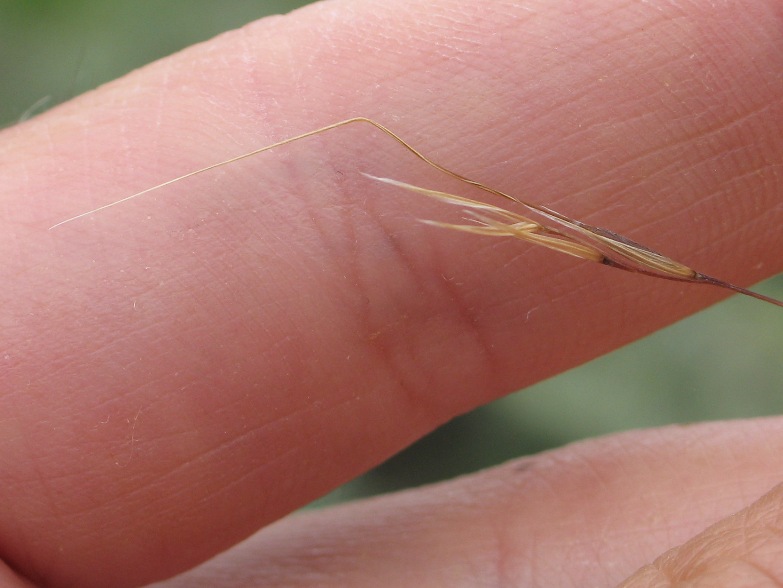
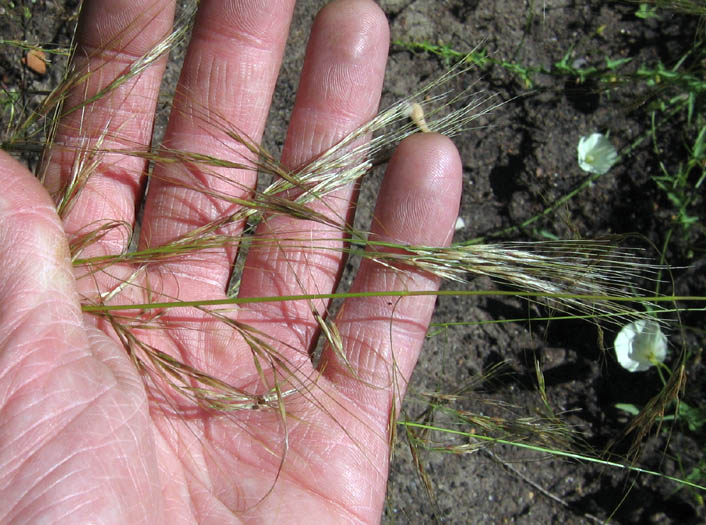
The inflorescence is a narrow, somewhat open panicle 3 to 8 inches (8–20 cm) long, bearing small one-flowered spikelets. Each floret matures into a sharp-tipped, awned seed (the “needle”): a slender, cylindrical grain tipped with a stiff, bent (geniculate) and twisted awn roughly 1 to 2.5 inches (2.5–6 cm) long. The lower part of the awn is tightly twisted and the upper part loosely bent, a combination that lets the seed drill itself into loose soil, fur, or clothing as humidity changes — a useful trait for the plant, a mild nuisance for hikers and pets. Flowering runs from February into June depending on elevation and rainfall, with seed shattering by early-to-mid summer.
Quick Facts
| Scientific Name | Nassella lepida (syn. Stipa lepida) |
| Family | Poaceae (Grass) |
| Plant Type | Perennial Bunchgrass |
| Mature Height | 1–2.5 ft in flower (30–75 cm); foliage to about 20 in |
| Mature Spread | 12–18 in clumps |
| Growth Rate | Moderate |
| Sun Exposure | Full Sun to Part Shade |
| Water Needs | Low once established |
| Soil Type | Rocky, sandy or clay loam; well-drained |
| Soil pH | 6.0–7.5 (slightly acidic to neutral) |
| Bloom Time | February – June |
| Flower Color | Pale green, aging straw-tan |
| Fall Color | Straw-tan (summer dormant) |
| Fruit | Sharp, awned grass seed (caryopsis) |
| Deer Resistant | Yes |
| USDA Hardiness Zones | 8–10 |
Native Range
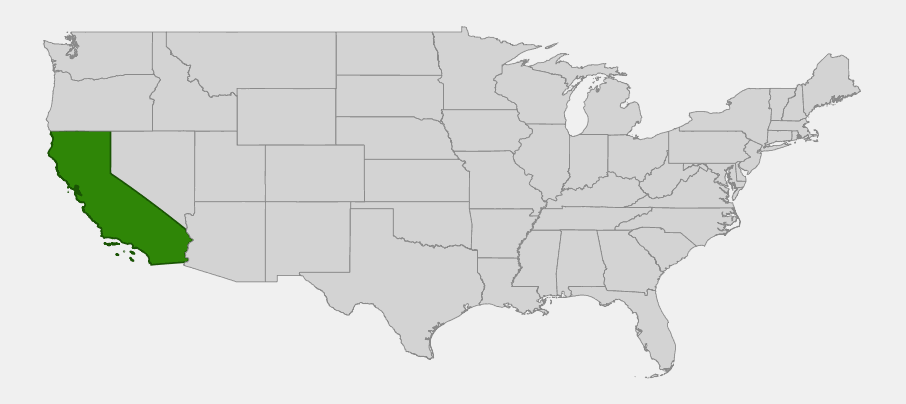
Foothill needlegrass is native to California, where it ranges from the coastal and inland mountains of the Coast Ranges south from Humboldt County, through the San Francisco Bay Area and central coast ranges, into the Transverse and Peninsular Ranges of Southern California and the Channel Islands, continuing south toward northern Baja California. It is a true Californian endemic within the United States — it is not native to Nevada, Oregon, or any other U.S. state, despite sometimes appearing on West Coast native-grass lists alongside species with broader ranges.
Within this range, foothill needlegrass grows mostly below about 4,000 feet (1,200 m) elevation, favoring open or lightly shaded slopes in chaparral, coastal sage scrub, oak woodland, and valley and foothill grassland. It often grows on thin, rocky, or clay soils where taller, thirstier grasses struggle, and it is notably tolerant of serpentine and other mineral soils in parts of its range.
Foothill needlegrass is a fire-follower: established clumps typically resprout from the root crown after chaparral and coastal sage scrub fires, and seedlings establish readily in the open, ash-enriched soil of recently burned slopes. This makes it an important early stabilizer on burned hillsides, where its fibrous roots help hold soil in place while slower-growing shrubs recover.
📋 Regional plant lists featuring Foothill Needlegrass: California & Nevada
Growing & Care Guide
Foothill needlegrass is a low-maintenance, low-water bunchgrass once it settles in, well suited to California gardens that mimic chaparral or oak-woodland conditions rather than a lush lawn aesthetic.
Light
Plants perform best in full sun along the coast, but tolerate and often prefer light to part shade inland or in hot interior valleys, especially at the dappled edge of oaks or large shrubs where they grow naturally in the wild.
Soil & Water
Foothill needlegrass thrives in lean, rocky, sandy, or clay soils with good drainage and needs no soil amendment. It is highly drought tolerant once established, needing little to no summer irrigation in most California gardens; occasional deep watering during the first one or two summers helps clumps establish a deep root system. Overwatering in heavy soils can shorten the plant’s life and invite rot.
Planting Tips
Plant from container stock or direct-seed in fall, timed with the start of the rainy season, so roots can establish before summer drought. Space plants 12 to 18 inches apart for a naturalistic meadow look, or closer for a denser groundcover effect. Avoid rich, heavily fertilized soil, which tends to produce floppy, short-lived growth instead of the tight, wiry clumps typical of wild populations.
Pruning & Maintenance
Cut or comb out old, dead foliage in late fall or winter to tidy clumps and encourage fresh spring growth; this also reduces the volume of sharp, barbed seed left lying around paths and lawns. No fertilizer is needed. Clumps are long-lived but can be divided in fall if centers become woody.
Landscape Uses
Foothill needlegrass fits naturally into several California native garden styles:
- Chaparral and coastal sage scrub gardens as an understory texture grass
- Oak woodland plantings beneath the dry shade of mature oaks
- Erosion control on dry slopes, including post-fire restoration
- Low-water meadows mixed with purple needlegrass and native wildflowers
- Habitat gardens that provide seed for birds and cover for small wildlife
- Fire-wise borders when kept trimmed and watered during peak fire season
Wildlife & Ecological Value
As a small, unassuming bunchgrass, foothill needlegrass plays an outsized supporting role in California’s chaparral and oak-woodland food webs.
For Birds
Seed-eating birds, including native sparrows and finches, forage on the ripening grain before the awns fully harden, and the dense tufted foliage offers low ground-level cover for towhees and other birds that forage near the soil surface.
For Mammals
Small mammals such as native mice and ground squirrels feed on the seed and use needlegrass clumps for cover. Deer generally avoid grazing the wiry, low-value foliage, which is part of why the species is considered deer resistant in home gardens.
For Pollinators
Like most grasses, foothill needlegrass is wind-pollinated and does not offer nectar, but its foliage serves as a larval host and shelter plant for several native grass-feeding skipper butterflies, and its base provides overwintering cover for beneficial insects.
Ecosystem Role
Foothill needlegrass is an important early-succession stabilizer after chaparral and coastal sage scrub fires, holding soil with its fibrous roots while slower-growing shrubs regenerate. Its presence in the herbaceous understory also helps native plant communities resist invasion by nonnative annual grasses, particularly on the thin, rocky soils where it is best adapted.
Cultural & Historical Uses
Foothill needlegrass does not carry the prominent food or craft history of California’s larger-seeded native grasses, but as one of the common native bunchgrasses of the coastal foothills and interior valleys, it was part of the diverse grassland and chaparral understory that Indigenous peoples of California actively managed with regular, low-intensity fire for millennia, a practice that favored fire-adapted perennial bunchgrasses like this species over many of the annual grasses introduced later by European settlers.
In more recent history, the sharp, drilling awns of needlegrass species including Nassella lepida have been studied by engineers and materials scientists as a natural model for self-burying seed mechanisms, informing research into biomimetic soil-anchoring devices and medical tools that take advantage of the same twist-and-bend motion.
Today, foothill needlegrass is primarily valued by restoration ecologists and native-plant gardeners as a durable, low-water bunchgrass for erosion control and habitat restoration on California’s dry slopes, rather than for any direct human use.
Frequently Asked Questions
Is foothill needlegrass the same as purple needlegrass?
No. Foothill needlegrass (Nassella lepida) is smaller and finer-textured, typically under 2.5 feet tall in flower, while purple needlegrass (Nassella pulchra), California’s state grass, is larger and often exceeds 3 feet. Both are California native bunchgrasses and are frequently planted together.
Are the seed awns a problem for pets or livestock?
Yes, some caution is warranted. Like many needlegrasses, the sharp, barbed seeds can work into fur, skin, eyes, and ears of dogs and grazing animals, occasionally causing injury or infection if not removed promptly. Keeping plantings trimmed before seed set, or away from high-traffic pet areas, reduces this risk.
How much water does foothill needlegrass need once established?
Very little. Established clumps typically need no supplemental irrigation in coastal and many inland California gardens, relying on winter and spring rainfall and going summer dormant in drought conditions, much as it does in the wild.
Will foothill needlegrass spread or become invasive in my garden?
No. It is a bunchgrass that stays in discrete clumps and spreads only by seed, not by rhizomes or stolons, so it will not run or take over a bed the way some spreading grasses do.
Can foothill needlegrass grow outside California?
It is not native outside California and northern Baja California, and it is best suited to climates with the dry-summer, wet-winter Mediterranean pattern typical of its native range. Gardeners outside this zone should look for a regionally native bunchgrass instead.

Looking for a nursery that carries Foothill Needlegrass?
Browse our native plant nursery directory: California