Slender-tubed Iris (Iris chrysophylla)
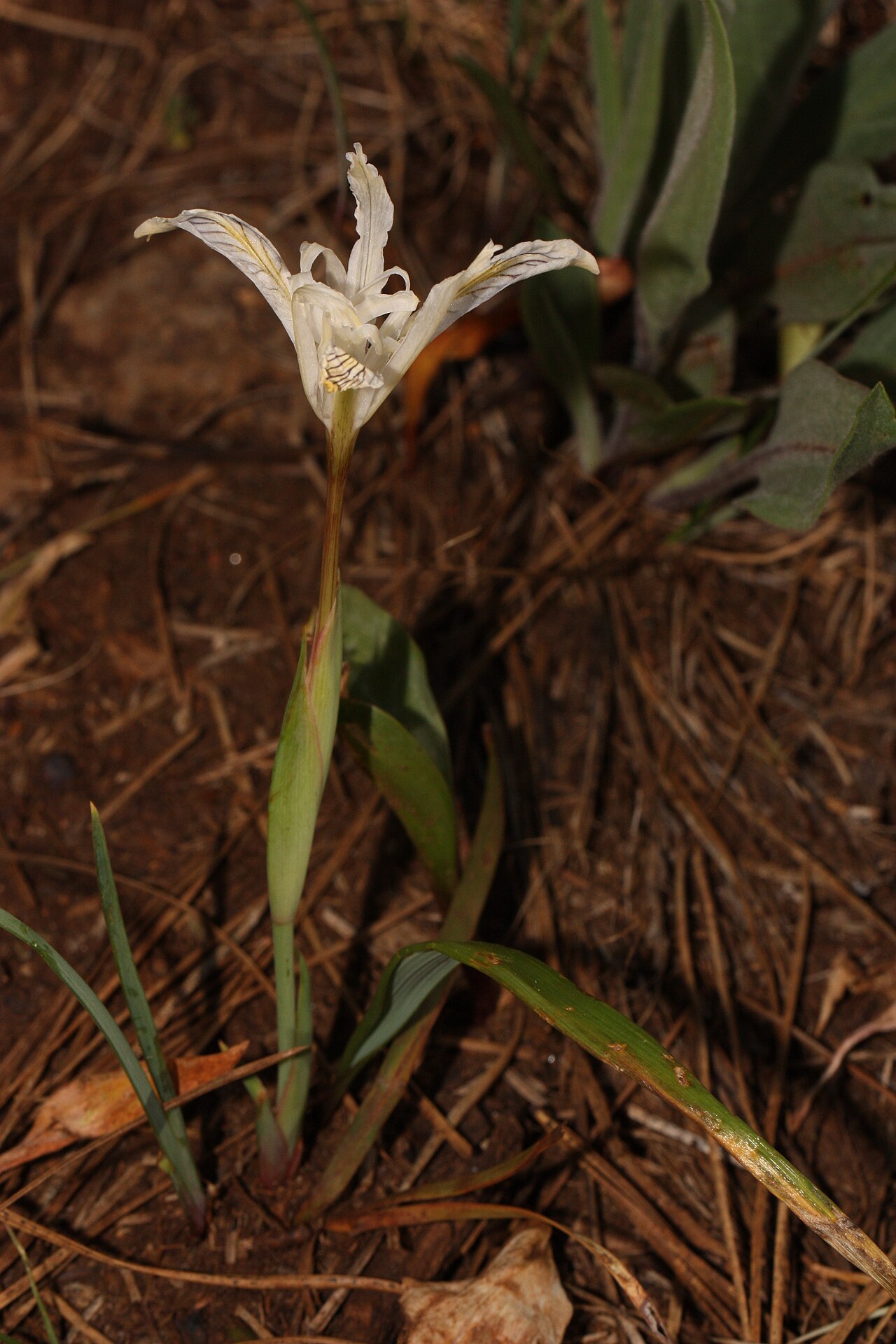
Iris chrysophylla, known as the Slender-tubed Iris or Yellowleaf Iris, is a modest but charming wildflower of the mixed conifer forests of southwestern Oregon and far northern California. Like its close relative the Siskiyou Iris, it belongs to the Pacific Coast Iris group (Iris series Californicae), a set of western North American species known for large flowers on compact, grass-leaved plants. Some botanists classify it as Iris tenax subsp. chrysophylla, but USDA PLANTS and most regional floras recognize it as a full species, the treatment followed on this page.
The common name “Slender-tubed Iris” refers to the unusually long, narrow floral tube connecting the ovary to the flower itself — among the longest of any Pacific Coast Iris, sometimes reaching nearly two inches. This slim tube holds the nectar at its base, a detail that shapes which pollinators can effectively reach it. The alternate name, Yellowleaf Iris, is something of a historical label rather than a literal description; the foliage is light green rather than yellow, though older leaf bases can take on a reddish or straw tint.
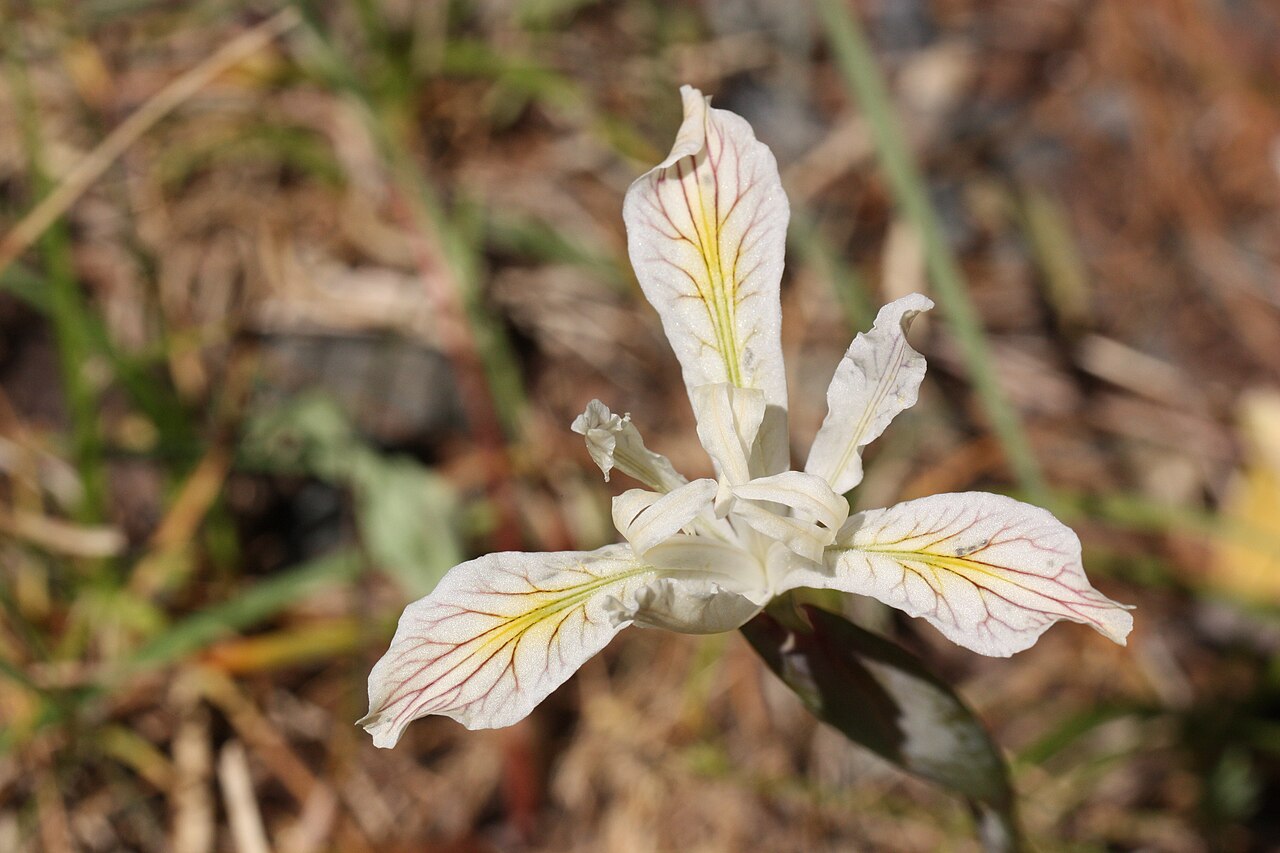
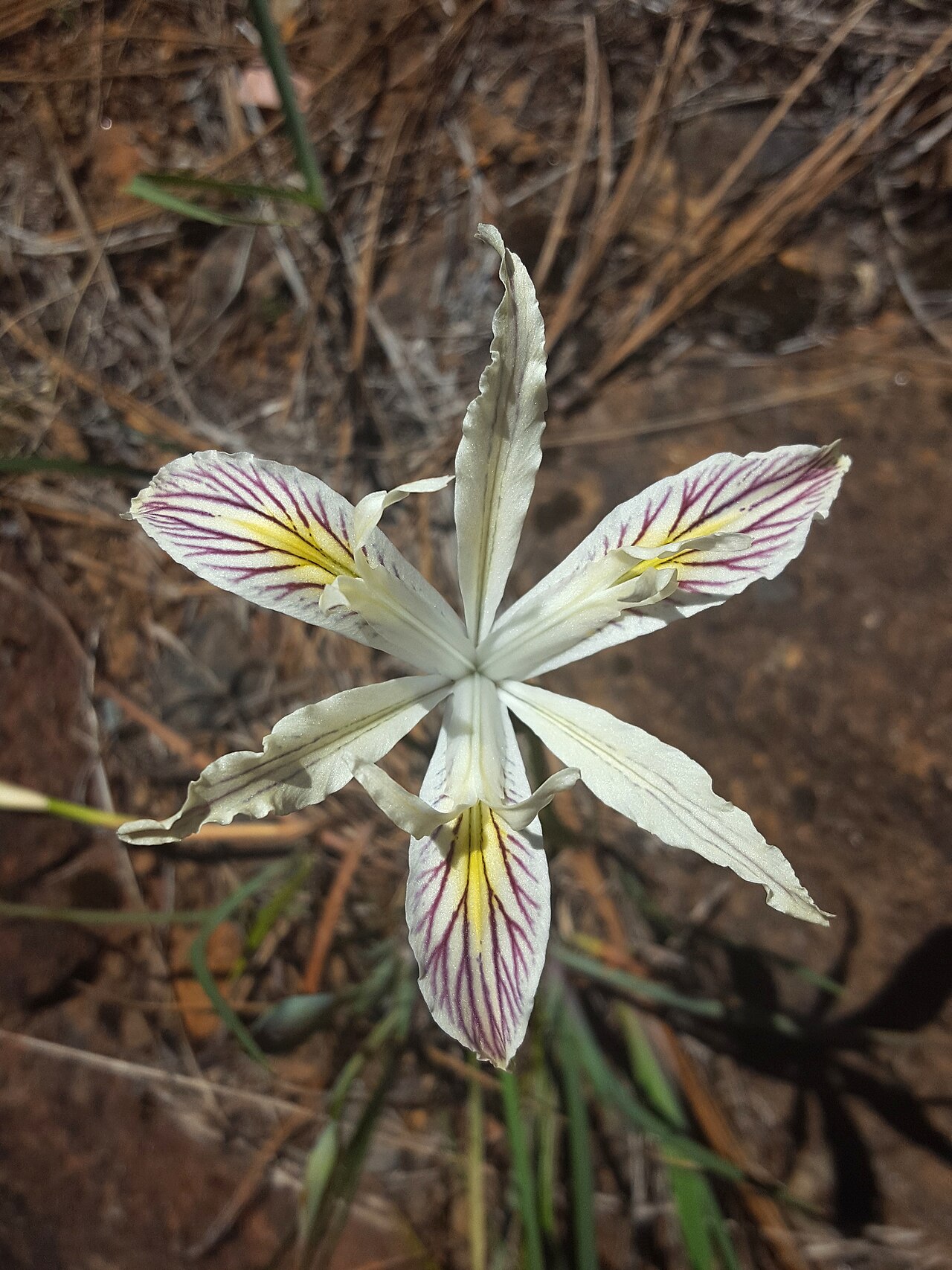
Flowering from April through June, Slender-tubed Iris produces pale, understated blooms — cream to soft yellow, often brushed with lavender and etched with fine reddish-brown veins — that blend naturally into the dappled light of an open conifer forest floor. It is a plant best appreciated up close, where the intricate veining and subtle color washes become apparent.
Identification
Slender-tubed Iris is easy to pass by when not in flower: a modest clump of narrow, light green leaves rising from slender rhizomes, often tucked among needle duff and low shrubs beneath open pine or fir canopy.
Leaves
The leaves are linear, finely ribbed, and light green, growing 10 to 20 inches (25–50 cm) long from compact, slender, dark brown rhizomes. The leaf bases are frequently tinged reddish, especially in sunnier sites. Unlike the stiffer, more evergreen-looking foliage of some Pacific Coast Iris relatives, the leaves of this species have a softer, more lax texture.
Flowers
Flowering stems are simple, solid, and slender, usually 1 to 8 inches (3–20 cm) tall — often shorter than the surrounding foliage. The flowers themselves are cream to pale yellow, frequently washed with lavender, and marked with dark golden to reddish-brown veins radiating across the three falls. The defining trait is the long, narrow floral tube, typically 1.5 to 4.5 inches (4–12 cm), noticeably longer and slimmer than in most other Pacific Coast Iris species. Bloom runs from April through June, with higher-elevation populations flowering later in the season.
Fruit & Seeds
Following bloom, an elongated three-chambered seed capsule forms at the base of the flower, maturing and splitting later in summer to release the seeds. Like other Pacific Coast Irises, the plant spreads gradually through its rhizomes, slowly enlarging a clump rather than colonizing aggressively.
Quick Facts
| Scientific Name | Iris chrysophylla (treated by some as Iris tenax subsp. chrysophylla) |
| Family | Iridaceae (Iris) |
| Plant Type | Rhizomatous Herbaceous Perennial |
| Mature Height | 10–20 in (25–50 cm) in leaf |
| Mature Spread | 12–16 in clumps, slowly expanding |
| Growth Rate | Slow |
| Sun Exposure | Part Shade to Full Sun |
| Water Needs | Low to Moderate; summer-dry once established |
| Soil Type | Well-drained, often gravelly forest soils |
| Soil pH | 5.5–7.0 (slightly acidic to neutral) |
| Bloom Time | April – June |
| Flower Color | Cream to pale yellow, often washed with lavender, with reddish-brown veins |
| Fall Color | Foliage persists green to straw-colored; not a fall-color plant |
| Fruit | Elongated three-chambered seed capsule |
| Deer Resistant | Yes (bitter, toxic foliage) |
| USDA Hardiness Zones | 6–9 |
Native Range
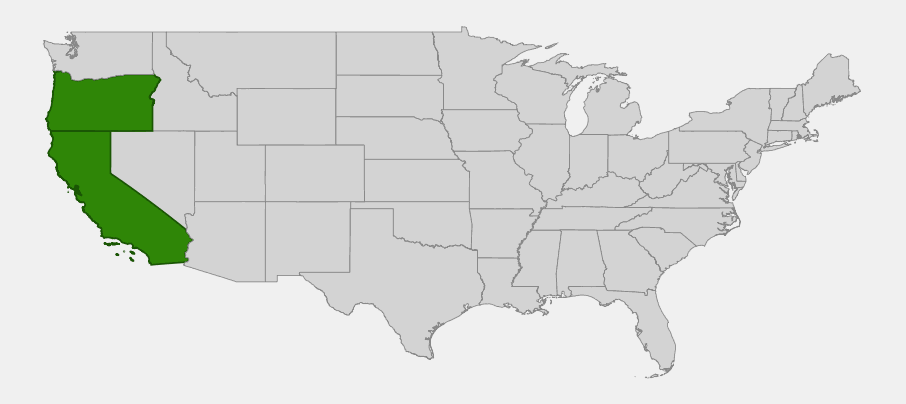
Slender-tubed Iris ranges more broadly than its close relative the Siskiyou Iris, extending through midwestern and southern Oregon west of the Cascade crest, and south to the crest of the Siskiyou Mountains in northern California. Within Oregon it occurs in forested country from around the western Cascade foothills down through the Rogue and Umpqua drainages; in California it is largely limited to the Siskiyou and Klamath mountain country of Del Norte and Siskiyou counties, generally not extending much farther south.
The species favors open to moderately shaded sites within coniferous and mixed conifer-hardwood forest, growing up to about 5,500 feet (1,700 m) in elevation. It is most commonly found scattered through the understory and forest-opening mosaic typical of its native mountains, rather than forming large showy drifts, which makes it more often discovered than deliberately sought out by wildflower hikers.
Where its range overlaps with the Siskiyou Iris and other Pacific Coast Iris species, natural hybridization can occur, producing plants with intermediate flower color or tube length. For garden use, nursery stock propagated from documented populations within its Oregon and California range gives the most reliable representation of the true species.
📋 Regional plant lists featuring Slender-tubed Iris: Western Oregon & Western Washington · California & Nevada
Growing & Care Guide
Slender-tubed Iris is a low-key woodland perennial, well suited to native plant gardens that replicate the dappled light and lean soils of an open conifer forest floor.
Light
Give it part shade to filtered sun, mimicking the light conditions found at the edge of a conifer canopy. It will tolerate more sun in cooler, coastal-influenced gardens, but in hotter inland sites some afternoon shade helps prevent stress during the dry summer months.
Soil & Water
This iris prefers well-drained, often gravelly or duff-covered forest soils with a slightly acidic to neutral pH. Water consistently during the first one to two growing seasons to help the rhizomes establish, then reduce watering; established clumps tolerate the dry summers typical of its native range, particularly with light shade and a litter mulch that retains some soil moisture.
Planting Tips
Plant container-grown divisions in fall, giving roots the cool, moist winter to settle in before the first bloom season. Space plants 12 to 16 inches apart to allow for slow clump expansion. A light leaf-litter or fine bark mulch helps replicate the forest-floor conditions this species is adapted to.
Pruning & Maintenance
Little maintenance is needed beyond removing spent flower stalks and tidying tattered foliage at the end of the season. Divide crowded clumps in early fall every four to six years if desired, taking care with the slender rhizomes, which can be slow to recover from rough handling.
Landscape Uses
Slender-tubed Iris suits several native garden settings:
- Woodland gardens — thrives in the dappled light under tall trees
- Native plant borders — subtle color pairs well with ferns and low shrubs
- Forest-edge restoration — appropriate for naturalizing conifer-forest margins
- Low-water landscaping — minimal irrigation once established
- Deer-prone gardens — foliage is unpalatable to browsing deer
Wildlife & Ecological Value
Though less showy than many garden wildflowers, Slender-tubed Iris contributes to the pollinator and ground-layer ecology of the mixed conifer forests it inhabits.
For Pollinators
The flower’s unusually long, narrow nectar tube favors pollinators with longer mouthparts, such as certain bumble bees and solitary bees capable of reaching deep into the tube, as well as occasional visits from hawk moths. This specialization makes the species a small but interesting piece of the pollinator network in its native range.
For Birds
The evergreen-to-semi-evergreen foliage offers low cover for ground-foraging birds moving through open forest understory, and the ripened seed capsules may draw the attention of seed-eating songbirds after they split open in late summer.
For Mammals
As with other true irises, the leaves and rhizomes contain bitter, mildly toxic compounds that make the plant unpalatable to deer and other browsing mammals, allowing it to persist in areas with significant deer pressure.
Ecosystem Role
As a long-lived, slow-spreading perennial of the forest floor, Slender-tubed Iris adds structural and seasonal diversity to the herbaceous layer beneath conifer canopy, flowering in the gap between early spring ephemerals and the summer dry-season bloomers of its home range.
Cultural & Historical Uses
There is no significant documented history of medicinal or food use of Slender-tubed Iris among Indigenous peoples of the Pacific Northwest, and like all true irises its rhizomes contain compounds that make it unsuitable and potentially harmful to eat.
Its chief significance today is botanical and horticultural. The species is of interest to iris specialists and native plant gardeners for its distinctive long floral tube, a trait that sets it apart from close relatives such as the Siskiyou Iris, and it has occasionally been used in breeding programs focused on Pacific Coast Iris hybrids. Within its native range, it is valued chiefly as a subtle, site-appropriate wildflower for naturalistic conifer-forest gardens rather than as a dramatic specimen plant.
Botanically, the species was first described by Oregon botanist Thomas J. Howell in the late nineteenth century, and it remains an example of the fine-grained diversity among Pacific Coast Iris species that developed across the Klamath-Siskiyou region’s complex mountain geography.
Frequently Asked Questions
How is Slender-tubed Iris different from Siskiyou Iris?
The two are close relatives with overlapping ranges, but Slender-tubed Iris has a much longer, narrower floral tube (up to about 4.5 inches versus a short tube in Siskiyou Iris), paler cream-to-lavender flower color, and typically taller, more numerous leaves. Siskiyou Iris tends to have shorter, stiffer evergreen foliage and a wider range of bold flower colors.
Why is it called “Yellowleaf Iris” if the leaves aren’t yellow?
The name is historical rather than strictly descriptive. The foliage is light green, though leaf bases can take on a reddish or straw-yellow cast, particularly in sunnier growing conditions, which may be the origin of the common name.
Will Slender-tubed Iris grow well outside the Pacific Northwest?
It is best suited to climates with the same general pattern as its native range — mild, wet winters and dry summers — combined with well-drained soil. It is not well adapted to regions with hot, humid summers or consistently wet, heavy soils.
Does Slender-tubed Iris spread aggressively in the garden?
No. It spreads slowly from short rhizomes, gradually enlarging an existing clump rather than running or self-seeding aggressively, so it stays well-behaved in a mixed native planting.
Is Slender-tubed Iris rare or protected?
It is not listed as threatened or endangered. It has a moderately wide range across southwestern Oregon and far northern California and is considered secure, though as with any regionally native wildflower, plants should be purchased from nurseries rather than collected from the wild.

Looking for a nursery that carries Slender-tubed Iris?
Browse our native plant nursery directory: Oregon · California