
Furbish’s Lousewort (Pedicularis furbishiae)
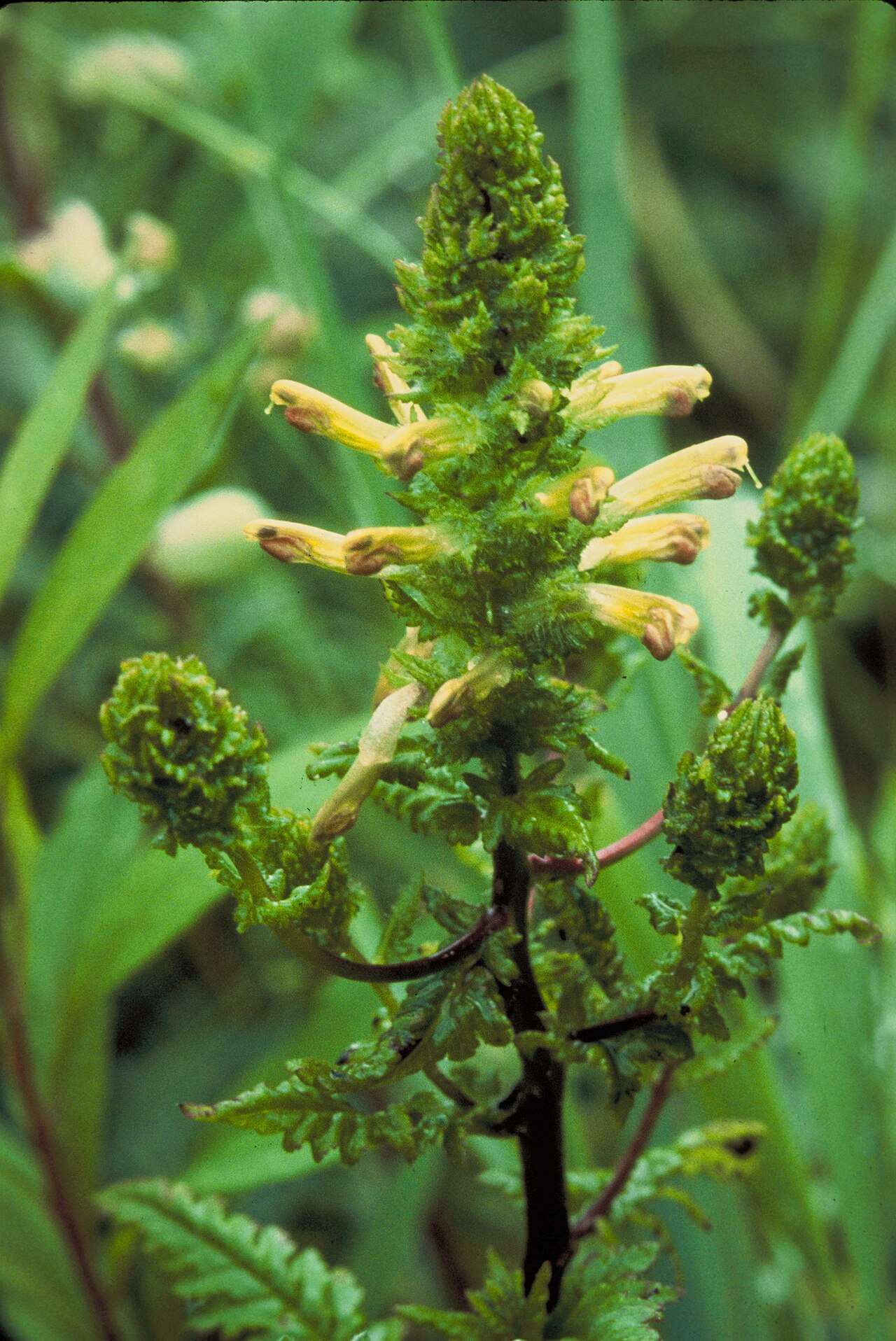
Pedicularis furbishiae, Furbish’s Lousewort, is one of the rarest plants in the eastern United States. It grows nowhere in the world except along a stretch of about 140 miles of the upper St. John River, which forms the border between northern Maine and New Brunswick, Canada. There it clings to steep, seepy, north-facing riverbanks that are scoured by ice and floods every spring.
It is a modest-looking plant: a single reddish stem 1½ to 3 feet tall with fern-like, deeply cut leaves and a short spike of pale yellow, snapdragon-like flowers in July and August. Its fame comes from its story. Discovered by the Maine botanist and artist Kate Furbish in 1880, it was thought to be extinct until it was rediscovered in 1976, during studies for a huge dam that would have flooded much of its habitat. It was listed as federally endangered in 1978 and is also endangered in Maine and in Canada.
This is an identification and appreciation page. Furbish’s lousewort cannot be bought, grown in gardens or transplanted, and it must never be dug, picked or collected. Like other louseworts, it is a hemiparasite that depends on the roots of neighboring plants and on a very specific, naturally disturbed riverbank habitat. This guide covers how to recognize it, where it lives, why it is rare and how people help protect it.
Identification
Furbish’s lousewort is the only lousewort on the upper St. John River banks with tall, single stems and pale yellow flowers in late summer. Because the plant is endangered, view it from a distance without trampling the fragile, eroding banks where it grows.
Leaves & Stems
For its first few years, the plant is only a low rosette of fern-like leaves, deeply cut into many toothed lobes. According to the Nature Trust of New Brunswick, it usually flowers after about three years, sending up a single, slightly hairy, reddish-tinged stem that averages about 2½ feet (75 cm) tall and may branch near the top. The stem leaves are alternate and fern-like, like the basal leaves but smaller.
Flowers
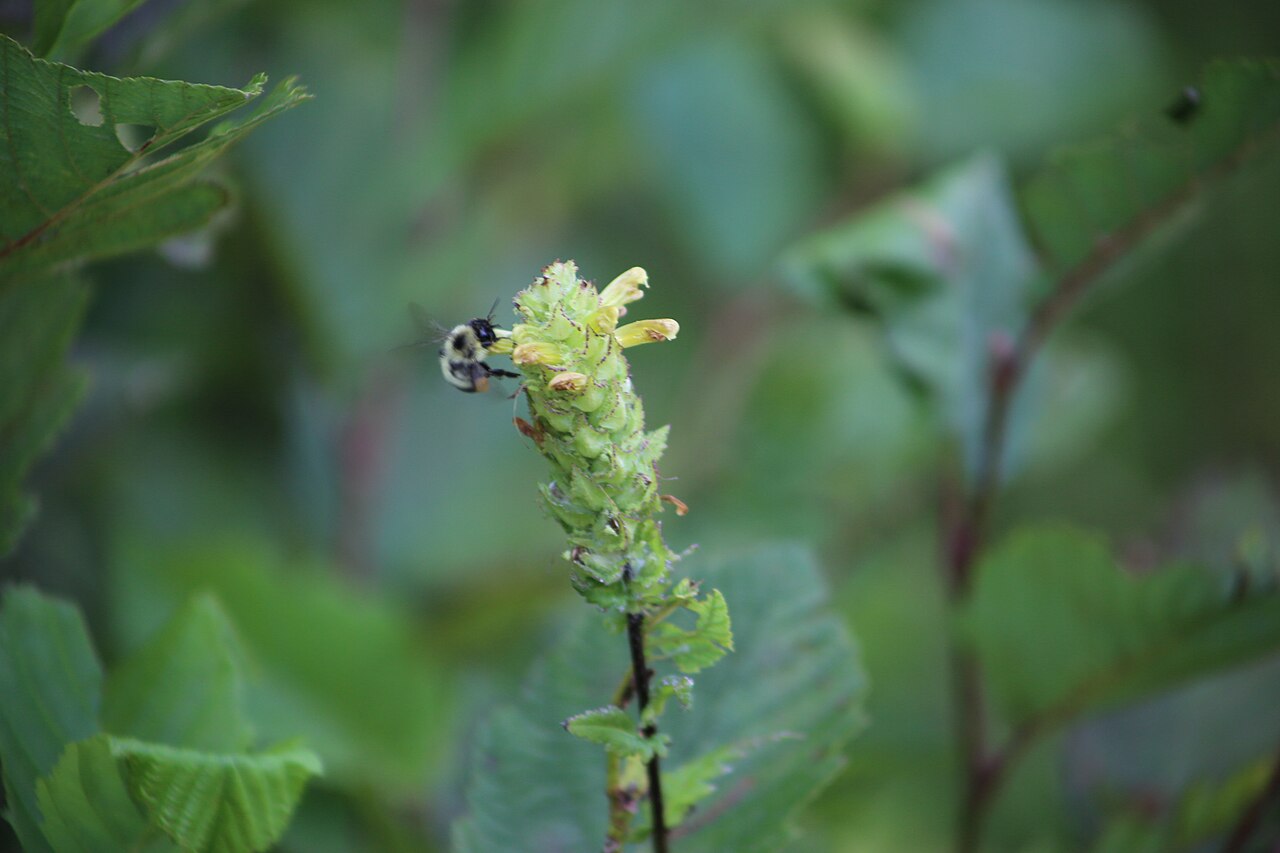
The flowers are small, roughly ½ to ¾ inch long, pale yellow and two-lipped, with a hooded upper lip like a snapdragon. They are crowded into a short, cylindrical spike at the top of the stem and open in sequence from the bottom up, from about mid-July through August. Leafy, toothed bracts are mixed among the flowers.
Fruit & Seeds
After flowering, each flower forms a flattened capsule that splits to release a few relatively large seeds in late summer and fall. Seeds mostly fall close to the parent plant, and new plants establish where fresh disturbance has opened up the bank.
Look-alikes
Canadian Lousewort (wood betony, P. canadensis) also has fern-like leaves and yellow flowers, but it is a shorter plant of dry woods and fields that blooms in spring, with several stems in a clump. Swamp Lousewort (P. lanceolata) has narrower, less deeply cut leaves and creamy flowers, and does not grow on the upper St. John River.
Quick Facts
| Scientific Name | Pedicularis furbishiae S. Watson |
| Family | Orobanchaceae (broomrape family; formerly Scrophulariaceae) |
| Plant Type | Hemiparasitic herbaceous perennial |
| Mature Height | 1½–3 ft (averages about 2½ ft) |
| Mature Spread | Single stems from a basal rosette |
| Growth Rate | Slow; usually flowers after about 3 years |
| Sun Exposure | Partial shade to sun on open riverbanks |
| Water Needs | Constantly moist, seepy banks |
| Soil Type | Wet glacial till, silt and gravel on eroding banks |
| Soil pH | Near neutral (not precisely documented) |
| Bloom Time | Mid-July–August |
| Flower Color | Pale yellow |
| Fall Color | Not notable; stems wither after seeding |
| Fruit | Flattened capsule with a few seeds |
| Deer Resistant | Not a garden plant; federally endangered |
| USDA Hardiness Zones | Not cultivated (native range zone 3–4) |
Native Range
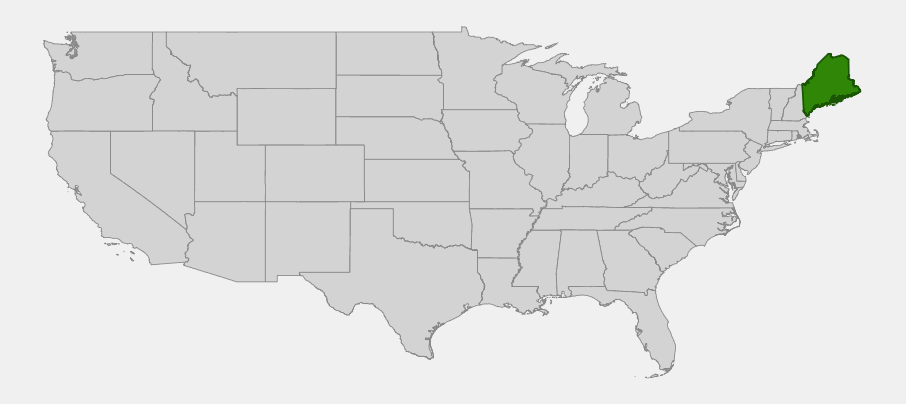
Furbish’s lousewort is endemic to the upper St. John River valley. Its entire range runs about 140 miles (225 km) along the river, from the town of Andover, New Brunswick, upstream into Aroostook County, Maine, to a point just past the confluence with the Big Black River. Maine is the only U.S. state where it grows. Surveys have recorded it at about 18 sites in Maine and a few areas in New Brunswick. Historic records show it once grew along the Aroostook River, but recent searches have not found it there.
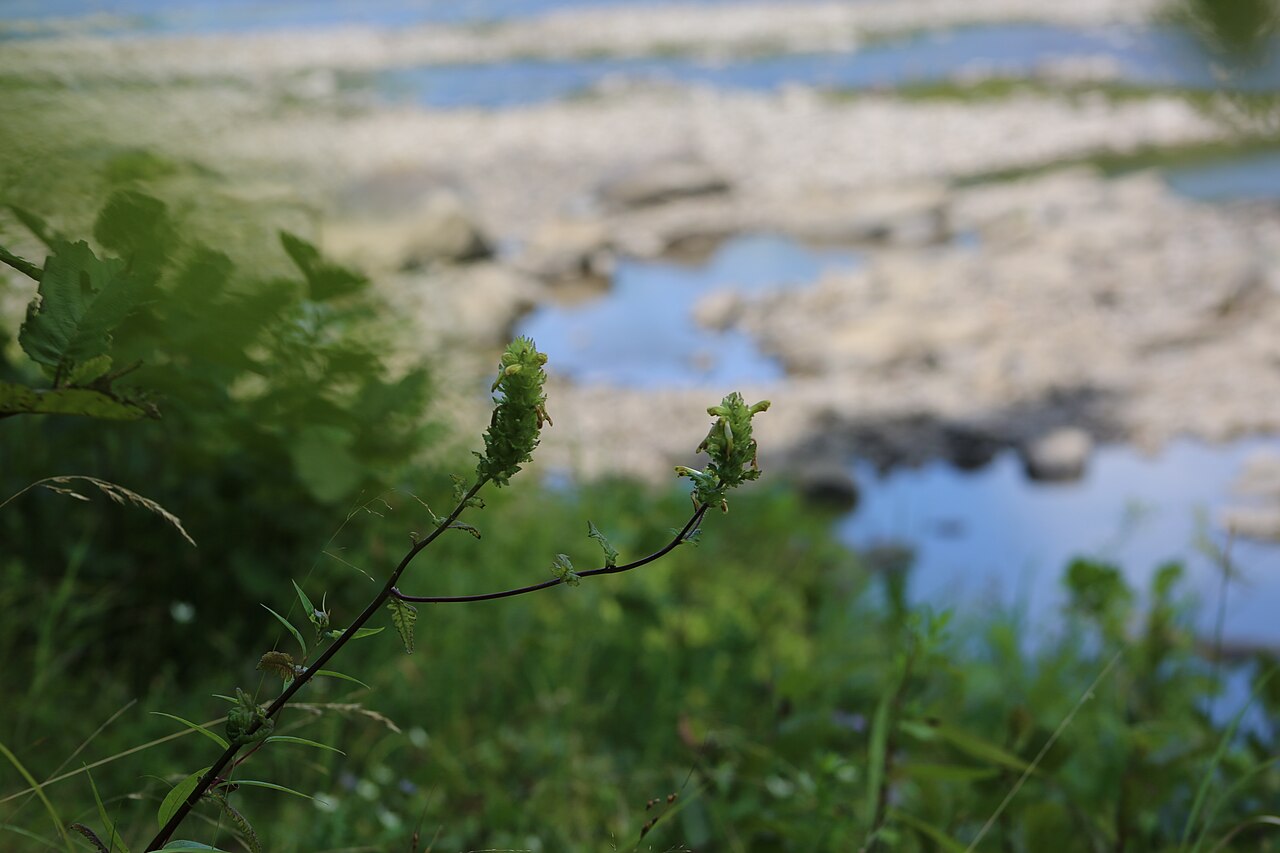
Its habitat is very specific: steep, north-facing, seepy riverbanks of glacial till that are kept open by spring floods, ice scouring and slumping of the bank. This disturbance clears away the alders and other shrubs and trees that would otherwise shade it out. But too much disturbance destroys a population outright. The species survives as a set of shifting colonies: some are wiped out by ice or landslides while new ones start on freshly opened banks, so the river’s natural flood and ice regime is essential to it.
It is threatened by anything that changes the riverbank or the river’s natural rhythm: dams, shoreline development, clearing of the forest above the banks (which changes seepage and stability), trampling, ATV use and other recreation, and invasive plants. Climate change may also alter the timing and force of spring ice and floods.
📋 Regional plant lists featuring Furbish’s Lousewort: New Hampshire, Maine & Vermont
Can You Grow It?
No. Furbish’s lousewort is not available from nurseries and cannot be grown in gardens. It is protected as an endangered species, and it depends on host plants and a dynamic, ice-scoured riverbank that cannot be recreated in a yard. Never dig, pick, collect seed from or transplant it. Conservation propagation and seed banking are carried out only by authorized botanists and agencies working under recovery plans.
Light
In the wild it grows in partial shade to sun on open banks, where ice and floods keep alders and trees from closing in. It cannot compete once shrubs shade the bank.
Soil & Water
It needs constantly moist, seepy, mineral soil, typically glacial till, on banks fed by groundwater. These conditions are almost impossible to recreate in cultivation.
Planting Tips
There is no way to plant it legally or successfully. Gardeners who want a lousewort can look for nursery-grown Canadian Lousewort from specialist native nurseries, which is far more widespread. Like all louseworts, it needs host plants and is not easy.
Pruning & Maintenance
None in gardens. In the wild, the best “maintenance” is to leave the river’s natural ice and flood cycle intact, keep forest buffers above the banks and stay off occupied banks.
Propagation
Only by conservation programs. Researchers have studied its seed germination and population dynamics, and seed is banked as insurance against extinction. Because it is a hemiparasite with very specific habitat needs, reintroduction is difficult, and protecting existing habitat is the main recovery strategy.
Where to See It
- Upper St. John River: visible from the river during canoe trips in late summer; view from your boat, without landing on occupied banks
- Protected lands: some sites are on conserved land, including the George M. Stirrett Nature Preserve in New Brunswick
- Photos and records: report sightings to Maine or New Brunswick natural heritage programs instead of collecting
- Garden alternative: grow Canadian lousewort or other nursery-propagated native wildflowers instead
Wildlife & Ecological Value
Furbish’s lousewort is a small part of a rich riverbank plant community shaped by ice and floods, which also supports other rare shoreline plants.
For Pollinators
Bumble bees are its pollinators. They climb into the hooded flowers for pollen and nectar and carry pollen between plants. Because populations are small and scattered along the river, healthy bumble bee populations are important for seed set.
For Birds
The riverbank thickets and forest edges where it grows provide habitat for warblers, sparrows and other songbirds, though the plant itself is not an important bird food.
For Mammals
Moose and deer browse along the river, and trampling and erosion from people and animals can damage plants on the soft banks.
Ecosystem Role
As a hemiparasite, it taps the roots of neighboring plants for water and nutrients while still making its own food. It is an indicator of healthy, naturally disturbed riverbanks, a habitat that also supports other rare species of ice-scoured shores in the region.
Cultural & Historical Uses
Kate Furbish (1834–1931), a self-taught Maine botanist and artist, found the plant in 1880 on the St. John River and called it Furbish’s wood betony. Harvard botanist Sereno Watson described it as Pedicularis furbishiae in 1882 in her honor. The name Pedicularis comes from Latin pediculus, louse, from an old belief that livestock grazing louseworts became infested with lice.
In the 1970s the U.S. Army Corps of Engineers planned the Dickey-Lincoln School Lakes hydroelectric project on the upper St. John River, which would have flooded about 88,000 acres of Maine forest. The lousewort was thought to be extinct, but in 1976 botanist Charles D. Richards rediscovered it during environmental surveys for the dam. It became nationally famous, and some critics mocked the idea of protecting a small plant. Congress deauthorized the dam project in 1986 for a combination of reasons, including cost.
Furbish’s lousewort was listed as endangered under the U.S. Endangered Species Act in 1978. In Canada, its discovery in New Brunswick by George Stirrett and Frederick Tribe led to its recognition as endangered in 1980, and the George M. Stirrett Nature Preserve was established in 1992. It is a well-known example of a narrow endemic that depends on the natural dynamics of a free-flowing river.
Frequently Asked Questions
Where does Furbish’s lousewort grow?
Only along about 140 miles of the upper St. John River, on the Maine-New Brunswick border, from Andover, New Brunswick, upstream into Aroostook County, Maine. It grows on steep, seepy, north-facing riverbanks.
Is Furbish’s lousewort endangered?
Yes. It has been listed as endangered under the U.S. Endangered Species Act since 1978 and is endangered in Maine and in Canada.
Can I buy or grow Furbish’s lousewort?
No. It is not sold, it is protected by law, and it depends on host plants and an ice-scoured riverbank habitat that cannot be reproduced in a garden. Never dig or collect it. Canadian lousewort is a nursery-grown alternative.
Why was a dam stopped because of a lousewort?
The plant was rediscovered in 1976 during surveys for the proposed Dickey-Lincoln hydroelectric project, which would have flooded much of its habitat. The plant became a symbol of the debate, and Congress deauthorized the dam in 1986 for several reasons, including its cost.
Is Furbish’s lousewort a parasite?
It is a hemiparasite. It has green leaves and makes its own food, but its roots attach to the roots of neighboring plants to take water and nutrients.

Looking for a nursery that carries Furbish’s Lousewort?
Browse our native plant nursery directory: Maine

