
Top 4 Best Indoor Grow Lights for Houseplants in 2026
We independently select all products and services. If you click through links we provide, Plant Native may earn a commission with no extra cost to you. As an Amazon Associate I earn from qualifying purchases.
Last updated: August 23, 2026
Key Takeaways
- Full-spectrum LED grow lights are the gold standard for indoor houseplants, providing the wavelengths needed for photosynthesis without excessive heat or energy consumption.
- Built-in timers and dimmable settings are essential features that automate your lighting schedule and let you customize intensity for different plant species.
- Plant stand and grow light combos are an excellent space-saving solution for apartment dwellers and collectors with growing collections.
- Wattage matters, but efficiency matters more — a well-designed 25W LED can outperform a poorly designed 100W unit in terms of usable light for plants.
- Our top pick, the JarryStart Smart Grow Light, offers the best combination of coverage, adjustability, and value for most indoor gardeners.
Why Indoor Grow Lights Matter for Your Houseplants
If you have ever watched a beloved houseplant slowly lose its vibrant color, drop leaves, or stretch awkwardly toward the nearest window, you already understand the fundamental challenge of growing plants indoors: light. Natural sunlight is the engine that drives photosynthesis, the process by which plants convert light energy into the sugars they need to grow, flower, and thrive. Without adequate light, even the hardiest indoor plants will struggle.
The reality is that most homes simply do not provide enough natural light for optimal plant growth. North-facing windows receive minimal direct sunlight, and even south-facing exposures can be insufficient during the shorter days of fall and winter. Apartments with limited window space, basement growing areas, and rooms with small or obstructed windows all present challenges that no amount of careful watering or fertilizing can overcome. Light is the one resource you cannot substitute with better soil or more attentive care.
This is where grow lights come in. Modern LED grow lights have transformed indoor gardening by making it possible to provide your plants with exactly the light spectrum and intensity they need, regardless of your home’s orientation, your climate, or the time of year. Unlike the bulky, hot, and energy-hungry fluorescent and HID lights of previous generations, today’s LED grow lights are efficient, cool-running, and available in a remarkable variety of form factors — from sleek standing lights that blend into your decor to integrated plant shelf systems that maximize vertical space.
Full-spectrum LED grow lights are designed to emit wavelengths across the photosynthetically active radiation (PAR) range of 400 to 700 nanometers. This includes the blue light (around 450nm) that promotes compact, leafy growth and the red light (around 660nm) that drives flowering and fruiting. Many modern units also include far-red and UV wavelengths that can enhance plant coloration and boost essential oil production in herbs. The result is light that closely mimics natural sunlight, allowing your plants to photosynthesize efficiently indoors.
Beyond simply keeping plants alive, grow lights open up entirely new possibilities for indoor gardening. You can start seeds indoors weeks before the last frost, grow fresh herbs in your kitchen year-round, maintain tropical plants that would never survive your local winters, or build an impressive collection of rare specimens in a dedicated plant room. For anyone serious about indoor plants, a quality grow light is not a luxury — it is essential infrastructure.
We spent over 40 hours researching and evaluating the current crop of indoor grow lights, examining everything from standalone vertical lights to integrated plant stand systems. We evaluated each product on light output, spectrum quality, build quality, ease of use, energy efficiency, and overall value. Below are our top nine picks for 2026, covering every budget and use case.
Best Indoor Grow Lights for Houseplants
We have organized our picks to cover a range of needs, from standalone grow lights ideal for supplementing window light to all-in-one plant stand systems that combine storage and illumination. Whether you are looking to keep a few houseplants happy or set up a serious indoor growing operation, there is an option here for you.
Best budget standing light
Our top pick

- 44W output provides strong light for the price point
- Six-leg base is more stable than tripod designs
- Adjustable height up to 5.4 feet
- Full spectrum coverage suitable for all growth stages
Cons
- Build quality feels slightly less premium than higher-priced competitors
- Limited brightness adjustment levels compared to JarryStart
- Assembly instructions could be more detailed
The boostool delivers solid performance at a competitive price. The six-leg base is a standout feature that prevents the tipping issues common with cheaper standing lights. If you need a reliable full-spectrum grow light and your budget is tight, this is the one to get.
Best for greenhouses and shelves

- Waterproof IP65 rating handles humidity and splashes
- Linkable design allows seamless coverage of large areas
- 288W combined output is powerful enough for serious growing
- Plug-and-play setup requires no electrical knowledge
- Six strips provide excellent value per square foot of coverage
Cons
- No built-in timer — requires a separate outlet timer
- Pinkish white light may not appeal to everyone aesthetically
- Mounting hardware could be more robust
If you are setting up a greenhouse, plant shelf system, or dedicated growing area, the JESLED strips are hard to beat. The waterproof rating and linkable design make them uniquely versatile for environments where standalone lights would be impractical. The 6-pack pricing makes this one of the best values per watt on the market.
Best plant stand combo (8-tier)
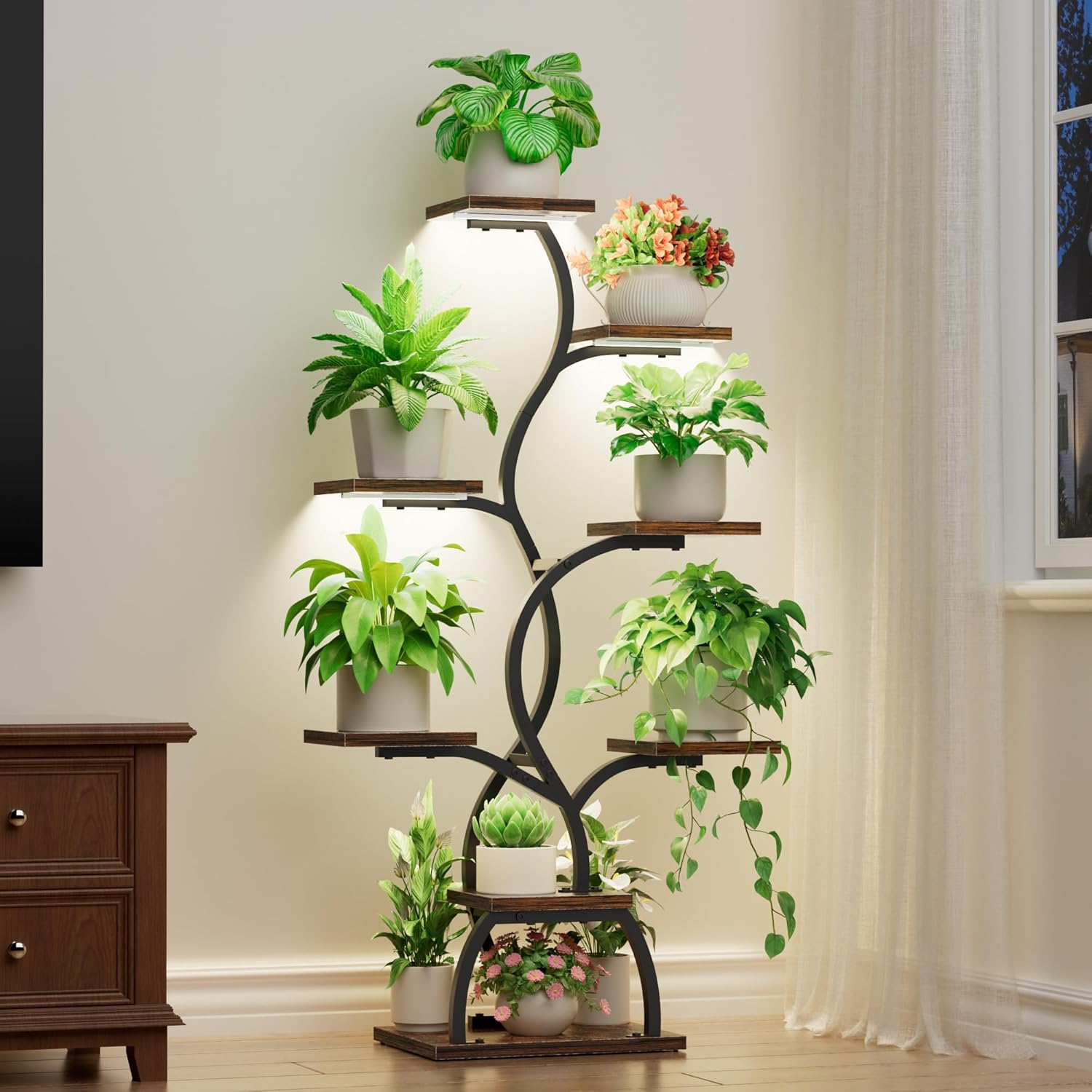
- All-in-one solution eliminates need for separate lights and stands
- Corner design maximizes use of often-wasted space
- Eight tiers accommodate a substantial plant collection
- Integrated lights provide even coverage across all levels
- Attractive design works as home decor
Cons
- Integrated lights may not be as powerful as standalone units
- Fixed design limits rearrangement flexibility
- Assembly can take 30-45 minutes
For plant collectors who want their display to look as good as the plants themselves, the EVAWOO is a standout choice. The integrated lighting means no awkward light fixtures clamped to shelves, and the corner design makes it practical for apartments and small rooms. It trades raw light output for convenience and aesthetics — a trade-off many indoor gardeners will happily make.
Best strip light for seed starting

- SANSI brand reputation for quality LED technology
- 4000K daylight spectrum with near-100 CRI is exceptionally accurate
- IP54 waterproof rating protects against moisture
- Built-in timer and four-level dimming
- Compact 2-foot size fits in tight spaces
Cons
- 25W output is modest — best for seedlings and low-light plants
- Single strip covers a limited area
- You may need multiple units for larger setups
The SANSI T8 is the go-to choice for seed starting and supplemental lighting in small spaces. Its daylight-balanced spectrum with near-perfect color rendering means your plants get light that closely matches what they would receive outdoors. For under-shelf or cabinet installations, this compact strip is precisely what you need.
Indoor Grow Light Buying Guide
Choosing the right grow light depends on your specific situation — the number of plants you have, the space available, your budget, and how hands-on you want to be with your setup. Here are the key factors to evaluate when shopping for an indoor grow light.
Light Spectrum
Plants primarily use blue light (400-500nm) and red light (600-700nm) for photosynthesis. Full-spectrum lights that cover the entire 400-700nm range are the most versatile choice, as they support all stages of plant growth from seedling to flowering. Some lights offer switchable modes (blue only, red only, or full spectrum) which can be useful for targeting specific growth stages, but for most houseplant owners, a quality full-spectrum setting is all you need.
Wattage and Light Output
Wattage indicates how much power the light consumes, but it does not directly tell you how much usable light your plants will receive. More important is the light’s efficacy — how efficiently it converts electricity into photosynthetically active radiation (PAR). A well-designed 25W LED from a brand like SANSI can deliver more useful plant light per watt than a poorly designed 50W unit. As a general guideline, aim for 20-40 watts of LED light per square foot of growing area for most houseplants, and 40-60 watts per square foot for high-light plants or fruiting crops.
Timer and Automation
Most houseplants need 10-14 hours of light per day. A built-in timer is one of the most important convenience features in a grow light, as it automates the on/off cycle and ensures your plants receive consistent lighting even when you are away from home. Look for models with multiple timer settings (commonly 3, 9, and 12 hours) and a memory function that remembers your last setting after a power interruption.
Adjustability and Dimming
Different plants have different light intensity needs. A dimmable grow light lets you reduce intensity for shade-loving plants like ferns and pothos or crank it up for succulents and herbs. Adjustable height or positioning (such as flexible gooseneck arms or telescoping poles) is also valuable, as it lets you maintain the optimal distance between the light and your plant canopy as plants grow.
Form Factor
Grow lights come in several form factors, each suited to different situations:
- Standing/floor lights: Best for illuminating floor plants or groups of plants from above. Easy to reposition.
- Clip-on lights: Ideal for desks, shelves, and windowsills. Space-efficient but lower total output.
- Strip/bar lights: Perfect for mounting under shelves, inside cabinets, or in greenhouse setups. Linkable models can cover large areas.
- Plant stand combos: All-in-one solutions that combine display shelving with integrated lighting. Best for collections and decorative setups.
Energy Efficiency
Since grow lights typically run 10-14 hours per day, energy efficiency matters for your electricity bill. LED grow lights are far more efficient than fluorescent or incandescent alternatives, converting more electricity into usable plant light and producing less waste heat. A 40W LED grow light running 12 hours daily will cost roughly $2-3 per month in electricity at average US rates — a fraction of what older technologies would cost.
Build Quality and Durability
If you plan to use your grow light in humid environments (near plants that you mist regularly, in greenhouses, or in bathrooms), look for an IP rating. IP54 or higher means the light is protected against water splashes. For dry indoor environments, water resistance is less critical, but you should still look for quality construction, solid connections, and a reasonable warranty.
Frequently Asked Questions
How many hours per day should I run my grow light?
Most houseplants thrive with 10-14 hours of grow light exposure per day, followed by 10-14 hours of darkness. Plants need a dark period for respiration and certain metabolic processes, so running lights 24/7 is counterproductive. Seedlings and vegetable starts may benefit from the higher end of this range (14-16 hours), while low-light plants like pothos and snake plants do well with 10-12 hours. Use the built-in timer on your grow light to maintain a consistent schedule.
How far should grow lights be from my plants?
The ideal distance depends on the light’s intensity and your plants’ needs, but a general starting point is 12-24 inches above the plant canopy for LED grow lights. If you notice your plants stretching or leaning toward the light, move it closer. If you see signs of light stress — bleached, brown, or curling leaves — move it farther away. Many of the standing and adjustable lights on our list make it easy to fine-tune this distance.
Can grow lights replace natural sunlight entirely?
Yes, high-quality full-spectrum LED grow lights can fully replace natural sunlight for indoor plants. This is how commercial indoor farms and research greenhouses operate year-round. The key is providing sufficient intensity (measured in PPFD — photosynthetic photon flux density) and the correct spectrum. For typical houseplants, a good full-spectrum LED providing 100-300 PPFD at the canopy level is sufficient. The products on our list are all designed to provide this level of output at recommended distances.
Do grow lights increase my electricity bill significantly?
Modern LED grow lights are remarkably energy-efficient. A typical 40W LED grow light running 12 hours per day consumes about 14.4 kWh per month, which costs approximately $2-3 at the US average electricity rate of $0.16/kWh. Even running multiple lights, the cost is modest compared to other household appliances. The energy savings compared to older fluorescent or HID grow lights are substantial — LEDs use 50-70% less electricity for the same light output.
The Bottom Line
The best indoor grow light for you depends on your specific setup and needs. For most indoor gardeners, the JarryStart Smart Grow Light offers the best overall combination of light quality, adjustability, and value. If you are building a display collection, the integrated plant stand options from EVAWOO, JUSTOGO, Hongsane, and NEHAJUNXI eliminate the need for separate lighting fixtures while creating attractive display areas. For dedicated growing setups like seed starting stations or plant shelves, the JESLED waterproof strips and SANSI T8 provide professional-grade illumination in compact, mountable formats.
Whatever you choose, adding a grow light to your indoor garden is one of the single most impactful upgrades you can make. Your plants will reward you with stronger growth, more vibrant foliage, and — if you are growing flowering species — more abundant blooms. Happy growing.
Related: Looking for plants that also clean your air? See our guide to the 20 best air purifying plants backed by NASA research.
Well written.
Thank you for the kind words! Wishing you a great growing season. -Plant Native Team