Alkali Sacaton (Sporobolus airoides)
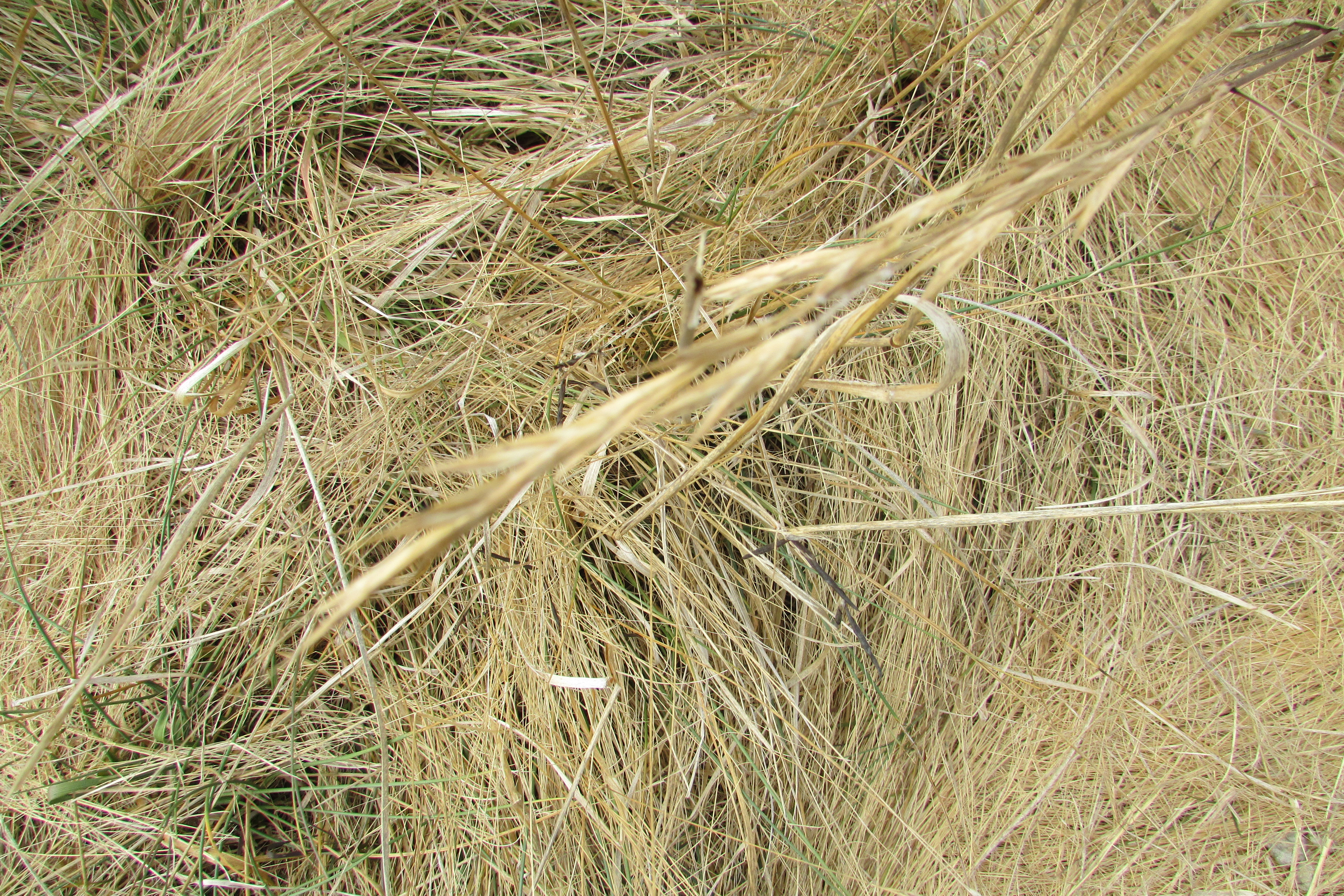
Sporobolus airoides, commonly known as Alkali Sacaton, is one of the most resilient and ecologically important native grasses of the American Southwest and Great Plains. This robust perennial bunchgrass thrives where most plants struggle — in highly alkaline, saline, and seasonally waterlogged soils of playas, floodplains, desert basins, and arroyos. Its name, “sacaton,” derives from the Spanish word for a type of coarse grass found in wet or alkaline areas, and “alkali” aptly describes the harsh soil chemistry it tolerates with remarkable ease.
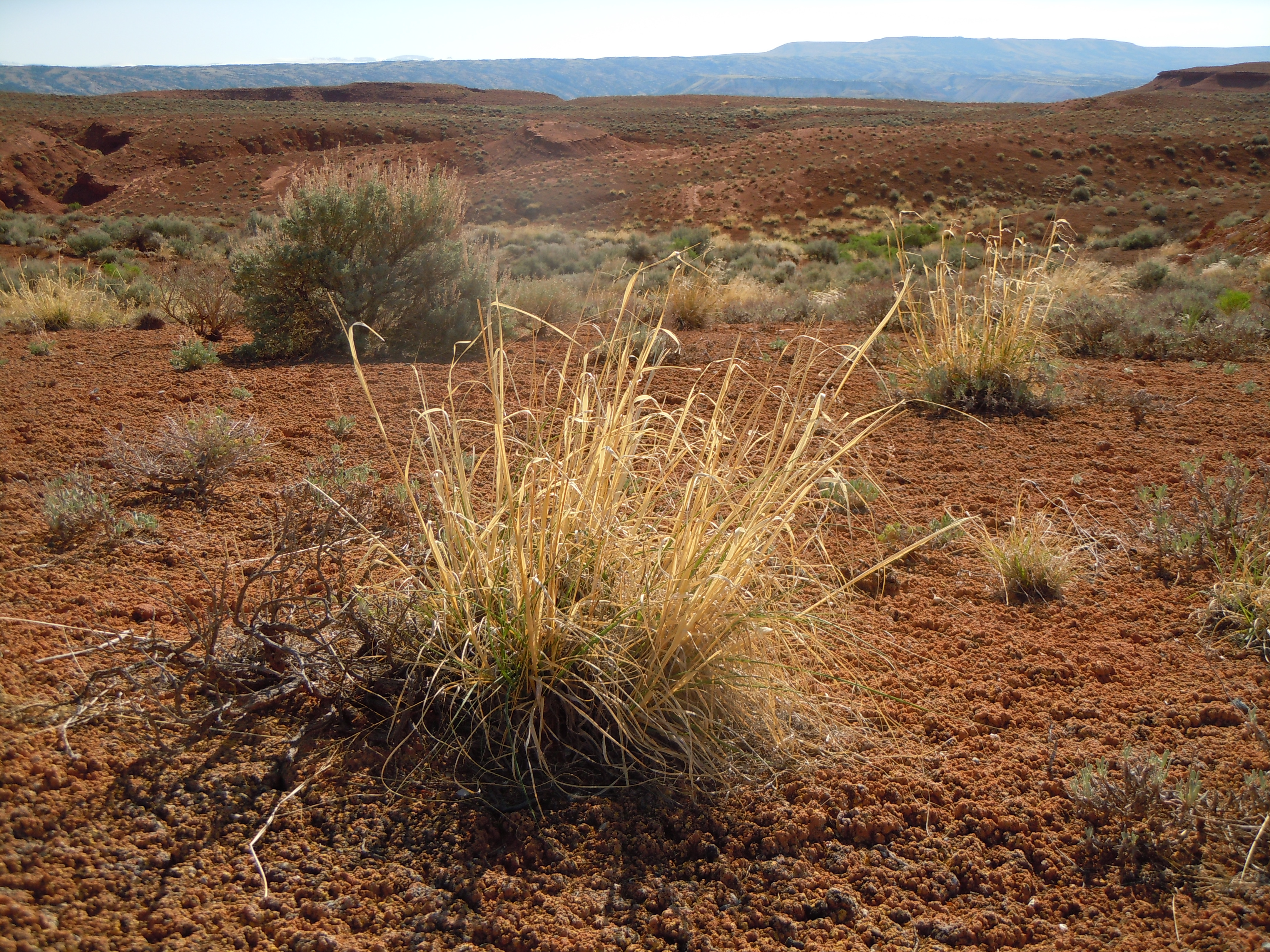
Alkali Sacaton forms large, dense bunchgrass clumps that can reach 2 to 4 feet tall, producing a striking fountain of fine-textured leaves and airy, open seed heads that catch the light beautifully in late summer. The plant’s extensive, deep root system — reaching down 5 to 8 feet — gives it exceptional drought tolerance once established, allowing it to tap into deep moisture reserves even during prolonged dry spells. Despite preferring alkaline conditions, it adapts to a wide range of soil types including clay, sand, and caliche hardpan soils common to the Sonoran and Chihuahuan Desert regions.
Beyond its toughness, Alkali Sacaton plays a vital ecological role in arid and semi-arid landscapes. Its dense clumps stabilize streambanks and arroyo margins, reducing erosion. The seeds provide food for many bird species and small mammals, while the clumps themselves offer nesting sites and thermal cover. Today, Alkali Sacaton is widely used in revegetation, erosion control, stormwater management, and native landscaping projects throughout the Southwest, valued equally for its beauty and its exceptional hardiness in disturbed and challenging sites.
Identification
Alkali Sacaton is a warm-season perennial bunchgrass with a distinctive growth form — dense, rounded clumps of arching, grass leaves that emerge from a fibrous crown. Plants can spread over time to form clumps 3 to 5 feet wide. The overall texture of the grass is relatively fine, with leaves that are narrower and more arching than many other large bunchgrasses of the Southwest.
Leaves & Stems
The leaves are flat to loosely involute (rolling inward), 8 to 24 inches long, and ⅛ to ¼ inch wide. They are smooth, pale gray-green to blue-green in color, and become somewhat straw-colored in winter and early spring before new growth emerges. The leaf bases are flattened and smooth. Culms (stems) are erect and slender, ranging from 18 to 48 inches tall. A distinctive feature of Sporobolus is that the seed is exposed at maturity — the grain separates from the hull — which is unusual among grasses and helps identify the genus.
Flowers & Seed Heads
The inflorescence is an open, diffuse panicle (seed head) that is pyramidal to ovoid in shape, 8 to 20 inches long, with spreading branches arranged in whorls. The panicle starts out contracted and purplish-tinted, then opens widely at maturity, giving the plant a beautiful, airy, cloud-like appearance. Individual florets are tiny, with purple anthers that make the freshly opened panicle particularly attractive. The seed heads persist through winter, providing food for seed-eating birds and adding winter interest to the landscape. Blooming occurs from July through October, with peak interest in late summer.
Roots
The root system is fibrous and extensive, reaching depths of 5 to 8 feet in well-drained soils. This deep rooting is central to the plant’s extraordinary drought tolerance — it can access subsoil moisture long after surface soils have dried out completely. The roots also exude compounds that help the plant tolerate high concentrations of salts in the soil, a physiological adaptation unique among grasses of this size.
Quick Facts
| Scientific Name | Sporobolus airoides |
| Family | Poaceae (Grass) |
| Plant Type | Perennial Bunchgrass |
| Mature Height | 2 ft |
| Sun Exposure | Full Sun |
| Water Needs | Low (Drought Tolerant) |
| Bloom Time | July – October |
| Flower Color | Purple-tinged seed heads, straw-colored at maturity |
| Soil Tolerance | Alkaline, saline, clay, caliche, sandy |
| Deer Resistant | Moderate (less palatable when mature) |
| USDA Hardiness Zones | 4–9 |
Native Range
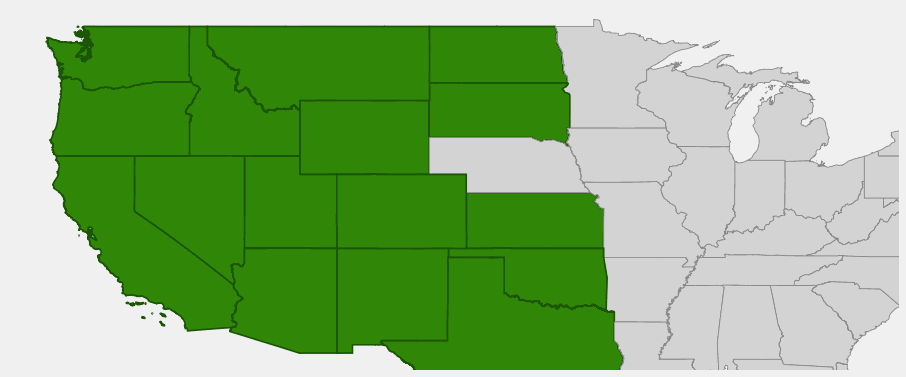
Alkali Sacaton is native to a broad swath of western and central North America, from the Great Plains west to California and south through the Chihuahuan and Sonoran Deserts into Mexico. In the United States, it occurs across much of the arid and semi-arid West, reaching its highest densities in alkaline flats, playas, and desert grasslands of Arizona, New Mexico, Texas, Nevada, Utah, and Colorado.
In Arizona, Alkali Sacaton is one of the most characteristic grasses of the desert riparian zones and alkaline flats along the Salt, Verde, Gila, and San Pedro river systems. It is a dominant grass in the Chihuahuan Desert grassland transition zone in southeastern Arizona, where it often forms pure stands covering many acres. In New Mexico, it similarly dominates alkaline lowlands in the Rio Grande Valley and the Tularosa Basin. Throughout its range, it is associated with areas of poor drainage, seasonal inundation, and soils with elevated salts.
The species also extends northward through the Great Plains, where it occupies the alkaline flats and saline wetland margins in Colorado, Wyoming, South Dakota, North Dakota, and Montana. On the Pacific side, populations occur in the alkaline flats of Nevada, Utah, and in the Central Valley of California. This wide distribution reflects the plant’s extraordinary physiological tolerance for difficult soils and extreme temperature swings.
📋 Regional plant lists featuring Alkali Sacaton: Arizona
Growing & Care Guide
Alkali Sacaton is an extremely low-maintenance grass once established, requiring minimal inputs and thriving under conditions that would stress or kill most ornamental plants. Its key to success is matching it with the right site — once you do, this grass virtually takes care of itself.
Light
Alkali Sacaton requires full sun for best performance. It grows in open, exposed conditions in nature and will not thrive in shaded settings. Plant in a location that receives at least 8 hours of direct sunlight per day. In partially shaded sites, the plant will grow thinner and weaker, with reduced seed head production and increased susceptibility to disease.
Soil & Water
This is where Alkali Sacaton truly excels — it is one of the few ornamental-quality grasses that actually prefers alkaline, poorly drained, and even somewhat saline soils. It tolerates soil pH as high as 8.5 or more. While it handles heavy clay, caliche, and compacted soils, it also grows well in sandy and gravelly soils as long as there is occasional moisture. Once established (after the first full season), it is highly drought tolerant and requires no supplemental irrigation except during the most extreme droughts. During establishment, water deeply once or twice per week. After establishment, the deep root system sustains the plant through long dry periods.
Planting Tips
Plant container-grown Alkali Sacaton from spring through fall, though fall planting in Arizona allows the root system to establish during the cool season before summer heat arrives. Spacing of 3 to 5 feet apart allows clumps to mature fully without crowding. Seed can also be used for large revegetation projects — Alkali Sacaton establishes readily from seed when sown in fall on moist, bare soil. No fertilization is needed and is actually counterproductive — excess nitrogen produces excessive vegetative growth with weak structure.
Pruning & Maintenance
Alkali Sacaton is a warm-season grass that goes partially dormant in winter. In late winter or early spring (February to March in Arizona), cut the clumps back hard — to 4 to 6 inches — using hedge shears or a weed eater. This removes the old, straw-colored thatch and stimulates vigorous new growth. Avoid cutting back in fall, as the seed heads provide excellent winter bird food and winter interest. Division every 5 to 7 years helps rejuvenate older, woody clumps that have developed a dead center.
Landscape Uses
Alkali Sacaton’s versatility makes it an excellent choice for many challenging landscape situations:
- Erosion control on slopes, streambeds, and arroyo margins
- Stormwater management — absorbs and filters runoff in bioswales and detention basins
- Xeriscape foundation plantings — dramatic bunchgrass accent for desert gardens
- Revegetation of disturbed sites, mine reclamation, and highway rights-of-way
- Wildlife gardens — seed heads attract seed-eating birds all winter
- Alkaline/saline site remediation — one of few ornamental grasses tolerating these conditions
- Mass plantings for a naturalistic, prairie-like effect in large spaces
Wildlife & Ecological Value
Alkali Sacaton is a keystone grass species in many arid Western ecosystems, providing food, shelter, and structural habitat for a wide array of wildlife.
For Birds
The small, exposed seeds of Alkali Sacaton are eagerly consumed by seed-eating birds including White-crowned Sparrows, Dark-eyed Juncos, Horned Larks, Savannah Sparrows, and various finch species. The persistent seed heads provide food through winter months when other food sources are scarce. The dense basal clumps provide nesting sites for ground-nesting birds including Savannah Sparrows and Grasshopper Sparrows, as well as ground cover for Gambel’s Quail and other desert gallinaceous birds.
For Mammals
Small mammals — particularly deer mice, harvest mice, and kangaroo rats — use Alkali Sacaton clumps for shelter and harvest the seeds as a food source. Pronghorn antelope graze the new spring growth in areas where this grass is abundant. Prairie dogs and ground squirrels also utilize stands of Alkali Sacaton in Great Plains habitats. The thick clumps provide essential hiding cover and runways for small mammals fleeing predators.
For Pollinators
Like most grasses, Alkali Sacaton is wind-pollinated and does not produce nectar. However, the grass provides important larval habitat for certain native moths and skippers whose caterpillars feed on grass foliage. The insect community supported by Alkali Sacaton stands provides food for insectivorous birds and bats.
Ecosystem Role
In alkaline playas and desert lowlands, Alkali Sacaton is often the dominant vegetation and functions as an ecosystem engineer — its deep roots improve soil structure, its litter decomposes into organic matter that slowly improves even the poorest soils, and its dense clumps trap windblown sediments, gradually building soil elevation. In riparian areas, it is one of the most effective native grasses for bank stabilization. Its tolerance of periodic flooding and saline conditions makes it irreplaceable in these specialized habitats.
Cultural & Historical Uses
Alkali Sacaton has a long history of use by Indigenous peoples of the American Southwest and Great Basin. The Pima and Tohono O’odham peoples used the grass for thatching roofs and walls of traditional structures — the dense, water-shedding seed heads made particularly effective thatch material. The stems were also used for weaving mats and baskets in some communities, though other grasses were more commonly preferred for fine basketry.
The Navajo used Alkali Sacaton as a fodder grass for horses and sheep — the grass’s palatability in early spring growth, when other vegetation is still dormant, made it particularly valuable during the lean months before summer rains brought new vegetation. The Navajo also gathered the seeds for flour, grinding them into a coarse meal used in breads and gruels. Historical accounts note that the seeds, while small, were plentiful enough in good years to make substantial harvests worthwhile.
In modern times, Alkali Sacaton has become increasingly important as a revegetation and erosion control grass for disturbed lands throughout the West. Road departments, mine reclamation specialists, and conservation organizations use it extensively because it is one of the few native grasses that establishes readily on disturbed alkaline soils where other species fail. Research by USDA’s Natural Resources Conservation Service (NRCS) has identified Alkali Sacaton as a priority species for riparian restoration in the Chihuahuan Desert region. Several commercial seed sources now offer it, making it increasingly available for restoration and landscaping projects.
Frequently Asked Questions
How big does Alkali Sacaton get?
Alkali Sacaton typically forms clumps 2 to 4 feet tall and 3 to 5 feet wide at maturity. In very favorable conditions — deep soils with occasional moisture — it may reach 5 feet in height. The batch data lists 2 ft as a conservative estimate for typical landscape conditions.
Does Alkali Sacaton spread aggressively?
No. Alkali Sacaton is a clump-forming (not spreading) grass that stays in a defined clump. It does reseed itself, and seedlings can appear in ideal germination conditions (moist, bare alkaline soil), but it is not considered invasive and is easy to manage. In most garden settings, volunteer seedlings are minimal.
Can Alkali Sacaton grow in regular garden soil?
Yes, it can tolerate a range of soils, though it is most at home in alkaline, well-drained, or periodically wet soils. In rich, well-amended garden soils, it may grow faster but be more prone to flopping. It actually needs no soil amendment and performs best with minimal intervention.
Is Alkali Sacaton deer resistant?
Mature plants are moderately resistant to deer browsing. Deer may sample new spring growth but generally leave established clumps alone. In areas with heavy deer pressure, some grazing of new growth may occur, but established plants recover quickly.
When is the best time to plant Alkali Sacaton in Arizona?
Fall (September through November) is the best planting time in low desert Arizona. This allows the root system to establish during the mild winter before facing the intense heat of summer. Spring planting (February through April) also works well. Avoid planting in summer unless you can provide consistent irrigation.

Looking for a nursery that carries Alkali Sacaton?
Browse our native plant nursery directory: Arizona