Alpine Bluegrass (Poa alpina)
Poa alpina, commonly known as Alpine Bluegrass, is a compact, densely tufted perennial grass native to alpine and subalpine zones across Alaska, the Rocky Mountains, and scattered high-elevation locations in the northeastern United States. One of the most cold-hardy and ecologically important grasses in North America’s mountain ecosystems, Alpine Bluegrass forms low, dense mats of thick, fleshy leaves that persist through extreme conditions — snowpack, freeze-thaw cycles, desiccating winds, and rocky, nutrient-poor soils — where few other plants can survive.
Distinctive for its stout, fleshy leaf blades and its unusual capacity for vivipary (producing tiny plantlets within the flower head instead of seeds), Alpine Bluegrass plays a critical ecological role on alpine tundra and in subalpine meadows. It serves as forage for mountain ungulates including caribou, Dall sheep, and mountain goats, and provides stabilizing ground cover on fragile alpine soils and disturbed slopes. Its drought tolerance and deep root system make it exceptionally suited to the demanding conditions of high-altitude environments, and it has been increasingly recognized for its value in high-elevation revegetation and restoration projects.
Beyond its ecological significance, Alpine Bluegrass has a quiet beauty — the dense bluish-green tufts, the delicate purple-tinged flower panicles waving in alpine breezes, and the golden autumn color create visual interest across multiple seasons. For rock gardens, native meadow restorations, and high-altitude landscaping, Poa alpina is an outstanding, low-maintenance native grass that connects gardens to the wild character of Alaska’s mountains and the American alpine landscape.
Identification
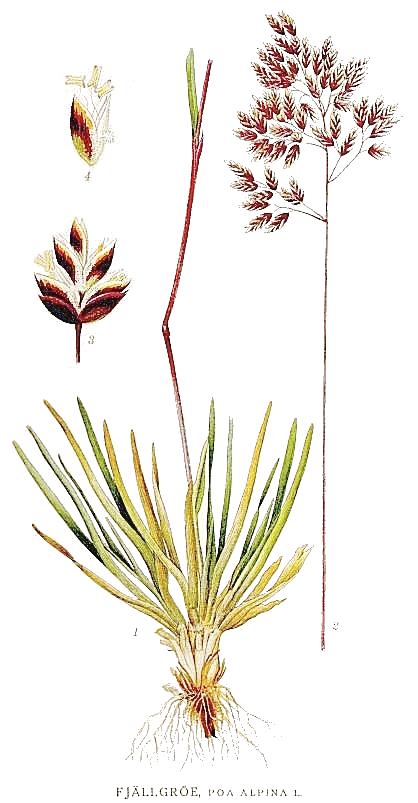
Alpine Bluegrass is a low-growing, densely clump-forming (caespitose) perennial grass, typically reaching 6–24 inches (15–60 cm) tall in flower, though vegetative tufts may be much shorter. The overall growth habit is distinctly compact and tufted, forming tight clumps rather than spreading by rhizomes. The species is readily identified by its combination of stout, fleshy leaf blades, relatively broad leaves for a bluegrass, and its tendency toward vivipary.
Leaves
The leaf blades are the most distinctive feature: they are noticeably stout and somewhat fleshy, flat to folded, 1–5 inches (3–12 cm) long and 2–5 mm wide — broad for a species of Poa. The tips are boat-shaped (prow-tipped), a characteristic shared with other bluegrasses. The color is typically a medium to bluish green, giving the species its common name. The ligule (the membrane at the junction of the leaf blade and sheath) is 1–4 mm long and membranous. Leaf sheaths are smooth and closed for about half their length. The basal leaves are particularly dense, forming the characteristic tight tuft.
Flowers & Seed Heads
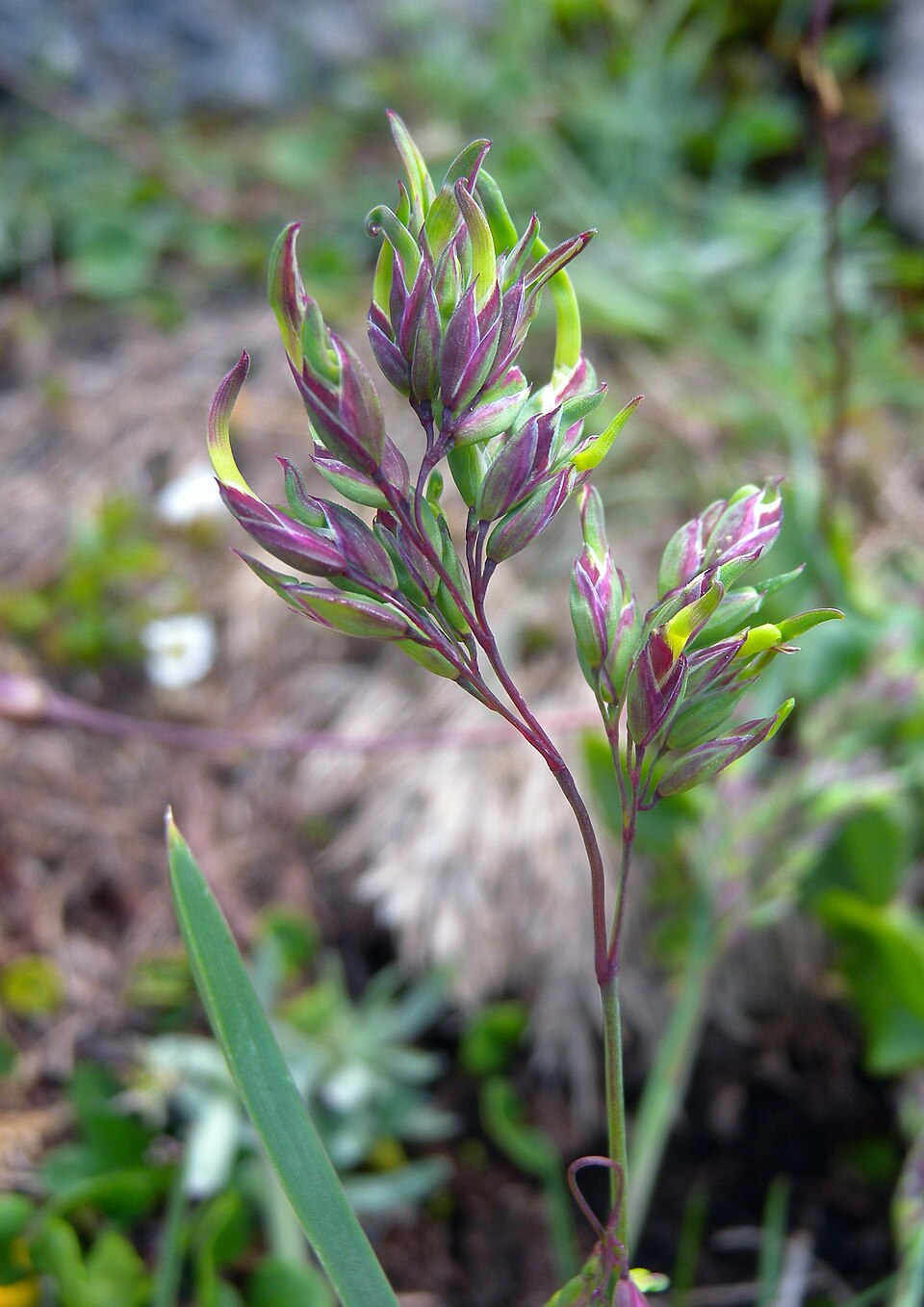
The inflorescence is a contracted to open panicle, 1–4 inches (3–10 cm) long, with branches bearing 2–5 spikelets. Spikelets are 3–7 mm long and contain 2–6 florets. The glumes are broad with distinct veins. In Poa alpina, a remarkable phenomenon frequently occurs: vivipary, where the spikelets are converted into tiny plantlets (bulbils) rather than producing seeds. These miniature plantlets — complete with tiny leaves — eventually fall from the parent plant and root independently, allowing the species to reproduce vegetatively in the challenging alpine environment where seed set is unreliable. Viviparous plants are often treated as a separate variety, var. vivipara, though vivipary and normal seed production can occur together. Blooming occurs June through August at lower alpine elevations, later at higher elevations.
Roots
The root system is fibrous and relatively deep for a small alpine grass, enabling access to moisture in rocky soils and strong anchorage on steep slopes. Dense fibrous roots bind soil particles and contribute to slope stabilization, an important ecological function in fragile alpine terrain where erosion risk is high.
Quick Facts
| Scientific Name | Poa alpina |
| Family | Poaceae (Grass Family) |
| Plant Type | Perennial Grass |
| Mature Height | 2 ft |
| Sun Exposure | Full Sun to Part Shade |
| Water Needs | Low (Drought Tolerant) |
| Bloom Time | June – August |
| Flower Color | Green to purplish (viviparous forms produce tiny plantlets) |
| USDA Hardiness Zones | 3–8 |
Native Range
Poa alpina has a circumboreal and alpine distribution, occurring across the high mountains and arctic tundra of the Northern Hemisphere. In North America, it is native to Alaska, where it is widespread and common from the Alaska Range and Wrangell-St. Elias mountains south through the Kenai Peninsula and Kodiak Island, to high-elevation alpine zones across the Rockies, Cascades, Sierra Nevada, and isolated northeastern peaks.
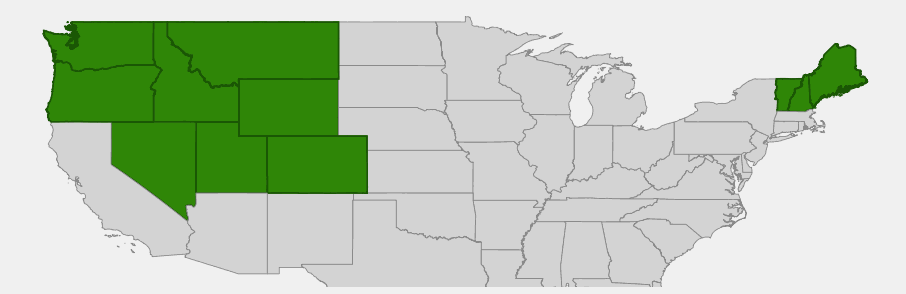
In Alaska, Alpine Bluegrass is one of the most common grasses of alpine and subalpine communities, occurring from sea level in arctic and subarctic tundra to above 6,000 feet in the Alaska Range. It thrives in a diversity of habitats including alpine meadows, rocky slopes, talus, fell-fields, streambanks, and disturbed areas. The species is also found across Canada (British Columbia, Alberta, Yukon, Northwest Territories, Nunavut, Quebec, New Brunswick) and south through the Rocky Mountains into Colorado, Utah, Nevada, and Wyoming. Isolated populations occur in the White Mountains of New Hampshire, the Green Mountains of Vermont, and other northeastern alpine summits.
Its wide distribution reflects exceptional adaptability to cold, nutrient-poor environments. Alpine Bluegrass is among the highest-elevation grasses in North America, colonizing bare mineral substrates at the margins of permanent snowfields and glaciers where growing seasons may last only 6–8 weeks per year. It is also a pioneer species on recently deglaciated terrain, being among the first grasses to establish on glacial moraines and outwash plains — a significant ecological role as Alaskan glaciers continue to retreat.
📋 Regional plant lists featuring Alpine Bluegrass: Alaska
Growing & Care Guide
Alpine Bluegrass is a low-maintenance, cold-hardy native grass that thrives in conditions where most ornamental grasses fail. Its adaptation to harsh alpine environments translates directly into exceptional resilience in the garden, particularly in cold climates, rocky soils, and sites with low fertility.
Light
In the wild, Poa alpina grows primarily in full sun on exposed alpine ridges and meadows, but also tolerates partial shade on north-facing slopes and under open shrubs. In the garden, full sun to part shade produces the best performance. At least 4–6 hours of direct sunlight promotes dense, compact growth and good flowering. In shadier conditions, the plant remains healthy but may grow taller and less tightly tufted.
Soil & Water
True to its alpine origins, Alpine Bluegrass thrives in lean, well-drained soils — it actually performs better in poor, rocky, or gravelly soils than in rich garden loam. Rich soils tend to produce lax, floppy growth and can reduce the plant’s natural compact form. The key requirement is excellent drainage: standing water or heavy clay soils are problematic. Moisture needs are low — established plants are quite drought tolerant, surviving on natural precipitation in most of its native range. Supplemental irrigation may help with establishment but should be minimal thereafter. This grass has no special pH requirements, growing in substrates ranging from acidic granite-derived soils to alkaline limestone talus.
Planting Tips
Alpine Bluegrass is best planted from nursery-grown plugs or divisions in spring. Prepare planting sites by incorporating coarse gravel or sand into heavy soils to improve drainage. Plant at the same depth as in the container, spacing plants 8–12 inches apart for ground cover effect, or 12–18 inches apart for specimen plants. Mulching with fine gravel mimics alpine conditions and helps maintain soil temperature stability. Avoid organic mulches that may hold excess moisture against the crown.
Pruning & Maintenance
Alpine Bluegrass is essentially self-maintaining. In spring, remove any dead foliage by gently raking through the tuft or trimming old flower stalks. Avoid cutting into the growing crown. Division every 3–5 years rejuvenates older plants and controls spread, though the tufted form rarely becomes invasive. Fertilization is generally unnecessary and may actually be harmful, promoting weedy, floppy growth inconsistent with the plant’s natural compact character.
Landscape Uses
Alpine Bluegrass excels in several garden contexts:
- Rock gardens and alpine gardens — perfectly scaled for rocky, well-drained beds
- Native meadow restorations — blends well with alpine wildflowers
- Slope stabilization — fibrous roots bind soil on slopes
- Pathway edging — compact habit suits border plantings
- Container planting — does well in raised troughs or alpine containers
- Green roofs — lightweight and drought tolerant for engineered systems
Wildlife & Ecological Value
In alpine ecosystems, Poa alpina is a foundational forage species that supports a diverse community of wildlife across multiple trophic levels.
For Birds
Alpine Bluegrass provides seed and vegetative material for ptarmigan (Willow Ptarmigan, Rock Ptarmigan, White-tailed Ptarmigan), which are year-round residents of alpine environments in Alaska. Rosy-finches and Snow Buntings forage on seeds in late summer and fall, and White-crowned Sparrows use the dense tufts for nest concealment in subalpine shrub-grass transition zones. The viviparous plantlets are particularly valuable as they remain attached to the parent plant well into the growing season, providing a sustained food source.
For Mammals
Alpine Bluegrass is an important forage grass for Dall sheep, caribou, and muskoxen in Alaska and the Yukon. Mountain goats browse the plants throughout summer, preferring the nutritious green growth on early-melting snow patches. Pika (Ochotona princeps) harvest and cache Alpine Bluegrass hay in rock piles for winter food storage — an iconic alpine behavior. Ground squirrels (Urocitellus parryii) graze extensively on the grass near their burrows, and lemmings use the dense tufts for shelter and foraging beneath winter snow.
For Pollinators
As a wind-pollinated grass, Alpine Bluegrass does not provide nectar, but the flowering spikelets contribute pollen to the alpine environment. More importantly, the dense, low-growing tufts create microhabitat for various insects — bumblebees overwinter in the soil beneath grass tufts, and alpine beetles and ground beetles use the spaces between tillers for shelter from wind and cold. The grass mats also create stable microsites where smaller alpine flowers can establish, indirectly supporting pollinator habitat diversity.
Ecosystem Role
In alpine tundra, Alpine Bluegrass plays an essential role in soil stabilization, preventing erosion on steep slopes and serving as a pioneer on disturbed or recently deglaciated soils. As glaciers retreat in Alaska and throughout western North America, Poa alpina is among the earliest colonizers of exposed mineral soils, beginning the slow process of soil building that eventually supports more complex plant communities. The species also contributes to carbon cycling in alpine systems — its deep fibrous roots deposit organic matter and create soil structure in otherwise barren substrates.
Cultural & Historical Uses
Alpine Bluegrass has not been a major cultural plant for humans in the way of many forest species, but its role in supporting subsistence practices in Alaska and the circumpolar north is significant. Indigenous peoples of Alaska — including the Athabascan, Yup’ik, and Inupiaq communities — have relied indirectly on Alpine Bluegrass through the animals it sustains. Caribou and Dall sheep, both of which consume large quantities of alpine grasses including Poa alpina, have been foundational food, clothing, and tool sources for Alaska Native peoples for thousands of years. Understanding where these grasses grew, and when, was part of traditional ecological knowledge informing hunting practices and seasonal movements.
Alpine Bluegrass has been used in range and pasture management throughout its range. The U.S. Forest Service and state agencies have used it extensively in high-elevation revegetation projects following mining disturbances, trail construction, and ski area development. It is one of a limited number of grasses capable of establishing at elevations above treeline in the American West, and its performance in these harsh environments has been extensively studied. Several seed sources have been developed for restoration use, selected from local ecotypes to ensure adaptation to specific regional conditions.
In European alpine regions, Poa alpina has a longer history of agricultural use, having been selected as a high-quality forage grass for mountain pasturelands. The species is known to alpine farmers as a reliable, nutritious pasture grass that persists under heavy grazing pressure. In North America, its use in managed pastures is limited by its small size and specialized adaptation to alpine conditions, but its ecological value continues to be recognized in rangeland conservation programs throughout the Rocky Mountain West and in Alaska.
Frequently Asked Questions
What makes Alpine Bluegrass different from other bluegrasses?
Poa alpina is distinguished by its stout, fleshy leaf blades (much thicker than lawn bluegrass), its densely tufted growth habit without rhizomes, and its remarkable tendency toward vivipary — producing tiny plantlets in the flower head rather than seeds. It is also far more cold-hardy and drought-tolerant than Kentucky Bluegrass (Poa pratensis).
Can Alpine Bluegrass grow at low elevations?
Yes, with some limitations. Alpine Bluegrass can grow at low elevations if provided with excellent drainage, lean soils, and cool temperatures. It tends to perform poorly in hot, humid summer climates and may struggle where summer heat is prolonged. It performs best in USDA Zones 3–7 in cold, northern, or high-altitude gardens.
Is Alpine Bluegrass suitable for a lawn?
It is not suitable as a traditional lawn grass — it forms distinct clumps rather than a continuous sod, and is too small and slow-growing for typical lawn use. However, it works beautifully in meadow-style plantings, rock gardens, and as a turf alternative in cool, harsh alpine or subarctic conditions where conventional lawn grasses fail.
How does vivipary work in Alpine Bluegrass?
Vivipary occurs when the spikelets (normally flower-producing units) are converted into tiny leafy plantlets. These plantlets eventually detach and fall to the ground, where they root and establish as new plants. This is an adaptation to alpine environments where the growing season is too short for reliable seed maturation, or where conditions favor clonal spread. Both viviparous and normal seed-producing plants occur across the species’ range.
Where can I buy Alpine Bluegrass plants or seeds?
Alpine Bluegrass is available from specialty native plant nurseries and native seed suppliers focused on high-altitude and cool-climate plants. Look for ecotypes sourced from your region for best performance. Seeds can also be harvested in late summer from wild plants, with appropriate permits.

Looking for a nursery that carries Alpine Bluegrass?
Browse our native plant nursery directory: Alaska