American Beautyberry (Callicarpa americana)
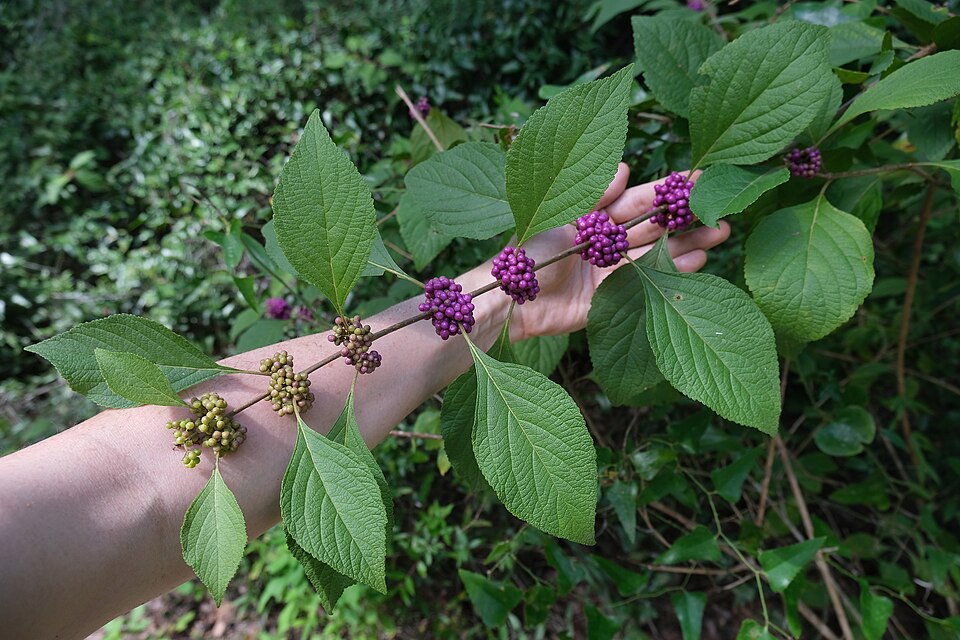
Callicarpa americana, commonly known as American Beautyberry, is one of the most visually striking native shrubs of the Eastern and South-Central United States. Its fame rests almost entirely on its extraordinary fruit — dense, tightly-packed clusters of brilliantly iridescent purple-violet berries that encircle the arching stems in late summer and fall, producing a display so vivid it looks almost artificial. No other plant in the American landscape produces quite this shade of luminous magenta-purple, which is why American Beautyberry has earned devoted fans among gardeners, wildlife enthusiasts, and native plant advocates alike.
A member of the Lamiaceae (mint) family — though formerly classified in Verbenaceae — American Beautyberry grows as a loose, arching deciduous shrub typically reaching 4 to 6 feet tall and equally wide. Its coarsely-toothed, oval leaves are large and somewhat dowdy through spring and summer, but the plant more than compensates with its spectacular fall fruit display. Small pink to lavender flowers emerge in clusters along the stems in midsummer, attracting bees and butterflies, before giving way to the berries that persist into winter. In mild winters, the stems can hold fruit long after the leaves drop, creating striking bare-branch berry displays against the winter landscape.
Beyond its ornamental value, American Beautyberry is an ecological workhorse. The berries are consumed by over 40 species of birds, including mockingbirds, catbirds, robins, towhees, and brown thrashers — as well as white-tailed deer, foxes, raccoons, opossums, and squirrels. Indigenous peoples used the leaves and roots medicinally and as an insect repellent. Modern research has confirmed that compounds in the plant’s leaves (callicarpenal and intermedeol) do indeed repel mosquitoes, deer ticks, and fire ants, validating centuries of traditional use. American Beautyberry is as functional as it is beautiful, making it an excellent choice for wildlife gardens, woodland edges, and naturalistic landscapes across the Eastern United States.
Identification
American Beautyberry is a medium-sized deciduous shrub with a loose, arching growth habit. Mature plants typically reach 4 to 6 feet in height with an equal or greater spread, forming a graceful, somewhat vase-shaped form. The overall impression is of a lax, open shrub with long arching branches that eventually bend toward the ground under the weight of fruit.
Leaves
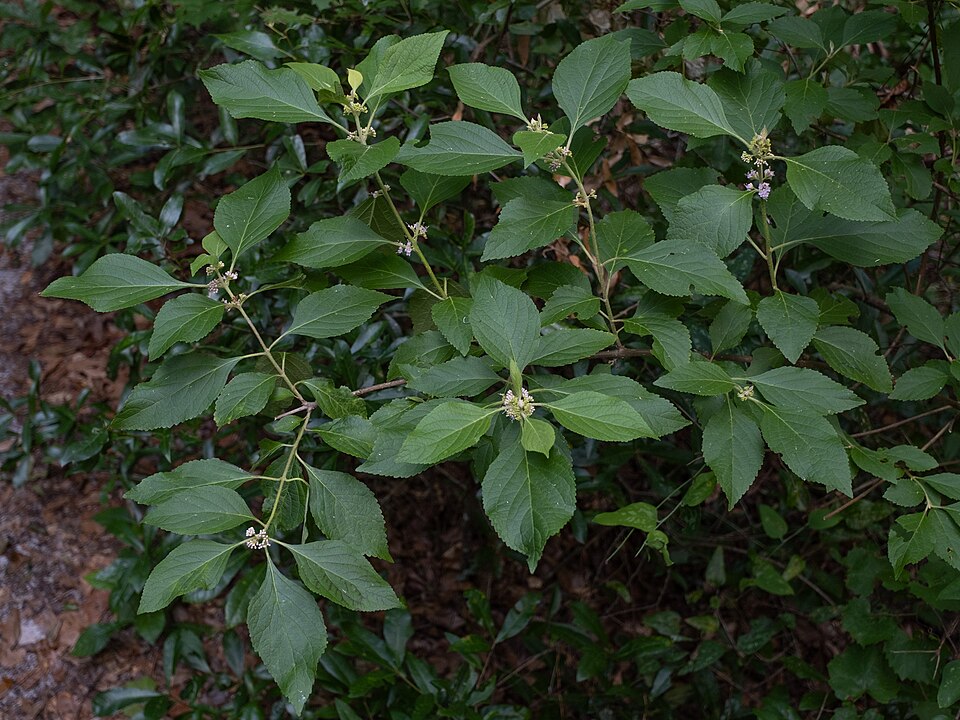
The leaves are the largest feature through most of the growing season — they are ovate to elliptic, 3 to 6 inches long and 1 to 3 inches wide, with a coarsely toothed margin. The leaf surface is somewhat rough or hairy on both sides. Leaves are arranged oppositely on the stems. The foliage is a medium to light green, providing a pleasant but unremarkable backdrop for the spectacular fruit display to come. Fall color is generally yellow, though not particularly showy. When crushed, the leaves emit a distinctive odor from the aromatic compounds that make them useful as an insect repellent.
Flowers
The flowers are small, tubular, and lavender to pinkish-white, clustered in dense axillary cymes along the stems in the leaf axils. They bloom from approximately June through August, emerging in multiple flushes. While not individually showy, the flower clusters are attractive up close and serve as an important nectar source for native bees, butterflies, and other pollinators. The flowers are perfect (containing both male and female parts) and are primarily insect-pollinated.
Fruit
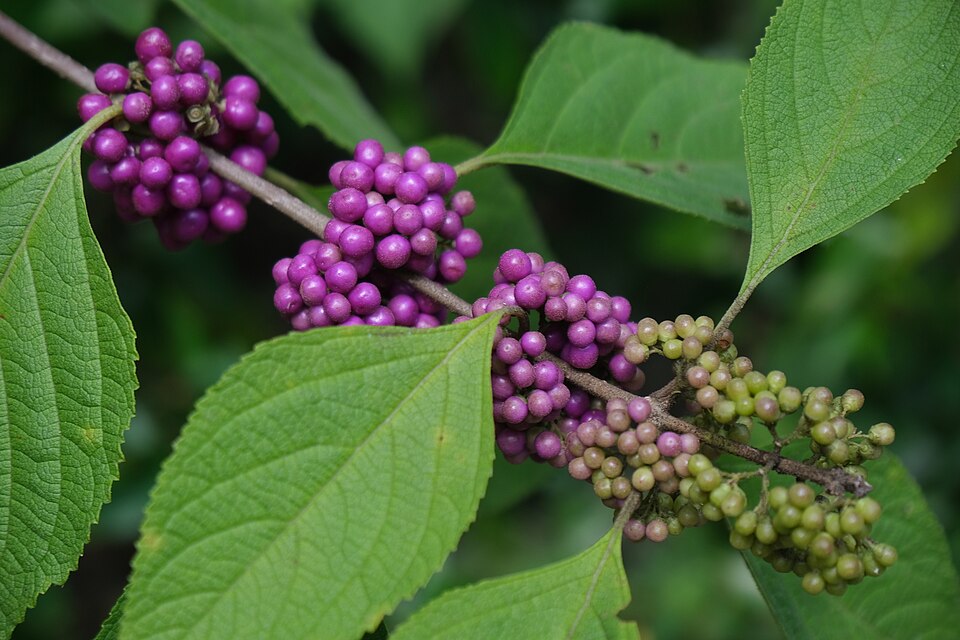
The fruit — berries technically called drupes — is what makes this plant legendary. They ripen in late summer through early fall (August–October), forming in extraordinarily dense, tightly-packed clusters (whorls) that completely encircle the stems at leaf nodes, creating the appearance of bracelets of gems decorating every branch. The color is a vivid, almost metallic, purple-violet to magenta-purple, a color so unusual and brilliant that it stops people in their tracks. Each individual drupe is small — about 3–4 mm in diameter — but the sheer density of the clusters creates enormous visual impact. The fruit persists into winter, especially if wildlife consumption is slow.
Quick Facts
| Scientific Name | Callicarpa americana |
| Family | Lamiaceae (Mint family; formerly Verbenaceae) |
| Plant Type | Deciduous Shrub |
| Mature Height | 4–6 ft |
| Sun Exposure | Full Sun to Part Shade |
| Water Needs | Low to Moderate |
| Bloom Time | June – August |
| Flower Color | Pink to lavender |
| Fruit Color | Iridescent purple-violet (August–winter) |
| Fall Color | Yellow |
| Deer Resistant | Moderately (deer browse but rarely decimate) |
| USDA Hardiness Zones | 6–11 |
Native Range
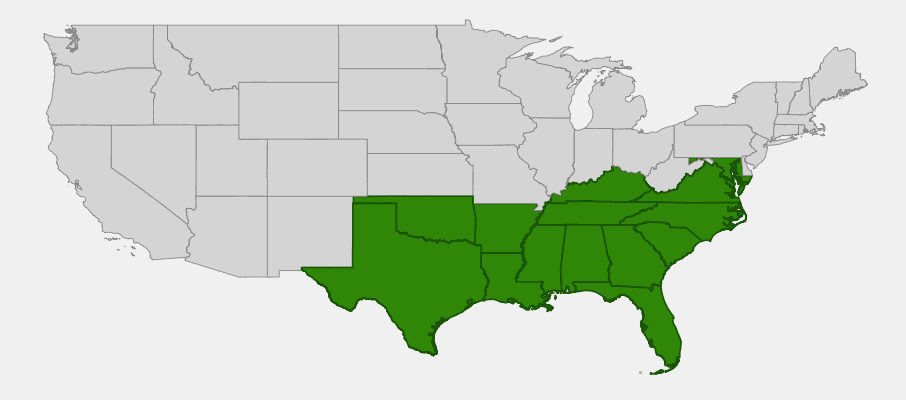
American Beautyberry is native to the Southeastern and South-Central United States, ranging from Maryland and Virginia south through the Carolinas, Florida, and across to Texas and Oklahoma, and north along the Mississippi Valley into Missouri, Illinois, and Iowa. It is especially abundant in the Gulf Coast states — Alabama, Mississippi, Georgia, Florida, Louisiana, and Texas — where it is a common understory shrub in pine forests, woodland margins, and floodplain thickets. In Kentucky and Tennessee, it reaches its northern interior limits, typically found in sheltered, south-facing ravines and bottomland woods.
American Beautyberry thrives in the warm, humid climate of the Southeastern Coastal Plain, where it grows in a wide variety of habitats: the understory of mesic mixed hardwood forests, pine flatwoods, upland pine-oak woodlands, stream corridors, and disturbed woodland edges. It is notably adaptable — tolerating both moist bottomland soils and drier upland conditions, as long as it receives some shade during the hottest part of the day in its northern range. In the Deep South, it often grows in large colonies along roadsides and forest edges, creating spectacular late-summer berry shows.
In Kentucky and Tennessee, American Beautyberry is typically found in the western portions of both states, particularly in the Jackson Purchase region of Kentucky and the West Tennessee lowlands. These areas share the flat, loamy floodplain soils and warm summers that characterize the Mississippi Embayment — conditions similar to Arkansas, Missouri, and the other north-central states where the species extends its range up the Mississippi Valley.
📋 Regional plant lists featuring American Beautyberry: Kentucky & Tennessee
Growing & Care Guide
American Beautyberry is one of the easiest native shrubs to grow in the Southeast and South-Central United States. Once established, it is remarkably self-sufficient, requiring little attention beyond an occasional hard pruning to maintain size and vigor. Its adaptability to a range of soil and light conditions makes it suitable for many garden situations.
Light
American Beautyberry performs best in full sun to part shade. In full sun, it produces the most abundant fruit and maintains a compact, upright form. In part shade (3–6 hours of direct sun), it still fruits well but may develop a slightly more open, sprawling form. In deep shade, fruiting diminishes significantly and the plant may become leggy. For gardeners in zones 8 and above, afternoon shade helps protect leaves from heat stress during peak summer.
Soil & Water
One of American Beautyberry’s great virtues is its soil adaptability. It grows in sandy, loamy, or clay soils and tolerates both moist conditions along stream banks and moderately dry conditions on upland sites. It prefers well-drained soils with a slightly acidic pH (5.0–6.5), but is quite forgiving outside these parameters. Once established — typically after one to two growing seasons — it has good drought tolerance, requiring little to no supplemental irrigation except during extended dry spells. It does not tolerate prolonged standing water or waterlogged soils.
Planting Tips
Plant American Beautyberry in spring or fall for best establishment. Space plants 5–6 feet apart if using multiple shrubs in a mass planting, or give a single specimen at least 6 feet of space to accommodate its natural arching habit. Container-grown plants establish readily. Adding 2–3 inches of organic mulch around the root zone helps retain soil moisture, moderates soil temperature, and mimics the leaf litter conditions of its natural forest floor habitat.
Pruning & Maintenance
American Beautyberry benefits from hard rejuvenation pruning every 2–3 years. Cut the entire plant to within 6–12 inches of the ground in late winter or early spring (before new growth emerges). This vigorous pruning produces the most vigorous new growth and the best fruit production — the plant fruits on current-year wood, so cutting it back hard stimulates the long, arching new branches that carry the most berries. Without regular pruning, plants can become woody and sprawling with diminished fruit production. Annual light pruning to remove dead wood is also beneficial.
Landscape Uses
- Wildlife garden centerpiece — the purple berries draw an extraordinary diversity of birds and mammals
- Woodland edge planting — thrives at the transition between sun and shade
- Native shrub border — spectacular fall interest alongside other fruiting natives
- Rain garden — tolerates temporary wet conditions
- Erosion control on slopes and stream banks
- Naturalized areas — spreads via bird-dispersed seeds to colonize woodland margins
- Children’s gardens — the extraordinary fruit color never fails to amaze
Wildlife & Ecological Value
American Beautyberry is one of the most wildlife-productive shrubs in the Eastern United States, providing food, shelter, and insect habitat across multiple seasons. It is an essential component of bird-friendly native gardens throughout its range.
For Birds
The berries are consumed eagerly by more than 40 species of birds, including Northern Mockingbird, Gray Catbird, American Robin, Brown Thrasher, Eastern Towhee, Northern Cardinal, American Woodcock, Cedar Waxwing, Purple Finch, and many warblers and thrushes during fall migration. The shrub’s dense growth also provides excellent nesting habitat and protective cover. In fall, migrating birds may strip the berries within days — so if you want to observe feeding activity, check the plant frequently in September and October.
For Mammals
White-tailed deer browse the foliage and fruit, though they rarely eliminate a planting. Raccoons, gray foxes, opossums, squirrels, and skunks all consume the berries. The plant’s roots and foliage are used by burrowing mammals as well. In the Deep South, American Beautyberry colonies provide critical cover and forage for white-tailed deer throughout the year.
For Pollinators
The small but plentiful summer flowers attract native bees — especially bumble bees and sweat bees — along with various butterfly species and beneficial flies. Because the flowers are produced in multiple flushes from June through August, they provide a sustained nectar source during the midsummer period when many other shrubs have finished blooming. The plant’s foliage also supports the caterpillars of several moth species.
Ecosystem Role
American Beautyberry plays a keystone role in the ecology of Southeastern woodland edges and forest understories. As a fruiting shrub in the mid-layer of forest structure, it links the canopy to the ground layer, providing food resources at a height accessible to both ground-feeding and mid-story birds. Its ability to regenerate quickly after fire, browsing, or mechanical disturbance makes it an important component of forest recovery and gap-filling. The plant’s allelopathic properties — its leaves suppress the germination of some competing plants — also help it establish and maintain its place in the woodland community.
Cultural & Historical Uses
American Beautyberry has a long history of use by Indigenous peoples throughout the Southeastern United States. The Cherokee, Creek, Choctaw, and other nations used various parts of the plant medicinally. Root tea was used to treat fever, dizziness, and rheumatism. Bark tea was given to treat colic and as a diuretic. Leaves were used in sweat lodge treatments for rheumatism and as a poultice for headaches.
Perhaps the most remarkable traditional use — and one that has attracted modern scientific interest — is as an insect repellent. Indigenous peoples reportedly crushed the leaves and rubbed them on skin and the bodies of horses to repel mosquitoes and ticks, or wove branches into horse bridles and harnesses for the same purpose. Farmers throughout the Deep South continued this practice well into the 20th century, weaving beautyberry branches under hat brims and around horse collars to keep insects at bay. This folk knowledge prompted scientific investigation at the USDA’s Agricultural Research Service in Gainesville, Florida, which confirmed in studies published in 2006 that compounds in beautyberry leaves — particularly callicarpenal and intermedeol — are as effective as DEET at repelling mosquitoes, deer ticks, and fire ants.
Historically, American Beautyberry berries were occasionally used to make jelly and preserves, though they are not particularly tasty raw. The berries have a faintly sweet but astringent flavor and are mildly toxic in large quantities. Today, beautyberry jelly has become something of a regional specialty, particularly in the Gulf Coast states, where home preservers prize its unusual color and delicate floral flavor. The plant has also been cultivated as an ornamental since colonial times, and several cultivars with white berries (‘Lactea’), more compact habits (‘Duet’), and variegated foliage have been developed for the garden trade.
Frequently Asked Questions
Are American Beautyberry berries edible?
The berries are technically edible when fully ripe and have been used to make jelly, but they are somewhat astringent and mildly toxic in large quantities when eaten raw. They should not be confused with food-grade berries. Leave them for the wildlife — that’s where they do the most good.
Can American Beautyberry grow in deep shade?
It will survive in light shade but performs best with at least 4–6 hours of direct sun. In deep shade, the plant becomes leggy and produces very little fruit. For the best berry display, choose a spot with full morning sun and afternoon shade, or light dappled shade throughout the day.
Does American Beautyberry spread aggressively?
It spreads via bird-dispersed seeds and can naturalize in suitable areas over time, but it is not considered invasive and does not spread aggressively. It is easy to manage by removing seedlings if they appear in unwanted locations. The spreading behavior is actually a feature in naturalistic woodland garden designs.
Why did my beautyberry not produce many berries?
Inadequate sun is the most common cause. The plant needs at least half a day of direct sun for good fruit production. Also check whether you pruned at the wrong time — beautyberry blooms and fruits on new wood, so pruning in late spring or summer removes the berry-producing wood. Only prune in late winter or early spring.
Is American Beautyberry deer resistant?
Not highly deer resistant — deer will browse the foliage and occasionally the berries. However, deer rarely eliminate an established planting, and the plant regrows vigorously from the roots even if severely browsed. In areas with high deer pressure, protect young plants with tree tubes or fencing until established.