
Arizona Alder (Alnus oblongifolia)
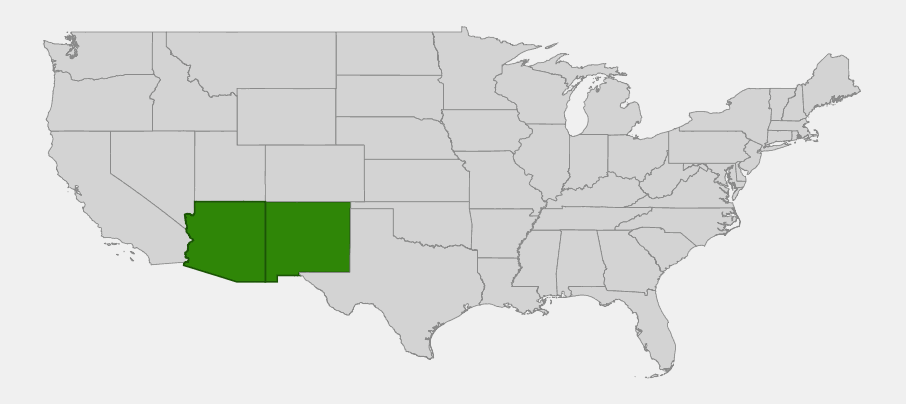
A note on photos: Arizona Alder is poorly represented in open-licensed photo archives. No Wikimedia Commons image of this species currently meets our sourcing standards for a hero or identification photo, so this page is illustrated with its native range map only. We will add photos as soon as a verifiable, appropriately licensed image becomes available.
Alnus oblongifolia, commonly known as Arizona Alder, is the largest native alder of the American Southwest and one of the signature trees of perennial streams in the Madrean sky-island mountains of Arizona and New Mexico. Where its roots can reach year-round water, it grows into a tall, arching streamside tree — reportedly to 70 feet or more in the best canyon-bottom sites — forming the shady, green corridor that marks a living desert stream from a dry wash.
Arizona Alder belongs to the birch family (Betulaceae) and, like other alders, hosts nitrogen-fixing bacteria in root nodules, allowing it to thrive in the nutrient-poor, rocky soils typical of mountain canyons while enriching the ground around it for other riparian plants. It is an obligate streamside species: in the wild it is essentially never found away from reliable surface or near-surface water, and that dependence makes it both a strong indicator of stream health and a species increasingly affected by groundwater pumping and drought in the Southwest.
For a large property with a perennial stream, pond, or reliably irrigated low spot in Arizona or New Mexico, Arizona Alder makes a fast-growing, handsome shade tree with genuine regional identity. It is not a candidate for dry upland gardens or small residential lots without consistent water.
Identification
Arizona Alder is a medium to large deciduous tree, typically 40 to 60 feet tall in cultivation and reported to reach 70 feet or more in favorable wild canyon sites, with a trunk that can exceed 2 feet in diameter on old streamside individuals. It usually grows with a single trunk and an open, rounded to spreading crown, often leaning gracefully out over the water it depends on.
Bark
Young bark is smooth and gray, often with a slightly mottled or blotchy appearance similar to sycamore bark at a distance. With age it becomes darker, furrowed, and broken into small scaly plates, though it remains noticeably thinner and smoother than many other large Southwestern trees.
Leaves
Leaves are oblong to elliptic — the trait behind the species name oblongifolia — typically 2 to 4 inches long, with sharply, doubly toothed margins and a somewhat leathery texture. The upper surface is dark green and the underside paler, sometimes with fine hairs along the veins. Leaves emerge later than the flowers, in spring, and turn a muted yellow before dropping in fall.
Flowers & Fruit
Arizona Alder is monoecious, bearing separate male and female flowers on the same tree, and it flowers conspicuously before leaf-out in late winter. Male catkins are long, slender, and pendant — 2 to 4 inches — turning yellowish-brown as they shed pollen on the wind in January through March. Female flowers are much smaller and develop into woody, cone-like strobiles about ½ to ¾ inch long that start green, mature to brown, and persist on the tree through winter, releasing small winged nutlets. These persistent “alder cones” are a reliable identification feature even when the tree is bare.
Quick Facts
| Scientific Name | Alnus oblongifolia |
| Family | Betulaceae (Birch) |
| Plant Type | Deciduous Tree |
| Mature Height | 40–60 ft, to 70+ ft in favorable canyon sites |
| Growth Rate | Fast (with reliable water) |
| Sun Exposure | Full Sun to Part Shade |
| Water Needs | High — requires reliable, near-constant moisture |
| Soil Type | Moist, well-drained streamside soils; sandy-loam to rocky |
| Soil pH | 6.0–7.5 |
| Bloom Time | January – March (before leaf-out) |
| Fruit | Small woody cone-like strobiles, persistent through winter |
| Special Trait | Nitrogen-fixing root nodules improve streamside soil |
| USDA Hardiness Zones | 7–9 |
Native Range
Arizona Alder follows perennial and near-perennial streams through the Madrean sky-island mountain ranges of southeastern and central Arizona and into scattered ranges of western New Mexico, continuing south into the Sierra Madre Occidental of Sonora and northwestern Mexico. In Arizona its range extends from the Mogollon Rim and the White Mountains region south through the sky-island ranges near the border; in New Mexico it occurs more sparingly, in isolated mountain canyons. It typically grows between about 3,500 and 8,000 feet elevation, always tied to a reliable water source — a perennial creek, spring-fed reach, or canyon bottom with a shallow water table.
As an obligate riparian species, Arizona Alder is found growing directly along streambanks, often leaning out over the water, in the company of Arizona Sycamore, Arizona Walnut, Fremont Cottonwood, Netleaf Hackberry, and various willows. These canyon-bottom gallery forests are among the most biologically rich habitats in the Southwest, and Arizona Alder is one of their defining trees.
📋 Regional plant lists featuring Arizona Alder: Arizona & New Mexico
Growing & Care Guide
Arizona Alder rewards a site that can offer it what its native canyons provide: constant moisture, good drainage, and room to grow large. Without reliable water it will struggle and decline, so it is best reserved for pond edges, stream restoration sites, or heavily and consistently irrigated landscape features.
Light
Arizona Alder grows well in full sun along open streambanks, and tolerates part shade beneath a canopy of larger riparian trees. In cultivation, full sun with consistent soil moisture produces the fastest, healthiest growth.
Soil & Water
This is a water-dependent tree. It needs consistently moist, well-drained soil and does not tolerate drought — in the wild it simply does not grow away from a reliable water source. Streamside, sandy-loam, or rocky alluvial soils suit it well; it is not adapted to heavy, poorly drained clay. In a garden setting, Arizona Alder is best planted beside a pond, stream, or an area irrigated regularly enough to approximate perennial-stream conditions.
Planting Tips
Plant young, container-grown trees in fall or early spring, and water deeply and frequently through the first several growing seasons to establish a deep root system. Because of its ultimate size, give Arizona Alder plenty of room — 30 feet or more from structures and other large trees — and avoid planting near underground utilities, since riparian trees like this one root aggressively toward moisture.
Pruning & Maintenance
Prune in late winter while the tree is dormant to remove dead, damaged, or crossing branches and to maintain a strong central structure while the tree is young. Established Arizona Alders need little other maintenance beyond consistent irrigation; watch for stress symptoms such as leaf scorch or early leaf drop, which usually signal insufficient water rather than disease.
Landscape Uses
Arizona Alder fills a specific but valuable niche:
- Streambank and pond-edge plantings on properties with reliable water
- Riparian restoration projects in Arizona and New Mexico canyon systems
- Erosion control along stabilized streambanks, where its roots help hold soil
- Fast shade tree for large, well-watered landscapes
- Wildlife and bird habitat plantings near water features
It is not suitable for dry upland xeriscape gardens or small residential lots without a dedicated water source — in those settings, consider a drought-adapted native tree instead.
Wildlife & Ecological Value
As one of the defining trees of Southwestern canyon-bottom riparian forest, Arizona Alder supports a disproportionate share of regional wildlife relative to the small footprint riparian habitat occupies in the arid Southwest.
For Birds
The small winged seeds released from the persistent woody cones are eaten by Pine Siskins, Lesser Goldfinches, and other seed-eating songbirds through fall and winter. The dense streamside canopy Arizona Alder forms, together with its riparian associates, provides essential nesting and foraging habitat for a wide range of Southwestern birds, from flycatchers to warblers, in a landscape where such lush cover is otherwise scarce.
For Soil & Streamside Ecology
Like other alders, Arizona Alder hosts nitrogen-fixing Frankia bacteria in nodules on its roots, enriching the often nutrient-poor soils of rocky mountain canyons and benefiting neighboring riparian plants. Its root systems also help stabilize streambanks against erosion, and its shade helps moderate water temperatures for aquatic life in the creeks it lines.
Ecosystem Role
Arizona Alder is an indicator species for healthy, perennial Southwestern streams: where it thrives, water is reliably present at or near the surface year-round. As groundwater pumping, drought, and stream diversion have reduced perennial flow in many Arizona and New Mexico canyons, Arizona Alder populations have become an informal barometer of watershed health, and its presence (or decline) is closely watched by riparian ecologists in the region.
Cultural & Historical Uses
Arizona Alder has seen relatively limited documented traditional use compared to some other Southwestern riparian trees, likely owing to its narrow, canyon-bound distribution. Its wood, like that of other alders, is soft and not highly durable, and has seen only minor local use for items such as small woodworking projects and firewood. Its greatest value, historically and today, lies less in direct human use and more in its role anchoring the streamside forests that have long made Southwestern canyon riparian zones important sources of water, shade, and wildlife for people living in the arid region.
Frequently Asked Questions
Can Arizona Alder grow without a stream or pond nearby?
Not successfully over the long term. It is an obligate riparian species that depends on consistently available moisture; without a reliable water source — natural or irrigated — it will decline and is not a good candidate for typical dry-climate landscaping.
How is Arizona Alder different from other native alders?
It is the largest of the Southwestern native alders and the one most tied to Madrean sky-island canyon streams, distinguished from species like Thinleaf Alder by its larger stature, oblong leaves, and more southern, higher-elevation canyon distribution in Arizona and New Mexico.
Is Arizona Alder messy in a landscape?
It drops catkins in late winter and small woody cones through the year, along with modest leaf litter in fall — typical for a large deciduous riparian tree, and generally manageable with normal yard cleanup.
Does Arizona Alder fix nitrogen like legumes do?
Yes, though through a different partnership — its roots host nitrogen-fixing Frankia bacteria rather than the rhizobia used by legumes, a trait shared across the alder genus that helps it colonize nutrient-poor streamside soils.
Is Arizona Alder endangered?
It is assessed as Least Concern by the IUCN, but because it depends entirely on perennial water in a region facing increasing drought and groundwater depletion, local populations in specific canyons can be vulnerable even though the species as a whole is not formally threatened.

Looking for a nursery that carries Arizona Alder?
Browse our native plant nursery directory: Alabama, Alaska, Arizona & Arkansas · Nebraska, Nevada, New Hampshire, New Jersey, New Mexico, New York, North Carolina, North Dakota, Ohio & Oklahoma
For other Southwestern riparian and streamside trees, see our pages on Thinleaf Alder, Goodding’s Willow, and Arroyo Willow. For more on landscaping with Southwestern natives, see our guide to best plants for an Arizona backyard and our overview on whether alder makes good firewood.

