Arizona Sycamore (Platanus wrightii)
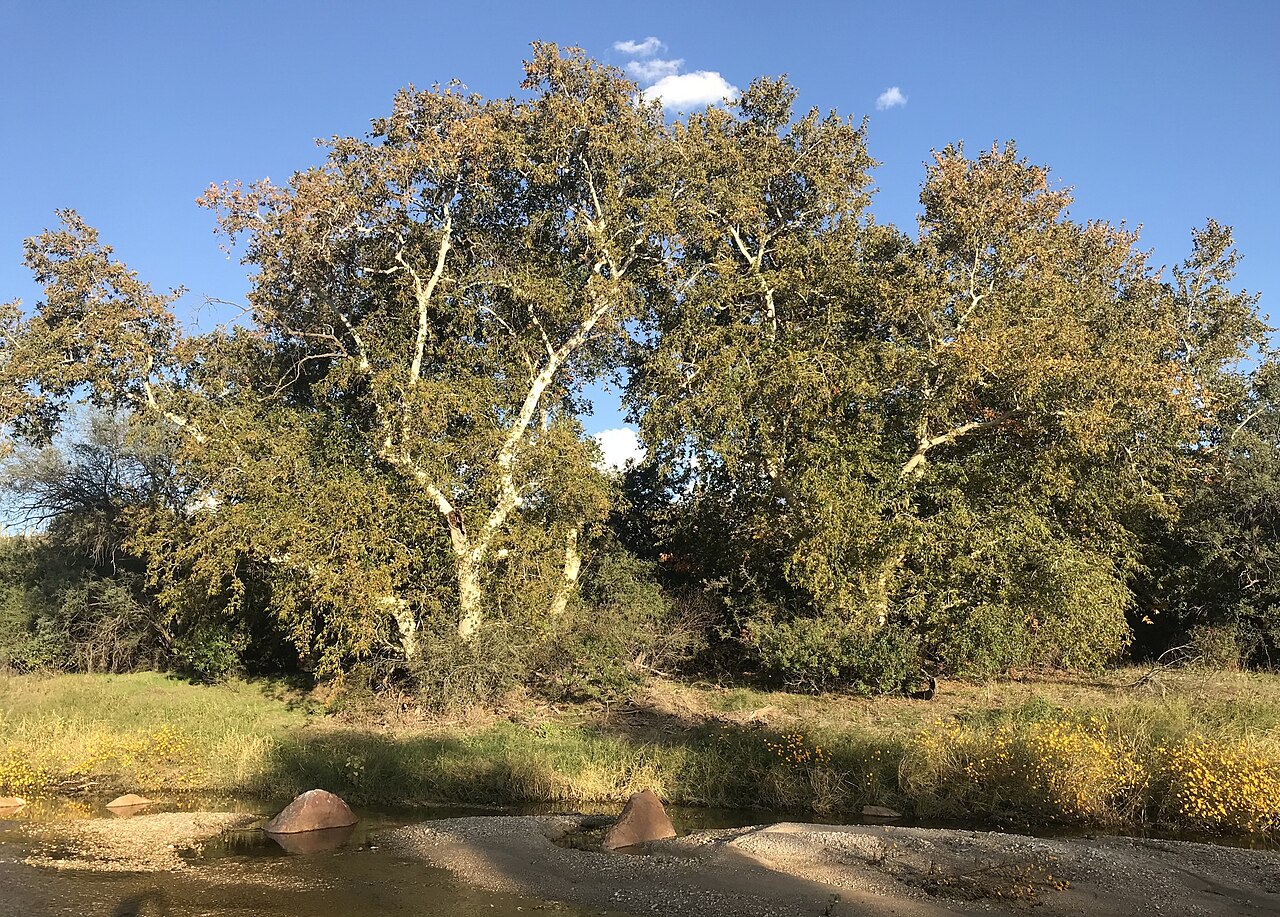
Platanus wrightii, the Arizona Sycamore, is the signature streamside tree of the desert Southwest’s canyon bottoms, instantly recognized by its smooth, chalky-white upper bark and deeply cut, hand-like leaves. Named for the 19th-century botanist Charles Wright, it is closely related to California sycamore and was at one time classified as a variety of that species (Platanus racemosa var. wrightii); current USDA and botanical treatments recognize it as its own full species, distinguished by more deeply lobed leaves and seed balls borne singly rather than in chains.
Wherever permanent or near-permanent water reaches the surface in southern Arizona and southwestern New Mexico — sycamore canyons, desert riparian corridors, and the banks of perennial creeks — Arizona sycamore towers over everything else, often the tallest and largest tree for miles in an otherwise arid landscape. Trees reach 40 to 80 feet with broad, often multi-trunked crowns, and old individuals along protected canyons can live for centuries.
For anyone restoring a desert streambank, shading a ranch house in a canyon bottom, or building wildlife habitat in the sky island region of the Southwest, Arizona sycamore is an essential native tree — but, like its California cousin, it needs dependable access to water and plenty of room, and it is not a plant for a small, dry yard.
Identification
Arizona sycamore grows as a large, often multi-trunked tree with a broad, spreading crown, frequently splitting into several major trunks low on the plant — a growth habit encouraged by periodic flood damage and resprouting along desert washes. Trees along permanent water in sheltered canyons can exceed 80 feet, while individuals in harsher, more exposed sites stay smaller and more shrub-like.
Bark & Stems
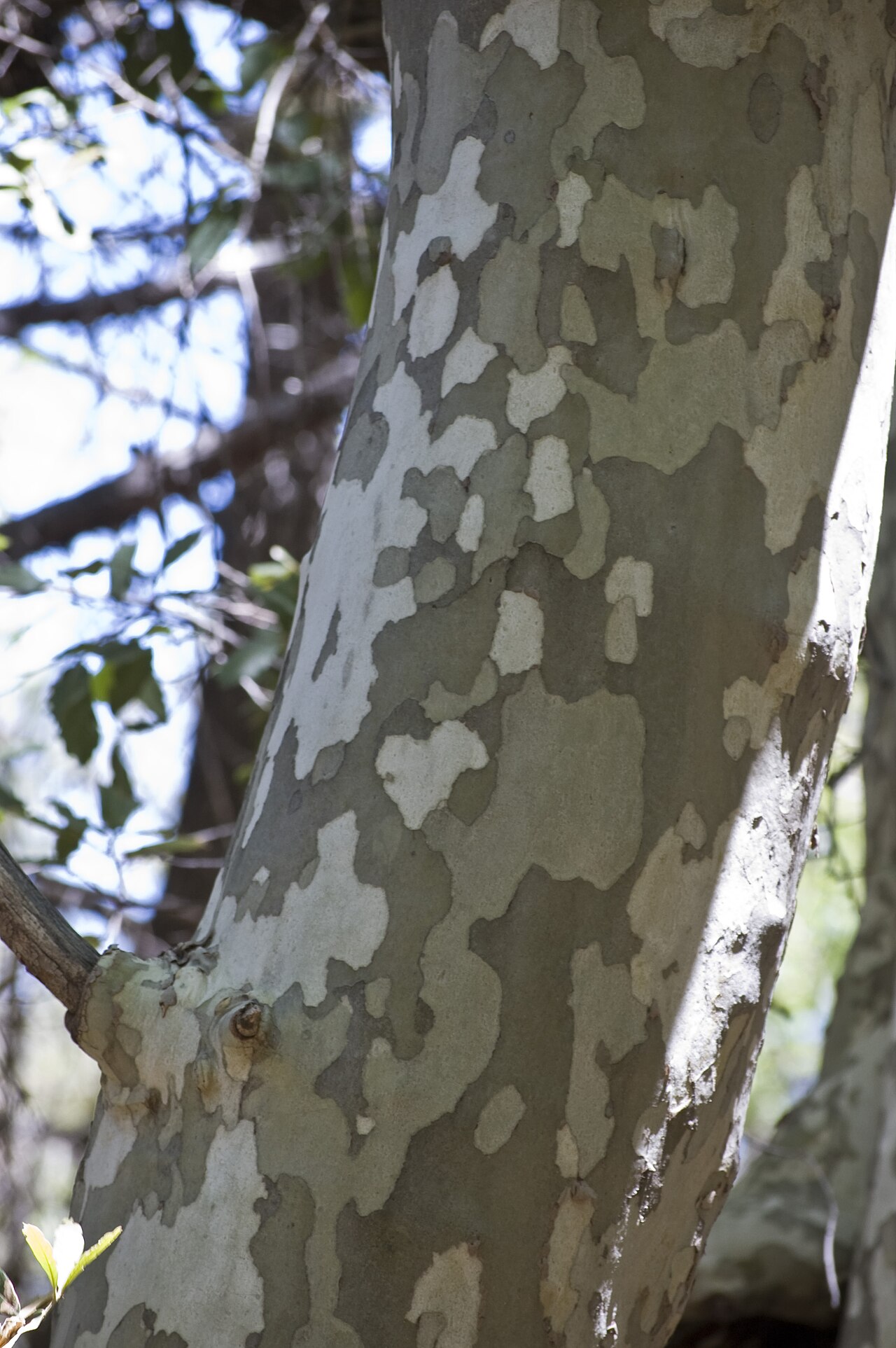
Young bark is smooth and pale gray-green, exfoliating in thin plates to reveal strikingly white to cream-colored patches beneath — the upper trunk and limbs of a mature tree often look almost bone-white from a distance. Older bark at the base thickens into gray-brown, furrowed plates. Young twigs and buds are covered in fine, pale hairs that wear away with age.
Leaves
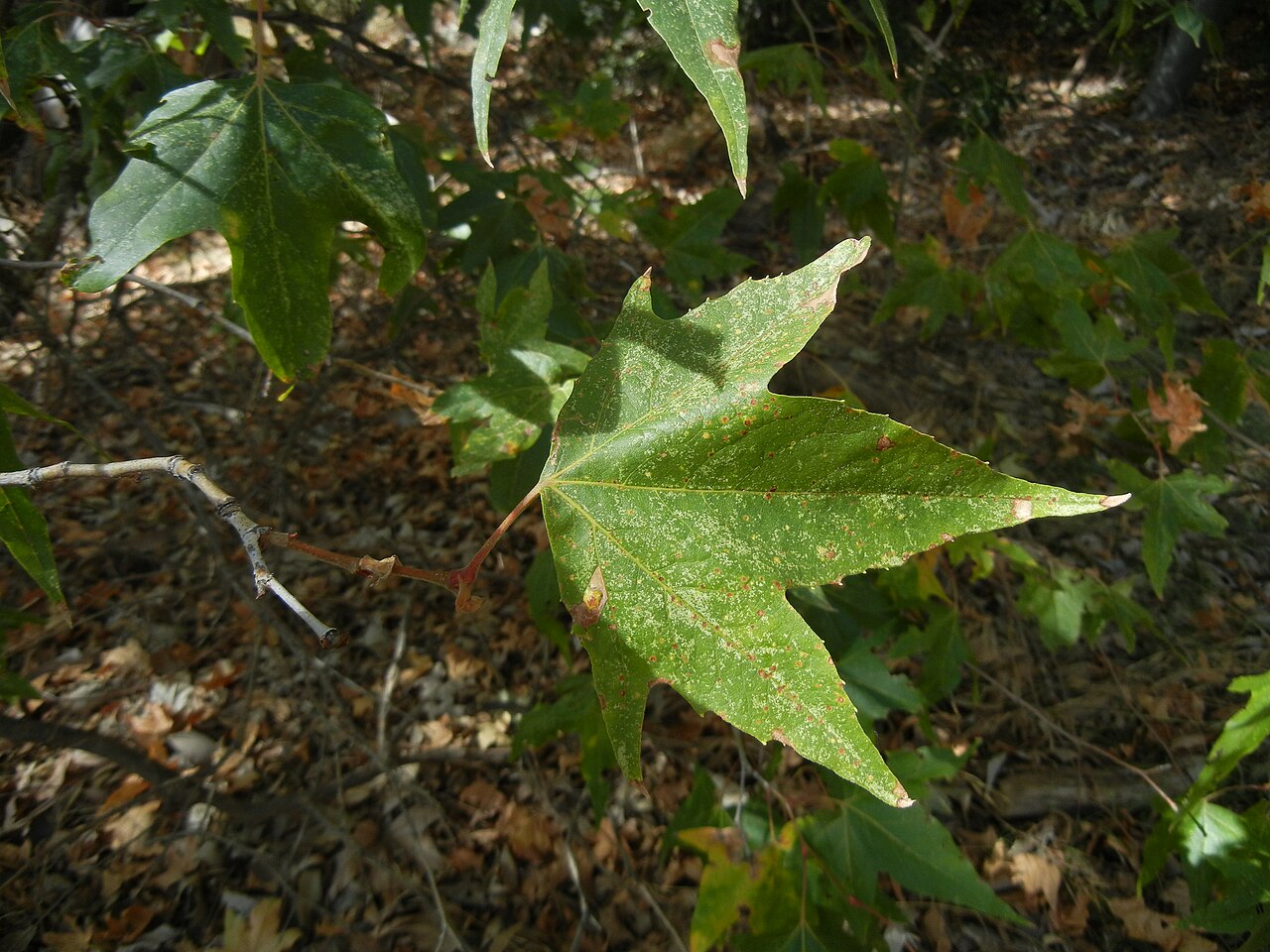
Leaves are alternate, simple, and large, 6 to 10 inches across, palmately divided into 3 to 7 narrow, deeply cut lobes that extend more than halfway to the leaf base — noticeably deeper and narrower-lobed than the broader, shallower leaves of California sycamore. The petiole base is hollow and encloses next year’s bud. Foliage is medium green above, paler and slightly fuzzy beneath, turning tan and dropping in fall without significant color change.
Flowers & Fruit
Flowers are small, inconspicuous, and wind-pollinated, in separate round male and female clusters that appear with the new leaves in spring. The fruit is a bristly, ball-shaped seed head about an inch across, and the key identification feature is that Arizona sycamore bears its seed balls singly on a stalk, only occasionally in a pair — unlike California sycamore’s typical chain of several balls on one stalk. The balls persist into winter, gradually breaking apart to release small, tufted seeds.
Quick Facts
| Scientific Name | Platanus wrightii |
| Family | Platanaceae (Sycamore/Plane) |
| Plant Type | Deciduous Tree |
| Mature Height | 40–80 ft |
| Mature Spread | 30–60 ft, often multi-trunked and wide-crowned |
| Growth Rate | Fast |
| Sun Exposure | Full Sun |
| Water Needs | Moderate to high; needs reliable moisture or groundwater access |
| Soil Type | Deep, sandy or gravelly alluvial soils; tolerates periodic flooding |
| Soil pH | 6.5–8.0 |
| Bloom Time | March – April |
| Flower Color | Greenish-red, inconspicuous |
| Fall Color | Tan, little color change |
| Fruit | Bristly 1-in seed ball, borne singly (occasionally paired) |
| Deer Resistant | Yes, generally |
| USDA Hardiness Zones | 7–10 |
Native Range
Arizona sycamore is native to central and southern Arizona and southwestern New Mexico, following perennial and near-perennial streams through the mountains and canyons of the sky island region, south into the Mexican states of Sonora and Chihuahua. It is not native to California; some older botanical treatments lumped it with California sycamore as a variety, but the two occupy largely separate ranges that do not naturally overlap, and current taxonomy treats them as distinct species.
Within its range, Arizona sycamore is almost entirely restricted to riparian corridors — canyon bottoms, streambanks, and desert washes with dependable subsurface water — from about 2,000 to 6,500 feet elevation. These gallery-forest corridors through otherwise arid desert and grassland country are some of the most biologically rich habitats in the Southwest, and Arizona sycamore, often the largest tree present, defines their structure.
Because it depends on permanent water, Arizona sycamore populations are sensitive to stream dewatering from groundwater pumping and drought, and many of its best remaining stands are protected within national forests, wilderness areas, and preserves such as those in the Chiricahua, Santa Rita, and Huachuca mountains.
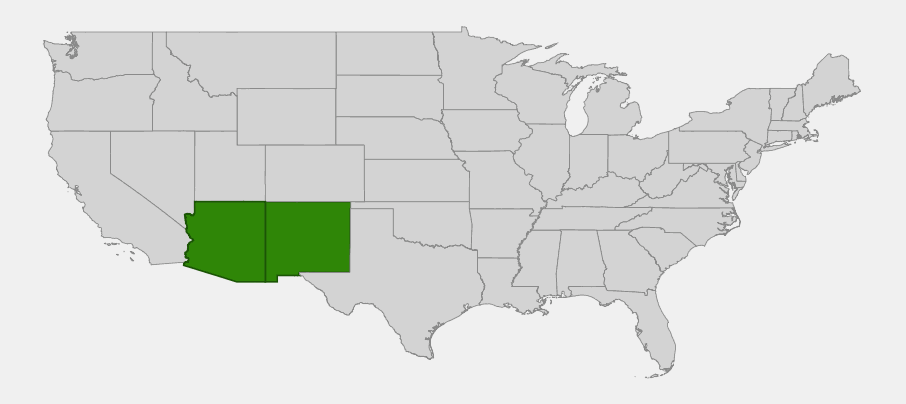
📋 Regional plant lists featuring Arizona Sycamore: Arizona & New Mexico
Growing & Care Guide
Arizona sycamore grows readily where it can reach water, but struggles badly without it — this is not a xeriscape tree despite its desert-region native range. It belongs in canyon-bottom and streamside landscapes, large irrigated properties, or restoration sites along washes and creeks, not in dry upland gardens.
Light
Plant Arizona sycamore in full sun. As a riparian pioneer species it grows best in open conditions and becomes thin and etiolated if shaded out by taller canopy while young.
Soil & Water
In the wild it occupies deep, well-drained alluvial soils along watercourses with dependable subsurface moisture and tolerates occasional flood scour. In cultivation it needs deep, regular watering to establish and benefits from occasional deep irrigation through the hottest months unless planted directly along a perennial stream or in a location with a naturally high water table. It is not drought tolerant once established the way many Southwest natives are.
Planting Tips
Choose a site with room for a genuinely large tree and, ideally, natural or supplemental access to water — a low spot that collects runoff, the margin of a pond or drainage, or a location that can be irrigated deeply through summer. Keep it well away from foundations, septic systems, and pavement, since its root system is extensive and its canopy casts heavy shade. Plant in fall or winter to allow roots to establish before summer heat.
Pruning & Maintenance
Structural pruning while young helps establish a strong framework, since this species naturally tends toward multiple co-dominant trunks that can develop weak unions. Mature trees need little care beyond removing dead or storm-damaged wood. Like other sycamores, it is susceptible to anthracnose leaf blight in cool, wet spring weather, which causes early leaf drop but rarely serious long-term harm; raking and removing fallen leaves helps limit the fungus from year to year.
Landscape Uses
- Riparian and wash restoration in the desert Southwest
- Large shade tree for ranch, canyon, and streamside properties
- Wildlife corridor plantings connecting desert riparian habitat
- Erosion control along watercourses with its extensive root system
- Specimen tree where its white bark and broad canopy can be a focal point
Wildlife & Ecological Value
Arizona sycamore is one of the most important wildlife trees in the desert Southwest, providing structure and habitat in riparian corridors that stand out dramatically from the surrounding arid uplands.
For Birds
Large sycamores with cavities and dead limbs are critical nest sites for numerous cavity-nesting birds in the region, including elegant trogons at the northern edge of their range, several owl species, and woodpeckers that excavate the soft wood. The canopy also hosts nesting raptors such as zone-tailed hawks, and the seed balls feed finches and other birds through the winter months.
For Mammals
The shade, cover, and proximity to water that sycamore galleries provide make them important travel corridors and refuge for mammals ranging from white-tailed and mule deer to coatis, ringtails, and black bears moving between mountain ranges across the otherwise dry desert floor.
For Pollinators
The tree’s own flowers are wind-pollinated and offer little direct forage, but the understory and canopy gaps of sycamore riparian woodland support diverse native bees, butterflies, and other pollinators that depend on the moisture and plant diversity these corridors sustain in an otherwise arid landscape.
Ecosystem Role
Arizona sycamore riparian woodlands are considered some of the most biologically diverse habitats in the Southwest, hosting a disproportionate share of regional bird and wildlife diversity relative to their small land area. The trees shade and cool desert streams, stabilize banks against flash flood scour, and contribute large fallen logs that create pools and structure within streambeds.
Cultural & Historical Uses
Indigenous peoples of the Southwest, including Apache and O’odham communities, used sycamore wood for implements and the broad leaves in various practical applications, though sycamore played a less central ethnobotanical role than the mesquite, agave, and other desert staples more central to Southwest Indigenous diets and material culture. The tree’s reliable association with water made sycamore groves important landmarks and camp locations along travel routes through otherwise dry country, a role it shared with its California relative.
The species is named for Charles Wright (1811–1885), a botanical collector whose extensive specimens from Texas and the Southwest contributed significantly to 19th-century understanding of the region’s flora. Arizona sycamore remains a valued shade and landscape tree in southern Arizona and New Mexico towns today, prized for its fast growth and distinctive white bark in a region where few other large native trees are available.
Modern conservation attention to Arizona sycamore centers on protecting the perennial streams it depends on, since groundwater depletion and prolonged drought threaten the riparian corridors that are both the tree’s habitat and some of the Southwest’s most valuable wildlife refuges.
Frequently Asked Questions
Is Arizona sycamore the same species as California sycamore?
No, though they are closely related and were once treated as varieties of one species. Current taxonomy recognizes Arizona sycamore (Platanus wrightii) and California sycamore (Platanus racemosa) as distinct species with mostly separate native ranges and reliable differences in leaf shape and fruit arrangement.
How do I identify Arizona sycamore versus California sycamore?
Look at the seed balls: Arizona sycamore bears them singly or in pairs on a stalk, while California sycamore typically strings two to seven together. Arizona sycamore’s leaves are also more deeply and narrowly lobed. Range is the simplest check in most cases, since the species barely overlap in the wild.
Does Arizona sycamore need to grow right next to a stream?
In the wild, essentially yes — it is almost always found within reach of permanent or near-permanent water. In a garden setting it can be grown away from a natural stream if given deep, consistent irrigation, but it is not a tree for dry, unirrigated sites.
How tall does Arizona sycamore get?
Most mature trees reach 40 to 80 feet, with the largest individuals in sheltered canyons with abundant water growing taller still. Trees in harsher, more exposed sites tend to stay smaller.
Why are the upper branches of Arizona sycamore so white?
The bark exfoliates in thin plates as the tree grows, exposing fresh, pale inner bark that has not yet weathered or picked up lichen growth. This creates the strikingly white or cream-colored upper trunk and limbs that make the species easy to spot from a distance, especially in winter.

Looking for a nursery that carries Arizona Sycamore?
Browse our native plant nursery directory: Arizona · New Mexico